The foster kid had bruises shaped like belt buckles, and the principal told her to stop lying for attention.
Eight-year-old Maya had shown three teachers. She’d begged the school counselor. She’d written a note to the nurse that said “please help me they hurt me at night.”
Every single report disappeared. Every cry was labeled “behavioral issues.” Every bruise was documented as “clumsy child, prone to falling.”
What nobody at Jefferson Elementary knew was that Maya had an uncle. A real uncle. Blood. Who’d spent two years fighting a corrupt family court system to find her.
And when “Uncle Razor” finally tracked his niece to that school, he didn’t come alone.
The rumble started at 2:47 PM. Thirty-six motorcycles pulling into the pickup lane, chrome gleaming, engines shaking the windows of every classroom.
Teachers rushed to lock doors. The principal grabbed the intercom: “Lockdown protocol. Everyone stay – “
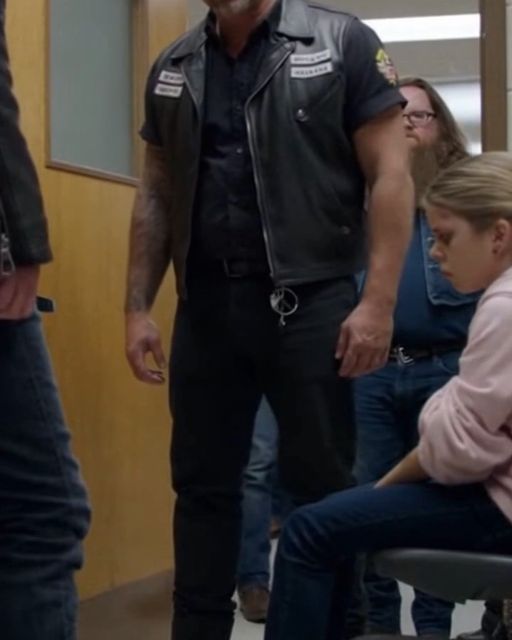
The front doors opened. Razor walked in first, holding a folder thick with documents. Behind him, a wall of leather and patches filled the hallway.
“I’m here for Maya Chen,” Razor said, his voice echoing off the linoleum.
The principal stepped forward, face red. “Sir, you cannot just – “
“I have custody papers,” Razor interrupted. “Signed yesterday by Judge Morrison after I showed him what your school has been hiding.”
He threw the folder on the floor. Photos scattered. Maya’s bruises. Medical records. A police report that had been “lost” three times.
“You knew,” Razor growled, stepping closer. “You knew what they were doing to her, and you protected them. Why?”
The principal backed into his office door. “I don’t know what you’re – “
“The foster father is your brother-in-law,” one of the bikers said, reading from his phone. “We did our homework.”
The color drained from the principal’s face.
That’s when a small voice cut through the tension: “Uncle Danny?”
Maya was standing at the end of the hallway, her teacher frozen behind her. She was skinny, fragile, her sleeves pulled down despite the warm day.
Razor dropped to his knees. The scariest man in the building suddenly looked like he might shatter.
“Yeah, butterfly,” he whispered. “It’s me. I finally found you.”
She ran. This tiny broken girl sprinted past the bikers, past the principal, and launched herself into Razor’s arms with a sob that made hardened men wipe their eyes.
“You came,” she kept repeating. “You actually came.”
Razor stood, cradling her like she weighed nothing. He looked at the principal one last time.
“The police are on their way. CPS is on their way. And so is Channel 7 News.” He gestured to a biker filming everything. “This is going everywhere.”
He turned to leave, then stopped.
“Oh, and Principal Morrison?” Razor’s voice went cold. “Those foster parents you’ve been protecting? They’re currently being arrested at their home. Seems someone tipped off the FBI about more than just abuse.”
The principal’s knees buckled. “How did you—”
“Because Maya’s not the only kid they had,” Razor said quietly. “She’s just the only one who survived long enough for me to find her.”
He carried his niece out through the wall of bikers, every one of them forming a protective corridor.
But the real revelation came three days later, when investigators found what was hidden in the foster home’s basement. And the connection to Principal Morrison went far deeper than anyone imagined.
Because Maya had been trying to tell them for months. She’d drawn pictures. Pictures of other children.
Pictures that matched the faces on missing posters from three different states.
Danny, who the world called Razor, sat on the edge of the motel bed, watching his niece sleep. It was the first time in three days she’d slept without waking up screaming.
He hadn’t slept at all. He just watched the gentle rise and fall of her chest, a sight he thought he’d never see again.
His sister, Maya’s mom, had died two years ago. Danny had been overseas, finishing his last tour.
By the time he got home, Maya was gone, swallowed by a system that saw him as an unfit guardian. A biker with a record.
He’d sold his garage, spent every cent he had on lawyers, and called in favors from men who lived by a code stricter than any law.
Now she was here. Safe. But broken.
He gently touched a faint yellow bruise on her cheek, and his hands clenched into fists. The rage was a physical thing, a fire in his gut that wanted to burn the whole world down.
A soft knock came at the adjoining door. A huge man with a graying beard and kind eyes poked his head in. His name was Thomas, but the club called him Grizz.
“How’s she doin’?” Grizz whispered.
“She’s sleeping,” Danny said, his voice rough with exhaustion.
Grizz nodded, looking at the small girl curled under the cheap motel blanket. “She’s a fighter, that one. Just like her uncle.”
He set a bag of food on the small table. “You need to eat, man. You can’t help her if you fall apart.”
Danny just shook his head, unable to look away from Maya. “They had a basement, Grizz.”
The kindness in Grizz’s eyes hardened into steel. “I know. The feds called.”
“The pictures she drew… they were real.”
The FBI agents who’d come to the motel had been surprisingly gentle. A woman named Agent Davies had sat on the floor with Maya, not asking questions, just coloring with her.
She’d brought a box of new crayons, a hundred different colors.
Maya had picked up a brown crayon, then a blue one, then a red one. She began to draw, her little hand moving with a certainty that was chilling.
She drew a girl with brown hair and a blue dress. Then a boy with red sneakers. She drew them inside a dark square with no windows.
Agent Davies had pulled out a tablet. She swiped through photos, her face a mask of professional calm.
There they were. The girl in the blue dress, a missing child from Ohio. The boy with the red sneakers, taken from a park in Pennsylvania.
Maya had been drawing their ghosts.
Danny got up and walked to the window, pulling the curtain back a sliver. Below, in the parking lot, half a dozen of his brothers stood watch.
They’d been taking shifts since the school. No one was getting near his niece again.
The next day, Maya spoke for the first time about the “quiet room.”
She spoke to Agent Davies, with Danny holding her hand so tight his knuckles were white.
“Mr. Morrison would come sometimes,” she said in a voice so small it was almost a whisper.
Danny’s blood ran cold. “Principal Morrison?”
Maya nodded. “He brought new kids. He told us to be good for the new families.”
But there were no new families.
The pieces clicked into place with a sickening finality. This wasn’t just a case of abuse being covered up for a family member.
This was an operation. A trafficking ring.
Principal Morrison used his access to school records. He targeted children in unstable situations, kids in foster care whose files could be easily manipulated.
Kids who wouldn’t be missed right away.
His brother-in-law, the foster father, was the handler. The house was the holding cell.
And Maya, with her relentless attempts to tell someone, had become a liability. Her bruises weren’t just from punishment. They were a warning to stay silent.
But she didn’t stay silent. She drew.
The FBI, armed with Maya’s testimony, raided Principal Morrison’s home. It was a pristine suburban house with a manicured lawn and a two-car garage.
In that garage, behind a false wall, they found a safe. Inside were passports. All with children’s photos and different names.
They also found ledgers detailing payments from untraceable accounts. It was a network that spanned half the country.
The news story that had started with a dramatic school rescue exploded into a national horror. Principal Morrison, the respected educator, was a monster.
Danny had to shield Maya from it all. He rented a small, secluded cabin two states away, a place where the only sounds were birds and the wind in the trees.
Grizz and a few others stayed nearby, a silent, watchful presence.
For the first week, Maya didn’t go outside. She just sat by the window, drawing.
Danny sat with her, not pushing, just being there. He learned to cook again, starting with the simple mac and cheese his sister used to make.
He read her stories at night, his deep voice stumbling over words in fairy tales he hadn’t thought about in twenty years.
One afternoon, she looked up from her drawing pad. “Uncle Danny, why do they call you Razor?”
He hesitated. It was a name from a different life, a life of bar fights and hard roads.
“It’s just a nickname, butterfly. From a long time ago.”
She considered this. “I like Danny better.”
He felt something in his chest crack open. “Me too.”
Slowly, carefully, she began to heal. She started smiling at his bad jokes. She helped him make pancakes, getting flour all over her face.
One day, she took his hand and led him outside. She pointed at a butterfly fluttering over a patch of wildflowers.
“It’s beautiful,” she whispered.
And for the first time since he’d gotten that call about his sister, Danny felt a flicker of hope. Real hope.
The trial was scheduled six months later. The prosecutors told Danny they had a strong case, but Maya’s testimony would be the final nail in the coffin.
He wanted to refuse. He wanted to lock her away from the world and never let anyone hurt her again.
But it was Maya who made the decision.
“I have to,” she told him, her nine-year-old face set with a resolve that humbled him. “For the other kids.”
The courtroom was a circus. Reporters packed the benches. Principal Morrison sat at the defendant’s table, looking pale but defiant, his expensive lawyer beside him.
When Maya walked to the stand, a hush fell over the room. She looked so small, her feet barely touching the floor from the witness chair.
Danny sat in the front row, right in her line of sight. Grizz and a dozen other bikers sat behind him, a silent mountain of leather and denim. They wore no club colors, just simple black vests, out of respect for the court.
But everyone knew who they were. They were Maya’s guard.
The prosecutor was gentle. He asked her to describe the house, to talk about the quiet room.
Maya’s voice was steady. She spoke of the cold floor and the single light bulb that was always on.
Then the defense attorney stood up. He was slick and sharp, and he tried to paint her as a troubled child.
“Maya, you’ve told people before that you get bruises because you’re clumsy, isn’t that right?” he asked.
“I was told to say that,” she replied simply.
“And these drawings… you have a very active imagination, don’t you?”
Maya looked not at the lawyer, but at the jury.
“I don’t imagine their faces,” she said, her voice clear and strong. “I remember them.”
She then described, in heartbreaking detail, the little girl in the blue dress. She remembered the lullaby the girl used to hum.
She described the boy with the red sneakers. She remembered that he was afraid of spiders.
She wasn’t just a witness. She was their voice. She was bearing witness for the children who couldn’t.
Principal Morrison’s composure finally cracked. He stared at this tiny girl who had unraveled his entire evil empire with a box of crayons.
The jury was out for less than an hour. Guilty. On all counts.
Life imprisonment, no possibility of parole. The same sentence was handed down to his brother-in-law and the foster mother.
As they led Morrison away in handcuffs, his eyes met Danny’s. There was no remorse in them. Only hatred.
Danny felt nothing. The fire in his gut was gone, replaced by a quiet peace. Justice wasn’t about his revenge. It was about her future.
A year later, Danny’s small cabin had become a home. He’d built a swing set in the yard.
Maya was a different child. She was still quiet, but her eyes were bright. She had friends. She was at the top of her class in her new school.
One Saturday, a convoy of motorcycles rumbled up their long gravel driveway. It was the whole club.
They weren’t there for a party. They were there for a ribbon-cutting.
Using the reward money from the FBI and donations that had poured in from around the country, Danny and his club had started a foundation.
Grizz had unveiled a new sign he’d made himself. It was carved from a single piece of oak.
It read: “Maya’s Voice.”
The foundation provided pro-bono legal services and private investigators to fight for kids lost in the system. It was run by a tough-as-nails lawyer Danny had hired, but its heart and soul were the bikers.
They were the ones who showed up. They would escort a child to a court hearing, or help a family move away from an abusive situation in the middle of the night.
They became unlikely angels, their rumbling engines a sound of hope for the hopeless.
That afternoon, Maya stood on the porch, surrounded by the large, tattooed men who had become her family. They had brought her a gift.
It was a small leather vest, just like theirs. On the back was a single patch: a beautifully embroidered butterfly.
She put it on, a huge smile spreading across her face.
Later that evening, as the sun set, she sat on the porch swing with Danny.
“Uncle Danny?” she said. “Do you think the other kids know we won?”
He put his arm around her, pulling her close. He looked out at the sky, painted in shades of orange and purple.
“Yeah, butterfly,” he said softly. “I think they know.”
He realized then that this was the real victory. It wasn’t the convictions or the headlines. It was this. A quiet moment with his niece, watching the day end, knowing she was safe.
Knowing she was finally free to just be a kid.
Life doesn’t always give you the family you expect, but sometimes, it gives you the one you need. It teaches you that true strength isn’t about the noise you make or the fear you inspire. It’s about the quiet courage to speak up for those who can’t, to fight for the light when you’re surrounded by darkness. And it proves that even the deepest wounds can heal, not by being forgotten, but by being transformed into the strength to help someone else.