I was sitting at the park bench when I heard the cruel laughter.
Three teenage boys had grabbed the little girl’s wheelchair and were sitting in it, passing it between them like a carnival ride.
“Want it back?” the ringleader taunted. “Crawl for it, cripple.”
The girl, maybe nine years old, was on the ground, tears streaming down her face, her legs twisted beneath her. She tried to pull herself forward with her arms.
The boys were filming it. Laughing. Making her beg.
I was frozen, phone in hand, about to call someone, when I heard the rumble.
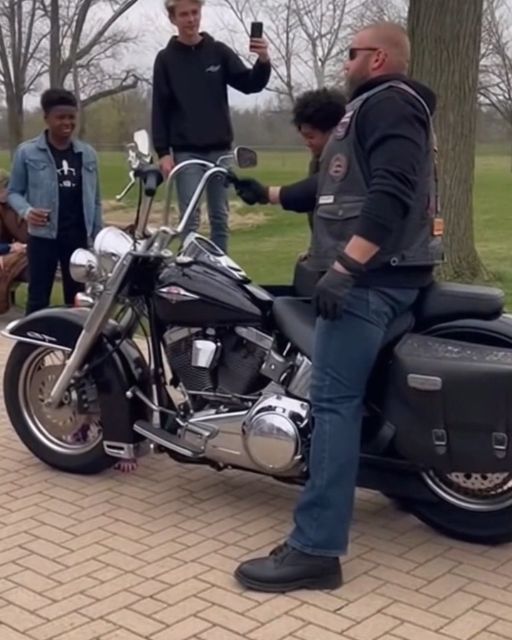
A single motorcycle. Black as midnight. The rider was massive, a leather vest covered in patches I couldn’t read from where I sat.
He pulled up slowly. Cut the engine. The sudden silence was worse than the sound.
The boys didn’t notice him at first. They were too busy mocking the crying child.
The biker dismounted. He didn’t rush. He walked with the kind of slow, deliberate pace that predators use.
“Give her the chair,” he said. His voice wasn’t loud. It didn’t need to be.
The ringleader turned around, smirk still on his face. “Or what, old man?”
The biker stopped walking. He reached up and removed his sunglasses.
That’s when I saw his eyes. Empty. Cold. The eyes of someone who’d seen things that would break most people.
“I’ll give you three seconds,” he said quietly. “To decide if your phone video is worth what happens next.”
The smirk vanished. The boy looked at his friends. They were already backing away.
“It was just a joke,” the ringleader stammered.
“Jokes are funny,” the biker said. “This isn’t funny.”
He walked past the boys, who scattered like roaches, and knelt beside the wheelchair. He looked it over carefully, checking the brakes, the wheels.
Then he walked to the little girl.
“Can I help you up?” he asked her gently.
She nodded, still sobbing.
He lifted her like she weighed nothing and set her carefully in the chair.
“You okay?” he asked.
She wiped her eyes. Then she looked up at him and her face changed from fear to shock.
“Uncle Bobby?” she whispered.
The biker froze. He stared at the little girl.
“Emma?” His voice cracked. “Emma Carlson?”
“You… you know my daddy,” she said. “You rode together. Before the accident.”
The biker’s hands started shaking. He knelt down to her level, and I saw tears running into his beard.
“Your daddy was my best friend,” he said. “I was at the funeral. You were three. You were… you were walking then.”
“The drunk driver hit us,” Emma said quietly. “Daddy died. I got hurt.”
The biker looked at her legs. His jaw clenched so tight I thought his teeth would crack.
“Where’s your mom?” he asked.
“Working. Two jobs. We can’t afford the motorized chair. This one’s borrowed from the hospital.”
The biker stood up. He pulled out his phone. He made one call.
“Church meeting. Tonight. Tommy’s girl needs us.”
He hung up. He looked at Emma.
“Your daddy made me promise something before our last ride,” he said. “He made me swear that if anything ever happened to him, I’d watch over his family.”
Emma’s eyes went wide. “He did?”
“Yeah. And I broke that promise. I didn’t know where you went after the funeral. But I know now.”
He looked at me then. I realized I was standing now, tears on my own face.
“You saw what happened?” he asked me.
I nodded.
“Good. You’re my witness. Those boys’ phones have video evidence of assault and harassment of a disabled minor. I’m calling the police. But first…”
He looked down at Emma. “First, I’m taking you home to your mom. And tonight, my brothers are coming by to discuss your new wheelchair. The kind with the motor. And the ramp your house needs. And maybe a college fund, because your daddy would’ve wanted that.”
Emma started crying again, but different tears this time.
“Why?” she asked. “Why would you do all that?”
The biker touched the patch on his vest. It said “In Memory of Thunder Tommy.”
“Because twenty years ago, your daddy pulled me out of a burning truck,” he said quietly. “He saved my life. He lost three fingers doing it.”
He looked at his own scarred hands.
“I owed him everything. And I forgot. But I won’t forget again.”
He started to push her wheelchair toward his bike, then stopped.
He turned back to where the boys had run. They were hiding behind a tree, still watching.
“And you three?” he called out. “The video you took is evidence. The police will want it. You can give it to them voluntarily, or I can make sure they get it another way. Your choice.”
One of the boys’ phones came flying out from behind the tree, landing in the grass.
The biker nodded. “Smart.”
As he walked Emma to his bike, I heard him ask her: “Your daddy ever tell you about the time we rode to Alaska in the snow?”
“No,” she said, smiling for the first time.
“Well,” he said. “That’s because… that’s what ended our friendship.”
The smile on Emma’s face faltered, replaced by a look of confusion.
“You weren’t friends anymore?” she asked, her voice small.
Bobby sighed, a heavy sound that seemed to carry years of regret. He looked at his motorcycle, then at her in the borrowed chair. There was no way to get her home on his bike.
“Plans change,” he said, more to himself than to her. “Let’s get this chair somewhere safe. I’ll call a cab.”
He walked over and picked up the bully’s phone from the grass. He tucked it into his vest pocket before walking back to Emma.
“Your mom’s name is Sarah, right?”
Emma nodded. “She talks about you sometimes. She said you and Daddy were like thunder and lightning. He was the loud one.”
Bobby let out a short, sad laugh. “Yeah, that was Tommy. All noise and big smiles.”
He pushed her toward the park exit, his steps slow and measured. The world seemed to have quieted down around them.
“So what happened in Alaska?” Emma pressed, her nine-year-old curiosity overriding her fear.
“It’s a long story, kiddo.” He paused, thinking. “We were young and stupid. Thought we could outrun a blizzard on two wheels. Your dad was always chasing something bigger.”
“Like what?”
“Like a dream,” Bobby answered, his voice distant. “A dream of his own garage. ‘Thunder Tommy’s Custom Rides.’ He had the whole thing planned out.”
The cab arrived, a minivan with enough room for the wheelchair. Bobby lifted her into the back seat as if she were made of glass, then folded the chair and placed it beside her.
During the ride to her apartment, the silence was thick. Emma kept stealing glances at him. This giant, sad man who was a ghost from her father’s life.
He smelled of leather and gasoline, a smell she vaguely associated with the oldest pictures of her dad.
Her apartment building was old, the paint peeling. It was clear money was tight.
Bobby paid the driver and helped Emma out, unfolding the chair on the cracked sidewalk. As they headed for the entrance, a woman in a worn nurse’s uniform was walking towards them, her shoulders slumped with exhaustion.
Her eyes landed on Emma, then shot to the massive man pushing her chair. Fear, then confusion, then a flicker of recognition crossed her face.
“Bobby?” she said, her voice barely a whisper. “Bobby Vance?”
“Hello, Sarah,” he said, his own voice quiet, almost ashamed.
Sarah rushed forward, ignoring him for a moment to check on Emma. “Honey, are you okay? Who is this man? What happened?”
“I’m okay, Mom,” Emma said quickly. “Some boys were mean at the park, and Uncle Bobby helped me.”
Sarah’s gaze hardened as she looked at Bobby. The weariness in her eyes was replaced by a protective fire. “Uncle Bobby? You don’t get to be ‘Uncle Bobby.’ Not after six years of nothing. Not one call.”
“I know,” he said, looking at the ground. “I don’t have an excuse. Not a good one, anyway.”
“Tommy waited for you to call,” she said, her voice trembling. “Right up until the end. He kept saying, ‘Bobby will come around.’ But you never did.”
The words hit him harder than any punch. He could only nod, the shame a physical weight on his shoulders.
“I found her being bullied in the park, Sarah,” he explained softly. “They had her on the ground. I… I couldn’t just ride away.”
Sarah’s anger wavered as she took in the scene. She saw the tear tracks on her daughter’s face, and the genuine pain in Bobby’s eyes.
“Let’s go inside,” she said finally, her tone clipped. “I just got off a twelve-hour shift. I’m too tired for this.”
Inside, the apartment was small but spotless. Photos of a smiling, dark-haired man were everywhere. Thunder Tommy. In every picture, he had his arm around Sarah or was holding a tiny Emma.
In one photo on the mantle, a younger Tommy stood with his arm slung around a younger Bobby. They were both grinning, covered in grease, two kings in their own small world.
Bobby couldn’t take his eyes off it. That was before Alaska. Before everything fell apart.
“She needs a motorized chair,” Bobby said, breaking the tense silence. “And a ramp for the steps outside.”
Sarah let out a bitter laugh. “And I need to win the lottery. Do you have any idea what those things cost, Bobby?”
“I do,” he said. “My club brothers are meeting tonight. We’re a registered charity now, for veterans and their families. It’s all above board. We’re going to take care of it.”
“Your ‘club brothers’?” Sarah asked, her skepticism clear. “The same guys who used to get into bar fights with Tommy every weekend?”
“We’re older now,” Bobby said. “A little wiser, I hope. We look out for our own. And Tommy was our own.”
Later that evening, the “church meeting” convened in the back room of a quiet bar. It was a group of six men, all in their late forties and fifties. They had gray in their beards and lines on their faces from years on the road.
There was Pat, a retired accountant who now managed the club’s finances. There was Gus, a contractor who owned his own construction business. And there was Mick, a quiet man who was a cop.
Bobby laid out the situation. He told them about Emma, about the borrowed chair, about Sarah’s two jobs. He didn’t have to say much.
He just passed around a photo of Tommy he kept in his wallet.
Gus the contractor pulled out a notepad. “How many steps to their apartment? I can have a crew out there to build a ramp by the weekend.”
Pat the accountant was already on his laptop. “I’ll open a trust for her college fund tomorrow morning. We’ll seed it with five grand from the emergency fund. We can hold a charity ride next month to build it up.”
Mick the cop looked at the phone Bobby had taken from the bully. “Let me handle this. I’ll pay a visit to these kids and their parents. A little official pressure can work wonders for a kid’s attitude.”
Bobby felt a lump form in his throat. These men, his family, hadn’t hesitated for a second.
This was the code. This was the promise.
The next day, Mick went to the ringleader’s house. The boy’s father, a wealthy lawyer named Mr. Davies, was arrogant and dismissive.
“It was just boys being boys,” Mr. Davies said with a wave of his hand. “I’ll have a word with him.”
“It’s a little more than that,” Mick said calmly, placing the phone on the man’s marble countertop. “This is a video of your son committing a hate crime against a disabled child. Assault, harassment, emotional distress. I can take this to the D.A. right now, and his future college applications will look very interesting.”
The lawyer’s face paled.
“Or,” Mick continued, “he and his friends can spend the next four weekends doing community service. A friend of mine is building a wheelchair ramp for the little girl they tormented. They will be his unpaid labor. And they will each write her a letter of apology. A real one.”
Mr. Davies looked at his son, then back at Mick. He knew he was beat.
Meanwhile, Bobby spent the day with Sarah and Emma. It was awkward at first. Sarah was polite but distant. Emma was the bridge between them, asking Bobby endless questions about her dad.
“Did he really have a snake tattoo?” she asked.
“He did,” Bobby smiled. “A big cobra on his forearm. He got it when he was eighteen and told his mom it was a garden hose.”
Sarah cracked a smile for the first time. “I remember that. She didn’t speak to him for a week.”
Slowly, the ice began to melt. Bobby helped fix a leaky faucet. He told stories about Tommy that made Emma laugh and brought a sad, nostalgic light to Sarah’s eyes.
That night, while looking for an old photo album, Sarah pulled a dusty box from the top of a closet. It was filled with Tommy’s things.
“I haven’t been able to go through this,” she said softly.
Inside were old patches, a worn leather wallet, and a stack of letters. Tucked at the bottom was a thick, sealed envelope with “BOBBY” written on the front in Tommy’s familiar scrawl.
“He wrote this right after he got back from Alaska,” Sarah said, her voice catching. “He told me to give it to you if I ever saw you again. He said you’d know what to do.”
Bobby’s hands trembled as he took the letter. He had always assumed Tommy hated him for how things ended. He thought their friendship had been destroyed by a stupid, prideful argument in a frozen motel room.
He opened it.
The letter inside explained everything. The dream of the garage was real, but Tommy had been in a hurry. He’d borrowed money from the wrong person, a local loan shark known for his brutality.
The Alaska trip wasn’t a joyride. It was a delivery run for that man, a desperate attempt to clear his debt.
“I messed up, brother,” the letter read. “I got in over my head. At the border, they searched us. They didn’t find the package, but I knew the guys who sent me wouldn’t believe that. They’d think I stole it. I had to get you away from me, Bobby. I had to make you hate me, so you’d leave and never look back. If you were with me, you’d be a target too.”
The argument in the motel room, the cruel words Tommy had said, it was all an act. A desperate, painful act to save his best friend’s life.
“I told you I never wanted to see you again,” Tommy wrote. “It was the biggest lie I ever told. Every day since, I’ve missed my brother.”
Bobby finally understood. The guilt he’d carried for six years, the shame of abandoning his friend, it was all based on a lie. A lie Tommy told to protect him.
Then came the final, chilling paragraph.
“The debt isn’t clear. This guy, his name is Silas, he doesn’t forget. He told me I still owe him. If anything happens to me, Bobby, if it’s not old age in a rocking chair, it wasn’t an accident. Don’t come looking for revenge. Just take care of Sarah and Emma. That’s all the justice I need. Fulfill your promise. Be the brother I couldn’t be.”
Bobby looked up from the letter, his face ashen. “The drunk driver,” he said to Sarah. “What was his name?”
“I don’t remember,” she said, confused by his tone. “He got a light sentence. Two years, out in eighteen months. Said he was swerving to avoid a deer.”
Bobby pulled out his phone and called Mick. “I need you to run a name. The driver who hit Tommy and Sarah Carlson six years ago. And I need everything you can find on a loan shark named Silas.”
The pieces were falling into place, forming a picture far uglier than he had ever imagined. His best friend hadn’t died in a random accident. He’d been murdered.
The following Saturday was a whirlwind of activity. Gus’s construction crew descended on the apartment building, with three shame-faced teenagers in tow. Mr. Davies watched from his luxury sedan, arms crossed.
The boys, stripped of their bravado, were clumsy at first. They complained and muttered under their breath.
Bobby walked over to the ringleader, whose name was Kevin. He didn’t raise his voice. He just knelt down.
“See that little girl watching from the window?” Bobby said, pointing to Emma. “Every day, she has to figure out how to navigate a world that wasn’t built for her. You made that harder. Today, you get to make it a little easier. You can complain, or you can build. Your choice.”
For the rest of the day, Kevin worked harder than the others. He learned to measure wood, to drill screws, to pour concrete. He wasn’t good at it, but he tried.
By sunset, the ramp was finished. It was a sturdy, beautiful structure.
A delivery truck pulled up. On the back was a brand-new, top-of-the-line motorized wheelchair, gleaming red. A gift from the entire motorcycle club.
Emma came outside with her mom. Her eyes went wide. She touched the joystick on the armrest, and the chair hummed to life. She glided up the ramp effortlessly, a massive smile spreading across her face.
For the first time in years, she could leave her own house by herself. It wasn’t just a ramp; it was freedom.
Kevin approached her, holding a crumpled piece of paper. “This is from me,” he mumbled, not looking her in the eye. “I’m sorry. What we did… it was wrong.”
Emma took the letter. “Thank you,” she said simply. “For the ramp.”
Later, Mick called Bobby. “You were right. The driver who hit Tommy’s car was a known associate of Silas. And Silas? The Feds have been trying to build a case against him for years for racketeering. Your friend’s ‘accident’ might be the piece they need.”
Bobby passed the letter to Mick, an anonymous piece of evidence that gave a dead man his voice back. The wheels of true justice began to turn, slowly but surely.
A few weeks later, Bobby was sitting on the new ramp with Emma, watching the sunset. Sarah sat beside them, a genuine, relaxed smile on her face. The club’s charity ride had raised over fifty thousand dollars for Emma’s college fund.
“Uncle Bobby?” Emma asked. “You never finished the story about Alaska.”
Bobby looked at Sarah, who nodded. It was time for the real story.
“Your daddy didn’t push me away because he was mad,” Bobby began. “He pushed me away because he loved me. He was in trouble, and he wanted to make sure it didn’t find me too. He acted mean to save my life.”
He continued, “He was the bravest man I ever knew. Not because he was tough, but because he was willing to sacrifice everything, even our friendship, to protect the people he cared about. He made a mistake, but he spent the rest of his life trying to make it right.”
Emma leaned her head against his arm. “He was a hero.”
“Yeah, kiddo,” Bobby said, his voice thick with emotion. “He was.”
Bobby had come back to fulfill a promise to a dead friend, but in the end, he found so much more. He found a family he didn’t know he still had, a purpose that had been buried under years of guilt, and the comforting truth that true brotherhood can never be broken, not by distance, not by anger, and not even by death.
Some debts can’t be paid with money. They can only be paid with love, loyalty, and a promise finally kept.