“Get him out! He’s going to ruin the photos!” I screamed, my voice cracking.
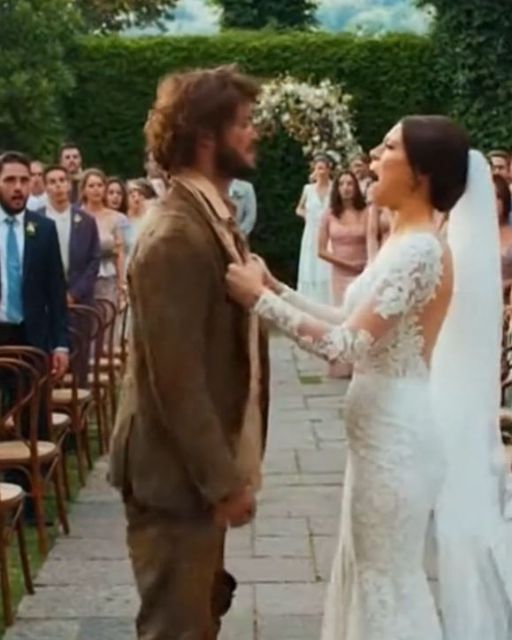
I had spent two years planning this. The flowers alone cost more than a Honda. And here was this man – filthy, smelling of mildew, wearing boots held together by duct tape – shuffling down my pristine white aisle.
Security was too slow. I saw red. I marched down the altar, grabbed the man by his greasy collar, and shoved him hard.
“You are trash!” I spat at him. “Get out before I call the cops!”
He didn’t fight back. He just looked at me with watery eyes and slumped to the grass. The guests gasped. I straightened my tiara, feeling justified. I saved the day.
Then I looked at Todd.
My fiancé’s face had drained of all color. He looked like he was going to be sick.
He didn’t come to comfort me. He sprinted past me. He dropped to his knees in the mud – ruining his custom Italian suit—and grabbed the old man’s callous hands. He kissed them.
The garden went dead silent. You could hear a pin drop.
Todd looked up at me, tears streaming down his face, looking at me like I was the garbage. He choked out a sentence that made my knees buckle.
“You just assaulted the man who raised me.”
The world tilted on its axis. My perfectly manicured reality fractured into a million pieces.
This… this was not possible. Todd’s father was dead. He told me he died in a car crash years ago.
“This is my father, Veronica,” Todd said, his voice a low, trembling whisper that carried across the silent lawn. “His name is Arthur.”
He helped the old man to his feet. Arthur, his father, just stared at the ground, his shoulders slumped in what looked like shame.
My mother rushed forward, her face a mask of horror. “Veronica, what is the meaning of this? Who is this person?”
I couldn’t answer. My throat was a desert.
Todd wrapped a protective arm around his father. “He’s the man who sold his home, his business, everything he owned, so I could go to college and then law school.”
He looked directly at me now, and the love I was used to seeing in his eyes was gone. It was replaced by a chilling disgust.
“He’s the reason I have anything. He’s the reason I could afford a ring for you. He gave up his entire life so I could have a chance at one.”
The guests were murmuring now, a low hum of shock and judgment. Every eye was on me. I felt like an insect under a microscope.
“Why didn’t you tell me?” I whispered, the words barely audible. “You said he was dead.”
“Because I was ashamed,” Todd admitted, his voice thick with self-loathing. “And because I knew. I knew this is how you would treat him.”
That single sentence was a dagger to my heart. He had known, all along, the kind of person I was.
He had hidden the most important person in his life from me because he knew I was too shallow, too cruel, to accept him. And I had just proven him right in the most public, humiliating way possible.
“The wedding is off,” Todd announced, his voice gaining a sliver of strength. He didn’t even look at me when he said it.
He turned his back on me, on our two years of planning, on our future. He gently guided his father away from the altar, toward the exit, his ruined suit a testament to his priorities.
My father stormed up to me. “Fix this, Veronica! You fix this right now!”
But I couldn’t move. I was frozen, a statue in a five-thousand-dollar dress, watching my perfect world crumble into dust.
The man I had shoved, the man I had called trash, was the source of everything I had come to love about my life with Todd.
The hours that followed were a blur of shame. The guests left in hushed whispers. The caterers packed up the untouched food. The band quietly disassembled their equipment.
My parents screamed at me. They weren’t concerned about my heartbreak. They were furious about the cost, the embarrassment, the social fallout.
“All that money, wasted!” my mother cried.
I finally found my voice. “Is that all you care about? The money?”
My father scoffed. “What else is there? You just threw away a life with a brilliant lawyer over some homeless person!”
“That homeless person was his father!” I shrieked.
I ran from them, away from the wilting flowers and the gossiping staff. I locked myself in the bridal suite and ripped the tiara from my hair. I looked at the stranger in the mirror, her face streaked with mascara, her eyes wide with a horror she was only just beginning to understand.
I called Todd a hundred times. He never picked up. I left frantic, sobbing voicemails, begging him to talk to me. There was only silence.
The next few days were my own personal hell. I stayed in my apartment, curtains drawn, refusing to see anyone. The story had, of course, leaked. My social media was a dumpster fire of vitriol. I was a monster, a “bridezilla,” a gold-digger who got what she deserved.
They weren’t wrong.
In the suffocating silence, Todd’s words echoed in my head. “He sold his business… everything he owned.”
I had never really asked about Todd’s past. I was content with the man he was: successful, handsome, generous. I didn’t care about the journey; I only cared about the destination.
I grew up with just enough. We weren’t poor, but every dollar was counted. My parents were obsessed with appearances, with climbing the social ladder. They taught me that what you owned defined who you were. My love for luxury wasn’t just a preference; it was a shield against the fear of ever having to struggle.
I had built my life on a foundation of things, and I had just discovered it was all made of glass.
A week after the wedding-that-wasn’t, a small, plain box arrived by courier. Inside was the engagement ring. There was no note.
That was it. It was truly over.
Holding the cold, heavy diamond in my palm, something inside me finally broke. This ring, this symbol of my “perfect” future, was paid for by a man’s sacrifice. A man I had abused.
I had to find him. I had to find Arthur.
It wasn’t about getting Todd back anymore. I knew I didn’t deserve him. It was about facing the ugliness inside myself. It was about apologizing to the man whose life I had trampled on with my designer heels.
I had no idea where to start. Todd had vanished, his phone disconnected. I called his law firm, but they coldly informed me he was on an indefinite leave of absence.
I had to think. Where would a man like Arthur go?
My journey into a world I had spent my life avoiding began. I started at the homeless shelters downtown. I showed Arthur’s picture, a grainy photo I’d found on Todd’s old social media page from years ago, a smiling man with kind eyes, standing next to a proud teenage Todd.
Most people shook their heads. Some offered sympathetic smiles. I was an alien in their world, in my expensive coat and my palpable desperation.
Day after day, I visited soup kitchens, community centers, and libraries where people went to escape the cold. I talked to people I would have crossed the street to avoid just weeks before.
I heard their stories. Stories of lost jobs, medical debt, family tragedies. They weren’t “hobos” or “trash.” They were people. They were former teachers, veterans, mechanics, and cashiers whose lives had taken a wrong turn.
Each story chipped away at the marble shell I had built around my heart.
My search led me to the grimiest parts of the city. I learned to see the invisible, the men and women huddled in doorways and under bridges. It was humbling. It was terrifying. It was necessary.
My fancy clothes were replaced by practical jeans and a warm, simple jacket. My makeup was washed away by the rain and the tears. For the first time, I was seeing the world without the filter of wealth and privilege.
After three weeks of dead ends, I was about to give up. I was sitting in a small, crowded diner, nursing a cup of coffee, when I overheard two men talking in the booth behind me.
“Old Art is back at the workshop,” one of them said.
“Figured he’d end up there,” the other replied. “That place was his whole life.”
My head snapped up. Workshop? Art? Could it be Arthur?
I leaned over the booth. “Excuse me,” I said, my voice trembling. “I’m sorry to interrupt. But the man you’re talking about, Art… what’s his last name?”
The man eyed me suspiciously. “Why do you want to know?”
“I think he’s my… my friend’s father. I really need to find him. It’s important.”
He must have seen the desperation in my eyes. He sighed. “His name is Arthur Miller. Used to own Miller & Son Woodworking over on Elm Street before he sold it.”
Miller. That was Todd’s last name.
My heart hammered against my ribs. “He’s there now?”
“Sleeps in the alley behind it most nights,” the man said, his voice softening with pity. “The new owner lets him be.”
I thanked them, paid for their meal, and ran out of the diner.
Miller & Son Woodworking was in an older, industrial part of town. It was a modest brick building, its sign faded but still legible. I walked around to the alley.
And there he was.
He was sitting on a crate, carving a small piece of wood with a pocketknife. He looked thinner, more tired than I remembered, but it was him. A small, makeshift shelter of cardboard and a tarp was set up against the wall.
He looked up as I approached, his eyes widening in recognition. He didn’t look angry. He just looked scared. He started to get up, as if to run.
“Please, don’t,” I said, my voice breaking. “Please. I’m so sorry.”
I stopped a few feet from him, tears streaming down my face. All the apologies I had rehearsed vanished.
“What I did… it was unforgivable,” I sobbed. “I was a monster. The things I said to you… I am so, so ashamed. You sacrificed everything for your son, and I… I treated you like you were nothing.”
Arthur just watched me, his expression unreadable.
“I don’t expect you to forgive me,” I continued, wiping my tears with the back of my hand. “I just needed you to know that I see it now. I see you. You’re a good man. A wonderful father. And I’m sorry.”
He finally spoke, his voice raspy. “My boy… is he okay?”
That was his first question. Not about himself, not about my apology. About his son. The depth of his love for Todd struck me so profoundly, it knocked the air from my lungs.
“I don’t know,” I answered honestly. “He left. I don’t know where he is.”
Arthur nodded slowly, his gaze drifting to the small wooden bird he was carving. “I embarrassed him. I shouldn’t have gone to the wedding. I just… I wanted to see him. Just for a second. See him happy.”
“You didn’t embarrass him,” I said fiercely. “I did. I embarrassed him. I humiliated you both.”
We stood in silence for a long moment. Then, something occurred to me. I looked at the faded sign on the building. Miller & Son Woodworking.
“My father,” I said slowly, a strange and terrible idea dawning on me. “He’s in property development. He started buying up smaller, older workshops in this area a few years ago. It’s how our family’s money really took off.”
I pulled out my phone, my hands shaking. I searched for the property records for this address.
My blood ran cold. The building was owned by a holding company. A holding company I knew my father owned.
“When did you sell this place?” I asked Arthur, my voice a whisper.
“About eight years ago,” he said. “To a developer. Got a lowball offer, but I needed the money fast. For Todd’s tuition.”
The final piece of the puzzle clicked into place, and it was uglier than I could have ever imagined. My family’s rise was built on his fall. My father had been the one to buy Arthur’s business, the business he had to sell to give Todd a future. The very money that funded my lavish lifestyle, my perfect wedding, had come, in part, from this good man’s sacrifice.
It wasn’t just a twist of fate. It was a karmic knot, tying our families together in a way that made my actions at the wedding infinitely worse.
I went home and confronted my father. He didn’t deny it.
“It was just business, Veronica,” he said, shrugging. “I didn’t know the man’s story.”
“But you know it now!” I yelled. “We have to give it back!”
He laughed. He actually laughed at me. “Don’t be ridiculous. That property is worth ten times what I paid for it.”
That was the moment I truly saw my parents for who they were. And I knew I couldn’t be like them.
I did something I never thought I would do. I had a trust fund, a safety net my parents had set up for me. Using a legal loophole, I liquidated the entire thing. I also sold my car, my designer bags, my jewelry—including the engagement ring. I sold every last piece of my old life.
It was a small fortune.
I went back to the alley. I found a lawyer who specialized in community aid and, together, we approached Arthur.
“I want you to have this,” I told him, presenting him with the plan. “It’s enough to buy back the workshop and get you back on your feet. It’s your money. It always was.”
Arthur looked at me, then at the lawyer, and then back at me. For the first time, I saw a flicker of hope in his watery eyes. He refused at first, but I insisted. This wasn’t charity. It was a debt being repaid.
While the lawyers worked everything out, I helped Arthur find a small, clean apartment. I bought him new clothes and a hot meal. We talked for hours. He told me about his wife, Todd’s mother, who died when Todd was little. He told me about his love for woodworking, for creating beautiful things with his hands.
He was gentle, and kind, and he had a quiet dignity that no amount of poverty could erase. He forgave me. He said he saw the change in me and that his son had fallen in love with me for a reason.
Two months later, Miller & Son Woodworking reopened. Arthur was back where he belonged, sawdust on his clothes and a real smile on his face. I worked there for free, sweeping floors and managing the books, happy just to be useful.
One afternoon, the bell above the door chimed. I looked up from the ledger.
It was Todd.
He looked tired, but his eyes were clear. He stared at me, then at his father, who was working at a lathe, a look of pure contentment on his face.
He walked over to me. “I’ve been staying upstate,” he said quietly. “I needed to think. A friend sent me an article about the shop reopening. I didn’t believe it.”
“It’s all him,” I said, nodding toward Arthur. “He’s amazing.”
“No,” Todd said, his gaze fixed on me. “It was you. My father told me everything.”
Tears welled in his eyes. “Veronica, what you did…”
“I did what I should have done from the start,” I whispered. “I started to see what’s actually important.”
He took my hand. It wasn’t the hand of a socialite anymore. It was calloused from sweeping and stained with wood varnish.
“I was so angry,” he said. “But my dad… he kept telling me that people can change. He said the woman who did this,” he gestured around the bustling workshop, “was not the same woman from the wedding.”
He paused, his thumb gently stroking my knuckles. “Is he right?”
I looked from Todd’s hopeful face to his father, who was watching us with a gentle smile. I thought about the hollow, materialistic person I had been and the quiet, simple peace I had found in the last few months.
My life wasn’t perfect anymore. It was real.
“Yes,” I said, a genuine smile spreading across my face for the first time in what felt like a lifetime. “He’s right.”
The real treasures in life are not the things we own, but the connections we forge and the kindness we choose to show. Sometimes, you have to lose everything you thought you wanted to find everything you truly need. True wealth is not measured in dollars, but in the richness of your character and the love you are willing to give and receive.