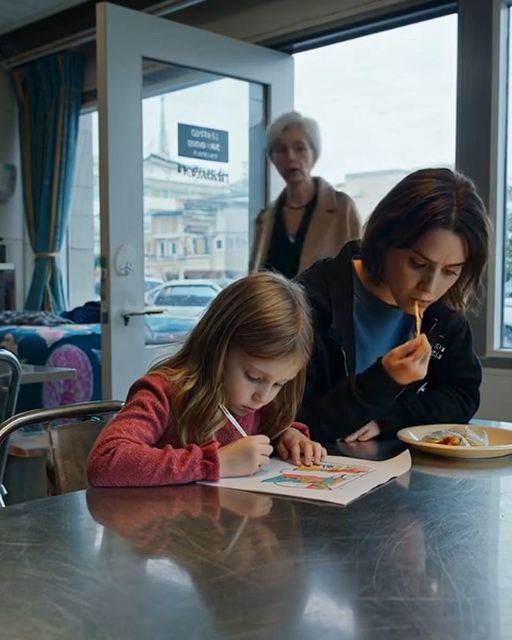
My daughter and I were eating canned soup on plastic trays when the black sedan pulled in.
We were in a family shelter downtown. Chloe, all of six years old, was humming and swinging her legs, happy with a fistful of broken crayons.
Then I saw her through the window.
White hair. An expensive coat. The kind of woman who belongs in a quiet suburb, not in a gravel parking lot next to a dumpster.
She got out of the car. Her eyes scanned the room and then just… stopped.
On us.
I figured it was a mistake. I was wearing a donated sweatshirt. Chloe’s jeans had another kid’s name in the tag.
But she walked right in.
Her gaze went past me, straight to our room. To the metal bunk beds you could see through the open door. Top bunk piled with Chloe’s stuffed animals. Bottom bunk where I stared at the ceiling every night.
She didn’t smile.
“Anna,” she said. My name sounded like a question she was afraid to ask. “What are you doing here?”
I hadn’t seen my grandmother in two years.
I told her the simplest truth.
“This is where we live now.”
Her hands shook as she sat down across from me. She looked at my daughter’s drawings of little houses, then her eyes came back to mine.
“Why aren’t you in your place on the north side?”
I actually laughed. A short, sharp sound.
“What place?”
She looked at me like I’d just said the sky was green.
Then she took out her phone.
She swiped to a document, a title deed, and turned the screen to me. There was my full legal name. An address I had never seen. A home.
A home that was supposed to keep my daughter from ever having to sleep on a mattress that smelled like disinfectant.
“I bought you that house two years ago,” she said, her voice a low whisper. “Your mother told me you moved in. She sends me pictures. New curtains. A fruit bowl she said you bought. She tells me stories about how much Chloe loves the yard.”
A layer of ice formed under my skin.
While my grandmother imagined me in a sunlit kitchen, I was rationing dollar-store shampoo and sharing a bathroom with five other families.
I had never seen that house.
I had never heard that address.
And on that phone was an entire life, a complete fabrication, starring me.
Later that night, long after my grandmother’s car had pulled away, I sat on the edge of my bunk.
I called my mom.
And for the first time in my life, I hit record before she answered.
I asked her about the house.
What came through the speaker was the calmest, most practiced lie I have ever heard. My grandmother was confused. I was stressed, not thinking straight. The kind of talk that makes you question your own memory.
She twisted every word except the ones that would answer the only question that mattered.
Who was living in the house my grandmother bought for me and my daughter?
After I hung up, it all started to click into place.
A dozen little comments from years ago. The holidays where my brother always had a new car, a new business idea to fund. The constant, gentle excuses for why there was never quite enough room, or money, for me.
The lights had finally come on. I had been stumbling in the dark for my entire life.
A few days later, a quiet lawyer with gray hair sat with me. He laid the papers out one by one.
The deed to a house on a quiet street.
Phone records. Bank statements.
Money moving every month, tied to my name, while my daughter slept under fluorescent lights that hummed all night.
And it all led back to the same people who smiled in church and told everyone I was just “going through a phase.”
That’s when I realized it.
The one phrase I had been trained, my whole life, to say. The three words that kept the whole machine running.
Okay, Mom.
But not anymore.
One week after that sedan pulled into the shelter parking lot, I stood in front of a mirror.
I ironed a clean blouse. I put every single piece of paper into a blue binder. I kissed Chloe on the forehead while she slept.
Then I drove through a steady rain toward my parents’ house.
Their driveway was full of cars. A banner hung over the door.
I could see the anniversary cake through the window.
And I walked toward that party with absolutely nothing left to lose.
The music was a soft hum I could feel through the soles of my shoes.
Laughter spilled from the open windows, bright and carefree.
I pushed open the heavy oak door. It wasn’t locked. Of course it wasn’t.
The air inside smelled like perfume and roasted chicken. It was a smell from my childhood, a smell I used to associate with safety.
Now it just felt like another part of the lie.
Dozens of faces turned to me. Friends of my parents, people from their church, distant cousins.
Their smiles faltered. I saw the pity in their eyes, the quick, assessing glances at my simple clothes.
This was Anna. The troubled one. The daughter who couldn’t get her life together.
My mother saw me first.
Her smile, bright and practiced, froze on her face for a single, breathtaking second.
Then it snapped back into place, wider than before.
“Anna, darling! What a wonderful surprise!” she exclaimed, rushing toward me.
She wrapped her arms around me. Her embrace felt like a cage.
“We were so worried you weren’t coming,” she whispered, her voice tight with a warning. “Play nice.”
I didn’t hug her back. I just stood there, the blue binder held tight against my chest like a shield.
My father was by the fireplace, holding a glass of whiskey. He nodded at me, a king acknowledging a courtier.
“Anna,” he said, his tone flat. “Good of you to make an appearance.”
He turned back to his conversation. I was dismissed.
Then I saw my brother, Mark.
He was standing by the buffet table, loading a plate. He wore an expensive watch, a tailored shirt. He looked like the golden son he had always been.
His eyes met mine across the room.
And for the first time, I didn’t see confidence. I saw panic.
He looked away instantly, suddenly fascinated by a bowl of potato salad.
That was all the confirmation I needed. He knew.
I let my mother lead me into the room. People offered me drinks, asked me how I was “holding up.”
Each question was a tiny paper cut. They had all heard the stories my mother told them.
That I was unstable. That I was making bad choices. That I needed their prayers.
I just smiled a little and shook my head. “I’m fine, thank you.”
I wasn’t there for small talk. I was a bomb, waiting for the right moment to go off.
The moment came, as I knew it would, with a toast.
My father tapped a spoon against his glass, calling for quiet. The room hushed.
“I want to thank you all for coming,” he began, beaming at my mother. “Forty years. Forty years with this incredible woman.”
He spoke about loyalty. He spoke about family values, about sacrifice and doing what’s right.
He spoke about how they had always tried to raise their children to be good, honest people.
The irony was so thick I could barely breathe.
My mother dabbed her eyes with a napkin. A perfect picture of a devoted wife.
“To my wife,” my father said, raising his glass high. “The rock of our family.”
“And to family,” he added, his eyes sweeping the room. “The most important thing in the world.”
That’s when I moved.
I stepped out from the edge of the crowd. The blue binder was in my hands.
“Dad,” I said. My voice didn’t shake. It was as clear and steady as the rain that had just stopped outside.
“Before everyone drinks to that, I’d like to add something about family.”
The room went silent. A hundred pairs of eyes were on me.
My father’s smile vanished. “Anna, this isn’t the time.”
“I think,” I said, opening the binder, “it’s the perfect time.”
I looked around at the familiar faces, the people who had judged me in silence for years.
“For two years, most of you have thought I was struggling. Making poor decisions. You’ve been told stories to that effect.”
I paused, letting the words hang in the air.
“The truth is a little different.”
I held up the first document. A clear copy of the deed.
“This is the deed to a house on the north side. My grandmother bought it for me and my six-year-old daughter two years ago.”
A low murmur rippled through the crowd.
“She thought we were living there. She thought we were safe.”
I looked directly at my mother. Her face was a mask of pale, tight fury.
“My mother was very convincing. She even sent Grandma pictures. Pictures of new curtains in the windows. Of a lovely little garden in the back.”
I pulled out the next sheet. A bank statement.
“This is a statement from a trust account set up in my name. Money for utilities, for property taxes, for my daughter’s future.”
“Money I never saw. Money that was moved, every single month, into a different account.”
My father took a step forward. “That is enough! You are unwell, Anna. You’re confused.”
“Am I?” I asked calmly. “Because I also have a recording of my last phone call with Mom, where she told me the exact same thing. That I was just confused.”
The word “recording” hit the air like a stone. My mother flinched.
The guests were no longer murmuring. They were staring, open-mouthed, from me to my parents. The perfect party was shattering.
“For the last year, my daughter and I have been living in a shelter,” I said, my voice finally cracking just a little. “We’ve been eating canned soup while someone else was living in our house, spending our money.”
I looked from my mother’s stony face to my father’s rage-filled one.
“So when you toast to family,” I said, my voice dropping to a whisper. “I just want you all to know what this family is capable of.”
The silence was absolute.
Then, a voice cut through it.
“Dad. Mom. Stop.”
It was Mark. He was pale, his hands shaking.
Everyone turned to look at him.
“She’s not lying,” he said, his voice barely audible. “It’s all true.”
My father’s face contorted with fury. “Mark, you be quiet.”
“No,” Mark said, taking a step forward. He wouldn’t look at me. He was looking at the floor. “I can’t. Not anymore.”
He took a deep, shuddering breath.
“It wasn’t just for them,” he said to the stunned crowd. “They did it for me.”
This was the twist I hadn’t seen coming. The final, missing piece.
“My business,” Mark said, his voice thick with shame. “The one they were all so proud of. It was failing. It was a complete disaster from the start.”
“I was going to lose everything. I was deep in debt.”
He finally lifted his head and looked at our parents.
“They told me it was a loan. They said Anna was irresponsible anyway, that she’d just mess it up. They rented out her house and funneled the money to me to keep my business afloat.”
He laughed, a bitter, broken sound.
“They said we’d pay it all back before she ever found out. That we were protecting her from herself, and protecting me from failure.”
The truth was somehow worse than simple greed.
It was a choice. They had chosen one child over the other. They had decided my daughter and I were disposable.
The party was over.
People didn’t even say goodbye. They just grabbed their coats and purses, their faces a mixture of shock and disgust, and fled.
Soon, it was just the four of us, standing in the middle of the decorated room, surrounded by half-eaten cake and deflating balloons.
My father turned on Mark first. “You fool! You weak, pathetic fool! You ruined us!”
My mother was just weeping, her hands over her face, the perfect hostess finally broken.
I didn’t stay to watch them tear each other apart.
I placed the blue binder on the dining room table.
“My lawyer has copies of everything,” I said into the silence. “You’ll be hearing from him.”
Then I turned around and walked out the front door.
The rain had stopped. The air felt clean and new. For the first time in my life, I felt like I could finally breathe.
The weeks that followed were hard, but they were honest.
My grandmother was my rock, her quiet strength holding me together.
The legal fight was surprisingly short. The evidence was undeniable. The house was mine, free and clear. The tenants were given legal notice to vacate.
The money was more complicated. But then, another surprise happened.
Mark called me.
He didn’t make excuses. He didn’t ask for forgiveness. He just apologized.
A week later, a cashier’s check arrived from his lawyer. It was a huge sum of money.
He had sold his business for parts. He sold his car, his expensive watch, everything of value. He was liquidating his entire life to begin paying me back.
It wasn’t everything they had taken, not even close. But it was a start. It was accountability.
My parents were a different story. They lost everything they cared about. Their reputation, their friends, their standing in the community. Their perfect image was gone, and they had nothing left. They never called me.
Two months after that night, I stood on a quiet, tree-lined street.
I was holding Chloe’s hand in one of mine, and a single, shiny key in the other.
My grandmother stood beside us, her eyes filled with tears.
It was a small house, painted a soft yellow, with a big oak tree in the front yard. Our house.
I slid the key into the lock. It turned smoothly.
The door swung open, revealing empty rooms filled with afternoon sunlight and the faint smell of fresh paint.
Chloe let go of my hand and ran inside, her sneakers squeaking on the hardwood floors.
She did a little spin in the middle of the empty living room.
“Mommy,” she shouted, her voice echoing happily. “Is this our forever house?”
I knelt down on the floor, the sunlight warm on my face, and pulled her into the tightest hug of my life.
“Yes, baby,” I whispered into her hair. “This is our forever house.”
Looking at her, at the safe, sunlit space around us, I finally understood. Betrayal doesn’t always announce itself with a bang. Sometimes it’s a series of quiet whispers, of gentle lies told in the name of love.
True strength isn’t found in screaming or in revenge. It’s found in the quiet, unshakable power of the truth. It’s found in refusing to be a secret, in refusing to be a sacrifice on someone else’s altar.
A home isn’t just a roof and four walls. It’s the place where your truth is honored, where your safety is a priority, and where your heart can finally, finally be at peace.
I had to walk through the darkest parts of my life to find it, but standing there, with my daughter’s laughter echoing through our new beginning, I knew I was finally home.