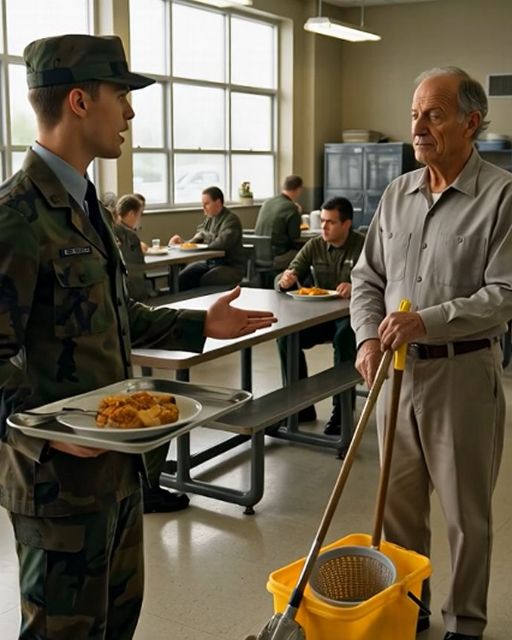
“Out of the way, old man,” the young airman snapped, shoving his tray forward. “Some of us have important places to be.”
The janitor, a quiet man named Walter who always kept to himself, simply nodded and started to move his mop bucket. He’d been cleaning the floors of this mess hall for over a decade and had seen a hundred kids like this one come and go.
But the rookie, Todd, wasn’t finished. He wanted an audience. “I said MOVE,” he barked, louder this time. His friends snickered behind him. “Show some respect for the uniform.”
The clatter of forks and conversation in the hall slowly died down. That’s when the side door opened.
Colonel Drummond, the base commander, walked in. The room went dead silent.
The rookie straightened up, a smirk on his face, clearly expecting the Colonel to discipline the slow-moving janitor. But the Colonel walked right past him. He stopped directly in front of Walter.
Heels clicked together. His arm shot up in the sharpest salute the rookie had ever seen. “Sir,” the Colonel said, his voice clear and strong. “A pleasure to see you this morning.”
Todd’s smirk vanished. He stared, completely baffled, as Walter gave a tired, knowing nod back to the commander.
Colonel Drummond lowered his salute and turned to the rookie, his eyes cold as steel. “Airman,” he said, his voice dangerously quiet. “You will stand at attention when addressing a Medal of Honor recipient.”
He gestured toward the janitor. “This is Mr. Walter Franklin. The man who dragged my father out of a burning helicopter in Saigon.”
The Colonel let that sink in for a second before continuing.
“His name isn’t just on the janitor’s payroll, son. It’s also on the side of the new F-35 training simulator.”
The air left Todd’s lungs in a painful rush. The Franklin-Drummond Advanced Flight Simulator was the crown jewel of the base, a project years in the making.
He felt the weight of hundreds of pairs of eyes on him. His friends were no longer snickering; they were staring at their trays as if their lives depended on it.
Colonel Drummond wasn’t finished. His voice dropped to a whisper that carried across the silent hall like a crack of thunder.
“My office. Five minutes.” He turned back to Walter. “Walter, if you have a moment later, I’d like to catch up.”
Walter just nodded, his expression unchanged, and went back to his bucket. It was as if the entire exchange was nothing more than a minor interruption in his day.
The walk to the Colonel’s office was the longest of Todd’s life. Every footstep echoed his stupidity.
He stood at attention in front of the large oak desk, his gaze fixed on a point on the wall just over the Colonel’s head. He braced himself for the screaming, the demotion, the end of his career before it had even begun.
But Colonel Drummond didn’t scream. He sat down slowly, lacing his fingers together.
“Do you know why Mr. Franklin mops floors, Airman?” he asked, his voice calm.
“No, sir,” Todd mumbled.
“Because he wants to.” The Colonel leaned forward. “After he came home, they threw parades for him. They offered him promotions, political positions, a lifetime of comfort.”
“He turned it all down.”
“He said the noise was too much. The handshakes, the cameras, the people calling him a hero.”
Colonel Drummond stood and walked to the window, looking out over the airfield.
“My father told me what happened that day. The chopper went down in a plume of fire. Everyone thought it was a lost cause.”
“But Walter, a young medic back then, he ran toward the fire, not away from it. He pulled my father, the pilot, from the wreckage while ammunition cooked off all around them.”
“He saved my father, but he couldn’t save the co-pilot in time.” The Colonel’s voice tightened. “That part has always haunted him. He doesn’t see himself as a hero. He sees the man he couldn’t save.”
The silence in the room was heavy. Todd felt an unfamiliar shame, hot and sharp.
“He came here twelve years ago, looking for a job. Any job. He said he just wanted to be around service members, to feel that sense of purpose again, but without the noise.”
“He wanted a quiet life of service. So we gave him one. He is more a part of this base than any of us.”
The Colonel turned back to face Todd. “Respect isn’t about the uniform you wear on the outside, son. It’s about the character you have on the inside.”
“You disrespected a man whose boots you are not worthy of cleaning, let alone commanding to move.”
Todd finally looked the Colonel in the eye. “Sir, I… I am so sorry. There’s no excuse.”
“You’re right. There isn’t,” the Colonel said flatly. “But an apology without action is just an empty word.”
“So here is your action. For the next thirty days, your duties are reassigned. You will report to Mr. Franklin at 0500 every morning. You will be his assistant.”
Todd’s heart sank. A janitor’s assistant.
“You will mop, you will sweep, you will scrub, and you will do it until he tells you it’s done right. And you will not speak unless spoken to.”
“And one more thing. You will write a two-thousand-word essay on the history of the Medal of Honor, its recipients, and specifically, Walter Franklin’s citation.”
“I want you to understand, truly understand, what that medal means. Dismissed.”
The first morning was brutal. The air was cold and dark when Todd met Walter by the mess hall service entrance.
Walter didn’t even look at him. He just handed him a bucket and a mop. “We start with the latrines.”
For hours, they worked in silence. Todd, who had prided himself on his physical fitness, found his muscles screaming from the unfamiliar work.
He scrubbed toilets and mopped floors, the sting of disinfectant burning his nostrils. Walter worked with an economy of motion that was almost mesmerizing. He was methodical, silent, and thorough.
Days bled into a week. The silence between them was a wall. Todd did his work, his mind a swirl of resentment and shame.
He started his research for the essay, reading Walter’s official citation online. The dry, military language described an act of unbelievable bravery. It detailed how PFC Walter Franklin had run through enemy fire to a downed helicopter, administered life-saving aid to the pilot, and single-handedly held off an enemy patrol until reinforcements arrived.
It was incredible. And it didn’t seem to fit the quiet, stooped man who was currently showing him how to properly wax the hallway floor.
One afternoon, Todd was struggling to move a heavy floor buffer. He grunted, trying to get it up a small step.
Suddenly, a pair of worn, steady hands were next to his. “Lift with your legs, not your back,” Walter said. It was the first full sentence he’d spoken to him.
Together, they lifted the machine. “Thanks,” Todd said, surprised.
Walter just nodded. “Break time,” he announced, pulling two bottles of water from a small cooler. He handed one to Todd.
They sat on a bench outside, watching the jets practice maneuvers in the sky.
“Why did you do it?” Todd asked, the question tumbling out before he could stop it. “Run toward the helicopter?”
Walter took a long drink of water. He looked at the sky, his eyes distant.
“Wasn’t much of a choice,” he said softly. “You hear someone calling for help, you go. That’s all.”
“But you were scared, right?”
A small, sad smile touched Walter’s lips. “Anyone who says they weren’t scared is a liar or a fool. I was both, I think.”
It was the most Todd had ever heard him say. It made him human.
As the weeks went on, the wall between them slowly crumbled. Walter started to share small things. He taught Todd how to fix a leaky faucet, how to mix cleaning solutions just right.
He never talked about the war, but he talked about growing up in Ohio, about his late wife, about the satisfaction of a job well done. Todd started to see the man, not the janitor or the hero. He saw Walter.
One night, working on his essay, Todd got stuck. The citation mentioned the pilot, Colonel Drummond’s father, but it was vague about the co-pilot, only listing him as “WIA,” wounded in action.
On a whim, Todd called his grandmother. His own grandfather, Arthur, had served in Vietnam as a helicopter co-pilot. He’d never talked much about it, but Todd was curious.
“Grandma,” he said. “I’m doing a report on a guy from Grandpa’s time over there. He was involved in a helicopter crash.”
He relayed the date and the details of the incident from Walter’s citation. The line went quiet.
“Grandma? You there?”
“Todd,” she said, her voice trembling slightly. “What was the name of the man you’re writing about?”
“Walter Franklin,” Todd replied.
He heard her gasp, a sharp intake of breath. “Oh, my lord. Arthur’s angel.”
Todd was confused. “What are you talking about?”
“Your grandfather was the co-pilot in that helicopter, Todd,” she said, her voice thick with emotion. “The pilot was his friend, Richard Drummond.”
The phone felt slick in Todd’s hand. His entire world tilted on its axis.
“Grandpa was trapped,” she continued. “His legs were pinned. He always said the fire was so hot, he was sure he was going to die. He told me a young medic pulled Richard out first, then came back for him.”
“He said the man was so calm, just talking to him, keeping him conscious while he worked to free his legs. He saved his life. Arthur tried for years to find him, to thank him. He never knew his name. He just called him his angel.”
Todd hung up the phone, his mind reeling. Walter hadn’t just saved his commander’s father.
He had saved his own grandfather.
The next morning, Todd found Walter cleaning the windows of the base chapel. The rising sun cast long shadows across the lawn.
“Walter,” Todd said, his voice unsteady. “Can I ask you something?”
Walter turned, rag in hand. “Go on.”
“The co-pilot. In the helicopter. My grandmother just told me…” Todd struggled to get the words out. “That was my grandfather. Arthur Hayes.”
Walter’s calm expression didn’t change, but something shifted in his eyes. A flicker of a memory fifty years old.
“Hayes,” he said, the name a soft echo. “I remember. He was a talker. Kept cracking jokes even with his leg busted up.”
“Why didn’t you say anything?” Todd asked, his voice breaking. “My grandfather looked for you. He wanted to thank you.”
Walter turned back to the window, polishing a smudge that only he could see.
“The medal… it was for pulling the pilot out,” he said quietly. “That was the official story.”
He paused, taking a deep breath. “But there’s more to it. There’s always more.”
“When we saw the chopper go down, a buddy of mine, a fella named Sam, he took off running first. He was faster than me. Always was.”
Walter’s voice grew heavy. “He didn’t make it halfway. He caught a stray round. I was right behind him. I had to keep going.”
“When I got to the chopper, all I could hear was Sam’s name in my head. When they gave me that medal, I felt like I was stealing it from him. He was the first to run. He was the brave one.”
“Pulling your grandfather out… that wasn’t for a medal. That was for Sam. It felt like finishing the job he started. It was the only part of that day that felt right.”
“I took this job so I could be in a quiet place. To live a simple life. The kind of life Sam never got. It’s my way of honoring him. Not by being a famous hero, but by being a good, quiet man.”
Todd stood there, the morning sun warming his face, and finally understood. He understood the weight of the medal, the burden of being a hero, and the profound, humbling power of a quiet life.
His punishment ended the following week. He handed his essay to Colonel Drummond, but he also handed him a second, unofficial proposal.
A few months later, a small crowd gathered on a newly landscaped piece of ground next to the base chapel. They were there to dedicate the new “Peace and Remembrance Garden.”
Colonel Drummond stood at a small lectern. “We are here today not just to honor a hero we all know, but also one that most of us never did.”
He spoke of Walter’s courage, but he also told the story of Private Samuel Jones, the man who ran first.
At the center of the garden were two simple, granite benches. One was inscribed with “Walter Franklin.” The other, “Samuel Jones.”
Todd, standing in the crowd, gave a short, heartfelt speech. He talked about how true honor isn’t found in a uniform or a rank, but in the heart. He looked directly at Walter and publicly apologized for his arrogance and ignorance.
“Some heroes save lives on the battlefield,” Todd finished, his voice clear and steady. “And some heroes spend their lives quietly teaching us how to be better men. I’ve been lucky enough to meet both, and they are the same person.”
After the ceremony, Walter walked over to Todd. For the first time, Todd saw a genuine, broad smile on the old man’s face. There were tears in his eyes.
“You brought my friend home, kid,” Walter said, clapping a hand on Todd’s shoulder. “After all these years, you brought him home.”
From that day on, a change was seen on the base. Airmen of all ranks would stop by to say hello to Walter, not with a salute, but with a simple, respectful nod. They’d ask him about his day. They saw the man, not the janitor.
And Todd, he was a different person. He excelled in his duties, but he did so with a newfound humility. He was the first to volunteer for the tough jobs, the first to lend a hand, and the first to see the value in every single person on that base, no matter their role.
The story reminds us that heroes are rarely the loudest people in the room. They don’t wear their courage like a badge of honor, but carry it quietly in their hearts. A person’s worth is not defined by their job title, but by the content of their character and the silent sacrifices they make when no one is watching. True strength is not in how high you can climb, but in how low you are willing to bend to lift someone else up.