It was a closed-casket funeral for Sergeant Brian Carter. He had served two tours and saved countless lives, but a “training accident” had supposedly taken him from us.
His partner, a retired German Shepherd named Duke, was sitting by the altar. Duke was usually calm, a stoic old dog with grey fur around his muzzle. But today, he was frantic.
Every time the pallbearers got close to the coffin, Duke would snap at their hands. He wasn’t just grieving; he was guarding.
“Get that dog out of here!” Brian’s stepmother, Margaret, hissed from the front row. “He’s ruining the ceremony.”
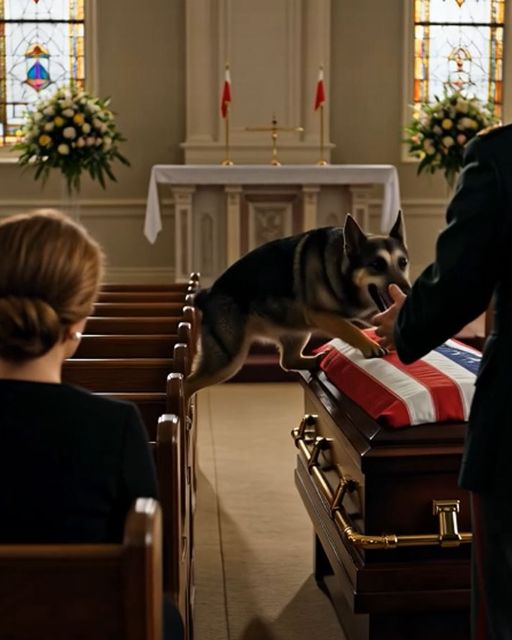
Two soldiers moved to drag Duke away by his collar. Duke let out a sound I’ll never forget – not a bark, but a high-pitched, desperate scream. He broke free and jumped with his front paws right onto the flag-draped wood.
General Vance, a man who hadn’t shown emotion in forty years of service, stood up. He walked to the casket to calm the animal.
“Stand down, soldier,” Vance whispered to the dog.
But Duke didn’t stand down. He looked the General in the eye and then pressed his nose firmly against the seam of the casket lid. He let out a single, sharp “woof” and sat down, staring intently at the wood.
The General froze. His hands started to shake.
The room went deadly silent. General Vance knew every signal that dog had been trained to give. A whine meant danger. A growl meant enemy.
But this? This specific sit-and-stare? That was the signal for “Survivor Located.”
The General dropped to his knees and pressed his ear against the polished mahogany. He closed his eyes, and tears immediately began to spill down his cheeks.
He stood up, drew his sidearm, and aimed it at the stepmother. “Open it,” he roared at the pallbearers. “Open it right now.”
Because the General didn’t hear silence inside that box. He heard a faint, rhythmic tapping.
A gasp swept through the church like a cold wind. The pallbearers, young men trained to follow orders without question, looked at the General, then at the casket, their faces pale with confusion.
“That is an order!” General Vance’s voice cracked like a whip, echoing off the stained-glass windows.
Margaret shot to her feet, her face a mask of practiced outrage. “Have you lost your mind, General? This is a funeral! You are desecrating my stepson’s memory!”
The General didn’t even look at her. His eyes were locked on the casket, his weapon steady. “I’ll ask you one more time. Open that box.”
The funeral director, a small man named Mr. Abernathy, scurried forward, wringing his hands. “Sir, please, there must be some mistake. The body was prepared. Everything was verified.”
The tapping from inside the casket stopped for a moment, then resumed, weaker this time. Tap. Tap-tap. Tap. It was Morse code. S.O.S.
Two of the pallbearers finally broke from their stupor. They fumbled with the latches on the side of the casket, their knuckles white. With a heavy groan, they lifted the lid.
The American flag that had been draped over it slid to the floor in a heap of red, white, and blue.
Inside, lying on the white satin lining, was Sergeant Brian Carter. He was deathly pale, his eyes barely open slits, but he was breathing. His uniform was immaculate, except for the single brass button he held between his thumb and forefinger, the one he had been using to tap out his desperate plea.
A collective scream erupted from the mourners. Margaret’s face went from indignant rage to ashen horror. It wasn’t the look of a relieved stepmother; it was the look of a criminal whose plan had just spectacularly imploded.
“Medic!” General Vance bellowed, holstering his weapon as medics who had been on standby for the military funeral rushed forward.
They carefully lifted Brian out of the casket and onto a gurney. His gaze was hazy, but he scanned the crowd until his eyes found one familiar, furry face.
“Duke,” he whispered, his voice a dry rasp.
The old dog, who had been held back by a soldier, broke free again. He didn’t jump or bark this time. He moved to the gurney and gently laid his head on his partner’s chest, letting out a low, contented whine.
Brian lifted a trembling hand and buried it in Duke’s thick fur. The chaos of the church faded into a dull roar around them.
The General stood over Margaret, his shadow falling across her expensive black dress. “You have a lot of explaining to do, ma’am.”
“I… I don’t understand,” she stammered, trying to regain her composure. “The hospital… they said he was gone. A tragic training accident. A fall.”
“Funny,” the General said, his voice dangerously low. “Because there isn’t a single bruise on him.”
Military police arrived and escorted a sputtering Margaret out of the side door of the church. The funeral for Sergeant Brian Carter was over. The investigation into his attempted murder had just begun.
At the military hospital, Brian slowly regained his strength. The doctors were baffled. He’d been given a massive dose of a potent beta-blocker combined with a synthetic paralytic agent. It was a sophisticated cocktail designed to slow the heart to a nearly undetectable rate, mimicking all the signs of death.
“Whoever did this knew what they were doing,” the head physician told General Vance. “Another hour, maybe two, and the effects would have become permanent. The lack of oxygen would have… well, he wouldn’t have woken up.”
Brian’s memory was foggy, a patchwork of confusing images. He remembered being at his father’s house, the house he grew up in before Margaret moved in. He was there to discuss his inheritance. His biological mother had left him a substantial trust fund that he would gain full control of on his thirtieth birthday, which was just a week away.
He remembered Margaret offering him a glass of iced tea. He remembered it tasting slightly bitter.
“She was so nice that day,” Brian told the General from his hospital bed, Duke’s head resting on the mattress beside him. “Over-the-top nice. Asking about my service, telling me how proud my father was.”
He’d felt dizzy after a few sips. He thought it was just exhaustion from his recent return from deployment. The last thing he remembered was the concerned look on Duke’s face before the world went black.
The investigators dug into Margaret’s life. On the surface, she was the perfect wife to Brian’s wealthy, aging father. But beneath that polished veneer, they found a different story. They found mountains of debt from online gambling. They found letters from loan sharks.
The motive became painfully clear. According to the terms of Brian’s mother’s will, if Brian died before his thirtieth birthday without any children, the entire trust fund would be absorbed back into his father’s estate, which Margaret effectively controlled. She stood to gain millions. The “training accident” was the perfect cover story.
She had an accomplice, of course. A disgraced pharmacist who she’d met through her gambling circles. He provided the drug cocktail for a cut of the money.
But Margaret was smart. She covered her tracks well. The pharmacist had an alibi, and there was no physical evidence tying her directly to the poison. She played the part of the grieving, confused stepmother perfectly, insisting there must have been a horrific mix-up at the morgue.
Her lawyer was good, and it was starting to look like she might actually get away with it. They had motive, but they couldn’t prove she administered the drug. It was her word against the fuzzy memory of a man who had been drugged unconscious.
Brian grew more frustrated with each passing day. He was alive, thanks to his partner, but his attacker was walking free.
“It’s like there’s a missing piece,” he said one afternoon, stroking Duke’s ears. “Something I can’t quite grab onto.”
Duke nudged his hand, then looked toward the corner of the room where Brian’s service gear had been placed. His K-9 vest was on top of his rucksack. The dog trotted over to it and began sniffing intently at a small, zippered pouch on the side, one Brian used for storing small tools or personal items.
“What is it, boy?” Brian asked.
Duke nudged the pouch with his nose, then looked back at Brian, whining softly.
A forgotten memory flickered in Brian’s mind, as blurry as an old photograph. The bitter taste of the tea. The room spinning. Margaret’s smiling face hovering over him. His hand feeling heavy as he reached for Duke.
He remembered her taking the now-empty glass from the table. As she turned, something small and plastic fell from her pocket onto the dark wooden floor. It was a tiny, brightly colored cap from a vial.
He remembered thinking it was strange, out of place. He didn’t have the strength to speak, but instinct took over. His mind was shutting down, but his training was kicking in. Preserve evidence.
He’d pointed a single, trembling finger toward the floor. Duke, ever attentive, had looked where he pointed.
“Get it,” Brian had whispered, his last conscious command. “Duke. Fetch.”
He remembered seeing Duke pad silently across the room, pick up the small object in his mouth, and then… nothing.
“The vest,” Brian said, his voice suddenly clear and strong. “General, check the pouch on his vest.”
General Vance, who was visiting, walked over and carefully unzipped the small compartment. Inside, nestled amongst some lint and a spare collar tag, was a small, teal-blue vial cap.
It was the missing piece.
The cap was custom-made, part of a specific batch created for a specialty compounding pharmacy. The kind of place the disgraced pharmacist used for his less-than-legal side business. When the investigators presented the cap to him, his tough exterior crumbled. Faced with tangible evidence that tied him directly to the scene, he confessed everything.
He told them how Margaret had planned it all. How she’d researched the perfect, untraceable drug. How she’d laughed about the irony of burying him alive on the day before he was set to inherit his fortune. He even recorded one of their conversations, an insurance policy for himself, which he gleefully handed over.
The day Margaret was arrested, for real this time, Brian was there. He wasn’t in uniform, just a pair of jeans and a simple shirt. He stood with Duke by his side as the officers led her out of his father’s house in handcuffs.
Her mask of civility was gone, replaced by a snarl of pure hatred. “That stupid dog,” she spat, looking at Duke. “It should have been put down years ago.”
Brian just shook his head. He didn’t need to say a word. Duke sat faithfully by his side, a silent, furry testament to the fact that true loyalty could never be defeated by greed.
Months later, the autumn leaves were turning gold and red in the park. Brian threw a well-worn tennis ball, and Duke, moving a bit slower but with the same joyful spirit, bounded after it. Brian’s father, frail and heartbroken by Margaret’s betrayal, had signed over control of the family business to him, wanting to retire from a world he no longer understood.
Brian had used a portion of his inheritance to start a foundation. It provided funding for K-9 units in underfunded police departments and covered the medical expenses for retired military and police dogs. He wanted to make sure that heroes like Duke were always taken care of, long after their service was over.
He sat on the bench, watching his best friend trot back with the ball, his tail wagging. The dog who had sniffed out bombs in dusty war zones and tracked criminals through dense forests had performed his greatest feat in the quiet, hallowed halls of a church. He hadn’t needed a command or a signal. He had simply refused to leave the person he loved.
It was a profound lesson. We spend so much of our lives trying to understand the world through complicated words and intricate plans. We build walls, create deceptions, and get lost in the noise of our own ambition.
But sometimes, the most important truths are the simplest ones. They aren’t spoken; they’re felt. They’re shown in a steadfast presence, a protective growl, a wet nose pressed against your hand. It’s a reminder that the purest form of love and loyalty doesn’t need a voice to be heard. You just have to be willing to listen with your heart.