
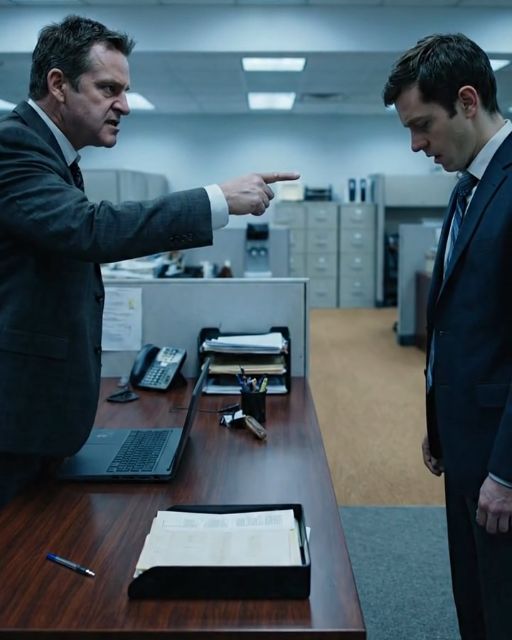
The moment I walked into the office, I could feel the tension. My boss, Mr. Griffin, was waiting by my desk with a look I’d never seen before – angry and almost… panicked.
“You missed the client meeting yesterday,” he snapped. “You know how important it was.”
I swallowed hard. “I was at my mother’s funeral,” I replied.
“No excuse,” he shot back. “Clear your desk by noon.”
I was crushed. Fired for attending my own mother’s last rites? I gathered my things, feeling humiliated.
As I reached for the company laptop to shut it down, I noticed an email on the screen. It was from Mr. Griffin’s wife, sent just minutes before our confrontation. The subject line read: “HE KNOWS.”
My heart pounded. Why was she emailing him from my account? I clicked it open to see what else I could lose. But when I read it, my jaw dropped.
The body of the message was a single, terrifying line. “The auditor is asking about the Phoenix account. It has to be today, Charles. Do it.”
Phoenix account? I’d never heard of it. And what did he have to “do” today? Fire me?
It felt like I was a pawn in a game I didn’t understand. My hands trembled as I packed the laptop into my bag along with my personal effects. It was company property, but in that moment of pure shock and injustice, I didn’t care. It was evidence.
The walk home was a blur of gray pavement and indifferent faces. The grief for my mother, a deep, steady ache, was now tangled with the sharp sting of betrayal. One moment I was mourning a lifetime of love, the next I was unemployed and implicated in something sinister.
I got to my small apartment and sank onto the sofa, the silence deafening. The sympathy cards for my mom were still on the mantelpiece. Now I felt like I needed them for myself.
For a full day, I did nothing. I let the grief wash over me, a necessary tide. But on the second day, the anger returned, cold and clear. I opened the laptop.
I wasn’t a hacker, just a methodical project manager. But I knew our company’s systems inside and out. I knew the servers, the file structures, the way Mr. Griffin liked to organize his digital life.
First, I checked the email’s metadata. Sure enough, it was sent from the IP address at our office, from my specific terminal, just three minutes before Mr. Griffin had stormed over to my desk. His wife, Eleanor, must have walked in, used my unlocked computer while I was grabbing my coat, and sent the message. She was setting me up.
But for what?
I started searching for “Phoenix account.” Nothing came up in the regular files, no client folders, no invoices. It was a ghost.
I remembered a data recovery software I had used once to save a corrupted client file. It could scan for deleted fragments and hidden partitions. I installed it and let it run, my heart thumping a nervous rhythm against my ribs.
Hours passed. The progress bar crawled across the screen. Finally, it dinged. A list of recovered files appeared, most of them gibberish. But one folder name stood out: “PHX_MED.”
My breath caught in my throat. I clicked it open.
It wasn’t a client account. It was a collection of medical records, hospital bills, and emails with doctors. They were for a child named Samuel Griffin. Mr. Griffin’s son. I remembered seeing a photo of him once on his desk, a smiling boy of about ten.
But these documents weren’t happy. They were filled with terrifying words: oncology, experimental trials, palliative care. My boss’s son was critically ill.
The bills were astronomical, figures with so many zeros they looked fake. I cross-referenced the payment dates with company financial statements I had access to. The money was coming from a shell corporation. The Phoenix account.
Mr. Griffin was embezzling company funds to pay for his son’s cancer treatment.
A wave of something complex and unsettling washed over me. My anger towards him was suddenly diluted with a confusing pity. He was a man breaking the law, but he was also a desperate father trying to save his child.
The “important client meeting” I had missed… I searched his calendar for that day. It wasn’t with a client. It was with a Dr. Alistair Finch, a specialist from a Swiss clinic, who was in the country for only two days.
My stomach turned. Mr. Griffin’s panic, his rage – it wasn’t just about business. It was about his son’s last hope. My mother’s funeral had coincided with what might have been his son’s only chance.
But that didn’t explain his wife’s email. It didn’t explain why they chose to fire me and plant a digital trail leading to my computer. Something was still missing.
I kept digging. I found a subfolder labeled “Transfers.” Inside was a spreadsheet that detailed every payment made from the Phoenix account. The amounts going to the hospitals and doctors were huge. But there were other transfers, too.
Payments to a luxury car dealership. A down payment on a beach house. Transfers to a personal investment account under the name E. Vance. Eleanor’s maiden name.
My blood ran cold.
Mr. Griffin was embezzling to save his son. His wife was embezzling for a new car and a vacation home. She was using their son’s tragedy as a cover for her own greed, siphoning off a fortune while her husband was blinded by fear and grief.
The auditor must have gotten close to uncovering the shell corporation. Eleanor panicked. She needed a scapegoat, someone to take the fall if the whole thing blew up. And there I was, the grieving employee who had just “missed the most important meeting of the year.” I was the perfect distraction.
I leaned back in my chair, the whole sordid picture now painfully clear. Mr. Griffin wasn’t a monster. He was just a man who had made a terrible choice for what he thought was the right reason. But his wife… she was something else entirely.
I knew I had to do something. I could go to the police and ruin them all. Or I could confront him. I thought about his son, Samuel, and the choice became obvious.
I called a lawyer first, a woman named Ms. Davies who specialized in employment law. I explained the situation, leaving out the embezzlement part for now, focusing only on the wrongful termination. She agreed it was a strong case.
“But,” I said, “there’s more to it. I think he’s in trouble.”
I drove to Mr. Griffin’s house that evening. It was a large, imposing home in a wealthy suburb, the kind of place that was supposed to be a fortress against the world’s problems. I rang the doorbell.
Mr. Griffin answered, his face pale and drawn. When he saw me, his expression hardened.
“What are you doing here?” he asked, his voice low.
“We need to talk,” I said calmly. “About the Phoenix account.”
The color drained from his face. He looked over his shoulder, then pulled me inside, shutting the door quickly. “How do you know about that?”
“I know everything, Mr. Griffin,” I said, my voice softer than I intended. “I know about Samuel. I’m so sorry.”
He crumpled. The powerful, intimidating boss I knew vanished, replaced by a heartbroken father. He sank onto a chair in the hallway, his head in his hands.
“He’s not getting better,” he whispered, his voice cracking. “The trial isn’t working.”
Just then, Eleanor appeared at the top of the stairs. She was dressed impeccably, looking cool and composed. When she saw me, her eyes narrowed to slits.
“Charles, what is he doing in our house?” she demanded.
“He knows, Eleanor,” Mr. Griffin said, his voice hollow. “He knows everything.”
“Then you should have handled it,” she snapped, descending the stairs. “I told you to be decisive.”
“Handled it? By destroying an innocent man’s life?” he shot back, a flicker of his old fire returning. “A man who was burying his own mother?”
I held up the laptop. “I also know about the beach house, Eleanor. And the car. And the offshore account in your maiden name.”
Mr. Griffin looked from me to his wife, his face a mask of confusion. “What is he talking about?”
Eleanor’s composure finally broke. A flicker of pure panic crossed her face. “He’s lying. He’s trying to blackmail us.”
“Am I?” I said, turning the laptop screen towards Mr. Griffin. I showed him the spreadsheet, the transfers, the dates that didn’t line up with medical bills. I showed him how the money he thought was for his son’s life was funding hers.
He stared at the screen, his breathing growing ragged. The betrayal in his eyes was profound, a wound far deeper than anything I had felt. He had sacrificed his integrity for his son, while his wife had used their son’s pain for her own gain.
“Charles, don’t listen to him,” Eleanor pleaded, her voice suddenly shrill.
But he wasn’t looking at her anymore. He was looking at me. “You came here to show me this,” he said, not as a question, but as a statement. “You didn’t go to the police.”
“Your son doesn’t deserve to have his father taken away,” I said quietly. “Not now.”
He nodded slowly, absorbing the weight of my words. He stood up, and for the first time, he looked me straight in the eye, not as a boss to an employee, but as one man to another.
“I am so sorry, Arthur,” he said, his voice thick with emotion. “What I did to you was unforgivable. I was drowning, and I pulled you under with me.”
He then turned to his wife. The look on his face was one I would never forget. It was the death of love, the birth of cold, hard clarity.
“Get out,” he said.
“Charles, you can’t be serious,” she stammered.
“The lawyers will be in touch,” he stated, his voice devoid of any warmth. “Pack a bag and leave.”
She stared at him, then at me, her face contorted with hatred. Then, without another word, she turned and walked back up the stairs.
Mr. Griffin and I stood in the silent hallway for a long time.
“I have to make this right,” he said finally. “All of it.”
The next day, he called me. He told me he was going to confess to the company board. He would face the consequences, but he was going to structure it in a way that protected the company’s stability. He was also pressing charges against Eleanor.
He offered me my job back, but I respectfully declined. I couldn’t go back there.
“I understand,” he said. “Instead, I’m arranging a severance package for you. It’s five years’ salary. Consider it an apology and a start-over fund.”
I was speechless.
“I’ve also made some calls,” he continued. “A competitor of ours has been trying to hire you for years. I told them you were available. They want to meet with you tomorrow. The job is a senior director position. It’s a big step up.”
He was right. I had turned them down twice before out of loyalty to Mr. Griffin’s company.
A week later, I accepted the new job. Mr. Griffin was true to his word. The money appeared in my account, and his lawyers sent over an ironclad settlement agreement. I heard through the grapevine that he was forced to step down as CEO and was facing legal action, but that he had cooperated fully. He sold his large house and moved into a smaller one to personally pay back every cent he had taken, ensuring his son’s medical care was funded legitimately.
On my first day at my new job, a courier delivered a small envelope to my desk. Inside was a handwritten card.
“Arthur,” it read, “Thank you. You showed me that decency is a choice, even when you’re in the dark. I will spend the rest of my life trying to earn the grace you showed me. I wish you nothing but the best. – Charles.”
Tucked inside was a photograph of his son, Samuel, smiling weakly from a hospital bed, giving a thumbs-up.
I put the card in my drawer and looked out the window of my new office. The view was expansive, the sky clear. I had lost my mother and my job in the same week, but in the wreckage, I had found something else. I had found the strength to stand up for what was right, not with rage, but with empathy.
The greatest lesson I learned wasn’t about corporate greed or betrayal. It was that you never truly know the battle someone else is fighting. Cruelty is often just fear wearing a mask. And sometimes, the most powerful thing you can do is not to fight back with the same fire, but to offer a hand to help someone find their way out of the darkness they’ve created. You can’t fix their life for them, but you can choose to not let their tragedy become yours, and in doing so, you might just help them save themselves.