It was a whiteout blizzard in rural Ohio. I was working the graveyard shift at the truck stop with only one customer, a quiet man named Steve who was sipping tea. He seemed nice. Clean-cut. He told me he was driving home to see his daughter.
Then the roar started.
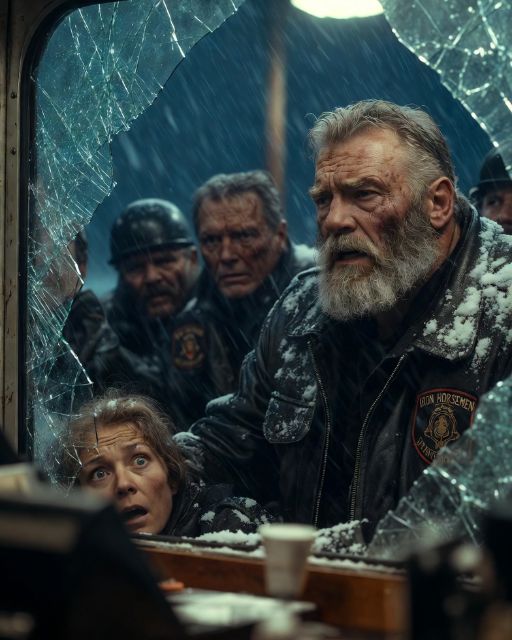
Twenty-four bikes surrounded the building. The ‘Iron Horsemen.’ They looked mean. Chains, leather, scars. Steve jumped up, his face draining of color. “Lock the door!” he yelled. “Call the police! Those are animals!”
I was terrified. I slammed the deadbolt home. The lead biker, a man the size of a fridge, didn’t wait. He threw a tire iron through the plate glass window. Glass sprayed everywhere. I screamed and ducked behind the counter. Steve pulled a hunting knife from his belt. “Stay back!” he shouted.
The bikers poured in through the broken window, snow swirling around them. They didn’t look at the register. They didn’t look at me. They surrounded Steve. The leader grabbed Steve’s wrist, twisting the knife away like it was a toy. He pinned Steve against the booth.
Then the biker turned to me. He wasn’t angry. He was crying.
“Get the keys to his sedan out of his pocket,” he barked at me. “Right now.”
I was shaking, but I grabbed the keys.
“Run to the car,” the biker roared. “He isn’t going home to his daughter. We’ve been chasing him for three hundred miles because the little girl tied up in his trunk is ours.”
My mind blanked. The word “ours” echoed in the sudden silence, a word that didn’t fit with the leather and the chains.
The keys felt like ice in my trembling hand. I stared at the giant biker, whose name I’d later learn was Bear. Tears were carving clean tracks through the grime on his face.
He wasn’t a monster. He was a man in agony.
Another biker, leaner and with a long gray braid, gently nudged my shoulder. “Go on, sweetheart. Please. We’ll handle him.”
That quiet “please” was what broke my paralysis. I scrambled out from behind the counter, my feet crunching on the shattered glass.
The wind hit me like a physical blow the moment I pushed the door open. The blizzard was a screaming wall of white, and I could barely see five feet in front of me.
I fumbled with the key fob, pressing the panic button. A car horn blared weakly from the far end of the lot, a pathetic cry against the storm’s fury.
I ran towards the sound, my thin work apron whipping around my legs. The snow was already calf-deep, each step a monumental effort. My breath came in ragged, burning gasps.
I finally reached the dark blue sedan, its windows already frosted over. My fingers were numb, clumsy as I tried to jam the key into the trunk lock. It wouldn’t turn.
Panic clawed at my throat. I tried the fob again, hitting the trunk release button. A soft click was my only answer.
I lifted the trunk lid. The little dome light flickered on, casting a weak, sickly glow.
And there she was.
She was so small, maybe six or seven years old, curled into a tight ball. Her hands and feet were bound with heavy-duty zip ties. A dirty blue bandana was tied cruelly across her mouth.
Her eyes were wide open, staring up at me. They weren’t just scared. They were exhausted, as if she’d run out of the energy for fear and was just waiting for the end.
A wave of nausea and rage washed over me. I reached in, my fingers fumbling with the knot on the bandana. It was tight, soaked with her tears.
“It’s okay,” I whispered, my own voice hoarse. “I’m here to help you. It’s okay.”
The bandana finally came loose. She took a shuddering, desperate breath. She didn’t cry out. She just watched me with those huge, haunted eyes.
The zip ties were another matter. They were pulled brutally tight, and her little wrists were raw and red. I had no knife, no tool.
“We have to go,” I said, my voice more urgent. “Can you move?”
She gave a tiny, almost imperceptible nod. I hooked my arms under her, lifting her out of the trunk. She weighed next to nothing, a little bundle of winter coat and terror.
She clung to me, her small face buried in my shoulder, shivering uncontrollably. The journey back to the diner felt ten times longer. The wind tore at us, trying to rip her from my arms.
I finally staggered back through the broken window, collapsing onto the gritty floor just inside. The bikers converged on us instantly.
The atmosphere had completely changed. The menace was gone, replaced by a raw, protective energy that was almost overwhelming.
Bear was on his knees beside us in a second. “Molly,” he breathed, his voice thick with emotion. “Oh, Molly-girl.”
He didn’t touch her right away, as if he was afraid of frightening her. He just looked at her, his big, calloused hands hovering in the air.
Molly peeked out from my shoulder. A flicker of recognition crossed her face. “Bear?” she whispered, her voice a tiny, scratchy thing.
“Yeah, kiddo. It’s me,” he said, and a fresh wave of tears streamed down his face. “We got you. We got you back.”
Another biker produced a small pocketknife and with surgical precision, sliced through the zip ties on her wrists and ankles. A third one was already behind the counter, making hot chocolate, his massive, tattooed hands surprisingly gentle as he stirred the milk.
They wrapped her in a thick wool blanket someone produced from a saddlebag. Bear finally gathered her into his arms, and she melted against his massive chest, her shivering slowly starting to subside.
I looked over at the booth. Steve was slumped there, held in place by two other bikers. The clean-cut facade had vanished. His face was a mask of pure, venomous hatred.
“You had no right,” he spat, his voice shaking with rage. “She’s my niece! My blood! You people are degenerates. I was saving her from your filth.”
Bear looked up from Molly, and the gentle sorrow in his eyes was replaced by a cold, hard fire.
“Her mother, your own sister, cut you out of their lives for a reason, Daniel,” Bear said, using a name that was clearly Steve’s real one. “Because you’re a poison. You couldn’t control her, so you tried to break her. And when she died, you thought you could just take her little girl.”
The pieces started to click into place. This wasn’t a random kidnapping. This was a twisted family dispute.
“Her dad was Marcus,” Bear continued, his voice low and dangerous. “He was my brother. Not by blood, but by choice. That’s a bond you’ll never understand. When he and Katherine died in that car crash last year, they left me as Molly’s legal guardian. It’s all on paper. They knew you’d try something like this.”
Steve, or Daniel, just laughed, a bitter, ugly sound. “A piece of paper doesn’t make you family. A court would give her to me in a heartbeat over a pack of criminal thugs.”
“Maybe,” Bear conceded, his gaze never leaving Daniel’s. “But we weren’t going to let it get that far.”
It was then that we all heard it. A new sound cutting through the howl of the blizzard. A siren. Faint at first, but growing steadily closer.
My heart leaped into my throat. The police. What would they see when they arrived?
A trashed diner. A man held captive. A gang of terrifying-looking bikers. And me, caught in the middle. Daniel’s face lit up with a triumphant, malicious grin. He was saved.
The diner door burst open, and a sheriff’s deputy stood there, his gun drawn. He was silhouetted against the swirling snow, his eyes wide as he took in the chaotic scene.
“Nobody move!” he commanded, his voice tight with authority.
Daniel immediately started shouting. “Thank God, Officer! These animals broke in! They assaulted me! They’re trying to kidnap my niece! Help me!”
The deputy’s eyes flicked from the bikers to Daniel, then to me, cowering on the floor, and finally to the little girl held in Bear’s massive arms.
His gun remained steady, but a flicker of confusion crossed his face. This wasn’t a simple robbery.
“Ma’am,” the deputy said, his voice firm but not unkind, gesturing to me with his chin. “You work here? Tell me what happened. Slowly.”
All eyes turned to me. My voice was trapped in my throat. Daniel was staring at me, his eyes full of threats. The bikers were watching me, their faces etched with a desperate hope.
This was my choice. I could tell him what it looked like, or I could tell him what I knew to be true.
I took a deep breath. “His name isn’t Steve,” I started, my voice trembling but clear. “He said it was. He was the only customer. Then… they came.”
I pointed a shaky finger at the bikers. “They broke the window. I was terrified. He told me they were animals.”
Daniel’s smile widened.
“But he was the one with the knife,” I continued, my voice gaining strength. “They didn’t want the money. They didn’t hurt me. They just… they wanted him.”
I looked at the deputy, my eyes pleading with him to understand. “Their leader, that man there,” I said, pointing to Bear, “he was crying. He told me to get the keys. He said there was a little girl in the trunk.”
The deputy’s focus sharpened. He looked at Molly, who was now peeking at him from the safety of Bear’s embrace.
“I ran out there,” I said, the words tumbling out now. “I found her. He had her tied up in the trunk. The bandana over her mouth… the zip ties… she was freezing.”
Daniel’s face contorted with fury. “She’s lying! They’re forcing her to say this!”
The deputy ignored him. He took a slow step into the room, his gun still raised but not quite as threateningly. “Sir,” he said to Bear. “I’m going to need you to explain who you are.”
Bear carefully shifted Molly so he could reach into the inner pocket of his leather vest. He moved with deliberate slowness, never breaking eye contact with the deputy.
He pulled out a worn leather wallet and, with one hand, extracted a folded, official-looking document.
“My name is Thomas Morrison,” Bear said, his voice steady. “My friends call me Bear. This is Molly-Ann Gable. I am her court-appointed legal guardian. Those papers are a copy of the court order.”
He gestured with his head toward Daniel. “That is Daniel Porter. He is Molly’s maternal uncle. He has a restraining order against him, filed by his own sister six months before she passed away. He’s been making threats for a year. He snatched Molly from her school playground in Pennsylvania yesterday afternoon.”
The deputy slowly lowered his weapon. He took the papers from Bear, his eyes scanning them quickly. He looked from the document to Molly, then back to Daniel, whose face had gone a pasty white.
“We didn’t call you,” Bear said quietly. “We figured handling it ourselves would be faster. We couldn’t risk him getting away. We’ve been on the road for eighteen hours straight, chasing him through this storm.”
The deputy nodded, a deep understanding dawning in his eyes. He’d seen enough in his career to know that the truth is rarely as simple as it looks on the surface.
He walked over to Daniel, pulling out a pair of handcuffs. “Daniel Porter, you are under arrest for kidnapping and for the violation of a restraining order.”
“You can’t do this!” Daniel shrieked as the cuffs clicked shut around his wrists. “Look at them! They’re the criminals!”
The deputy looked around the trashed diner. He looked at the shattered window, the broken glass littering the floor.
He sighed, then looked at Bear. “You and your boys caused a lot of property damage here, Mr. Morrison. And assault. Technically, I should be taking a few of you in, too.”
Bear nodded slowly. “I know. We’ll pay for everything. Every last cent. We just wanted to get our little girl back.”
The deputy was quiet for a long moment. He looked at me, then at the biker making hot chocolate, then at Molly, who was finally starting to look warm and safe.
“Get a broom,” the deputy said, his voice flat. “Start cleaning up this mess. I’ll need all your statements. But tonight… I only saw one crime committed here. And it wasn’t by any of you.”
A collective sigh of relief filled the small diner. The tension that had been stretched to its breaking point finally snapped.
The storm outside raged on, but inside, a different kind of storm had finally passed. The bikers didn’t leave. They stayed and helped me clean, their quiet efficiency a stark contrast to their chaotic arrival.
One of them expertly boarded up the broken window with plywood from his bike trailer. Another swept up every last shard of glass. Bear made a list of all the damages and handed me a thick wad of cash from his wallet, far more than was needed.
When I tried to refuse, he just shook his head. “For the damages, and for your trouble. And for being brave.”
As the sun began to rise, painting the snow-covered landscape in hues of pink and orange, the bikers prepared to leave. The deputy had arranged for child services to meet them a few towns over, just as a formality before Molly could officially go home with Bear.
Before he left, Bear came over to me. Molly was holding his hand, looking up at me with a small, shy smile.
“I don’t know your name,” Bear said.
“It’s Sarah,” I told him.
“Well, Sarah,” he said, his voice filled with a gratitude that felt deeper than the ocean. “We owe you more than we can ever repay. You trusted your gut instead of your eyes. Not many people would do that.”
I just shook my head. “I just did what was right.”
He squeezed my shoulder, a gesture of profound thanks. Then he and Molly and the rest of the Iron Horsemen walked out into the bright, cold morning, leaving me alone in the quiet of the diner.
I stood there for a long time, looking out at the tire tracks in the fresh snow, a complex web leading away in one direction.
That night taught me something I’ll never forget. The world isn’t black and white. It’s a million shades of gray.
Heroes don’t always wear capes, and monsters don’t always have fangs. Sometimes, the most monstrous people look just like us, sipping tea and talking about their daughters.
And sometimes, the most heroic people are the ones we’ve been taught to fear. They’re the ones who will ride through a blizzard and break down a door, not for money or for power, but for family. Because family isn’t just about the blood you share. It’s about the people who show up for you when the storm hits.