The house was finally quiet.
A low buzz from the kitchen light, the soft click of my son’s toy cars on the hardwood floor. Normal.
Then my phone lit up the dark. A text from my father.
Not an “I love you.” Not a “how are you.”
Just a number: $2,200. And a demand. For my brother’s graduation, as if I owed him rent.
Before I could even answer, the doorbell rang.
Not a polite chime. A hard, impatient jab, followed by a knock that sounded like a fist against wood.
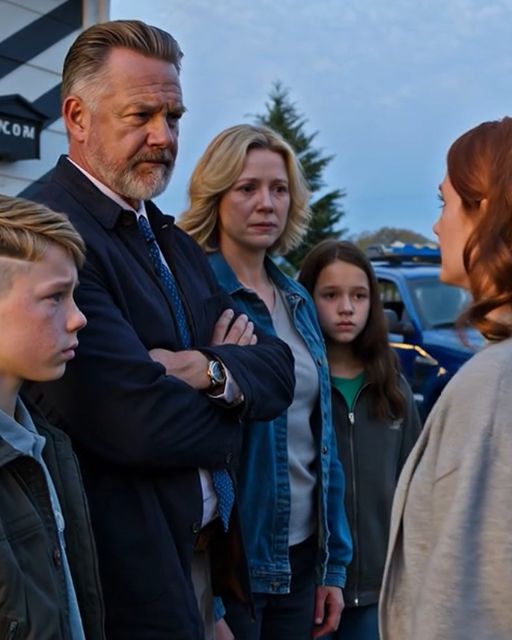
I peered through the peephole. My family, stacked on the porch like a battering ram.
My father in front, my mother a shadow at his shoulder. My brother and sister flanking them like muscle. The look in their eyes was the same. Certainty.
I slid the chain lock. The click was small, but it was mine.
I opened the door just a crack.
“Open up, Anna,” my father said, not to me, but to the door itself. “This behavior stops today.”
“Honey, please,” my mother tried. “Let’s just talk.”
My brother Ben smirked. “You’re embarrassing yourself.”
My father’s hand landed on the door, testing the chain. “My key doesn’t work.”
“I changed the locks,” I said. My voice didn’t even tremble.
His eyes went flat. “You don’t get to do that without telling me.”
I let the silence stretch for a full second.
“Watch me.”
The air in the hallway grew thin, tight. Behind me, the clicking of the toy cars stopped. My son was listening.
My father lowered his voice, that old trick. The one where control pretends to be concern. “You are coming to our house. You are apologizing. And you are transferring the money.”
I looked right through the crack in the door, into his eyes.
“No.”
The word hung there, solid and real. He looked stunned, as if I’d slapped him.
My mother’s eyes darted past me, searching for my son. “Leo, honey – Grandma’s – ”
“Don’t,” I said. The word was a blade. “Do not call for my son.”
That’s when he pulled out his phone. He didn’t just dial 911. He performed it. A slow, deliberate show of power.
“If you won’t be reasonable,” he said, “I’ll get someone who will.”
My throat felt like it was closing. “Are you calling the police?”
He ignored me. His voice changed, became warm and measured for the dispatcher. “Yes, officer… I’m worried about my grandson’s welfare. My daughter… she’s not being cooperative.”
The lie didn’t scare me.
The fact that he believed it would work, that’s what made my stomach drop.
I shut the door. The deadbolt slid home with a clean, final thud.
Leo looked up from his cars. “Mama, who’s outside?”
“Just grown-up stuff,” I said, forcing the calm. “Go play.”
I moved on instinct, not panic. Panic is messy. I walked to the entryway table and picked up the thick manila folder I had set there that morning.
Tires crunched on the street. A car door slammed.
Then the knock came again. Different this time. Official.
“Ma’am,” a woman’s voice called out. “Officer Evans. Can you come to the door, please?”
I stepped onto the porch and pulled the door closed behind me, sealing the quiet in with my son.
My father launched into his story, a rush of practiced worry. The officer held up a hand, silencing him without a single glance his way.
“Sir,” she said, firm. “I need to hear from her first.”
I didn’t speak.
I just opened the folder and held out the first page.
Her eyes scanned the document. The header. The official stamp. The date.
I watched her posture shift. Her shoulders squared. Her jaw set.
She looked from the paper to my father, then back to the paper. Her eyes landed on the final, binding sentence at the bottom of the page.
Her voice dropped, so low the wind almost carried it away.
She tapped one line with her finger.
“Sir,” she said, her eyes fixed on his. “According to this restraining order… you’re not supposed to be here at all.”
The mask of concern on my father’s face didn’t just slip. It shattered.
For a split second, there was nothing there. Just shock. Then came the flush of red, crawling up his neck.
“That’s a misunderstanding,” he sputtered, turning his salesman charm on Officer Evans. “A family squabble.”
Officer Evans didn’t smile. “This court order says otherwise. It says you’re to have no contact and to remain at least 500 feet from this residence.”
She gestured vaguely at the curb. “You are in violation of that order right now.”
My mother, Carol, stepped forward, her hands fluttering like nervous birds. “Officer, please. We’re just worried about our grandson.”
“Ma’am, your husband is the subject of this order,” the officer stated, her patience wearing thin. “And you all need to leave the property.”
My brother Ben took a step toward me. “What did you do?” he hissed, his smirk gone, replaced by a sneer.
Officer Evans shifted her weight, a subtle movement that put her directly between us. “Sir. Back up.”
He backed up.
My sister, Megan, who had been silent this whole time, just stared at me. Her expression was one I couldn’t quite read. Not anger, but a kind of bewildered hurt.
My father wasn’t done. “I own this house!” he boomed, his voice cracking with rage. “She can’t keep me from my own property!”
“Is your name on the deed, sir?” Officer Evans asked calmly.
He faltered. “I’m on the mortgage. I make the payments!”
“Then you can take that up with the civil courts,” she said. “But for tonight, you’re leaving. Willingly, or in my car.”
The threat hung in the air, absolute and non-negotiable.
Defeat settled over him. It was an ugly sight. His shoulders slumped, his face pale. He looked from the officer to me, and in his eyes, I saw pure, undiluted hatred.
He turned without another word and stalked to his car.
My mother gave me one last pleading look. “Anna, you’re tearing this family apart.”
Then she followed him. Ben and Megan trailed after her, like disciples of a fallen prophet.
I stayed on the porch with Officer Evans until their taillights disappeared down the street.
“Are you and your son safe in there?” she asked, her voice softer now.
I nodded, my throat too tight to speak.
“This order is a serious thing,” she added. “If he comes back, if he even calls you, you dial 911 immediately. Don’t hesitate.”
I finally found my voice. “Thank you.”
She just nodded and walked back to her car.
I went back inside and locked the deadbolt. The click echoed in the sudden, profound silence.
The house was quiet again. But this quiet was different. It wasn’t just the absence of my family’s demands. It was the presence of peace. A peace I had fought for.
Leo was asleep on the rug, his cheek pillowed on a stuffed bear, his toy cars in a neat row beside him. I scooped him into my arms, his small body warm and heavy against mine, and carried him to bed.
Watching him sleep, the events of the last year washed over me.
It hadn’t started with this demand for $2,200. It had started years ago, in drips and drabs.
After my husband, Mark, died, they swooped in under the guise of “helping.”
My father took over my finances, claiming I was too grief-stricken to manage. He’d transfer money from my account to his, calling it “holding it for safekeeping” or an “investment.”
The demands grew. Money for Ben’s car repairs. For Megan’s trip abroad. He’d frame it as me contributing to the family, my duty.
This house had been my grandmother’s. She left it to me. But my father had insisted on co-signing the refinanced mortgage after Mark’s death, “to protect me.” What it really did was give him a key and a sense of ownership.
The restraining order wasn’t an impulse. It was a last resort. It came after he showed up at my office, demanding I cosign a business loan for him, causing a scene in the lobby. That was the line. The final one.
The next few days were blissfully silent. No texts. No calls. No unexpected knocks on the door. I started to breathe again.
Then the letter came.
It was from a law firm, delivered by certified mail. Thick, cream-colored paper that felt important and ominous.
The words swam before my eyes. Legalese and threats wrapped in formal language.
“Notice of Partition Action.” “Forced Sale of Property.”
My father was suing me. He was going to force a sale of the house and take his “share” of the equity. His name on the mortgage was the weapon he was now using to make me homeless.
My breath caught in my chest. The quiet I had cherished now felt fragile, like a thin sheet of ice over a deep, dark lake. He had found a way past the restraining order. He was going to take my home.
Panic, cold and sharp, rose in my throat. I sank onto the kitchen floor, the letter crinkling in my fist. He was going to win. He always won.
My hand trembled as I scrolled through my phone’s contacts. There was only one person I could call.
My Aunt Clara. My mother’s estranged sister.
She answered on the second ring. “Anna? Is everything alright?”
I broke down, the story tumbling out of me between sobs. The confrontation, the police, and now, the letter.
Clara listened patiently, her silence a comforting presence on the other end of the line.
“That man,” she said, her voice laced with a fury I hadn’t heard in years. “He is a thief of joy, that one.”
“He’s going to take the house, Clara. I don’t know what to do.”
“No, he’s not,” she said with fierce certainty. “Now listen to me. Your grandfather, my dad, he was no fool. He saw your father for exactly what he was, even back then.”
“What are you talking about?”
“Grandpa’s will,” she said. “I was the executor. I remember it clear as day. He put the house in a testamentary trust for you. Your father was supposed to be the trustee, but there were conditions. Very specific conditions.”
A flicker of something I hadn’t felt in days sparked inside me. Hope.
“What conditions?” I asked, my voice barely a whisper.
“I can’t recall the exact legal words,” she said. “But it was something about control. He wanted you to have the house free and clear. Your father was just a placeholder. You need to find your copy of that will, Anna. The answer is in there.”
After we hung up, I tore through the old file box in my closet. It was filled with memories I tried to keep packed away. Mark’s old letters, Leo’s first drawings, and a thick envelope labeled “Grandpa’s Estate.”
Inside, beneath layers of other documents, was the will. My hands shook as I read through the dense text.
And then I saw it. Article IV, Section B.
The property was to be held in trust, administered by my father, for my benefit. However, the trust was to be dissolved and all assets, meaning the house, transferred solely and completely to my name upon one of two conditions: my thirtieth birthday, or in the event I became widowed.
I became a widow three years ago. I turned thirty-one last spring.
My father was never supposed to be on the mortgage. He was legally obligated to sign the house over to me, free and clear, three years ago.
He hadn’t just been controlling me. He had been breaking the law. He’d been committing fraud.
The next morning, I was in the office of a lawyer Clara had recommended. A sharp, no-nonsense woman named Ms. Albright.
I laid everything on her desk. The threatening letter from my father’s lawyer. The restraining order. And my grandfather’s will, with Section B highlighted.
Ms. Albright read everything in silence, her expression unreadable.
When she finished, she looked up at me over her glasses.
“He never informed you of this clause?”
“Never,” I said. “He told me he had to be on the mortgage to help me, that it was the only way I could keep the house.”
A slow smile spread across her face. “Well, Anna. Your father hasn’t just overplayed his hand. He’s knocked the whole table over.”
The meeting was held at Ms. Albright’s office. A sterile conference room with a polished mahogany table.
I was there first. Then my father arrived with his lawyer. He wouldn’t look at me, his face set in a mask of grim determination. He thought this was his victory lap.
Ms. Albright walked in and set a single file on the table.
My father’s lawyer began, puffing out his chest. “As you know, my client is a co-borrower on the mortgage and has significant equity invested. We are here to discuss the terms of the sale – ”
“We are not,” Ms. Albright cut in, her voice like ice. “There will be no sale.”
She slid a copy of my grandfather’s will across the table.
“I direct your attention to Article IV, Section B,” she said. “It seems your client has been in breach of his fiduciary duty as a trustee for the past three years.”
I watched my father’s face as his lawyer read the passage. I watched the confident smirk slowly dissolve. I watched his eyes dart back and forth, searching for a loophole that wasn’t there.
“His name on that mortgage is fraudulent,” Ms. Albright continued. “His financial contributions were not ‘investments,’ they were a violation of a trust he was legally bound to uphold. He doesn’t have a claim to this house. In fact, he’s lucky my client isn’t suing him for damages and filing a complaint with the district attorney.”
Silence.
The only sound was the quiet hum of the air conditioning.
My father stared at the paper, then at his lawyer, then finally, at me.
The hatred was gone. The anger was gone. In his eyes, for the first time in my life, I saw fear. He was small. A bully who had finally been punched back, and had no idea what to do. He had lost. Completely.
He and his lawyer left without another word.
That evening, the house was quiet.
It was the same quiet as always. The low buzz from the kitchen light, the soft click of Leo’s cars on the floor.
But it was mine. All of it. The peace was real this time, not a temporary ceasefire but a permanent state of being. The silence wasn’t empty; it was full. Full of safety, full of freedom, full of a future I would build on my own terms.
I had spent so many years believing that family was an obligation, a debt I had to keep paying no matter the cost to my own soul. But I learned that family isn’t about blood. It’s about who helps you feel safe in the quiet moments.
Sometimes, the most loving thing you can do for yourself is to lock a door. To say “no.” To choose your own peace over someone else’s control. It’s a quiet click, but it can be the loudest, most beautiful sound in the world.