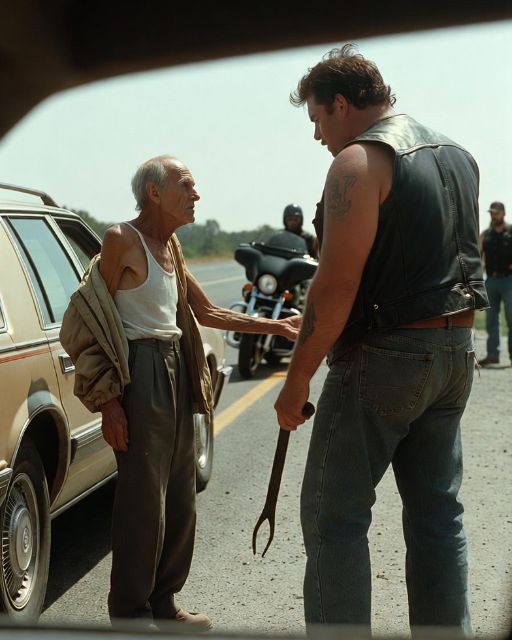
My grandfather, Arthur, is 82. He has Parkinson’s. He spills his coffee if he doesn’t use two hands. We were driving to his checkup when three guys on Harleys cut us off and forced us onto the shoulder. They were big men. Patches. Chains. Beards thick with grease.
One of them, a giant with a scar across his nose, slammed his fist on our hood. “You cut me off, old man! Get out!”
I was dialing 911. I was terrified. But Arthur wasn’t shaking anymore. His hand was steady on the door handle. “Stay here, Bobby,” he said. His voice was different. Cold. Flat.
He stepped out of the Buick. He looked tiny next to them. The leader raised a tire iron. “I’m gonna teach you a lesson.”
Arthur didn’t flinch. He just took off his beige windbreaker. He was wearing a white tank top. The leader swung the iron back to strike, but then he froze mid-swing. His face went pale. He dropped the weapon on the asphalt with a clang. He was staring at the faded, amateur ink on Arthur’s left forearm. It wasn’t a military tattoo. It was the original, “Founding Five” crest of the Iron Sentinels MC.
The air on the highway shoulder went still. The roar of passing cars seemed to fade into a distant hum.
The leader, the one with the scar, just stood there, his mouth slightly open. His two companions, who had been flanking him like wolves, now looked confused. One of them, a wiry man with a long ponytail, took a hesitant step forward. “Grizz? What is it?”
The leader, Grizz, didn’t answer. He just slowly lowered his arm, his eyes locked on the crude tattoo on my grandfather’s arm. It was a simple design: a shield with a single gear in the center, flanked by two pistons. It was faded to a blurry, sea-greenish blue.
He took a step back, then another. He looked from the tattoo to my grandfather’s face, his expression shifting from rage to disbelief, and then to something that looked a lot like awe.
“No way,” Grizz whispered, the sound barely audible over the wind. “It can’t be.”
My grandfather just stood there. The tremors that usually plagued his hands were completely gone. He looked harder, more solid, than I had ever seen him.
“You know the mark,” Arthur said. It wasn’t a question.
Grizz swallowed hard, nodding. “Every chapter knows the mark. We’re taught it. The First Crest.” He looked at his own vest, at the much more elaborate, professionally stitched patch of the same design. “But the originals… they said you were all gone. Dead.”
“Not yet,” Arthur said, his voice as dry as dust.
The other two bikers now understood. Their entire demeanor changed in an instant. The aggression drained out of them, replaced by a nervous energy. They looked at my grandfather like he was a monument that had just stepped out of a history book.
“You’re… you’re one of them,” the wiry one stammered. “The Five.”
Grizz finally found his voice, and it was filled with a respect so deep it was almost fearful. “You’re Anvil,” he said. “Arthur ‘Anvil’ Collins.”
My grandfather gave a slight, almost imperceptible nod. Anvil. I had never heard that name before. It sounded like a name for a different man, from a different lifetime.
Grizz ran a hand over his face, his tough-guy facade completely shattered. “Anvil,” he repeated. “My old man, he rode with the Chicago chapter in the seventies. He used to tell stories about you. Said you could fix any bike with a rock and some twine. Said you once stared down the whole Devils Legion crew by yourself.”
“Your old man told too many stories,” Arthur said flatly, but I saw a flicker of something in his eyes. A memory.
Grizz let out a short, nervous laugh. “Man, I am so sorry. We thought… you swerved a little back there. We thought you were just some old timer not paying attention.”
“I was,” Arthur said. “My grandson was telling me a joke.” He glanced back at me in the car, and for a second, he was just Grandpa again.
“We… we can’t believe it,” Grizz continued, shaking his head. “To meet you. Here. On the side of the road after… after we acted like that.” He looked genuinely ashamed, his face flushed under his beard. “We owe you a profound apology, sir. My name is Frank, they call me Grizz. This is Spike and Tiny.”
Tiny, who was anything but, gave a sheepish wave. Spike just nodded, looking at the ground.
“You wear the patch, you represent the club,” Arthur said, his voice gaining a hard edge. “All of you. Is this what the Sentinels do now? Run old men off the road?”
Grizz’s face fell. “No, sir. It’s not. Things have gotten… different. The new leadership, especially around here. It’s not like the old days. It’s not about the ride anymore.”
Arthur looked at them, a long, searching gaze. He seemed to be weighing them, judging them. He looked at their bikes, then back at their faces. “What’s the chapter president’s name?”
“Breaker,” Grizz said, the name leaving a bad taste in his mouth. “He took over about two years ago. Pushed out the old guard.”
Arthur nodded slowly. “Never heard of him.” He then started to put his windbreaker back on, and as he did, the slightest tremor returned to his hands. The moment was passing. The legend was receding, and my grandpa was coming back.
“Sir, wait,” Grizz said, stepping forward. “Please. Let us make this right. Let us at least escort you where you’re going. Safely. It’s the least we can do.”
I was still sitting in the car, my phone in my hand, the 9-1-1 call never completed. I was watching a scene I couldn’t comprehend. My grandfather, the man who needed help buttering his toast, was being treated with the reverence of a king by three of the most intimidating men I had ever seen.
Arthur looked back at the car, then at the bikers. “We’re going to St. Jude’s Medical Center. For a checkup.”
“We know it,” Grizz said immediately. “We’ll clear a path.”
Arthur gave another slow nod. “Fine.”
He got back into the Buick, and the silence in the car was thick and heavy. He sat in the passenger seat, staring straight ahead. His hands were shaking again, resting in his lap.
“Grandpa?” I finally managed to say. “Who is Anvil?”
He was quiet for a long time as I pulled back onto the highway. True to their word, the three bikers formed a perfect escort around us, one in front, two behind, blocking traffic and waving us through intersections like we were a presidential motorcade.
“Anvil was a young man’s name,” he said finally, his voice soft again, the grandpa-voice I knew. “A man who thought brotherhood was forged in engine grease and asphalt. A man who didn’t have a family yet.”
He told me the story then. How he and four friends, just back from the war and feeling lost, started the Iron Sentinels. It wasn’t about crime or intimidation. It was about freedom. It was about having a family when you felt like you had none. They built bikes, they rode across the country, they lived by a simple code: loyalty to the man riding next to you.
“I was the mechanic,” he said, a faint smile on his lips. “They said I could hammer any piece of junk into a running machine. So they called me Anvil.”
He left it all behind in 1968. He met my grandmother, Eleanor. She saw past the leather and the grease. She saw Arthur. He knew he couldn’t have both worlds. He couldn’t be a husband and a father and still be Anvil. So he walked away from the club. He never rode again.
“I chose a better life, Bobby,” he said, looking at me. “I never, ever regretted it.”
When we got to the hospital, Grizz and his crew parked their bikes and insisted on waiting. They sat in the waiting room, their leather vests looking completely out of place next to the pastel walls and magazines. People gave them a wide berth.
While Grandpa was in with the doctor, my mom called. I stepped into the hallway to talk to her.
“How is he?” she asked, her voice tight with worry.
“He’s okay. We got here fine,” I said, leaving out the part about the biker escort.
“I just got off the phone with the insurance company again,” she sighed, and I could hear the exhaustion in her voice. “They’re refusing to cover the new deep brain stimulation treatment. They’re calling it ‘experimental.’ Bobby, it’s the only thing the doctors think will really help stop the progression. But it costs a fortune.”
My heart sank. We’d been talking about this for months. It was our last, best hope to give Grandpa more good years, to still his hands, to keep him with us.
“How much is it?” I asked, dreading the answer.
“The initial procedure is over fifty thousand dollars,” she said, her voice cracking. “We just… we can’t. I don’t know what we’re going to do.”
I hung up the phone feeling completely helpless. I walked back toward the waiting area and saw Grizz standing just outside the door. He must have heard everything. His face was a mask of grim contemplation.
He looked at me, then at the floor. “The doctor’s appointment,” he said quietly. “It’s for Parkinson’s?”
I just nodded, too defeated to speak.
“And the treatment is expensive,” he stated. It wasn’t a question.
I nodded again.
He clenched his jaw, a muscle twitching in his cheek. He looked through the window at my grandfather, who was now talking to a nurse, looking frail under the fluorescent lights.
“This is not how the founder of the Iron Sentinels should be treated,” he said, his voice a low growl. “Not by the world, and damn sure not by us.” He turned to Spike and Tiny. “We’re calling a chapter meeting. Tonight.”
Later that week, Grizz called our house. He asked if Arthur would be willing to come to their clubhouse. My mom was terrified, but Grandpa agreed without hesitation. He asked me to drive him.
The clubhouse was an old, unmarked warehouse in an industrial part of town. The sound of dozens of motorcycles rumbled from within. When we pulled up, the massive bay door rolled open. The bikers inside parted like the Red Sea as I drove the Buick right into the center of the building.
The place fell silent. At the far end of the room, on a makeshift stage, sat a man with a shaved head and a cruel-looking face. This had to be Breaker. He looked at my grandfather with open contempt.
“So the ghost decides to show his face,” Breaker sneered. “What do you want, old man? Here for a pension?”
Grizz stepped forward. “He’s here because he’s family, Breaker. And we take care of our family.”
“He ain’t family,” Breaker shot back. “He walked out. He’s nothing to us.”
Arthur got out of the car. He moved slowly, his hands trembling. But when he spoke, his voice carried across the entire warehouse.
“I started this club with my brothers,” he said, looking around at the faces staring at him. “We started it because the world had no place for us. We made our own place. We had a code. We protected our own. We didn’t prey on the weak.” He fixed his eyes on Breaker. “And we didn’t run old men off the road.”
A murmur went through the crowd.
Grizz spoke up. “Anvil needs our help. His medical bills… it’s a lot. I say we pass the hat. Not just here, but to every chapter. We start a fund. For one of our own. For one of the First.”
Breaker laughed. A loud, ugly sound. “Are you kidding me? We’re not a charity. We don’t spend our money on has-beens who abandoned the patch. Any money we raise goes back into the club.”
“This is for the club!” Grizz argued. “This is about what we stand for!”
An old biker near the front, his own leather vest worn and faded, spoke up. His voice was gravelly. “I remember the code. The real code. Breaker’s way… it ain’t the Sentinel way.”
More voices joined in, a chorus of agreement. They were the older members, the ones who remembered the stories, who believed in the original purpose.
Breaker saw he was losing the room. His face turned red with fury. He stood up, puffing out his chest. “I am the president of this chapter! What I say goes! We ain’t giving him a dime!”
Then, my grandfather did something I never expected. He walked slowly toward the stage. He stopped right in front of Breaker, looking up at him. The whole room held its breath.
“You’re right,” Arthur said calmly. “You shouldn’t give me a dime.”
He reached up, and with a surprisingly steady hand, he unpinned a small, tarnished silver pin from the inside of his windbreaker. It was a tiny version of the gear from the crest.
“This was my pin. The original Vice President’s pin,” he said, holding it up for all to see. “There are only five like it. One for each founder.” He looked Breaker dead in the eye. “And according to the original bylaws we wrote, any of the Founding Five can call for a vote of no-confidence in any chapter president, at any time.”
The warehouse erupted. Breaker’s face went from red to white. He had broken the new rules, but he had forgotten about the old ones. The very foundation of the club.
Grizz called for the vote. It was almost unanimous. Breaker was out. He stormed off the stage, shouting threats, but no one was listening to him anymore.
In his place, they voted Grizz as the new chapter president. His first act was to start the “Anvil Fund.”
The response was overwhelming. Word spread like wildfire through the national network of the Iron Sentinels. Chapters from California to Maine sent donations. They held charity rides and fundraisers. They saw it not as charity, but as a debt. A chance to honor their own history.
They raised more than three times what was needed for the surgery. The rest was put into a new emergency fund for any member, old or new, who fell on hard times.
My grandfather had the treatment. It wasn’t a cure, but it was a miracle. His tremors subsided. He could hold a coffee cup with one hand. He could work on the old lawnmower engine in his garage. He got a piece of his life back.
He never went back to the clubhouse. He had no desire to be part of that world again. But sometimes, on a Saturday afternoon, Grizz and a few of the other guys would ride over. They wouldn’t stay long. They’d just sit in the garage with Grandpa, talking quietly about engines and old roads, their roaring Harleys parked respectfully on the street next to our Buick.
One evening, we were sitting on the porch, watching the sunset. His hand, resting on the arm of his chair, was almost perfectly still.
“You know, Bobby,” he said quietly, “the strongest thing you can ever build isn’t a motorcycle club or a reputation. It’s the bridges you leave behind.”
I looked at him, confused.
“I walked away from that life,” he explained, “but I tried to do it the right way. I left brothers, not enemies. I chose your grandmother, I chose this family. For decades, I thought that bridge was gone forever. But it was just waiting. Waiting for me to be in need, and for a few good men to remember which way to ride.”
He looked at his own forearm, at the faded blue ink that had changed everything.
“We all carry marks from our past. Tattoos on the skin, scars on the heart. They tell the story of where we’ve been. But they don’t have to decide where we’re going. It’s the choices we make today, the kindness we offer, the family we hold close – that’s the legacy that truly lasts.”