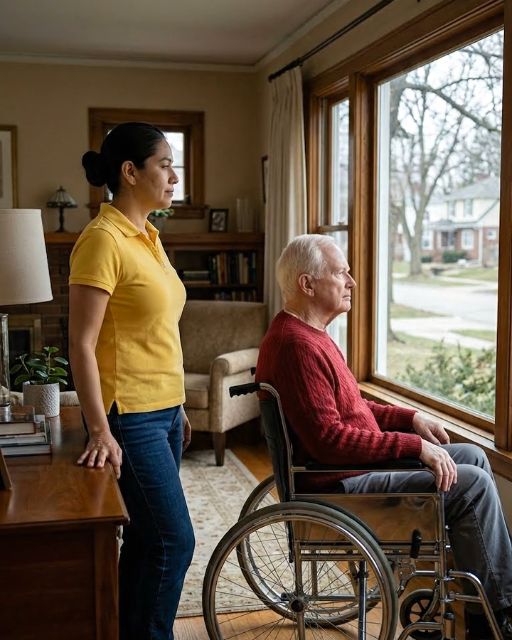
My mother’s lungs finally gave out and she died on a rainy Tuesday morning in a quiet hospital room in Manchester. She had been fighting for air for years, her world slowly shrinking down to the size of an oxygen tank and a recliner. I was the one who sat with her during those long afternoons, listening to the rhythmic hiss of the machine and reading her the local news. When the end came, it was peaceful, but the aftermath was anything but calm.
My sister, Helena, didn’t waste a second after the doctor called the time of death. We were standing in the sterile hospital corridor when she turned on me, her eyes red and her voice sharp enough to cut glass. “She died alone because of you! You lived the closest, Arthur! You were supposed to be there every single night!”
I kept my mouth shut, even though I had been at the hospital until four in the morning and had only gone home to shower. Helena lived three hundred miles away in London and hadn’t visited in six months, citing her busy career in public relations. I knew that her anger was just a shield for her own guilt, a way to move the heavy weight of regret onto my shoulders. I didn’t argue because my mother hated bickering, and I wanted to honor her memory with a bit of dignity.
The funeral was a somber affair, filled with distant cousins and neighbors who remembered my mother’s famous sponge cakes. Helena played the part of the grieving, perfect daughter to a T, accepting condolences with a graceful tilt of her head. I stood in the background, handling the logistics and making sure the wake had enough tea and sandwiches. I felt like a stranger in my own life, watching my sister perform a role while I carried the actual grief in the pit of my stomach.
A week later, we found ourselves in a small, wood-paneled office in the city center for the reading of the will. Helena was dressed in designer black, her posture rigid and expectant, likely already calculating the value of the family home. I sat across from her, wearing my only suit, feeling exhausted and ready for the whole ordeal to be over. Our family lawyer, Mr. Sterling, looked over his spectacles with a weary expression that suggested he had seen many families fall apart in this very room.
At the inheritance reading, the lawyer handed the entire estate to me, including the house, the savings, and the small plot of land in the countryside. The room went dead silent for a heartbeat, the kind of silence that feels heavy and pressurized. My sister lost it, standing up so quickly her chair scraped loudly against the floorboards. She began shouting, “This is a scam! You manipulated her in her final days! I’m the one who achieved things, and you’re just a local failure who hovered around her for a paycheck!”
Helena’s voice rose to a scream as she accused me of elder abuse and brainwashing, claiming that our mother wasn’t in her right mind when she signed the documents. Mr. Sterling cleared his throat loudly and held up a hand, silencing her with a look of stern authority. He reached into a manila folder and pulled out a handwritten letter, sealed with a familiar wax stamp my mother had used for years. “There is an addendum,” he said quietly. “Your mother asked that I read this only if Helena reacted this way.”
As the lawyer began to read my mother’s words, the atmosphere in the room changed from hostile to hauntingly still. My mother wrote about how she knew Helena would be angry, and she explained that the “inheritance” wasn’t a reward for me or a punishment for her. She revealed that years ago, she had discovered Helena had been secretly taking money from her accounts through a shared digital login. Helena had used the money to fund her “perfect” life in London, thinking our mother was too old to notice the slow drain of her savings.
I looked at my sister, and the blood had completely drained from her face; she sank back into her chair, her designer bag sliding to the floor. My mother had known all along, but she hadn’t confronted Helena because she didn’t want to lose her daughter entirely. She had balanced the books in her will, ensuring that the total amount Helena had already “borrowed” was roughly equivalent to her half of the estate. The house and the remaining funds were mine simply because I was the only one who hadn’t already taken them.
But the letter didn’t stop there, and this was the part that made my own eyes fill with tears. My mother wrote that she had kept a second set of records, a diary of every time I had come over to fix a leak, bring her groceries, or just sit and watch the birds. She knew I had turned down a promotion in Leeds so I could stay nearby and keep an eye on her health. She didn’t give me the house because I lived the closest; she gave it to me because she saw the sacrifices I made when I thought no one was looking.
The rewarding part of the conclusion wasn’t the property or the money, though that was a relief after years of struggling. It was the realization that my mother had truly seen me, even when I felt invisible in my sister’s shadow. She had protected me from Helena’s greed without ever making me feel like I was a part of a scheme. I felt a profound sense of peace, knowing that the “silence” I had kept during Helena’s outbursts was exactly what my mother had expected of me.
Helena didn’t say another word; she didn’t even try to fight the will after that. She knew that if she went to court, the evidence of her theft would become public record and ruin the reputation she had worked so hard to build. She left the office without looking at me, her heels clicking a fast, frantic rhythm down the hallway. I stayed behind for a moment, talking to Mr. Sterling about the next steps and the logistics of keeping the family home.
A few months later, I moved back into the house where we had grown up, the halls finally quiet and free of the hiss of oxygen tanks. I found a small box in the back of my mother’s closet that wasn’t mentioned in the will, filled with old photos and a single gold watch. There was a small note inside that said, “For the son who gave me his time, here is the only thing I have left of it.” I realized that the true inheritance wasn’t the bricks and mortar, but the memories of those quiet afternoons in the recliner.
I eventually reached out to Helena, not to gloat, but to offer her a chance to talk without the shadow of the money hanging over us. She wasn’t ready to apologize, and maybe she never will be, but we’ve started sending the occasional text on birthdays. I learned that you can’t force someone to be grateful, and you can’t make them see the truth if they aren’t willing to look at themselves. My job was to be the son my mother needed, and I did that until her very last breath.
The house is full of life now; I’ve started a small woodworking business in the garage, and the garden is blooming with the peonies my mother loved so much. I often think about that day in the lawyer’s office and how close I came to snapping back at my sister’s insults. I’m glad I kept my mouth shut, because the truth doesn’t need to be shouted to be powerful. It just needs to be lived, day after day, in the quiet choices we make for the people we love.
We often think that the loud, successful people are the ones who “win” at life, but real victory is much quieter than that. It’s found in the integrity of staying when things get hard and the kindness of helping when there’s nothing in it for you. My mother taught me that being “the closest” isn’t about geography; it’s about the heart. I’m proud to be the one who stayed, and I’m proud of the home I’ve built on a foundation of honesty.
Life has a way of balancing the scales if you give it enough time. You don’t always have to defend yourself against every lie or every accusation, especially when you know you’ve done the right thing. Character is what you do in the dark, and eventually, the light always finds a way in. I miss my mother every day, but I feel her presence in every corner of this house, reminding me that love is the only thing that actually lasts.
If this story reminded you that your quiet sacrifices are seen even when you feel invisible, please share and like this post. We all have a “Helena” in our lives sometimes, and we all need a reminder to keep our heads held high. I’d love to hear about the people in your life who have seen your true heart—would you like me to help you write a message of appreciation to someone who has always been there for you?