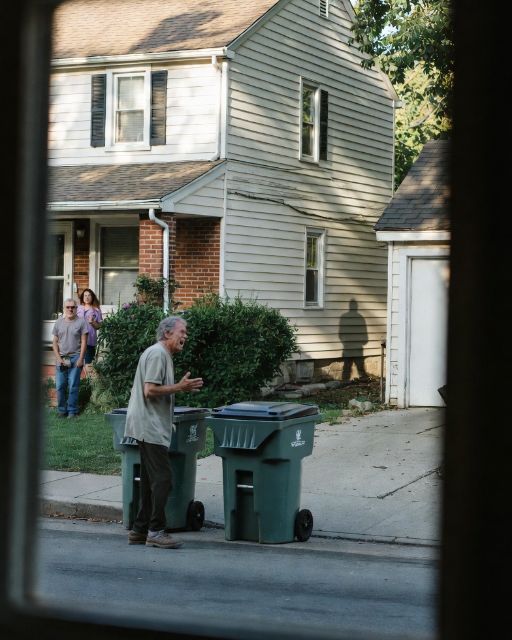
For six months, Mr. Peterson was the bane of my life. He’d call the town office if our grass was two inches too long. He’d glare from his window if my wife, Brenda, played music in the garden. He was a bitter, lonely old man. Last Tuesday was the breaking point. I left the garbage bins by the curb for an extra hour after pickup. He stormed onto our lawn.
“Get them in!” he screamed, his face turning red. “Are you lazy or just stupid? Put them away NOW!”
I had enough. I called the cops to file a harassment report. They showed up an hour later. They were calm, but they took my statement. They went next door to talk to Mr. Peterson. I watched from my window, expecting them to cuff him. Instead, they stayed for nearly thirty minutes.
When one of the officers came back, he looked pale. He didn’t have a report in his hand. He had his laptop.
“Sir,” he said, “we reviewed your neighbor’s security footage. He wasn’t mad about your trash cans. He was yelling to make a scene. He was trying to get your wife’s attention because he saw this man hiding behind your rhododendron bush.”
The officer turned the laptop toward me. The screen showed a grainy, black-and-white image from a camera mounted on Mr. Peterson’s house. It was aimed directly at the side of my home.
My heart hammered against my ribs.
The timestamp in the corner of the screen matched the time of Mr. Peterson’s outburst. There, nestled in the thick leaves of the bush beside our back door, was the unmistakable shape of a person.
He was crouched down, almost completely hidden from the street.
The officer zoomed in. The man was wearing a dark hoodie, and his face was mostly obscured. But I could see his eyes, fixed intently on our kitchen window where Brenda was washing dishes just moments before.
“Mr. Peterson saw him sneak into your yard about ten minutes before he came over,” the officer continued. “He knew that if he just called 911, the man might hear him and do something rash. Or he’d just run off, and we’d never catch him.”
So he created a distraction. A big, loud, angry distraction.
The footage played on. I saw Mr. Peterson storming into my yard, waving his arms and shouting about the garbage bins. His voice was a roar. In the corner of the screen, the figure behind the bush flinched. He looked confused, then annoyed.
He clearly wasn’t expecting an old man to start a war over residential waste management.
A few seconds later, my own front door opened. I stepped out, my face a mask of fury, and started yelling back at my neighbor.
The hidden man peered around the bush, saw us both occupied, and used the opportunity. He slipped out from behind the plant and scurried back the way he came, disappearing behind my garage.
He was gone before the first police car even turned onto our street.
A wave of nausea washed over me. The blood drained from my face. I had been so wrapped up in my own petty anger that I had been completely blind to the real danger.
My wife. Brenda had been right there.
“The man,” I stammered, my voice barely a whisper. “Did you… did you get him?”
The officer shook his head. “Not yet. He was gone when we arrived. But Mr. Peterson’s camera got a decent shot of his face as he was leaving. We’re running it through the system now.”
I just stood there, staring at the screen. At the ghost that had been hiding in my yard.
The officer closed his laptop. “Your neighbor saved her, sir. He might be a pain about the lawn, but he was looking out for you.”
The weight of my own stupidity felt like a physical blow. I had called the police on the man who had just protected my wife from an unknown threat.
I thanked the officer, my mind a complete blur. He nodded and left, leaving me alone on my porch with the silence and my shame.
I went back inside, my legs feeling like lead. Brenda was in the living room, reading a book, oblivious.
She looked up and smiled. “Is everything sorted? Did they give that old grump a warning?”
I couldn’t speak for a moment. I just walked over and pulled her into a hug, holding her so tightly she grunted in surprise.
“What’s wrong?” she asked, her voice muffled against my chest. “You’re trembling.”
I led her to the couch and told her everything. I explained what the officer said, what the video showed. I watched as her smile faded, replaced by a look of sheer terror.
Her hand flew to her mouth. “Oh my god. I was right there. I was at the sink.”
We sat in stunned silence for what felt like an eternity. The comfortable safety of our home felt shattered.
Then Brenda looked at me, her eyes wide. “Mr. Peterson,” she whispered. “He did that… for me?”
I nodded, the shame burning in my throat. “And I called the cops on him.”
I knew what I had to do. It was the hardest, most humbling thing I’d ever had to do in my life.
I walked out my front door and across the perfectly manicured lawn that separated our two houses. I raised my hand to knock on his door, then hesitated. What could I possibly say?
Before my knuckles could touch the wood, the door creaked open. Mr. Peterson stood there, looking just as frail and cantankerous as ever. He had a glass of iced tea in his hand.
He just stared at me with his pale, watery blue eyes.
“I…” I started, my voice cracking. “I saw the video.”
He didn’t say anything. He just took a slow sip of his tea.
“Mr. Peterson, I am so sorry,” I finally managed to get out. “I was a fool. A complete and utter fool. You were trying to help us, and I treated you like a criminal.”
The words felt inadequate. Pathetic.
He continued to stare, his expression unreadable. For a second, I thought he was going to slam the door in my face. I deserved it.
Instead, he let out a long, slow sigh. “Your wife,” he said, his voice raspy. “Is she alright?”
“She’s fine,” I said quickly. “Shaken up, but she’s fine. Thanks to you.”
He nodded once, a short, sharp movement. “Good.”
An awkward silence stretched between us. I needed to say more, to make him understand how grateful I was, how ashamed I felt.
“I don’t know how to thank you,” I said. “You saved her life. Or… you saved her from something terrible, at least.”
He looked away then, his gaze drifting over my shoulder toward my house. “Just keep your bins off the curb,” he mumbled.
It was such a typical Mr. Peterson thing to say that I almost laughed. But there was no humor in his eyes. Only a deep, profound sadness.
“Can I ask you something?” I asked, feeling bold. “Why do you watch so closely? The cameras, the grass… everything.”
He was silent for a long time, looking at a spot on his porch only he could see. I thought he was going to ignore me.
“I had a daughter,” he said finally, his voice so quiet I had to lean in to hear it. “Her name was Sarah.”
He spoke of her in the past tense. My heart sank.
“She was a lot like your Brenda,” he continued, a faint, ghost of a smile touching his lips. “Full of life. Loved to play her music too loud in the garden.”
He paused, taking another sip of tea to wet his throat.
“She had a boyfriend in college. A charming boy, I thought. But he wasn’t. He was controlling. Jealous. When she finally got the courage to leave him, he wouldn’t let her go.”
A cold dread crept up my spine. I knew where this was going.
“She would call me, tell me she thought he was following her. That she saw his car on her street. I told her she was being paranoid. I told her she was overreacting. I was busy with work. Too busy to listen.”
He stopped, and I saw his hand tremble slightly as he held his glass.
“One night, he broke into her apartment. He was hiding in the closet, waiting for her. She had been home for over an hour before he…”
He couldn’t finish the sentence. He didn’t have to. The grief in his eyes told the rest of the story.
“The police said if a neighbor had just noticed the broken window screen… if someone had just seen him lurking around… maybe it would have been different,” he whispered. “I wasn’t there to watch out for her. I failed her.”
Tears were now openly streaming down my face. This man wasn’t a monster. He was a father trapped in an endless loop of grief and regret.
“So I watch,” he said, his gaze finally meeting mine again. It was fierce, determined. “I watch for broken screens. I watch for strange cars. I watch for men hiding in bushes. I won’t let it happen again. Not on my street. Not on my watch.”
My perception of the world, of this man, of my entire neighborhood, shifted on its axis. Every complaint about the grass, every glare from his window, every angry phone call to the town office – it wasn’t about bitterness.
It was about vigilance. It was penance. It was his way of protecting the daughter he couldn’t save by protecting someone else’s.
“Arthur,” I said, using his first name for the very first time. “My name is Tom.”
I extended my hand. He looked at it for a moment before placing his own fragile, bony hand in mine and giving it a firm shake.
“I know,” he said.
Later that evening, the police called. They had identified the man from Arthur’s footage. His name was Daniel.
He was Brenda’s ex-boyfriend from over a decade ago. The one she had moved across the country to escape. The one she still had nightmares about.
He had a history of stalking and a restraining order from two other women. He must have spent years trying to find her. The police found a bag in his car containing rope, duct tape, and a knife.
My blood ran cold. Arthur Peterson hadn’t just saved Brenda from a scare. He had saved her from a nightmare I couldn’t even begin to comprehend.
The next day, Brenda baked a lemon cake, Arthur’s favorite, though we didn’t know it at the time. She carried it over to his house herself.
I watched from our window as she stood on his porch, talking to him. After a few minutes, he gave a small, hesitant smile and invited her inside.
That was the beginning of the change.
Slowly, tentatively, Arthur became a part of our lives. We started small. We’d invite him over for dinner once a week. Brenda would take him a plate of whatever she was baking.
I started helping him with his yard work. We’d mow our lawns at the same time, the roar of the engines a strange sort of shared conversation. I learned that he had a bad back, and that he secretly loved the vibrant, chaotic look of Brenda’s flower garden.
He started to soften. The hard, angry shell he had built around himself began to crack. We saw glimpses of the man he must have been before his world fell apart.
He told us stories about Sarah. How she wanted to be a veterinarian. How she had a laugh that could fill a room. In our living room, surrounded by pictures of our own family, he was finally able to let his daughter live again, if only in memory.
In return, he looked out for us. He became our guardian angel, a silent protector perched in the house next door. His constant vigilance no longer felt intrusive. It felt like a shield.
One Saturday, about a year after that terrible day, we were having a barbecue in the backyard. My brother and his kids were over, and the yard was filled with laughter and the smell of grilled hot dogs.
I looked over and saw Arthur sitting in a lawn chair, a plate of food on his lap. He was talking to Brenda, and he was genuinely smiling. A real, deep, happy smile.
He wasn’t the bitter old man from next door anymore. He was our friend. He was our family.
He caught my eye from across the yard and raised his glass of iced tea in a small salute. I smiled and raised my own can of soda in return.
In that quiet moment, a profound truth settled over me. We live our lives surrounded by walls, both physical and emotional. We judge our neighbors by the length of their grass or the placement of their trash cans, never stopping to think about the battles they might be fighting on the other side of the fence.
We assume the worst, when sometimes, the truth is something so deeply human and heartbreaking it would bring us to our knees. Arthur’s anger was just his grief wearing a disguise. His obsession was his love with nowhere else to go.
He had lost his own daughter because he wasn’t looking. So he spent the rest of his life looking out for ours. And in the process of saving us, I think, in a small way, we helped save him, too. We gave his vigilance a new purpose, and his lonely heart a new home.
Life’s greatest lessons often come from the most unexpected teachers. And sometimes, the most important thing you can do is look past the angry shouts and see the terrified, loving heart hiding just beneath the surface.