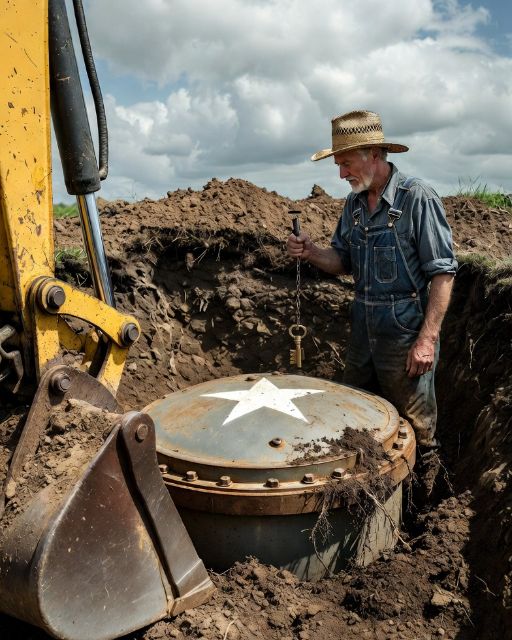
My wife, Carol, and I bought the farm for a song. The old man who worked the land, a guy named Earl, was part of the deal. He mostly just stared at the fields. We’d joke about him. Last week, we decided to put in a pool. Earl came shuffling over. “Not there,” he said, pointing at the spot we’d marked out. “Bad soil.”
We laughed him off. What did this old dirt-kicker know about anything? The backhoe started digging. Five feet down, it hit solid metal with a deafening clang. We all stopped. The operator scraped away the dirt. It wasn’t a rock or an old tank. It was a massive steel hatch, with a faded military star painted on it.
Earl walked over, his face grim. He pulled a key from around his neck – a key I’d never seen before. He looked at me, not with the dull eyes of a farmer, but with an authority that chilled my blood. “You weren’t supposed to find this,” he said, unlocking the hatch. “This farm isn’t for crops. It’s the lid for…”
He trailed off, his jaw working as he turned the key. There was a heavy, grinding click that seemed to echo up from the center of the Earth. A hiss of compressed air escaped from the edges of the hatch, smelling of stale, cold dust and something else. It smelled like time itself.
Carol grabbed my arm, her knuckles white. The backhoe operator had already killed the engine and was slowly backing away, his eyes as wide as dinner plates.
“The lid for what, Earl?” I asked, my voice barely a whisper. My earlier arrogance felt like a lifetime ago. It had evaporated in the face of this impossible reality.
Earl grunted, putting his shoulder into the heavy steel. He motioned for me to help. Together, we strained, and the hatch groaned open, revealing a steep metal ladder descending into absolute blackness.
“It’s the lid for Project Last Light,” Earl said, his voice low and flat. “Or what’s left of it.”
He flicked a heavy-duty switch on the wall just inside the opening. A string of bare, caged bulbs flickered to life down the shaft, illuminating a descent that seemed to go on forever. The air that rose up was cold, sterile, and utterly still.
“What is… what was Project Last Light?” Carol asked, her voice trembling slightly.
Earl looked at her, and for the first time, I saw a flicker of something other than duty in his eyes. It might have been sadness. “It was a place for people to hide when the world ended. A command and control bunker. One of dozens built in the fifties and sixties.”
My mind reeled. A Cold War bunker. Here. Under the spot where I was going to put a swimming pool with a little waterfall feature. The absurdity of it was staggering.
“Come on,” Earl said, already swinging a leg onto the ladder. “You started this. You might as well see it.”
Carol and I exchanged a look of pure disbelief, but we followed. We had to. The ladder was cold to the touch, the metal rungs vibrating slightly with a low, deep hum from somewhere far below. The descent took minutes. The air grew colder, the smell of ozone and old electronics getting stronger with every step down.
We finally reached a solid concrete floor. We were in a small, reinforced entryway with another thick steel door. Earl produced a different key, a more intricate one, and opened it.
The space beyond was like a museum of a forgotten apocalypse. It was a sprawling complex. A central command room was dominated by a huge map of the United States, dotted with lights that were now dark. Heavy, archaic computers with green monochrome screens lined one wall. Desks with rotary phones and empty coffee cups sat as if their occupants had just stepped out for a cigarette fifty years ago.
“This place was built to withstand a direct nuclear hit,” Earl explained, his voice echoing in the cavernous silence. “It has its own power, its own water from a deep-earth aquifer, and enough supplies to keep two hundred people alive for ten years.”
We walked through the complex in a daze. We saw the dormitories with their neat, military-style bunks. We saw the mess hall, with its gleaming stainless-steel kitchen. We saw the infirmary, stocked with medical supplies that had long since expired. It was a ghost town, built for ghosts that never arrived.
“Why are you here, Earl?” I finally asked, looking at the immense weight of this place. “Did they just… forget about it?”
“Almost,” he said, running a hand over the back of a dusty chair. “I was stationed here in ’82. Airman First Class. Just a kid. My job was communications. Listened to the silence, mostly.”
He paused, his gaze lost in the past.
“When the Cold War thawed, sites like this were decommissioned. They were expensive to maintain. Most were stripped and sealed. But this one… this one was different.”
He led us to a smaller, secondary room off the main command center. It was a laboratory of some kind, but it was different from the rest of the bunker. The equipment was newer, from the nineties, maybe early 2000s. There were soil sample kits and charts detailing plant genetics.
“The government started a new project here in the late eighties. A quiet one,” Earl continued. “They realized the next great war might not be fought with bombs, but with famine. They wanted to create a repository. A seed vault. Like the one in Norway, but secret. A backup for the backup.”
He pointed to rows of temperature-controlled containers. “They gathered seeds from all over the world. Heirloom varieties, hardy strains, plants that were on the brink of extinction. The plan was to use the bunker’s resources – the stable environment, the power, the water – to preserve them indefinitely.”
Carol stepped closer, peering through a small window on one of the containers. “It’s incredible,” she whispered.
“It was,” Earl said, and the sadness in his voice was palpable now. “But then budgets were cut again. The program was officially shuttered in ’98. The scientists were reassigned. The trucks came and took most of the important equipment.”
“So they abandoned this, too?” I asked, a sense of profound waste settling over me.
“They tried to,” Earl said, a stubborn glint in his eye. “They offered me a transfer. An honorable discharge. I was the last man on site. They were just going to pour concrete down the shaft and bury it forever.”
He looked from me to Carol, his expression making it clear this was the most important part of the story.
“I’d spent sixteen years of my life down here. First watching for missiles, then watching over these seeds. I grew up in Nebraska. My grandparents lost their farm in the Dust Bowl. I’ve seen what happens when the land gives up on you.”
He took a deep breath.
“So I made them a deal. I told them I’d stay. I’d officially resign my commission but stay on as an unofficial caretaker. No pay, just the small pension I’d earned and the right to live in the old farmhouse up top. They saw it as a way to save on demolition costs. They agreed. They shut off the main power grid, turned out the lights, and left me the keys.”
The full weight of his life hit me like a physical blow. For over twenty years, this man, this quiet old farmer we’d mocked, had been the solitary guardian of a dead project. He wasn’t just staring at fields; he was standing watch.
“But… the lights are on,” Carol said softly, gesturing to the humming fluorescent tubes overhead.
Earl finally smiled. It was a small, tired, but genuine smile. “They shut off the main grid. But they never decommissioned the geothermal generator that taps into the heat from the Earth’s core. It doesn’t produce much, but it’s enough. Enough for the essentials.”
My mind was still trying to process it all. The history, the sacrifice, the sheer loneliness of it. But one thing still didn’t add up.
“Earl,” I said slowly, “why did you tell us not to dig? You said it was ‘bad soil’.”
His smile widened a little. He beckoned for us to follow him back towards the ladder. “Come on up. The tour’s not over yet.”
We climbed back into the late afternoon sun, blinking as our eyes readjusted. The world seemed different now. The rustling leaves, the smell of the grass, it all felt more precious, more fragile.
Earl didn’t lead us back to the house. He walked past the gaping hole in our lawn, past the silent backhoe, and out towards one of the fields. It was a field of corn, like any other in the region, its stalks rustling in the breeze.
We thought he was just showing us his crop. I was about to say something about how healthy it looked. But then he parted the stalks.
Hidden in the center of the cornfield was another operation entirely. It was a series of meticulously maintained greenhouse tunnels. Inside, plants I’d never seen before were growing. Strange-looking grains with deep purple husks, tomatoes that grew in tight, spiraling clusters, potatoes that were a brilliant blue.
It was a secret garden. A vibrant, thriving, impossible garden.
“You see,” Earl began, his voice filled with a quiet pride I’d never heard before, “they took the scientists and the fancy equipment. But they forgot about two things. Me, and a few sample cases of the most promising seeds.”
He pointed to the bizarre-looking grain. “This is a strain of sorghum from the Ethiopian highlands. I’ve been cross-breeding it with a local millet. It can grow with a third of the water and has twice the protein. The government’s project was about preservation. Just keeping things on ice. That seemed like a waste to me.”
He gestured to the other plants.
“This whole time, I haven’t just been a caretaker. I’ve been continuing the work. I’ve been using the bunker’s geothermal power to run the pumps for my well and the heaters in these greenhouses. I’ve been using the old lab equipment to analyze the soil, to track the genetic markers.”
The twist wasn’t the bunker itself. The bunker was just the tool. The twist was Earl. He hadn’t been guarding a tomb. He’d been using a forgotten sword to plow a new kind of field.
“The ‘bad soil’ comment,” he said, looking at me directly. “The ground above the hatch is packed with clay and gravel to help with drainage for the bunker. Nothing grows there. It was the truth. It just wasn’t the whole truth.”
I looked at Carol. Her eyes were shining with tears. We had been so smug, so dismissive. We had planned to pave over a piece of this land for our own fleeting pleasure, while this man had been using it to try and save the world, one seed at a time. The shame was overwhelming.
“Why didn’t you tell anyone?” Carol asked. “You could have gotten grants, funding…”
Earl shook his head. “To who? A government that forgot I existed? Big agricultural companies that would patent my work and sell it back to the farmers who need it most? No. This is better. Slow. Quiet. I send the seeds, for free, to small farming co-ops in struggling areas. I just label them as ‘experimental hybrids’. They don’t know where they come from. They just know they work.”
He had created an underground railroad of life, powered by a relic of war and his own unyielding dedication.
That night, Carol and I sat on our porch, the plans for the pool lying on the table between us. They looked ridiculous now, a monument to our own ignorance.
The next morning, I found Earl by his greenhouses.
“The backhoe operator is coming back today,” I said. “I’m going to have him fill in the hole.”
Earl just nodded, tending to a vine.
“And then,” I continued, my voice catching a little, “I was wondering if he could help you dig a new irrigation trench for this field. And Carol has been looking into solar panels. We think we could supplement the geothermal and get your main lab back up and running.”
Earl stopped what he was doing. He slowly turned to look at me, his weathered face unreadable. He studied me for a long moment, and I felt like I was being weighed and measured.
Then, he nodded again, a slow, deliberate motion. “The soil is good over there,” he said, pointing to a patch of land nearby. “That’s a fine place to start.”
We never built our pool. Instead, we built a new life. We invested our savings not in landscaping and leisure, but in Earl’s project. Carol, with her background in marketing, built a network to distribute the seeds more widely, always under the guise of an anonymous foundation. I learned more about soil composition and crop rotation in one year than I had learned in a decade behind a desk.
We found that the farm wasn’t just a piece of property. It was a purpose. Earl had been its guardian, and now he was our teacher. We learned that the greatest things aren’t always loud and impressive. Sometimes they are as quiet as a seed in the earth, waiting for the right time to grow.
We thought we were buying a simple farm for a quiet life. But we had stumbled upon a legacy. And in helping to cultivate Earl’s secret garden, we ended up cultivating the best parts of ourselves. The real treasure wasn’t buried under a steel hatch, but was growing all around us, in the rich, dark soil we had once been too blind to truly see.