“That is MY property!” Sherry shrieked, pointing a trembling finger at the new fence post. “You are three feet over the line, and I will sue you into the ground!”
This had been going on for a month.
I bought the house, put up a fence for my dog, and she instantly became the neighbor from hell.
I showed her the original plot map.
She tore it up.
Finally, I paid $2,000 for an official land survey, just to shut her up.
The surveyor came out, did his work, and confirmed it: my fence was perfectly on my property.
I couldn’t wait to shove the report in her face.
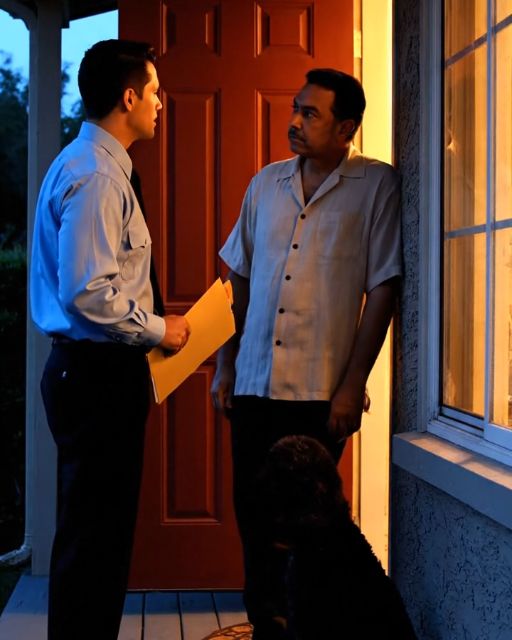
But that evening, the surveyor knocked on my door.
He looked pale.
“Mr. Gable,” he said, “The property line is correct. But when I did the title search… I found this.”
He handed me a brittle, yellowed document from 1957.
An easement.
I thought it was about a shared driveway.
But I read the first sentence, and my blood ran cold.
Sherry wasn’t trying to gain three feet of land.
She was trying to stop me from ever discovering that my entire backyard was technically a public right-of-way.
The document was an “Easement of Passage” granted to the descendants of the original landowners, the Miller family.
It stipulated that they, and by extension the public, had the right to cross my property to access a “site of historical town interest.”
The surveyor, a kind man named David, pointed to a faded, hand-drawn map on the second page.
There, right in the middle of where my dog was currently chasing a squirrel, was a small “X”.
It was marked “Miller’s Spring.”
“I’ve never heard of it,” David admitted. “But this document is legally binding. It was filed with the county. Your title insurance should have caught this, Mr. Gable.”
My head was spinning.
A public path through my backyard?
That meant anyone could just walk through, anytime they wanted.
Suddenly, Sherry’s behavior made a terrifying kind of sense.
Her fight over the three feet of fence wasn’t about the land itself.
It was a distraction.
She was trying to bully me, to make me so focused on that small dispute that I’d never look into the larger property records.
She didn’t want the land.
She wanted to keep the secret buried.
The next morning, I walked over to her house, surveyor’s report and easement in hand.
I was ready for a fight, but I was determined to be calm.
Sherry opened the door before I could even knock, a smug look on her face.
“Come to apologize and move your fence?” she sneered.
I held up the easement document.
“I know what this is about, Sherry. It’s not about the fence, is it? It’s about Miller’s Spring.”
The color drained from her face.
For a split second, I saw raw panic in her eyes.
Then, it was replaced by a cold, triumphant fury.
“So you found it,” she hissed. “Took you long enough. That easement has been dormant for fifty years. Nobody remembers.”
“But it’s still valid,” I said, my voice shaking slightly. “Why didn’t you just say something?”
She let out a harsh, barking laugh.
“And have the whole town trampling through here? I don’t think so. My family, the Comptons, have lived next to this property for generations. We’ve enjoyed the peace and quiet.”
“So your plan was just to threaten every new owner?” I asked, incredulous.
“The last owner was a sweet old lady who never questioned a thing. You were different. You had to go and dig,” she spat, her eyes narrowing. “But you’ve made a mistake, Mr. Gable. You’ve woken the sleeping giant.”
She slammed the door in my face.
I walked back to my house feeling sick.
This was so much worse than a simple property dispute.
I called a lawyer my friend recommended, a sharp woman named Meredith.
I explained the whole situation over the phone.
She was quiet for a long time after I finished.
“This is messy, Mr. Gable,” she finally said. “Easements are notoriously difficult to dissolve. Especially ones tied to historical sites.”
“But there’s nothing there!” I protested. “It’s just grass. My dog’s favorite spot to nap.”
“The document says there is. We need to find out what Miller’s Spring was, and if it still exists,” she advised. “Go to the town archives. See what you can find. The more we know, the better our chances.”
The next day, I took a half-day off work and went to the town hall.
The archives were in a dusty basement, managed by a wonderfully kind and ancient man named Arthur.
He had spectacles perched on the end of his nose and a passion for local history that was infectious.
I showed him the easement.
His eyes lit up with recognition.
“Miller’s Spring! My goodness, I haven’t heard that name in decades,” he exclaimed, shuffling over to a large filing cabinet.
He pulled out a thick, leather-bound book filled with old photographs.
He licked his thumb and carefully turned the brittle pages.
Finally, he stopped and pointed.
It was a black and white photo from the 1920s.
A group of people were gathered around a small, stone-lined well in a field.
Behind them, I could just make out the roofline of a house.
My house.
“The spring was said to have the purest water in the county,” Arthur explained. “The Miller family allowed the whole town to use it, free of charge. They were pillars of the community.”
“What happened to it?” I asked.
“Well,” he sighed, “the town grew. We got municipal water in the late fifties. The well was capped for safety reasons. People just… forgot about it.”
He looked at the easement again, his brow furrowed in thought.
“And Sherry… her last name is Compton?”
I nodded.
Arthur let out a low whistle.
“Ah. Now that is interesting. The Comptons and the Millers had a bit of a rivalry, you see. A famous one.”
He told me a story about how Sherry’s great-grandfather, a man named Jedediah Compton, had tried to buy the land from the Millers.
He wanted to commercialize the spring, bottle the water, and sell it.
The Millers refused.
They believed the water was a gift for everyone, not something to be profited from.
Jedediah Compton was furious and held a grudge that was passed down through the generations.
A piece of the puzzle clicked into place.
This wasn’t just about peace and quiet for Sherry.
It was about an old family feud.
It was about control.
Over the next few weeks, Sherry escalated her campaign of terror.
She’d stand at her window and glare at me whenever I was in my yard.
She reported me to the city for my grass being two inches too long.
She called the non-emergency police line complaining my dog’s barking was a public nuisance.
Each time, the complaint was dismissed, but the stress was immense.
It felt like I was under siege in my own home.
Meredith, my lawyer, was filing motions, but the wheels of justice were turning slowly.
The easement was old but legally sound on its face.
Our only hope, she said, was to prove that the purpose of the easement no longer existed.
We had to prove the spring was gone, not just capped.
We got a court order to bring in a ground-penetrating radar team.
The day they arrived, Sherry stood on her porch, arms crossed, a smirk on her face.
The technicians scanned my backyard for hours.
Finally, they came to me with the results.
The good news was they found the old stone well, right where the “X” was on the map, buried about four feet down.
The bad news was the radar also detected a significant water source still feeding into it.
The spring wasn’t gone. It was very much alive.
Sherry’s smirk widened into a triumphant grin.
I felt defeated.
Meredith told me our case was now significantly weaker.
We could argue it was a private well, but the historical documents Arthur found clearly called it a public resource.
It looked like I was going to have a permanent path through my backyard.
That night, I couldn’t sleep.
I went back to the archives to see Arthur.
I just needed to talk to someone who understood the history of this whole mess.
I told him about the radar results.
He looked thoughtful, not defeated.
“You know,” he said, tapping a long finger on his chin. “That feud between the Comptons and the Millers… it got very nasty after the bottling plan fell through.”
“Jedediah Compton accused the Millers of all sorts of things. He even challenged the original land grant.”
My ears perked up. “What happened?”
“He lost, of course. The Miller grant was ironclad,” Arthur said. “But in my research, I remember seeing a follow-up filing. A few years after the big fight, and right around the time the town got municipal water.”
He started pulling out massive, dusty plat books from the late 1950s.
We spent hours poring over deeds, transfers, and amendments.
My eyes were blurry from reading the dense, cursive script.
And then we found it.
It wasn’t a big, flashy document like the first easement.
It was a small, single-page addendum, filed in 1958.
It was titled “Agreement of Termination.”
My heart started pounding.
The document stated that with the arrival of the town’s water system, the Miller family, in an act of civic cooperation, agreed to terminate the public’s right of passage to the spring.
In exchange, the town agreed to reduce the family’s property taxes for the next 20 years.
The easement was legally dissolved.
Over sixty years ago.
It was signed by the last living Miller descendant and the town mayor at the time.
“It was never about public access,” I whispered, the pieces slamming together. “It was a tax break.”
“And when the 20 years were up, everyone had forgotten,” Arthur finished, his eyes wide. “The original easement was famous, a piece of folklore. This termination agreement? It was just boring paperwork. It got lost in the shuffle.”
I felt a surge of adrenaline so powerful my hands were shaking.
Sherry didn’t know.
Or if she did, she was betting no one would ever find this.
She was relying on the old, famous document to bully me, while the quiet, boring one that nullified it sat collecting dust.
The final court hearing was scheduled for the following week.
Sherry was there with her lawyer, looking supremely confident.
She had submitted the 1957 easement as her primary evidence.
Her lawyer argued that Mr. Gable was attempting to block public access to a historical landmark.
He painted Sherry as a concerned citizen, a guardian of the town’s history.
When it was Meredith’s turn, she stood up calmly.
“Your Honor,” she began, “the plaintiff has based her entire case on this document, the 1957 Easement of Passage.”
She held up a copy.
“However, she seems to have overlooked this.”
She then presented the judge with a certified copy of the 1958 “Agreement of Termination.”
There was a stunned silence in the courtroom.
Sherry’s lawyer snatched the paper and his face went white as he read it.
He leaned over and whispered furiously to Sherry.
I saw the exact moment her smug confidence shattered and was replaced by pure, unadulterated panic.
The judge read the document carefully.
He looked over his glasses, first at Sherry, then at me.
“Well,” he said, his voice booming in the silent room. “This certainly changes things. This document clearly terminates the easement in question.”
He dismissed Sherry’s case with prejudice, meaning she could never bring it against me again.
He then looked at her sternly.
“And based on the evidence of harassment presented by Mr. Gable’s counsel, I am also issuing a restraining order. You are to have no contact with your neighbor.”
But the story didn’t end there.
The judge, intrigued by the case, asked the town clerk to look into the property records for both my house and Sherry’s.
This was the final, karmic twist.
The investigation revealed that the old fence that had stood between the properties before I bought my house, the one Sherry had been so comfortable with, was not on the property line.
It was a full five feet inside her property.
For decades, her family had been unknowingly giving up five feet of their own yard.
Her crusade to stop me from discovering a non-existent right-of-way ended with her losing a very real strip of her own land.
The new fence, my fence, was now the official, legally recognized boundary.
The aftermath was quiet.
Sherry became a ghost. I never saw her outside again.
A “For Sale” sign appeared on her lawn a few months later.
As for me, I decided to honor the history I’d unearthed.
With the town’s permission, I hired a crew to carefully excavate the old Miller Spring.
We restored the beautiful, hand-laid stone well.
I didn’t open it to the public, but I placed a small, bronze plaque next to it, right by my fence.
It tells the story of the Miller family and their gift to the town.
Sometimes, new neighbors walking by will stop and read it.
They smile and wave.
This whole ordeal taught me something profound.
It taught me that bullies rely on fear and misinformation.
They want you to get angry and loud, to fight on their terms.
But the best weapon against a lie is the quiet, simple, and undeniable truth.
It might take some digging to find it, and it might cost you time and peace of mind.
But once you hold it in your hand, it’s more powerful than any threat and more solid than any fence.
And sometimes, in the process of defending what is yours, you uncover a history that enriches not just your own life, but the lives of everyone around you.