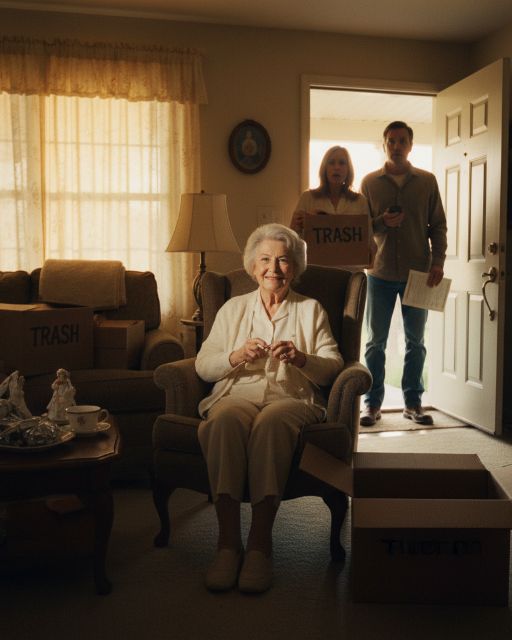
“It’s for your own good, Mom.” That’s what my daughter, Linda, said as she swept my porcelain figurines into a cardboard box labeled ‘TRASH’.
She didn’t ask. She just took.
My son, Greg, was in the kitchen with a realtor. I could hear them laughing. “She won’t even notice,” Greg said. “She’s losing it anyway. We sign the papers, get the cash, and dump her at the facility by Monday.”
They thought I was deaf. Or stupid.
I sat in my armchair and continued knitting. I didn’t fight them. I watched them pack up my life for three hours. They were practically drooling over the $800,000 listing price.
“The buyers are coming for the final walkthrough in five minutes,” the realtor announced, checking his expensive watch. “Everyone look sharp.”
Greg rubbed his hands together. “Finally. Payday.”
I cleared my throat. “You can’t sell this house, Greg.”
He rolled his eyes, not even looking at me. “Don’t start, Mom. We have Power of Attorney. It’s over.”
“I know you do,” I said softly. “But you can’t sell something I don’t own anymore.”
The room went deadly silent.
The doorbell rang.
“That’s them!” Linda squealed, ignoring me and rushing to the door. She threw it wide open, putting on her best fake smile. “Welcome to your new – ”
The words died in her throat. She froze.
Greg walked up behind her and his face turned the color of ash.
Standing on the porch wasn’t a wealthy developer. It was a young man in dirty work boots, holding a deed I signed over to him yesterday for exactly one dollar.
I stood up and smiled for the first time all day. “Kids, I’d like you to meet the new owner of this house. His name is Samuel.”
Samuel gave a polite, nervous nod. He clutched the document in his work-roughened hand like it was a winning lottery ticket.
Greg found his voice first, a strangled, angry sound. “What is this? What kind of sick joke is this, Mom?”
“It’s no joke,” I said, my voice steady as a rock. “It’s a legally binding contract. The house is his.”
The realtor, a slick man named Mr. Davies, stepped forward, clearing his throat. “Ma’am, I think there’s been a misunderstanding. Your son holds Power of Attorney. He has the authority – ”
“Power of Attorney gives him the authority to act on my behalf,” I interrupted gently. “It doesn’t give him the authority to sell property that no longer belongs to me. I sold it yesterday, of my own free will.”
Linda finally snapped out of her trance. “You sold it? For a dollar? To him?” She gestured at Samuel with a look of pure disgust, as if he were something she’d scraped off her shoe.
“He’s the groundskeeper, for crying out loud!” she shrieked. “He mows the lawn!”
“He does more than that,” I said, looking at Samuel with a warmth that I hadn’t felt for my own children in years. “He’s the only one who’s asked me how I was feeling in the last six months.”
Samuel shuffled his feet, looking uncomfortable with the praise. “Mrs. Gable, I…”
“It’s alright, Samuel,” I assured him.
Greg stormed over to me, his face twisted in a mask of rage. “You are not of sound mind! We’ll fight this in court! We’ll have you declared incompetent!”
“I thought you might say that,” I said, reaching into my knitting bag. I pulled out a folded piece of paper and handed it to him.
It was a letter from my doctor, Dr. Peterson. It was dated two days ago. It stated, in no uncertain terms, that I was perfectly lucid, competent, and fully capable of managing my own affairs. I had made the appointment the moment I overheard their plan last week.
Greg’s hands trembled as he read it. The color drained completely from his face.
Mr. Davies, the realtor, read the room perfectly. He saw his commission vanishing into thin air. “Well, it appears this sale is… complicated,” he said, already backing towards the door. “I’ll just see myself out. We can discuss this later, Greg.”
He was gone before Greg could even protest.
“Why?” Linda whispered, her fake bravado gone, replaced by a genuine, pathetic sort of bewilderment. “Why would you do this to us? This was our inheritance!”
I finally let the sadness I’d been holding back show in my eyes. “Your inheritance? This house was never just a pile of bricks and mortar to be cashed in. It was a home. Your father built that back porch with his own two hands.”
I pointed to a faint pencil mark high on the kitchen doorframe. “That’s where we measured you every year on your birthday, Greg.”
I looked at the scuffed floorboard by the fireplace. “That’s where you took your first steps, Linda.”
“This house is filled with our memories,” I continued, my voice growing stronger. “And you were so eager to sell them to the highest bidder. You didn’t see a home. You saw a payday.”
They stood there, silent. They had no answer.
“Samuel,” I said, turning to the young man who was still standing quietly by the door. “He saw it. He saw the work that needed to be done. He saw a place that deserved to be cared for.”
For the past two years, since my husband Frank passed, Samuel had been my lifeline. My children would call once a month, their questions always circling back to the property value and whether I’d considered “downsizing.”
But Samuel would show up every Tuesday, rain or shine. He’d mow the lawn, and then he’d stay for a cup of tea. He’d listen to my stories about Frank. He’d fix the dripping tap in the bathroom that Greg promised to look at for eight months. He’d bring me groceries when the weather was bad.
He never asked for anything more than the modest fee we’d agreed upon. He treated me with dignity. He treated me like a person, not a problem to be managed.
“We were trying to help you, Mom!” Greg insisted, his voice cracking. “That facility is state-of-the-art! You’d have been safe!”
“Safe? Or out of the way?” I asked him directly. “You got Power of Attorney by telling me it was to help pay my bills if I ever got sick. You lied. You used my trust to try and steal my home from under me.”
The truth of it hung in the air, thick and undeniable.
“You can’t just give him the house,” Linda whimpered. “It’s not fair.”
“Fair?” I chuckled, a bitter sound. “Let me tell you about fair. Let me tell you why I chose Samuel.”
I sat back down in my armchair. “Samuel, do you know who your grandfather was?”
He looked surprised. “His name was Arthur. He was a carpenter. He passed away before I was born.”
“I know,” I said. “His full name was Arthur Jennings. He was your father’s best friend, Frank.”
My children exchanged confused glances. They had never bothered to learn the names of Frank’s old friends.
“Long before you two were born,” I began, “Frank and Arthur were going to start a business together. A custom furniture workshop. They poured all their savings into it. Frank was the designer, Arthur was the master craftsman. They were a perfect team.”
“But they had a third partner. A man who handled the finances. He convinced them to sign some papers, and it turned out he signed the entire business over to himself. He pushed them both out with nothing. Arthur was wiped out. He lost his house, everything.”
“Frank was devastated. He felt like he’d let his best friend down. He managed to get back on his feet, working for other people, and eventually, we bought this land and he built this house himself. But he never forgave himself for what happened to Arthur. He lost touch with him over the years, the shame was too great.”
I pulled another item from my knitting bag. It was an old, sealed envelope, the paper yellowed with age. Frank’s familiar handwriting was on the front. “For my Helen, just in case.”
“Frank gave this to me before he died,” I said, my voice thick with emotion. “He told me not to open it unless I was truly in trouble, or unless I felt that his legacy was at risk.”
I looked pointedly at Greg and Linda. “I’d say his legacy was very much at risk.”
“Inside,” I continued, “was a letter. It told the whole story of Arthur. And it contained one last wish. He wrote, ‘If you ever find Arthur’s family, and if they are good people, please find a way to make things right. Our dream was built on a handshake and a shared passion. Money ruined it once. Don’t let it be about money. Let it be about kindness.’”
“When Samuel first came here to ask about mowing the lawn, he introduced himself. Samuel Jennings. The name struck me. I asked him about his family, and he told me about his grandfather, the carpenter who had lost everything. It was fate.”
“I watched him for a year. I saw how he worked. I saw his character. He is an honest, hardworking, and kind man. He is the grandson of the man your father owed a debt of honor to.”
The room was silent except for the ticking of the grandfather clock in the hall, a clock Frank and Arthur had built together.
“So, you see,” I said, my gaze sweeping over my two greedy children. “This isn’t just me giving away your inheritance. This is me fulfilling your father’s last wish. This is me settling a fifty-year-old debt. This is me choosing character over cash.”
Greg just stared, his mind clearly reeling as he processed the loss of nearly a million dollars.
Linda, however, seemed to have one last ounce of fight in her. “Fine. He can have the stupid house. But everything inside is ours. We’re taking it.”
She made a move toward a beautiful oak bookshelf that Frank had built, filled with first-edition books he had collected his entire life.
“Actually,” Samuel spoke up, his voice quiet but firm. “You can’t.”
He held up the deed. “The contract Mrs. Gable and I signed was for the property and its ‘contents as-is at the time of signing’. Everything in this house, except for your mother’s personal belongings like her clothes and photos, now belongs to me.”
Linda’s jaw dropped.
“But… but that’s not all,” I said, a small, sad smile on my face. “There’s one more thing you never knew about this house. The one thing your father was most proud of.”
I stood up and walked toward the kitchen pantry. Greg and Linda followed, their expressions a mixture of confusion and suspicion.
“You always complained this pantry was too small,” I said, pushing aside a rack of spices. I pressed my hand against a specific knot in the pinewood wall.
There was a soft click, and a section of the wall swung inward, revealing not shelves of canned goods, but a short, dark hallway.
A gasp escaped Linda’s lips.
I flicked a switch, and a warm, yellow light flooded the space beyond. It was a workshop.
It wasn’t just any workshop. It was a masterpiece. The walls were lined with gleaming, hand-sharpened tools, each in its designated spot. A massive lathe stood in the center. Stacks of rare, aged wood—bird’s-eye maple, cherry, dark walnut—were neatly piled in a corner.
And against the far wall were three finished pieces of furniture, covered in dust cloths. A rocking chair of such delicate grace it looked like it could float. A roll-top desk with intricate inlay work. A child’s crib with hand-carved animals dancing along the rails.
“Your father never stopped building,” I said softly. “He called it his ‘secret garden’. He spent the last twenty years of his life in here, perfecting his craft. These pieces… collectors have offered me tens of thousands for each one over the years. I always said no. He told me they were his real legacy for his children.”
Greg stepped into the workshop, his hand hovering over the polished surface of the desk. He looked like he’d seen a ghost.
“This was your inheritance,” I told them, my voice devoid of anger, filled only with a profound sadness. “Not the market value of the land. This. The fruit of his passion. The work of his hands. A legacy of love and creation.”
“But you were never interested. You never asked what he did with his time. You just saw the old man puttering around in the garage. You saw the house, but you never saw the home. You were so blinded by the price tag on the box that you never even thought to look what was inside.”
The full weight of their actions finally seemed to crash down on them. It wasn’t just the money from the house they had lost. They had lost this. They had desecrated the memory of their father in their quest for easy money, and in doing so, had forfeited the true treasure he had left for them.
Linda began to sob, not the crocodile tears of before, but deep, gut-wrenching sobs of genuine loss and shame.
Greg just stood there, speechless, running his hand over the wood, perhaps for the first time truly understanding the man his father was.
They didn’t say another word. They turned and walked out of the workshop, through the house, and out the front door, leaving their boxes of trinkets and trash behind.
The door clicked shut behind them, leaving me and Samuel in the quiet, peaceful home.
Samuel finally looked at me, his eyes full of emotion. “Mrs. Gable… Helen. I… I can’t accept this. It’s too much.”
“Nonsense,” I said, patting his arm. “Frank would have wanted this. He would have wanted his tools to be in the hands of a good man, a man who understands the value of building something real.”
“And don’t you worry,” I added with a wink. “The deed includes a very important clause. A life estate. It means I get to live here for as long as I want. You’re just the landlord. And you’re stuck with me.”
A huge, relieved smile spread across his face. “I think I can live with that.”
In the end, my children didn’t understand that a home is more than its monetary value. It’s a living thing, built from moments and memories, from love and labor. They tried to sell the walls, but they had already thrown away the treasure that lived within them.
I had lost a son and a daughter that day, but in a way, I had lost them long ago. And in their place, I had found a new kind of family—one built not on obligation or greed, but on the simple, sturdy foundation of human kindness. I had honored my husband’s memory, and in doing so, I had finally secured my home.