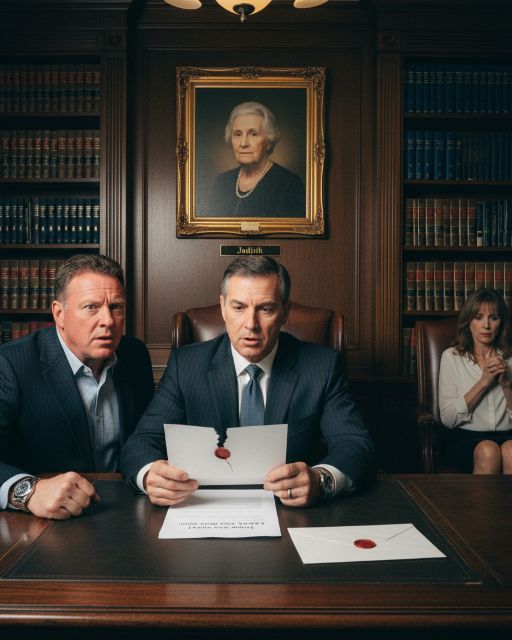
“To my only son, Adam, I leave exactly one dollar.”
The lawyer’s voice echoed in the silent, wood-paneled office. My husband Adam’s face went from smug to a deep, blotchy red. For weeks, he’d been planning how to spend his mother Judith’s inheritance.
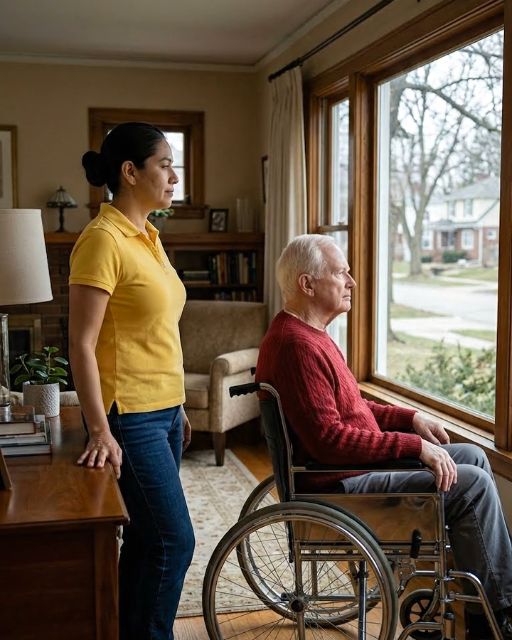
The lawyer continued, his tone flat. The ten-million-dollar estate, the house, the stocks… all of it was left to her caregiver, a quiet woman named Rhonda who sat in the corner, looking terrified.
“She manipulated a dying woman!” Adam screamed, slamming his fist on the table. “I’ll sue! You’ll never see a penny!”
The lawyer didn’t flinch. He simply waited for Adam to finish his tirade, then slid a second, smaller envelope across the table. It was sealed with wax.
“Your mother left a final letter to be read in this event,” he said calmly. He broke the seal, unfolded the single page, and read the first line aloud.
My blood ran cold when he said, “My dearest Adam, I’m sorry I never told you that on the day you were born, my real son…”
The lawyer, Mr. Gable, paused, letting the words hang in the heavy air. Adam just stared, his mouth slightly open, the anger on his face replaced by sheer, dumbfounded confusion.
Mr. Gable cleared his throat and continued reading Judith’s elegant script. “My real son was placed in the bassinet next to yours. There was a small fire that night in the maternity ward.”
The letter explained the chaos. Smoke filled the halls, nurses rushed to evacuate the newborns, and in the confusion, two baby boys were switched.
“I didn’t know,” the letter went on. “For years, I raised you as my own. I loved you with every piece of my heart.”
I reached out to touch Adam’s arm, but he shook me off, his eyes glued to the lawyer.
Judith’s words filled the room, a voice from beyond the grave telling a story I could hardly believe. A nurse involved in the evacuation, consumed by guilt, had confessed on her deathbed only five years ago.
She gave Judith the other family’s name, the Holbrooks.
“I hired investigators, Adam. I tried to find them, to find my son. But they had moved away years earlier, leaving no trace. I never found him.”
The weight of it all was crushing. All those years, Judith had carried this secret.
“I kept raising you, hoping the love I gave would be enough. But as you grew, I saw a coldness in you that frightened me. A hunger for things, not people.”
Adam flinched as if he’d been struck. The words were a direct hit, a mother’s final, painful assessment.
“You visited me only when you needed money. You called only to ask about my will. You saw my home not as a place of memories, but as an asset to be liquidated.”
Every word was true. I had sat through countless uncomfortable dinners where Adam would steer the conversation toward finances, his tone laced with impatience.
“You were not the son of my heart, just as you were not the son of my blood,” Mr. Gable read, his voice softening with a hint of pity. “Your actions, not your birth, are what led to this day.”
The letter then addressed Rhonda.
“Rhonda came into my life when I was at my lowest. She didn’t see a bank account. She saw a lonely old woman.”
The woman in the corner, Rhonda, was crying silently, her shoulders shaking.
“She held my hand. She listened to my stories about your father. She made me laugh. She showed me the kindness and compassion I had so desperately missed from my own son.”
The final lines were a devastating blow.
“The one dollar is a symbol of the value you placed on our relationship. The rest of my estate goes to a woman who was more of a daughter to me in two years than you were a son in forty. Do not try to fight this, Adam. You will not win. Goodbye.”
The silence that followed was absolute. It was broken by Adam, who let out a sound that was half-laugh, half-sob.
“A lie,” he whispered, shaking his head. “A crazy old woman’s lie to punish me.”
He stood up, his chair scraping loudly against the floor. “This is a joke. She’s a con artist, and you’re all in on it!”
He pointed a trembling finger at Rhonda, who shrank back in her seat. He then turned his fury on me.
“And you! You knew, didn’t you? You probably helped them cook this up!”
The accusation was so wild, so baseless, that I couldn’t even form a response.
He stormed out of the office, slamming the door so hard that a framed print on the wall tilted sideways.
Mr. Gable sighed, a long, weary sound. He looked at me with kind eyes. “Ma’am, I am truly sorry.”
I just nodded, my mind a whirlwind. My husband, the man I had built a life with, was a stranger. And his mother had died with a secret that re-framed our entire existence.
The ride home was silent and tense. Adam drove too fast, his knuckles white on the steering wheel.
“I’m calling my own lawyer,” he finally said, his voice clipped and hard. “We’re going to take her for everything she has. We’ll prove my mother was incompetent.”
“Adam, you heard the letter,” I said softly. “Her mind was perfectly clear.”
“Whose side are you on, Sarah?” he snapped, turning to glare at me.
The question stunned me. For fifteen years, I had always been on his side. I had defended his ambition, excused his selfishness, and mediated his conflicts with his mother.
But sitting there, in the shadow of Judith’s final words, I wasn’t so sure anymore.
When we got home, he went straight to his office and started making angry phone calls. I walked through our large, sterile house, a house Judith’s money had helped buy.
I saw everything with new eyes. The expensive art Adam had bought as an investment. The minimalist furniture he’d chosen because it was “a statement.” There was nothing of us here. Nothing of warmth or love.
It was a showroom for a life, not a home.
Over the next few days, Adam became a monster. He was consumed by the lawsuit, by his rage and his perceived victimhood.
He talked of nothing else. He barely slept. He drank too much.
One evening, I found him staring at an old family portrait on the mantelpiece. It was of him as a boy, standing with Judith and his father.
“She lied,” he said, his voice thick with scotch. “Look at that. I have my father’s eyes. This is all a lie.”
But I looked closer, and for the first time, I saw that it wasn’t true. His father’s eyes were a pale, clear blue. Adam’s were a murky gray. It was a small detail I’d never noticed, or perhaps never wanted to.
A week later, I couldn’t take it anymore. While Adam was out meeting with his lawyer, I found the address for Rhonda that Mr. Gable had given me for legal correspondence. I needed to see her. I needed to understand.
She lived in a small, clean apartment in a much humbler part of town. When she opened the door, she looked just as frightened as she had in the lawyer’s office.
“I don’t want any trouble,” she said immediately, her hands twisting the fabric of her apron.
“I’m not here to cause trouble, Rhonda,” I promised. “I just… I want to talk.”
She hesitated, then let me in. The apartment was cozy and filled with books and plants. It felt more like a home than my own house did.
We sat at her small kitchen table, and I offered her a sincere apology for Adam’s behavior.
“He’s just… he’s in shock,” I said, the excuse sounding weak even to my own ears.
Rhonda nodded, though she didn’t look convinced. “Your mother was a wonderful woman,” she said softly. “She talked about you a lot, you know. She said you had a good heart.”
Tears welled in my eyes. Judith had seen something in me that I was afraid I had lost.
“She never told you anything?” I asked. “About the will? About… the other son?”
Rhonda shook her head vehemently. “Never. I thought she was going to leave a little something for my son’s college fund, maybe. When the lawyer said everything… I thought I was going to faint.”
Just then, a door opened, and a young man came into the kitchen. He looked to be in his late teens, with a shy smile and kind eyes.
“Hi, Mom. Sorry, I didn’t know you had company,” he said.
“Daniel, this is Sarah,” Rhonda said, her voice filled with love. “Sarah, this is my son, Daniel.”
I smiled and said hello, but my breath caught in my throat. Daniel’s eyes were the exact same shade of pale, clear blue as the man in Adam’s family portrait. The same eyes as Judith’s late husband.
It was impossible. It had to be a coincidence.
Daniel grabbed a bottle of water from the fridge. I noticed a slight tremor in his hands and a brace on his wrist.
“It was nice to meet you,” he said politely, before retreating to his room.
Once he was gone, I couldn’t hold back. “Rhonda,” I began, my voice trembling. “What was Daniel’s father’s name?”
She looked at me, confused by the question. “It was Holbrook,” she said. “David Holbrook. He passed away when Daniel was a baby.”
Holbrook. The name from the letter.
My heart was pounding in my chest. “Rhonda… what hospital was Daniel born in?”
Her eyes widened as she understood where I was going. Her hand flew to her mouth.
“Saint Jude’s,” she whispered. “But… that’s not possible.”
We stared at each other, the impossible truth settling between us. Judith hadn’t just found a kind caregiver. She had, by some cosmic twist of fate, found her real family.
But that wasn’t the biggest shock. The real twist was why she had done it this way.
Rhonda began to cry, but these were not tears of fear. They were tears of understanding, of awe.
“Judith knew,” Rhonda said, her voice thick with emotion. “She must have known.”
She explained that Daniel had a rare degenerative neurological condition. It was manageable with medication and therapy, but the long-term prognosis was uncertain and the costs were astronomical.
“She was always asking about him,” Rhonda recalled. “About his doctors, his treatments. She read articles about his condition. I just thought she was being kind, that she was interested.”
I pictured Judith, frail but with a mind as sharp as a tack, piecing it all together. The name. The hospital. The tell-tale blue eyes of her grandson.
She didn’t want to upend their lives with a shocking revelation. She didn’t want a DNA test to create a legal storm or a media circus.
She found a quieter, more elegant solution. A way to protect her true legacy.
The ten-million-dollar inheritance wasn’t a gift to Rhonda. It was a lifeline for her grandson, Daniel. It was Judith’s way of being the mother and grandmother she never got to be.
An act not of revenge against Adam, but of profound love for Daniel.
I left Rhonda’s apartment that day a different person. The world had tilted on its axis, and everything was suddenly clear.
When I got home, Adam was in a triumphant mood.
“My lawyer found something!” he crowed, waving a piece of paper. “Rhonda’s son has a pre-existing medical condition. We can argue she preyed on my mother’s sympathy, manufactured a sob story to get the money!”
He was smiling, a cruel, predatory grin. He was planning to use a sick boy’s misfortune as a weapon.
That was the moment I stopped being his wife.
“No, Adam,” I said, my voice quiet but firm.
“What do you mean, no?” he scoffed. “This is our ticket! We’re going to get our money back!”
“There is no ‘we’,” I told him, looking him straight in the eye. “And it was never your money.”
I told him everything. About Rhonda’s last name. About Daniel’s eyes. About the quiet, brilliant way his mother had ensured her real grandson would be cared for.
He didn’t believe me at first. He called me a traitor, a fool. But as I spoke, laying out the undeniable facts, I saw the bravado drain from his face, replaced by a hollow, vacant look.
The truth had finally broken through his wall of greed. He wasn’t the wronged heir. He was just the obstacle his mother had to plan around.
I packed a bag that night and left. I didn’t take anything that Judith’s money had paid for. I just took my own things and my own dignity.
Adam’s lawsuit crumbled. Without me as the grieving, supportive wife, his case looked exactly like what it was: a bitter son’s greedy cash grab. The story of the switch, though not officially proven in court, circulated and turned public opinion firmly against him. He was humiliated.
He ended up with his one dollar.
The legal fees and his lavish lifestyle had left him deep in debt. He had to sell the house, the art, everything.
The last I heard, he was living in a small apartment, working a job he hated, a man haunted by the ghost of a fortune he thought was his.
I, on the other hand, found a new life. I started volunteering at a center for families dealing with chronic illness. It was there that I reconnected with Rhonda and Daniel.
I wasn’t trying to replace the family I’d lost, but to build a new one based on something real.
With the estate secure, Daniel was able to get into a clinical trial with the best doctors in the country. The tremor in his hands lessened. He finished high school and started taking online college courses, his future brighter than ever.
Rhonda, free from the crushing weight of medical bills, finally had time to breathe. She was a pillar of strength, managing the trust Judith had left with wisdom and grace.
One afternoon, the three of us were sitting in a park. Daniel was sketching in a notebook, his blue eyes focused in concentration, a perfect echo of his grandfather.
Rhonda turned to me, her face full of a peace that had been absent for so long.
“You know,” she said, “I think Judith knew her letter would do more than just explain the money. I think she wrote it for you, Sarah. And for him.”
I knew she was right. For Adam, the letter was a judgment. It held up a mirror to his soul, and he couldn’t stand what he saw.
For me, it was a key. It unlocked me from a life that was cold and empty and showed me a path to something better.
We often think that legacy is about the money and things we leave behind. But Judith taught me that a true legacy is built from love. It’s the kindness you show, the lives you touch, and the protection you offer to the people who truly matter. It’s not about bloodlines, but heart lines. And those can never be broken.