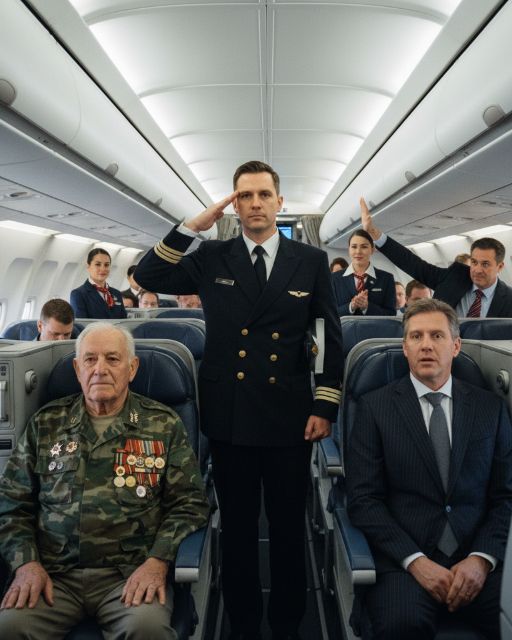
“Get that hobo out of first class!” the guy in the pinstripe suit barked, nose wrinkled like he smelled garbage. “I paid top dollar. He’s ruining my flight with that veteran stench.”
The old man in the faded camo jacket just stared out the window, his service medals pinned crooked on his chest. He didn’t flinch. Didn’t even blink.
The flight attendant stammered, trying to move him to coach. The suit laughed, high-fiving his buddy across the aisle.
That’s when the cockpit door swung open.
Captain Hayes strode down the aisle, eyes locked on the veteran. The plane hushed.
He stopped right in front of the old man, saluted sharp, then turned to the snob with a voice like gravel.
“This man doesn’t sit in coach. He doesn’t sit in first class either.”
The suit smirked. “Then where does the bum belong?”
Captain Hayes pointed to the empty co-pilot seat up front. “Right there. Because he’s the one who taught me to fly… and saved this airline when it was about to go under.”
The smirk on the man’s face, whose name was Sterling Vance, melted like wax. His high-five buddy, Todd, suddenly found the safety card in his seat pocket intensely fascinating.
The silence in the first-class cabin was thick enough to cut with a knife. Every eye was on the four of them: the captain, the veteran, the snob, and the flustered flight attendant.
Captain Hayes didn’t raise his voice. He didn’t need to.
His words carried the weight of command, cold and precise. “This man is Arthur Bellweather.”
The name meant nothing to Sterling, but he saw a flicker of recognition in the eyes of an older passenger across the way.
“Thirty years ago, our first fleet of passenger jets had a flaw,” the captain continued, his gaze still fixed on Sterling. “A fatal one.”
He explained how a tiny vibration in the turbine assembly went undetected in every simulation. It only appeared after a hundred hours of flight time.
“Two planes went down in training. No survivors.” Captain Hayes’s voice was somber.
“The board was ready to declare bankruptcy. The whole airline was about to be a footnote in aviation history.”
Arthur Bellweather, the old veteran, finally turned his head from the window. His eyes, a pale, washed-out blue, met the captain’s.
There was a deep, unspoken understanding between them. A shared history that filled the space around them.
“But Arthur here, he was our head of maintenance back then,” Hayes said. “He’d flown similar engines in the war.”
“He refused to give up.”
The captain told them how Arthur had slept in the hangar for three weeks straight, surrounded by blueprints and dismantled engines. He lived on black coffee and stale sandwiches.
“He smelled of grease and jet fuel then, too,” Hayes said, a pointed edge to his words. “The smell of dedication, Mr. Vance.”
Sterling Vance’s face was turning a blotchy red. He tried to speak, but no words came out.
“He found it,” the captain said, a note of awe in his voice even after all these years. “A hairline fracture in the mounting bracket. A one-in-a-million defect.”
“He didn’t just find the problem. He designed the solution.”
Captain Hayes gestured around the cabin. “The dampening collar he invented is still standard on every plane in this fleet. Including this one.”
“He didn’t ask for a bonus. He didn’t ask for a promotion.”
“He just did his job and saved hundreds of lives, and thousands of livelihoods, in the process.”
A quiet murmur went through the cabin as the story sank in. The other passengers were looking at Arthur with newfound respect.
The flight attendant, Clara, looked like she was about to cry with relief. She gave Arthur a small, watery smile.
Captain Hayes then turned his attention fully to Arthur. “Art, I’m sorry about this.”
Arthur just gave a slight nod, his expression unreadable. For him, it seemed, this was just another moment in a long life.
“As for teaching me to fly,” Hayes went on, his voice softening. “I was a punk kid from the wrong side of the tracks, washing planes for pocket money.”
“Arthur saw something in me. He paid for my flight school out of his own pocket.”
“He told me that the sky is the one place where it doesn’t matter where you came from.”
The captain’s words hung in the air, a stark contrast to the ugliness that had started the whole affair.
Sterling Vance finally found his voice, though it was thin and reedy. “That’s… that’s all very noble. From the past.”
He was trying to claw back some of his lost dignity. “But I am a major investor in this airline now. And I expect a certain standard.”
Captain Hayes’s expression hardened again. “The standards of this airline were set by men like him, not by men like you.”
Then he turned back to Arthur. “Seriously, Art. The seat’s open. The view is better from up there.”
Arthur looked from the captain to the cockpit door, and for the first time, a small smile touched his lips. “Well, I never did get to see the new avionics on this model.”
He slowly unbuckled his seatbelt, his old joints creaking in protest. As he stood, his faded jacket fell open slightly, revealing the corner of a worn, oil-stained rag tucked into his pocket.
Sterling Vance flinched, as if the very sight of it offended him.
Arthur started to walk toward the front, and the other first-class passengers watched him with a quiet reverence. He was no longer a “hobo” to them.
He was a hero. A founder.
As Arthur passed Sterling’s seat, he paused for a moment. He didn’t say a word.
He just looked at Sterling, and in that gaze, there was no anger, no malice. There was only a profound, bottomless pity.
Then, he continued on to the cockpit, disappearing inside with the captain. The door clicked shut, leaving the cabin in a stunned silence.
The flight attendant, Clara, finally composed herself. “Can I get you anything, Mr. Vance?” she asked, her voice professionally polite but with an unmistakable chill.
Sterling just shook his head, slumping in his expensive leather seat. He felt small, exposed, and utterly foolish.
The flight continued, and for a while, everything seemed normal. The seatbelt sign turned off, and drink service began.
But an hour into the flight, a subtle, low-frequency hum started to vibrate through the floor. It was barely noticeable at first, like the buzz of a distant machine.
Sterling felt it in the soles of his Italian leather shoes. He tried to ignore it.
But it grew.
It became a tangible tremor, making the glass of scotch on his tray table tremble. The water in the glass rippled.
Passengers started to exchange nervous glances. The calm atmosphere had evaporated, replaced by a rising tide of anxiety.
Clara and the other flight attendants moved through the cabin with forced smiles, their eyes betraying their own concern. “Just a bit of turbulence, folks,” they’d say, but their words sounded hollow.
The hum wasn’t like turbulence. It was constant. It was mechanical.
It sounded wrong.
Sterling’s heart began to hammer against his ribs. The smug confidence he wore like a second skin was gone, replaced by a cold, primal fear.
He was trapped in a metal tube, seven miles above the earth, and something was deeply, terribly wrong with it.
Then the cockpit door opened again. It was Captain Hayes.
His face was a grim, stony mask. The easy confidence he’d shown earlier was gone.
“Folks, I need your attention,” he said, his voice amplified by the intercom. “We’re experiencing a minor mechanical issue.”
A collective gasp went through the cabin. The word “mechanical” is the last thing any passenger wants to hear.
“It’s a sensor malfunction in the starboard engine. We’re getting some erratic readings, and you may be feeling a slight vibration.”
He tried to sound reassuring, but no one was buying it. The vibration was no longer slight.
“We have the situation under control,” he continued. “But as a precaution, we’re going to divert and land at the nearest available airport.”
Fear, raw and palpable, flooded the cabin. A woman in the row behind Sterling started to cry softly.
Sterling’s own throat was dry. He looked out the window at the endless blue sky, and it no longer seemed beautiful. It seemed like a vast, empty void.
He thought about his portfolio, his meetings, his meaningless rivalries. All of it felt absurd in the face of this humming, vibrating reality.
He then looked toward the front of the plane, at the closed cockpit door. And he thought of the old man inside.
The man he had called a hobo. The man he had mocked for his “veteran stench.”
The man who had built this very plane.
A new kind of dread washed over Sterling. It was the sickening, karmic irony of it all.
His life, and the lives of everyone on this plane, might now depend on the grace and knowledge of the man he had so cruelly disrespected.
Inside the cockpit, the atmosphere was thick with tension. Alarms were blaring, a symphony of electronic panic.
Captain Hayes was wrestling with the controls, his knuckles white. “The throttle response is sluggish! It feels like we’re dragging an anchor.”
Arthur Bellweather wasn’t looking at the flashing lights. His eyes were closed.
He had one hand pressed against the bulkhead, feeling the vibrations travel through the frame of the aircraft. He was listening.
He was listening to the soul of the machine he knew so intimately.
“It’s not the sensor,” Arthur said, his voice calm amidst the chaos. “The sensor is telling the truth.”
He opened his eyes. They were sharp and clear. “It’s the actuator for the number three hydraulic line. The one I designed the dampener for.”
“That’s impossible, Art,” the co-pilot said, his voice strained. “That part has never failed. Not in thirty years.”
“Everything has a lifespan,” Arthur said simply. “It’s starting to shear. The vibration isn’t from the engine itself, it’s from the hydraulic fluid pulsing unevenly.”
He pointed to a gauge. “Look at the pressure variance. It’s tiny, but it’s there. The computer isn’t programmed to see it as a threat.”
Captain Hayes looked at the gauge, then at Arthur. He trusted the instruments, but he trusted this man more. “What’s the play, Art?”
“We need to reduce pressure on that line,” Arthur said. “Drop our altitude to twenty thousand feet. It’ll be a bumpy ride.”
“Then, we need to manually disengage the outer aileron control from that system. It’ll make steering feel heavy, like a truck, but it will stop the shearing.”
It was a complex, risky maneuver. It went against every standard procedure in the manual.
But it was based on a knowledge that no manual could contain.
“Do it,” Captain Hayes said without a second’s hesitation.
For the next twenty minutes, the passengers were thrown against their seatbelts as the plane descended rapidly. Panic was rising.
Sterling Vance gripped his armrests, his eyes squeezed shut. He was praying. For the first time since he was a child, he was genuinely praying.
He prayed for forgiveness. He prayed for a second chance.
And then, as suddenly as it began, the worst of the shaking stopped. The violent hum settled back into a manageable thrum.
The plane was stable.
A collective sigh of relief swept through the cabin. The tension didn’t disappear, but the sharp edge of terror had been blunted.
Forty minutes later, the plane touched down on the runway with a bump and a screech of tires. It was not a graceful landing, but it was a safe one.
Emergency vehicles with flashing lights raced alongside them, but they weren’t needed.
When the plane finally came to a complete stop, a strange silence fell over the cabin. Then, one person started to clap.
Then another, and another, until the entire plane erupted in a thunderous, grateful applause.
As the passengers deplaned onto the tarmac, they saw Arthur Bellweather and Captain Hayes standing by the cockpit.
The airline’s ground crew and the airport’s chief of operations were there. The CEO of the airline himself was rushing across the tarmac.
He bypassed everyone else and went straight to Arthur, grabbing his hand and shaking it with heartfelt emotion. “Arthur, you did it again. We owe you everything.”
Sterling Vance was one of the last to get off the plane. His legs felt like jelly.
He saw the scene unfolding and felt a profound sense of shame. He slowly walked over to the group.
He waited until the CEO had finished, then he stood before Arthur Bellweather.
“Mr. Bellweather,” he began, his voice cracking. “I… I don’t know what to say. I was arrogant. I was cruel. I’m sorry.”
He looked the old man in the eye. “You saved my life. How can I possibly repay you?”
Arthur looked at Sterling’s expensive suit, his panicked eyes, and his broken pride.
He reached into his pocket and pulled out the old, oil-stained rag. He looked at it, then back at Sterling.
“This rag has fixed more problems than a wallet ever could,” Arthur said, his voice quiet but firm. “Worth isn’t about what you have in the bank. It’s about what you have in your hands, and in your heart.”
He offered a simple piece of advice. “Just… try to see the person next time. Not their clothes.”
With that, he turned and walked away with Captain Hayes, the two of them already talking about a fishing trip they had postponed for too long.
Just then, the airline CEO turned to Sterling. His expression was cold and professional.
“Mr. Vance,” the CEO said. “I was just reviewing the captain’s report of the initial incident in first class before the emergency.”
Sterling felt a new pit in his stomach.
“Your company is currently under consideration for our new corporate travel contract. A multi-million-dollar account.”
The CEO adjusted his tie. “That review is now over. We will not be doing business with a man, or a company, that shows such profound disrespect for the heroes who built this airline and who continue to keep our passengers safe.”
“Your prejudice just cost you the biggest deal of the year.”
Sterling Vance stood alone on the tarmac, the sound of the jet engines fading in the distance. He had boarded the plane a king and left it as a fool.
He had learned his lesson not in a boardroom, but at thirty thousand feet, where the only thing that mattered was character.
And he realized, with a clarity that was both painful and humbling, that the true measure of a man is not the cost of his suit, but the content of his soul. It is the silent dignity, the quiet competence, and the simple respect we show to one another that truly allows us all to fly.