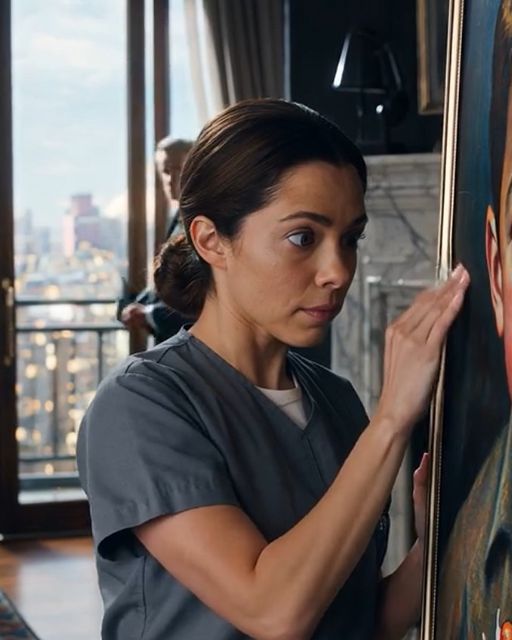
I was polishing the glass on a gold frame when the room tilted.
The boy in the portrait had dark hair and a toy airplane clutched in his small fist. His eyes were the kind that saw everything.
It wasn’t a look-alike.
It was him. Leo.
My breath caught in my throat. Leo from the Oak Creek Home. From the long cafeteria lines and the nights thunder shook the walls. The boy who could disappear into a drawing of a jet wing.
A voice behind me cut through the silence. “Can I help you?”
The owner. Mr. Vance. He carried his grief like a second suit.
I couldn’t look away from the painting. My finger was still pointing.
“His name is Leo,” I said. The words just fell out.
He went stiff. “Why would you say that?”
“Because that boy,” I said, my voice shaking, “lived with me in the orphanage.”
His file folders slid from his hand and scattered across the marble.
The air in the penthouse became thick. Heavy.
“He’s my son,” he whispered. The words were broken glass.
His son. Taken from a city park at seven years old. A case gone cold for eighteen years. A bedroom kept waiting. A father who never gave up hope, even when it cost him everything.
So I told him.
I told him about a quiet boy arriving at Oak Creek on a bus, wearing a faded t-shirt. How he never spoke about where he came from. How he drew planes with perfect, steady lines as if he could fly away.
I told him the part I never said out loud. That I got out at twelve and never looked back.
“Come with me,” Mr. Vance said. It wasn’t a question. It was a prayer.
Two days later, the air out west was so clean it hurt to breathe. Oak Creek Home looked smaller, sadder. The woman at the desk shut us down before we could even ask.
We stepped back into the cold. The sky was huge and empty.
“Anna?”
I turned.
A man in work boots stood by a truck, a toolbox in his hand. Older, lines around his eyes, but the eyes were the same.
He smelled like sawdust.
“Leo,” I breathed.
The world shrank to the three of us in that gravel lot.
“What are you doing here?” he asked, his gaze shifting from me to the stranger in the expensive coat.
Mr. Vance looked like he was seeing a ghost. He took a half-step forward, a man walking on ice, terrified it might crack.
“I don’t understand,” Leo said. “I grew up here. I don’t have a family.”
“You do,” Mr. Vance choked out. “You always did.”
Leo’s hand went to his left shoulder, a motion he didn’t seem to notice. A nervous habit.
Mr. Vance’s breath hitched. “A birthmark,” he said. “A little triangle.”
Leo froze. His grip tightened on the handle of his toolbox.
He sat down hard on the curb, as if his legs just gave out.
“I remember pieces,” he said to the ground. “A red door. A toy plane. Looking down at the city.”
Mr. Vance knelt in the dirty slush. “I kept your room,” he said, his voice raw. “It’s still there. Just let me show you.”
Leo looked at me, his eyes asking a question he was too old to ask.
“You should see,” I said. “You’ve spent long enough not knowing.”
He swallowed. He nodded. He stood up.
He looked at the man who was his father.
And for the first time in eighteen years, he started walking home.
The ride back was quiet enough to hear your own heart beat.
Mr. Vance drove his luxury car like it was made of glass. He kept looking in the rearview mirror, not at the traffic, but at Leo.
Leo sat in the back, staring out the window at the passing landscape. His hands, calloused and strong, rested on his knees. They looked out of place against the plush leather.
I was in the front passenger seat, feeling like the pin holding two sides of a broken locket together.
Every few minutes, Mr. Vance would clear his throat, about to speak, then stop. What do you say to the son you lost for two decades?
“Do you still draw?” I asked Leo, just to break the suffocating silence.
He glanced at me in the mirror. A small, sad smile touched his lips.
“Sometimes,” he said. “Mostly I build things now.”
“He was always building things,” Mr. Vance said, his voice too loud in the small space. “Blocks. Little cities. He wanted to be an architect.”
Leo said nothing. He just went back to watching the world blur past.
We arrived at the penthouse as the sun was setting, turning the city into a sea of orange and gold. The doorman’s eyes widened as Leo stepped out of the car, carrying his old toolbox.
The elevator ride up was another stretch of silence.
When the doors opened directly into the apartment, Leo stopped. He looked around at the high ceilings, the sprawling art, the windows that held the entire skyline.
It was a palace. It was a world away from Oak Creek.
“This…” he started, but couldn’t finish.
“This is your home,” Mr. Vance said, his voice gentle.
He led us down a long hallway. He stopped at a dark wooden door at the very end.
His hand trembled as he reached for the knob.
“I never changed a thing,” he whispered.
He opened the door.
The room was a time capsule. Blue wallpaper with little white clouds. A bookshelf filled with children’s stories. A small desk with a stack of clean drawing paper.
And on the nightstand, next to a bed perfectly made, was a small, silver toy airplane.
Leo walked into the room slowly, as if entering a dream. He didn’t touch anything. He just looked.
He walked to the window and stared down at the city lights twinkling to life.
“I remember this,” he said, so quietly I almost didn’t hear him. “I remember the lights.”
He turned and his eyes fell on the desk. He walked over and ran his fingers over the smooth surface of the drawing paper.
Then he saw it. Tucked into the corner of the desk, almost hidden. A small block of wood, half-carved into the shape of a bird. The little knife was right beside it.
Mr. Vance saw him looking. “You were working on that the morning… the morning you were gone.”
Leo picked it up. He turned the rough-hewn bird over and over in his palm. His face was a mask of concentration.
A memory was fighting its way to the surface.
“There was a woman,” he said. His voice was distant.
Mr. Vance went completely still. “What woman?”
“In the park,” Leo continued, his eyes unfocused. “She was crying.”
He looked up from the wooden bird. “She told me she had lost her little boy. She asked if I could help her look for him.”
The air left the room. It was the piece of the puzzle the police had never found.
“She had a little bird like this,” Leo said, holding up the carving. “She said her son made it for her. She was holding it so tight.”
He set the bird down on the desk. “She was nice. She bought me ice cream. I just wanted to help her find her son.”
The next few days were a blur of trying to fit together.
Mr. Vance tried to give Leo everything. A new wardrobe, a bank account, keys to a car Leo didn’t know how to drive.
Leo politely refused it all. He wore his work boots and flannel shirts. He spent most of his time in his old room, just sitting.
He’d pick up the wooden bird, then put it down.
I stayed, at Mr. Vance’s insistence. I made coffee. I listened. I was the only person who knew both the boy who drew airplanes and the man who fixed broken things.
One evening, Mr. Vance came into the kitchen where I was cleaning up. He looked exhausted.
“He doesn’t want any of this,” he said, gesturing around the vast apartment. “I don’t know how to reach him.”
“You lost eighteen years,” I said softly. “You can’t buy them back in a week.”
He sank into a chair. “He keeps talking about that woman. The one in the park. He says he doesn’t remember her being mean. He remembers her being sad.”
That didn’t make any sense. Kidnappers weren’t supposed to be sad. They were supposed to be monsters.
“The police looked for disgruntled employees, anyone with a grudge,” Mr. Vance continued, thinking out loud. “They found nothing.”
An idea sparked in my head. A terrible, unlikely idea.
“You said you lost him at the city park,” I said. “But you took him to the orphanage way out west. That’s hundreds of miles. Why there?”
He looked at me, confused. “I didn’t take him there. The kidnapper did.”
“But why that specific one?” I pressed. “It’s not famous. It’s small. It’s in the middle of nowhere.”
The person had to know it existed.
We went back to Oak Creek a week later. Leo refused to come. He said he was done with that place.
This time, we didn’t go to the front desk. We went to the local town hall. Mr. Vance, with his money and influence, requested the orphanage’s public employment records from eighteen years ago.
A clerk handed us a dusty, bound ledger. We sat at a rickety table and started reading through the names of cooks, cleaners, and administrators.
My finger ran down a list of part-time groundskeepers. And then it stopped.
The name was familiar. I’d seen it on a plaque in the orphanage lobby. ‘In recognition of twenty years of service.’
It was the woman from the front desk. The one who had been so cold, so quick to dismiss us.
Her name was Martha Albright.
Mr. Vance read the name aloud. He said it once, then again.
A strange look crossed his face. His blood drained away, leaving him pale as paper.
“Albright,” he repeated, the name tasting like poison.
He scrambled for his phone, his hands shaking so badly he could barely type. He pulled up an old business contact.
“Robert, it’s Richard Vance,” he said into the phone. “I need you to look up something for me. An old acquisition. From nineteen years ago. Albright Manufacturing.”
He listened, his eyes closed. I watched his fist clench on the table until his knuckles were white.
“His wife’s name,” Mr. Vance said, his voice tight. “What was his wife’s name?”
He fell silent again. A long, terrible pause hung in the air.
“Thank you, Robert,” he said, and hung up without saying goodbye.
He stared at me, his eyes filled with a horror that was nineteen years in the making.
“Her name was Martha,” he whispered. “Her husband… he lost everything when my company bought his. He took his own life a month later.”
The pieces crashed together.
It wasn’t a ransom. It was revenge.
A soul for a soul.
Martha Albright still lived in the same small house a few miles from the orphanage. It was modest, with a wilting garden out front.
She opened the door before we even knocked, as if she’d been expecting us.
She was older now, her face a roadmap of hard years, but there was no fear in her eyes. Only a deep, profound weariness.
“I always knew this day would come,” she said.
She invited us in. The house was clean but bare. There were no pictures on the walls.
She told us everything. She didn’t cry. She spoke in a flat, monotone voice, as if retelling a story that had happened to someone else.
She spoke of her husband, a good man who had built his company from nothing. She spoke of the day Richard Vance, a ruthless corporate titan, had destroyed their life’s work in a hostile takeover.
“You never saw the people,” she said, looking directly at Mr. Vance. “We were just numbers on a page to you.”
After her husband was gone, she was consumed by a grief so vast it blotted out the sun. She watched Mr. Vance in the papers, saw him with his perfect wife and his perfect son.
“I wanted you to feel it,” she said. “Just for a day. I wanted you to feel what it was like to have your whole world ripped away.”
So she went to the park. She saw Leo. A beautiful boy who looked just like his father.
She didn’t plan to keep him. She just wanted to scare his father. But as she drove, with the little boy sleeping in the back seat, she couldn’t do it. She couldn’t be a monster.
And she couldn’t give him back.
So she drove west, to the town she’d grown up in. To the orphanage she knew. She left him on the steps with a note that said his name was Leo and he had no one.
Then she got a job there. Just to watch him. To make sure he was okay.
“I made sure he had enough to eat,” she said, her voice finally cracking. “I mended his clothes when they tore. I watched him draw his airplanes. I just wanted to make sure he was safe.”
Mr. Vance didn’t speak. He just sat there, taking it all in. The man he used to be was staring back at him from this woman’s empty eyes.
When she was finished, a long silence filled the small room.
“I’ll call the police,” Mr. Vance finally said. His voice was hollow.
“I know,” she replied. She folded her hands in her lap, ready.
But he didn’t reach for his phone.
He looked at me, then at the empty walls around us. He was a man looking at the wreckage of two lives he had destroyed. His own, and this woman’s.
He stood up.
“No,” he said, shaking his head. “No more broken lives.”
He looked at Martha Albright. “What you did was wrong. But what I did… it started all of this.”
He turned and walked out the door. I followed him, leaving Martha Albright sitting alone in her quiet house.
When we got back to the city, Leo was in the workshop Mr. Vance had built for him in a spare room of the penthouse.
The smell of fresh-cut cedar filled the air.
Mr. Vance stood in the doorway and told him everything. The whole, ugly, heartbreaking story.
Leo didn’t stop his work. He just kept sanding a piece of pine, his movements smooth and practiced.
When his father was done, he set down the wood and wiped his hands on his jeans.
He looked at the man who had lost him, and the man who had found him.
“So,” Leo said. “It sounds like no one won.”
He was right.
A few weeks later, we all went back out west. This time, Leo came with us.
He walked up to Martha Albright’s door by himself.
We waited in the car. We couldn’t hear what they said. We just saw them standing on the porch for a long time.
When he came back, his face was calm.
“She gave me this,” he said, opening his hand. In his palm was a small, exquisitely carved wooden bird, worn smooth with time.
Leo didn’t want the penthouse. He didn’t want the money.
He wanted to build things.
So, that’s what they did. Mr. Vance sold his company. He used the money to build a new wing on the Oak Creek Home.
It was a vocational school, for kids aging out of the system. It had an auto shop, a computer lab, and a state-of-the-art woodshop.
Leo runs the woodshop. He teaches teenagers how to build things that are sturdy, and beautiful, and useful. He gives them a skill, a purpose.
Mr. Vance is there every day. He’s not a CEO anymore. He’s just Richard. He helps with the paperwork and talks to the kids. He’s finally learning how to be a father.
Martha Albright works in the school’s garden. She is quiet, but sometimes, I see her smile as she watches the kids. She’s planting things now, instead of pulling them up by the roots.
And me? I’m not a cleaner anymore. Mr. Vance paid for my education. I’m a social worker now, at Oak Creek. I help kids find their way.
Sometimes, a life has to be completely torn down before you can rebuild it into something stronger. It’s not about forgetting the broken pieces or the pain they caused. It’s about using them to build a new foundation, one based on forgiveness and a second chance you never thought you’d get. It’s about understanding that the home you are looking for is not always the one you lost, but the one you have the courage to build.