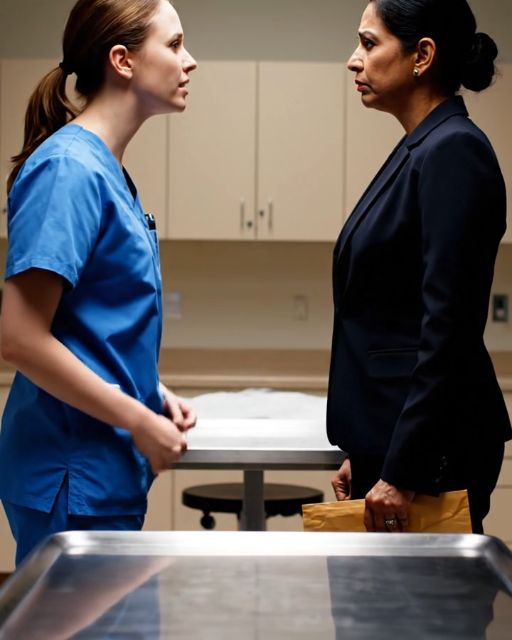
I was pulling an all-nighter at the hospital when security approached me. “We need to talk,” the guard said, his face unreadable. They led me to a small room.
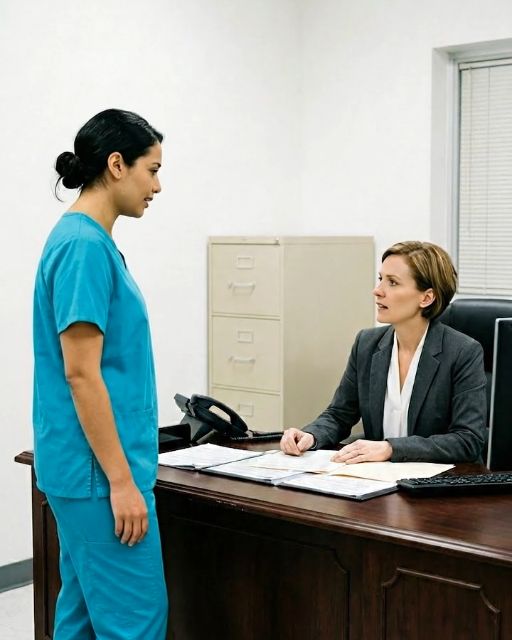
Inside, the head nurse, Ms. Harris, was holding a brown envelope. “Jenna,” she began, “we found pills missing from the inventory. And your access card was the last used.”
My heart pounded. I’d never taken anything.
“I swear, there’s been some mistake,” I pleaded, my voice trembling.
“You need to empty your locker,” Ms. Harris instructed coldly.
I walked to my locker, feeling eyes on me. The staff had gathered, whispering. As I turned the key, something felt off. Inside, my locker was a tiny black camera blinking, hidden among my things.
My blood ran cold. I’d never seen it before. Then I remembered – the new IT guy, Dan, who’d been asking odd questions.
“Check the footage,” I said, my voice steadying. “You’ll see.”
They hooked up the camera to the monitor. As the footage played, the room gasped. But what we saw next made everyone’s jaw drop…
The video started, grainy and silent. The first image was the inside of my locker, just as I’d left it. My spare scrubs, a worn-out paperback, a photo of my dog.
Then, a hand reached in. It was a man’s hand. He carefully positioned the tiny camera behind a stack of medical journals.
The man pulled back, and for a split second, his face was visible. It was Dan, the IT guy. His expression was nervous, furtive.
A murmur went through the small crowd. So, I was right. He was trying to frame me.
Ms. Harris shot a sharp look at the security guard. “Find him. Now.”
But I held up a hand. “Wait,” I whispered. “Just wait.”
The footage continued to play. For several minutes, nothing happened. It was just a silent, unblinking view from inside my locker. The sounds of the hospital were muffled, distant.
Then, the locker door opened again. This time, it wasn’t Dan.
It was Carol.
A collective gasp filled the room. Carol was one of the most senior nurses on the floor. She had been working at this hospital for over thirty years. She was the one who trained me, the one everyone went to for advice. She was like a grandmother to all of us.
Her hands were shaking. She looked over her shoulder, her face etched with a fear I had never seen on her before.
She quickly opened my tote bag, which was hanging on a hook. From her pocket, she pulled a small, unlabeled bottle of pills. She slipped it deep into the side pocket of my bag, zipped it up, and then gently closed the locker door.
The footage ended there.
The room was utterly silent. No one knew what to say. The image of sweet, kind Carol acting like a thief was impossible to process.
Ms. Harris finally broke the silence. Her voice, usually so stern, was now soft with disbelief. “I… I don’t understand.”
My own mind was reeling. Why would Carol do that? Why would she put something in my bag, in my locker? It didn’t feel like a setup. It felt like an act of desperation.
And why was Dan filming it?
Just then, the door opened. The security guard came back in, with a pale and sweating Dan in tow.
All eyes turned to him. He looked like a cornered animal.
“Mr. O’Connell,” Ms. Harris said, her voice regaining its steel. “You have some explaining to do. Placing a camera in a staff locker is a serious breach.”
Dan swallowed hard. “I know. I’m sorry. I just… I didn’t know what else to do.”
“What are you talking about?” she demanded.
“I saw her,” he stammered, nodding toward the frozen image of Carol on the screen. “A few times, I saw her near the dispensary looking… strange. Acting suspiciously. I saw her slip something into her pocket last week.”
He took a deep breath. “I’m new here. She’s… well, she’s Carol. Who would believe me? I thought if I just got proof, I could show someone without having to make a formal accusation.”
“So you decided to frame Jenna?” a younger nurse from the back asked, her voice filled with accusation.
“No! Not at all!” Dan insisted, his eyes wide with panic. “I saw Carol go to Jenna’s locker a couple of times. I think she felt it was a safe spot, a place no one would think to look. I put the camera in there to catch her, not Jenna. I was going to retrieve it at the end of the shift and check the footage myself. I never thought… I never thought any of this would happen tonight.”
It was a clumsy, stupid plan, but looking at his terrified face, I believed him. He wasn’t malicious. He was just a young guy in over his head.
Ms. Harris sighed, pinching the bridge of her nose. “This is a mess. A complete mess.” She looked at the security guard. “Go find Carol. Ask her to come to my office. Quietly.”
The next hour was the longest of my life. I was officially cleared, but the relief was overshadowed by a deep, confusing sadness for Carol. The whispers in the hallway had changed. My name was no longer the subject, but hers was.
Finally, we were all called into Ms. Harris’s office. It was a larger room, but it felt suffocating. I was there, Dan was there, and a moment later, Carol was escorted in.
She looked a hundred years old. Her face was ashen, her shoulders slumped in defeat. She wouldn’t look at any of us.
“Carol,” Ms. Harris began gently. “We saw the video.”
Carol flinched but didn’t speak. A single tear rolled down her cheek.
“Can you please tell us what’s going on?” Ms. Harris pressed.
Carol finally looked up, her eyes finding mine. They were filled with such profound shame and sorrow that it took my breath away.
“It’s for my husband, George,” she whispered, her voice cracking. “He has cancer. It’s… it’s very bad now. The pain is unbearable.”
She explained that his insurance had stopped covering a specific, high-dosage pain medication that was the only thing that gave him any relief. They couldn’t afford it out of pocket. Their savings were gone.
“I never took from the inventory,” she clarified, her voice a little stronger now. “I would never do that. These were… they were discarded meds. A patient was discharged, and these were the pills left in his personal drawer. They were scheduled for disposal.”
She was still breaking the rules, of course. Major rules. But she wasn’t stealing from the hospital’s active supply.
“I didn’t know where to put them,” she continued, her gaze dropping to her lap. “I was scared to take them home right away. I saw your locker, Jenna. You always leave it unlocked during your shift. I am so, so sorry. I thought it was safe. I was going to get them before I left. I never, ever meant for you to get in trouble.”
The story tumbled out of her, a heartbreaking confession of a woman pushed to the edge, trying to ease the suffering of the man she had loved for fifty years.
My anger had completely vanished, replaced by a wave of empathy so strong it made my own eyes well up. This wasn’t a crime of greed. It was an act of love, however misguided.
Ms. Harris was stoic, but I could see the conflict in her eyes. She was a manager, but she was also a nurse who had seen a lifetime of suffering.
“Carol, you know the protocol,” Ms. Harris said softly. “What you did… we can’t ignore it.”
Carol nodded, fresh tears streaming down her face. “I know. I’ll pack my things.”
But something still wasn’t right.
“Wait a minute,” I said, speaking up for the first time. Everyone looked at me.
“The pills Carol took were from a discharged patient,” I said, thinking out loud. “They wouldn’t be part of the official inventory count. But you said, Ms. Harris, that pills were missing from the locked dispensary inventory.”
Ms. Harris’s eyes widened slightly. She had been so focused on the video, on Carol’s confession, that she’d forgotten the detail that started this whole nightmare.
“You’re right,” she said slowly. “The report from the pharmacy manager was about a significant discrepancy in the controlled substance log. Specifically, high-grade opioids.”
Suddenly, the pieces shifted. Carol’s desperate, small-scale theft was a completely separate issue. It was a tragic coincidence that had been caught in the net of a much larger investigation.
There was another thief in the hospital.
“Dan,” Ms. Harris said, turning to him. “Your methods were unorthodox and illegal. But your instincts were sharp. There is something wrong on this floor.”
Dan, who had been expecting to be fired on the spot, looked up in surprise.
“Jenna,” she said, her gaze now fixed on me. “I owe you a profound apology. I followed the evidence, but I should have known your character better.”
“It’s okay,” I said, though it wasn’t, really. The sting of being judged by my colleagues was still fresh.
“No, it’s not,” she insisted. “And I’ll make it right. But first, we need to find out what’s really going on.”
A strange new energy filled the room. We were no longer adversaries. We were a team.
Over the next two days, Ms. Harris and I worked in secret. She pulled the dispensary access logs for the past three months. We spent hours in her office, fueled by vending machine coffee, poring over pages and pages of data.
“It has to be someone with high-level access,” she murmured, tracing a line with her finger. “Someone who can not only take the medication but also alter the digital logs to cover their tracks.”
We cross-referenced the times of the discrepancies with the access card logs. A pattern began to emerge. The inventory adjustments, the ones meant to hide the theft, were always made late at night, often between 2 and 4 a.m.
Only a handful of people had that level of system access. Most were department heads who were never in the hospital at that hour.
Except for one.
Mr. Peterson, the pharmacy manager. He was known for being a workaholic, frequently sending emails at all hours of the night, claiming he was “catching up on paperwork.”
He was a quiet, unassuming man in his fifties. Always polite. Always professional. It seemed impossible.
“It can’t be,” Ms. Harris said, shaking her head. “I’ve known him for a decade.”
“Just like everyone knew Carol,” I reminded her gently.
Her face hardened with resolve. “We need proof. We can’t make another mistake.”
We devised a plan. Ms. Harris ordered a new shipment of the specific opioid that had been going missing. Before it was logged into the system, she and I went down to the pharmacy with a special UV marking pen from the forensics department.
Under the dim lights of the pharmacy, we carefully opened each box and marked a tiny, invisible dot on every single bottle. Then, we sealed them back up.
Mr. Peterson logged the shipment the next morning, none the wiser.
All we had to do was wait.
Three nights later, it happened. The system flagged another inventory discrepancy. It was 3:15 a.m.
Ms. Harris called hospital security and me. We met them near the employee parking garage.
We saw Mr. Peterson walking to his car, carrying his briefcase. He looked tired, just another manager heading home after a long night.
Ms. Harris and the two guards approached him. “Mr. Peterson,” she said, her voice calm and even. “We need to have a word.”
He looked startled, then annoyed. “Can’t this wait until morning? I’m exhausted.”
“I’m afraid not,” she said. “We have reason to believe you have hospital property in your possession. We need to look in your briefcase.”
A flicker of panic crossed his face, but he quickly masked it with indignation. “This is outrageous! You have no right!”
But when one of the guards shone a small, handheld UV light onto the briefcase, a faint glow emanated from the seams of the leather. He had missed a few grains of powder when transferring the pills.
His face crumbled. He knew he was caught.
Inside his briefcase, they found three of the bottles we had marked. He’d been running a sophisticated operation for over a year, skimming medication and selling it, using his administrative access to cook the books. He saw the smaller, unrelated investigation into the missing meds and used my name from the access log to deflect attention from himself, hoping I would be a convenient scapegoat.
In the end, Carol was terminated, a mandatory action for her violation. But Ms. Harris and I spoke to the hospital board on her behalf. We explained the full story of her husband’s illness and her desperation. Instead of filing criminal charges, the hospital connected her with their charitable foundation, which found a program to cover the cost of George’s medication. It was a bittersweet ending for her, the end of a long career, but a lifeline when she needed it most.
Dan was also let go for placing the unauthorized camera. But Ms. Harris wrote him a personal letter of recommendation, highlighting his integrity and observational skills, if not his methods. He found a job a few months later as a junior fraud investigator for an insurance company, a perfect fit for him.
As for me, Ms. Harris made a public announcement to the entire hospital staff, clearing my name and detailing the full investigation. She commended my integrity and my unwillingness to accept an easy answer. The whispers in the hallway turned from suspicion to respect. A few weeks later, a position for Assistant Head Nurse opened up. Ms. Harris encouraged me to apply. I got the job.
Looking back, that terrible night was a turning point. It taught me that things are rarely as they seem. A person’s actions, when viewed without context, can look like one thing, when they are something else entirely. It taught me that desperation can make good people do regrettable things, while greed can make quiet people do monstrous ones.
Most importantly, I learned that in moments of crisis, your true character is revealed. It’s not about being the loudest or the strongest. It’s about holding onto your integrity when it’s being questioned, and showing compassion when it’s least expected. That is a strength that no one can ever take from you.