The smell hit before the words did.
A sour, pointed question that cut through the cafeteria noise.
“Seriously, what is that?”
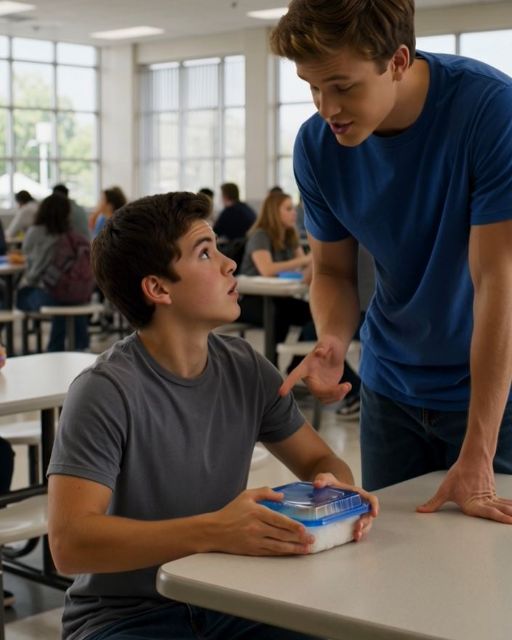
Caleb stood over my table. His friends, a laughing pack of hyenas, fanned out behind him.
My face went hot. I tried to slide the lid back over my plastic container.
Too late.
He leaned in, wrinkling his nose in a performance for the whole room. All eyes were on us now. My lunch, my mom’s carefully packed rice and fried egg, was the center of a circus.
My throat felt like it was closing up.
“Dude, are you eating garbage?” Caleb said, his voice dripping with theatrical disgust.
A few kids snickered. The sound was like sandpaper on my skin.
But it didn’t stop there.
He reached down, his clean fingers snatching the container from my hands before I could react. He held it up like a trophy.
“This is a health code violation,” he announced to the room.
Then he started walking.
I was frozen. Every step he took toward the trash cans at the far end of the room felt like a hammer blow. My heart hammered against my ribs, a frantic drumbeat of pure shame.
He didn’t even hesitate. He just dropped it.
The clatter of the plastic hitting the bottom of the empty bin echoed in the sudden quiet.
He dusted off his hands, turned, and smirked. The show was over. The laughter started up again, louder this time.
That’s when I saw her.
Ms. Evans, my history teacher, was standing by the door. She wasn’t looking at me. Her eyes were locked on Caleb.
And she wasn’t smiling.
The next day, I almost skipped lunch. The thought of walking back into that room made my stomach clench. But I went. I had to.
I sat alone in the corner.
Caleb was at his usual table in the middle of the room, holding court, louder and more confident than ever.
Then the doors opened and Ms. Evans walked in.
She wasn’t on duty. She just walked straight toward the center of the room, carrying a small, familiar-looking plastic container.
She didn’t stop at my table. She walked right up to Caleb’s.
The whole table went silent. The whole cafeteria started to go silent.
She pulled out the chair across from Caleb and sat down. She placed the container on the table and clicked open the lid.
Inside was a bed of white rice. And a single, perfect fried egg.
She picked up her fork, took a bite, and chewed slowly, never taking her eyes off of him.
The silence was absolute now. You could hear a pin drop.
After a moment, she swallowed.
“When I was your age,” she said, her voice quiet but carrying through the entire room, “my mother worked two jobs. This was my lunch. Every single day.”
She took another bite.
“It was the best meal I ever had.”
Caleb’s face, usually so full of color and arrogance, was sheet-white. He looked like he’d been punched in the gut. He opened his mouth, but no words came out.
Ms. Evans just kept eating her lunch.
And for the first time, I didn’t feel ashamed of mine.
She finished the entire container, down to the last grain of rice.
Then she carefully closed the lid, stood up, and placed the empty container in her bag.
She looked at Caleb one last time, a look that wasn’t angry, but was filled with a deep, profound disappointment.
Then she turned and walked out of the cafeteria.
The bell rang a few minutes later, ending the period, but it felt like it was ending so much more. The spell was broken.
No one laughed. No one even spoke to Caleb.
His friends got up and shuffled away, suddenly very interested in their shoes.
I walked home that afternoon feeling lighter than I had in months. The usual knot of dread in my stomach was gone, replaced by something warm and solid.
When I got to my apartment, the smell of garlic and soy sauce filled the small hallway.
My mom was in the kitchen, her back to me, humming a song I didn’t recognize.
She was already preparing dinner, and probably my lunch for tomorrow.
I watched her for a moment, her worn hands moving with a familiar, practiced grace.
All the times I’d wished for a sandwich, for a bag of chips, for anything that looked like what the other kids had, flashed through my mind.
And a different kind of shame washed over me. A shame for ever being ashamed in the first place.
“Hey, Mom,” I said, my voice a little thick.
She turned, wiping her hands on her apron, a tired but happy smile on her face. “Hello, sweetie. How was school?”
I just walked over and hugged her.
She was surprised, but she hugged me back tightly. “Everything okay?”
“Yeah,” I said into her shoulder. “Everything’s great.”
The next week at school was strange.
It was like a switch had been flipped. The social map of the middle school had been redrawn.
Caleb was an island.
People didn’t mock him. They just ignored him. His loud jokes fell into silence. His attempts to start a conversation were met with one-word answers.
His power, which had always been fueled by the attention of others, was gone.
I didn’t feel happy about it. I just felt… quiet.
I saw him one day, sitting by himself at the edge of the schoolyard, just staring at the grass. He looked smaller, somehow.
A few days later, I stayed after class to talk to Ms. Evans.
She was erasing the chalkboard, the white dust clouding around her.
“Can I help you, Michael?” she asked, turning to face me.
“I just wanted to say thank you,” I said, my voice barely a whisper. “For what you did. In the cafeteria.”
She gave me a small, kind smile. She leaned against her desk.
“You don’t have to thank me, Michael,” she said. “Kindness shouldn’t be something we have to be thanked for. It should be the default.”
We were quiet for a moment.
“My mom,” she continued, her voice softer now, “she came here with nothing. She cleaned offices at night and worked in a diner during the day.”
“She was so tired all the time. But every morning, before I left for school, there was a container on the counter. With rice and an egg.”
She looked out the window, but I knew she was looking back in time.
“She always made the yolk a little runny, just how I liked it. It wasn’t just food, Michael. It was her telling me she loved me, even when she was too exhausted to say the words.”
I nodded, understanding completely.
“Shame is a heavy thing to carry,” she said, looking back at me. “Don’t ever let anyone make you carry it for them.”
That conversation stuck with me.
The following Monday, Ms. Evans gave us a new history assignment. It wasn’t about dates or battles.
The assignment was called “The Story of a Meal.”
We had to choose a food that was important to our family and tell the story behind it. Where it came from, who taught us to make it, what it meant to us.
We had two weeks. We had to present it to the class.
I knew my topic immediately.
I spent the next two weeks talking to my mom more than I ever had.
I learned about my grandmother in her village, and how she could make a feast for ten people out of almost nothing.
I learned that a perfectly fried egg, with crispy edges and a soft yolk, was the first thing my dad ever cooked for my mom. It was their story.
My lunch wasn’t just my lunch. It was a novel.
The day of the presentations arrived.
Kids talked about their grandma’s spaghetti sauce, their uncle’s secret barbecue recipe, the first time they baked a cake from a box. The stories were simple and beautiful.
Then it was Caleb’s turn.
He walked to the front of the room, holding a single, crumpled piece of paper. He wouldn’t look at anyone.
He cleared his throat.
“My meal,” he started, his voice shaky, “is steak.”
He talked about how his dad would grill huge, expensive steaks in the backyard every Sunday. How it was a family tradition.
His voice was flat, like he was reading a script he didn’t write.
“It was a symbol of success,” he said. “My dad always said, ‘As long as we can afford this, we’re doing okay.’”
He paused. He took a deep breath, and the paper in his hands shook.
“We haven’t had it in six months.”
The classroom was completely still.
“My dad lost his job,” Caleb said, the words coming out in a rush. “We’ve been… we’ve been pretending. Selling things. My mom works, but it’s not enough.”
He finally looked up, and his eyes were swimming with tears. The mask of the bully had completely crumbled.
“I was so scared,” he whispered. “I was so angry that everything was changing. And I saw your lunch…” he looked at me, his gaze full of a raw, painful honesty.
“And it just made me angrier. Because it felt… simple. And real. And I hated you for it. Because my life was a lie.”
He couldn’t speak anymore. He just stood there, tears silently streaming down his face.
No one laughed. No one moved.
In that moment, I didn’t feel triumph. I didn’t feel like I had won.
I felt a pang of empathy so sharp it took my breath away.
I understood.
I understood the fear that made him so cruel.
After the bell rang, I saw him hurrying out of the school, trying to disappear.
I packed my bag and followed him.
He was standing by the curb, waiting. A dented, ten-year-old car pulled up, one I’d never seen before. A woman with tired eyes was behind the wheel. His mom.
My own mom was waiting for me across the street, holding a small bag of groceries.
I took a breath. I walked over to Caleb.
He flinched when he saw me, like he was expecting a punch.
“Hey,” I said quietly.
“What do you want?” he mumbled, staring at the ground.
“I’m sorry about your dad,” I said.
He looked up, shocked. He didn’t know what to say.
Just then, my mom crossed the street. “Michael, are you ready to go?”
She saw Caleb, and the woman in the car. She saw the look on both of their faces. My mom had a superpower for seeing things people tried to hide.
I did something I didn’t even know I was going to do.
“Mom,” I said. “This is Caleb. And his mom.”
My mother smiled a genuine, warm smile. She held out a hand to Caleb’s mother, who had rolled down her window.
“It’s so nice to meet you,” my mom said. “I’m Maria.”
“Helen,” Caleb’s mom replied, her voice strained.
They just looked at each other for a moment. Two mothers, from different worlds, standing on a curb outside a middle school.
And my mom, my amazing mom, seemed to understand everything in that one single look.
“You know,” she said, her tone light and casual, “I made way too much for dinner tonight. It’s a silly habit of mine.”
She turned to me. “Michael, why don’t you invite Caleb and his mom to join us? It’s nothing fancy.”
Caleb and Helen both looked stunned.
“Oh, no, we couldn’t possibly,” Helen started.
“Please,” my mom insisted, her smile unwavering. “I hate for good food to go to waste. It would be my pleasure.”
There was a long silence.
Then, Helen nodded slowly, a look of profound gratitude, and exhaustion, on her face. “Okay,” she whispered. “Thank you.”
That night, Caleb and his mom came to our tiny apartment.
It was awkward at first. We sat at our small kitchen table, the one with a slight wobble.
My mom brought out the food.
There was a big bowl of steamed rice. There was a plate of vegetables stir-fried with garlic.
And in the center of the table, there was a platter of perfect, crispy-edged fried eggs.
Caleb just stared at it.
My mom served everyone. She put a scoop of rice and a fried egg on Caleb’s plate.
He picked up his fork and took a bite.
He chewed slowly.
Then he looked at me, his eyes full of something I couldn’t quite name.
“It’s good,” he said, his voice quiet. “It’s really good.”
We didn’t talk about what happened in the cafeteria. We didn’t talk about his dad’s job.
We talked about movies. We talked about Ms. Evans. His mom and my mom talked about the rising price of groceries.
It was normal. It was simple.
As they were leaving, my mom packed a container for them to take home. It had rice and eggs for the next day’s lunch.
Helen hugged my mom, a real, heartfelt hug.
Before he left, Caleb turned to me at the door.
“Michael,” he said. “I am so, so sorry.”
“I know,” I said. “It’s okay.”
And it was.
Things changed after that.
Our families became friends. My mom would drop off meals sometimes. Helen, who was an accountant, helped my parents with their taxes for free.
Caleb and I weren’t suddenly best friends. But we started talking. We’d sit together at lunch sometimes.
He never made fun of anyone again.
He learned, just as I had, that everyone is carrying something. You just can’t always see the weight.
The greatest lessons aren’t always taught in a classroom. Sometimes they are served in a humble plastic container.
It taught me that kindness is a circle. It taught me that the simplest things – a plate of rice, an outstretched hand, a shared meal – are often the most powerful.
Shame can build a wall between people, but empathy can build a bridge. My lunch, the one I was so ashamed of, became that bridge. It wasn’t a source of humiliation. It was a source of connection, of forgiveness, and of hope. It was, and always will be, the best meal I ever had.