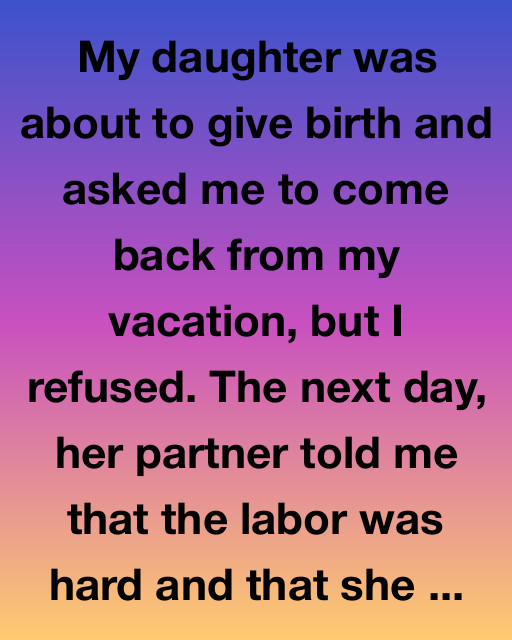
My daughter was about to give birth and asked me to come back from my vacation, but I refused. The next day, her partner told me that the labor was hard and that she had been asking for me the entire time.
I was sitting by the pool in a resort in Portugal, sipping a drink when I got the call. My son-in-law, Mark, sounded exhausted. “She’s okay now,” he said. “But it was rough. She cried for you a lot.” I remember pausing, unsure what to say. I mumbled something weak like “Glad she’s okay,” and hung up.
It wasn’t that I didn’t care. I love my daughter, Clara. But I’d booked this trip months in advance—my first real vacation alone since her father passed away. The timing was bad, sure, but Clara had Mark, and hospitals these days only allowed one person in anyway. I told myself it was fine.
But it didn’t feel fine.
I spent the rest of the trip trying to enjoy the sights, but my heart felt heavy. Every time I opened my phone, I half-expected another call. I thought maybe Clara would understand, maybe she’d text me a photo of the baby, maybe we’d laugh about it later. But her silence stretched on.
When I returned home two weeks later, I drove straight from the airport to her house. I had a little gift bag with baby clothes and a stuffed rabbit. My heart was pounding the whole way there.
Mark opened the door, holding the baby. He looked tired but smiled politely. “Hey,” he said. “Come in.”
Clara was on the couch, pale and quiet, the baby swaddled beside her. She didn’t look up when I walked in.
“Hi, sweetheart,” I said softly.
She nodded but didn’t smile. “Hey.”
I sat beside her, set the bag on the floor, and reached for her hand. She let me hold it, but there was no warmth in her grip.
“I’m sorry I wasn’t there,” I began.
She looked at me then. “I begged you,” she said. “I called and begged.”
My throat tightened. “I thought—I didn’t think it’d be so bad. You had Mark. I didn’t think I’d be allowed in anyway.”
Her eyes filled with tears, but she didn’t cry. “I was scared, Mom. I was in pain and terrified, and I just wanted you.”
I didn’t know what to say. I sat there in silence, feeling like the worst mother in the world.
For the next few weeks, I tried to make up for it. I cooked, cleaned, rocked the baby—Ellie—so Clara could nap. But there was a wall between us now. She didn’t talk much, didn’t laugh. I tried not to push her.
One afternoon, while folding laundry, Clara said quietly, “You chose a beach over me.”
I froze.
“I get it,” she continued. “You needed a break. But I needed my mom.”
I nodded slowly. “You’re right. And I was wrong.”
The thing about regret is that it doesn’t just show up once—it lingers. I thought maybe over time, she’d forgive me. That time would heal it.
But Clara changed after Ellie was born. She stopped calling as often. She stopped inviting me over. When I did visit, she was cordial but distant.
One day, I brought Ellie a little pink dress and Clara said, “She already has too many clothes. Maybe donate it.”
That was when it hit me—this wasn’t just hurt. This was a slow shutting of the door.
I called my sister that night and cried. “I ruined everything,” I said.
“You made a mistake,” she replied gently. “But mistakes don’t mean you stop trying.”
So I did try. I wrote Clara a letter, poured my heart out. Told her how proud I was of her, how much I loved her, how deeply I regretted not coming home. I left it in her mailbox.
She didn’t reply.
Months passed. I saw Ellie less and less. My friends told me to give it time, but time wasn’t healing this wound.
Then, in the spring, Clara called.
Her voice was shaky. “Can you come over?” she asked.
I was out the door in minutes.
When I got there, she opened the door and just stood there.
“Everything okay?” I asked.
She nodded. “Yeah. I just—Ellie took her first steps today.”
My heart clenched. I missed it.
“I thought you’d want to know,” she added.
I looked at her, really looked. She wasn’t mad. Just tired. Maybe a little sad.
“I do want to know,” I said. “Thank you.”
That night, she let me hold Ellie for an hour while she took a shower. It was the first time I’d been alone with my granddaughter in months. I kissed her chubby cheeks and whispered, “I’m so sorry I missed your first day, baby girl.”
Over the next few weeks, things got a little better. Clara called me once or twice to ask for help, and I showed up right away. No hesitation. No excuses.
Then, one day, Clara got a job offer. A big one. She was excited—but worried. “It’s full-time,” she said. “I don’t want Ellie in daycare all day.”
I waited.
“I was thinking,” she said slowly, “maybe you could watch her two days a week?”
My eyes welled up. “I’d love to.”
That was the start of something new.
Twice a week, I had Ellie. We played, laughed, danced in the kitchen. I fell in love with her in a way I hadn’t expected. She started calling me “Mimi,” and every time I heard it, it healed a little more of the crack between me and Clara.
One evening, Clara picked her up and stayed for dinner. Over a bowl of pasta, she said, “I think you’re trying now. I see it.”
I smiled. “I am. I’m sorry it took me so long.”
She nodded. “I’m still hurt. But I’m not angry anymore.”
That night, I cried again—but this time from relief.
Months passed. Ellie turned two. Clara started inviting me over more. She even asked if I wanted to join them for a weekend trip to the mountains. I went, of course. I wasn’t missing anything else.
And then came the twist.
It was early one morning, and I was getting Ellie ready when Clara walked in looking pale.
“I took a test,” she said.
I blinked. “A test?”
“I’m pregnant.”
My jaw dropped.
“I wasn’t planning it,” she added quickly. “But… I think I’m happy.”
I stood up and hugged her. “You’re going to be okay.”
She looked up at me, tears in her eyes. “Will you be here this time?”
I didn’t hesitate. “From the first appointment to the last push.”
She laughed through her tears. “Good.”
When the due date came close, I cleared my schedule, turned down an old friend’s invitation for a cruise, and told Clara I’d sleep on the couch the week before just in case she went into labor early.
She did.
At 2:47 a.m., her water broke. We rushed to the hospital together. Mark was on a work trip and couldn’t make it in time. It was just me and Clara.
I held her hand through the pain. I coached her breathing. I wiped her forehead and whispered, “You’re strong. I’m here.”
When her son came into the world, I cut the cord. The nurse handed him to Clara, and she looked up at me.
“Thank you for being here,” she whispered.
I kissed her head. “There’s nowhere else I’d be.”
We named him Caleb. She said she liked the sound of it, and I said it sounded like a second chance.
When we got home, Clara said something I’ll never forget. “I was angry for a long time. But watching you with Ellie, seeing you show up for me—maybe people do change.”
We can’t rewrite our mistakes. But we can write what comes after.
Now, every Tuesday and Thursday, I have both grandkids. We bake cookies, go to the park, read stories. I tell them how much their mom loved to paint when she was little, how she used to sing into her hairbrush.
Sometimes, late at night, I sit alone and think about that first phone call. The one I ignored. The trip I didn’t cut short.
And I remind myself: regret doesn’t have to be a life sentence. It can be a reason to become better.
Clara forgave me. Slowly, painfully, but truly.
And in doing so, she taught me something I didn’t expect: showing up after you’ve failed takes more courage than getting it right the first time.
But it’s worth it.
So if you’ve hurt someone you love… don’t give up. Keep showing up. Even if they don’t welcome you at first. Even if it’s awkward and hard.
Because sometimes, the second chance isn’t given. It’s earned.
If this story moved you, made you reflect, or reminded you of someone—share it. Maybe it’ll help someone else earn their second chance too. And don’t forget to like it if it touched your heart.