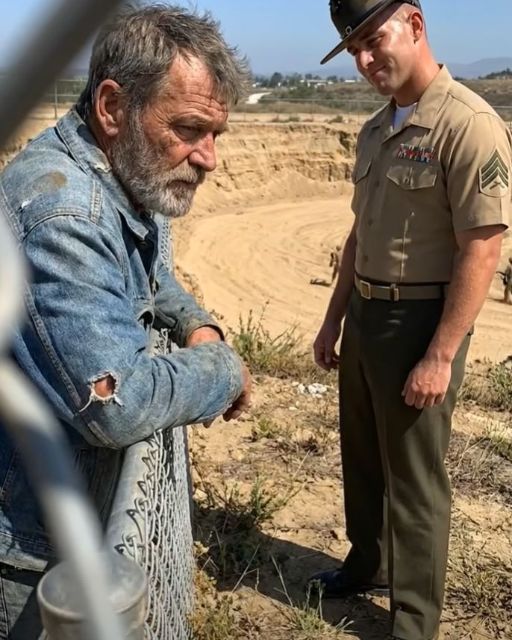
He was just some old man leaning on the fence, watching my guys run the course. Frayed denim jacket, worn-out boots. Looked lost. I’m Gunnery Sergeant Miller, and this is my pit. I don’t like strays.
“Gotta move, pops,” I said, walking over. My recruits were watching, so I put a little bass in my voice. “This is a live-fire area. Restricted.”
The old man, maybe seventy-five, just nodded. He didn’t look at me. He just kept watching the range. I saw a small, ragged hole on the shoulder of his jacket. I tapped it with my finger.
“You should get that stitched up,” I said, a little louder. A few of my guys snickered. “Looks sloppy.”
That’s when the three black trucks pulled up, kicking dust everywhere. A two-star General got out of the lead one. General Peterson. The whole platoon went stiff as boards. I barked “Attention!” and threw the sharpest salute of my life, my chest swelling with pride. He was here to see my boys.
But he walked right past me. He walked past my perfect line of hardened Marines. He walked straight to the old man at the fence.
General Peterson stopped. He didn’t shake his hand. He raised his own, slow and deliberate, and held a salute. It was the kind of salute you see at a funeral. Deep. Heavy. The old man just nodded back.
My smirk melted. My stomach went cold. The General lowered his hand and turned to me. His eyes weren’t angry. They were worse. They were full of pity. He pointed one clean, manicured finger at the little frayed hole I had just made fun of.
“Gunny,” he said, his voice barely a whisper. “That hole was made by the same piece of shrapnel that would have taken my life in the Ia Drang Valley.”
The world tilted. The dust in the air seemed to freeze. My own spit felt thick in my throat.
He wasn’t finished. His voice was still quiet, but it cut through the silence of the entire training ground. “This man, Corporal Arthur Vance, was standing in front of me when the mortar hit. He took the blast.”
My recruits weren’t snickering anymore. They were statues, their young faces pale under their high-and-tight haircuts. They were looking at the old man, then at me. I could feel their judgment, and it was a thousand times heavier than the General’s.
“He never put in for the Purple Heart,” General Peterson continued, his gaze locked on me. “Said he wasn’t wounded bad enough. Said other men deserved it more.”
I looked at the old man, really looked at him for the first time. His face was a roadmap of wrinkles, but his eyes were clear. They held a quiet stillness, a kind of peace that I’d never seen in a man before. He wasn’t looking for praise. He was just here.
My own pride, the thing I polished every morning along with my boots, felt like a lead weight in my gut. I had used my rank, my voice, my position to belittle a man whose quiet courage I couldn’t even comprehend.
“Sir,” I croaked out. The word was sawdust in my mouth.
The General didn’t acknowledge my apology. He put a hand on Arthur Vance’s shoulder, careful to avoid the hole. “Good to see you, Art. It’s been too long.”
“You too, Jimmy,” the old man said, and his voice was surprisingly gentle. He called a two-star General ‘Jimmy’.
The General turned back to me, and his expression softened just a little. “Gunnery Sergeant Miller, you have a new duty for the rest of the day. You will escort Mr. Vance to the mess hall. You will get him the best steak they have. Then you will drive him wherever he wants to go. Is that understood?”
“Yes, sir,” I managed, my voice cracking with shame.
“Loud and clear, Gunny. Dismissed.” He gave Arthur a final, respectful nod and walked back to his trucks, leaving me alone with the man I had so casually insulted.
The silence was excruciating. My recruits were still standing at attention, their eyes boring into me. I cleared my throat.
“Platoon, at ease,” I said, my voice hoarse. I turned to Arthur Vance. “Sir. Please, follow me.”
He just gave that same slow nod and started walking toward my Humvee. He moved with a slight limp I hadn’t noticed before. Each step he took felt like a hammer blow to my conscience.
The drive to the mess hall was the longest five minutes of my life. I wanted to say something, anything. I wanted to apologize, to explain, but what could I possibly say? ‘Sorry for being a loudmouthed fool?’ ‘Sorry for not recognizing a hero?’ The words felt cheap and empty.
We sat in the mostly empty mess hall. I got him a steak, mashed potatoes, the works. He ate slowly, deliberately, as if he were savoring every bite. I just pushed my food around my plate, my appetite gone.
Finally, I couldn’t take it anymore.
“Mr. Vance,” I began. “I… I am so sorry. There’s no excuse for my behavior. I was arrogant. I was disrespectful. And I was wrong.”
He looked up from his plate. He chewed his food, swallowed, and took a sip of water. He didn’t look angry. He just looked… thoughtful.
“You’re a good Gunny,” he said simply. “You keep your men sharp. I was watching them. They’re good kids.”
That almost made it worse. He was complimenting me. He was showing me a grace I didn’t deserve.
“But I…”
“You made a mistake,” he interrupted, his voice still soft. “You judged a book by its cover. A lesson everyone has to learn at some point. Some learn it harder than others.” He gestured at his old jacket, draped over the back of the chair. “This old thing? It’s seen better days. Just like me.”
He told me he’d been a Corporal in the Army, drafted at nineteen. He talked about the jungle, the heat, the constant fear. He didn’t tell it like a war story. He told it like he was describing a job he once had, a job that was difficult and dirty and changed him forever.
He described the day of the mortar attack. He didn’t use heroic language. He said, “I was just standing in the wrong place at the right time, I guess. Or the right place at the wrong time. Saved the Lieutenant. Got a face full of dirt and a new hole in my jacket.”
He smiled a little. “My wife tried to patch it a dozen times. But I asked her to stop. I told her it reminded me to be grateful for every sunrise.” His smile faded. “She’s been gone ten years now.”
We finished our meal in a more comfortable silence. When I asked him where he wanted to go, he just gave me an address on the other side of town.
The house was small, a little one-story place with peeling blue paint and a garden that had long since surrendered to weeds. It was tidy on the inside, but worn. Everything was worn. Just like his jacket. Just like him.
“Why were you at the base today, Mr. Vance?” I asked as I walked him to his door. “If you don’t mind me asking.”
He stopped on his porch and looked back toward the direction of the base, even though we couldn’t see it from here. His eyes took on that distant look again.
“Today’s the day,” he said, his voice dropping to a near whisper. “It’s been six years today.”
I waited, not understanding.
“My grandson,” he explained, his gaze finding mine. “Corporal Daniel Vance. United States Marine Corps.”
The air left my lungs.
“He was killed in Fallujah. Six years ago today.” He swallowed hard. “I go to the base on this day every year. I like to watch the new boys run. They have the same fire in their eyes that he did. Makes me feel… close to him. Makes me feel like what he did still means something.”
This was the second gut punch of the day, and it was even harder than the first. The man I had mocked wasn’t just a decorated war hero. He was a Gold Star grandfather. He was a man drowning in a private grief, seeking a moment of connection with the only thing he had left of his grandson: the uniform, the institution, the brotherhood. And I, a Gunnery Sergeant in that same brotherhood, had treated him like garbage.
Tears pricked my eyes. This time, I didn’t fight them.
“Sir,” I said, my voice thick. “I don’t know what to say.”
“Nothing to say,” he said, offering a weak smile. “Just a tough day. Thank you for the lunch, Sergeant. It was a good steak.” He turned and walked inside, closing the door gently behind him.
I stood on his porch for a long time, the image of that peeling paint and weedy garden burned into my mind. I drove back to the base a different man than the one who had left it. My pride was gone, replaced by a profound and aching shame.
The next morning, at platoon formation, I stood before my men. The snickering from the day before was gone. There was just a quiet, waiting tension.
“Yesterday,” I started, my voice clear and steady, “you saw your Gunnery Sergeant act like a fool. I disrespected an elder. I disrespected a veteran. I disrespected a hero.”
I told them everything. I told them about Corporal Arthur Vance and the Ia Drang Valley. I told them about General Peterson’s life being saved. And then I told them about Corporal Daniel Vance, USMC, and the real reason the old man was at our fence.
When I finished, you could have heard a pin drop. I saw the understanding and the shame dawning on their faces. They had laughed. They were complicit. And now they knew the truth.
“We have a new mission, platoon,” I announced. “It’s not on the training schedule. You won’t get a medal for it. It’s voluntary. But I expect to see every last one of you there.”
That Saturday, at 0600 hours, a convoy of pickup trucks and beat-up cars pulled up to Arthur Vance’s little blue house. My entire platoon was there, dressed in civilian clothes, armed with paint rollers, shovels, lawnmowers, and toolboxes. We had pooled our own money to buy the supplies.
When Arthur opened the door, he just stood there, speechless. His eyes welled up as he looked at the sea of young, determined faces on his lawn.
“What… what is all this?” he stammered.
“Gunnery Sergeant Miller’s platoon, reporting for duty, sir,” I said, giving him a proper salute this time. “We’re here to conduct a little home improvement.”
We worked all weekend. We scraped and painted the entire house a clean, handsome shade of gray with white trim. We tore out the weeds and planted a new garden, full of flowers and fresh mulch. A couple of my guys who knew their way around plumbing fixed his leaky faucet. Another group patched a soft spot on his roof.
The whole time, the men treated him with a reverence they usually reserved for the Commandant of the Marine Corps. They called him “Sir.” They asked him to tell them stories about his grandson, Daniel.
And he did. He brought out a photo album, and we all gathered on his newly painted porch as he showed us pictures of a smiling young Marine. He told us about how Daniel loved to fish, how he was a terror on the high school football field, how he signed up the day after he graduated because he believed in serving his country.
For the first time, Arthur Vance wasn’t just a quiet old man. He was alive. He was telling his boy’s story to a new generation of his brothers. He was passing the torch. My recruits weren’t just fixing a house. They were connecting to their own lineage, understanding that the uniform they wore was part of a story much bigger and older than themselves.
Late Sunday afternoon, as we were packing up our tools, another truck pulled up. It was General Peterson, in jeans and a polo shirt, holding a cooler.
He didn’t say a word. He just looked at the transformed house, at the new garden, at the group of tired, dirt-smudged Marines laughing with an old veteran. He walked over to me and clapped me on the shoulder.
“Now that’s what a Gunny does,” he said, a proud smile on his face.
The real reward, though, came a moment later. Arthur Vance stood on his porch, looking at his home. He looked at my platoon. And he smiled. It was a real, genuine smile, one that reached his clear blue eyes. He wasn’t just the old man at the fence anymore. He was our old man. He was one of us.
I learned a powerful lesson that week. It wasn’t just about respecting my elders. It was that the marks of a hero aren’t always polished brass medals or crisp uniforms. Sometimes they’re as humble as a frayed denim jacket. Sometimes the deepest scars a person carries are the ones you can’t see at all. And true strength, the kind that defines a real leader, isn’t found in a booming voice or unbending pride. It’s found in the humility to admit when you’re wrong, and the courage to make it right. That old, torn jacket with the shrapnel hole is now the most important war memorial I have ever seen.