The laughter was the first thing. A sound like tearing metal.
Mark Jennings had him pinned against the lockers. His two friends formed a wall. There was nowhere for Jacob Stone to go.
The hallway noise, the usual chaos of Northwood High, faded to a dull hum.
The only thing that mattered was the leather notebook in Mark’s hand.
He held it up like a trophy. “So, what’s in the secret diary, Stone? Poems about how much you hate your life?”
Jacob’s throat went dry. He reached for it. “Give it back.”
His voice was a ghost. He wasn’t even sure he’d said it out loud.
Mark just smiled. He opened the cover to the first page, his eyes scanning the lines.
Jacob saw the words in his own mind. November 12th. I remembered the smell of her soap today. Lavender.
A memory flared behind his eyes. A hospital room. A smell of disinfectant and quiet fear. His mother looking at him, her gaze polite and empty.
“Are you a friend of my son?” she had asked.
That sentence was a shard of glass in his gut. This notebook was the only thing that kept him from bleeding out.
“Please,” Jacob said, his voice cracking this time. “It’s not what you think.”
But that was a mistake. The word “please” was blood in the water.
Mark’s smile widened. He snapped the book shut. “Oh, I think it is.”
He tossed the notebook to his friend on the left. Jacob lunged, but the other one, a tall kid from the basketball team, just held it over his head.
They were toying with him now. A game of keep-away with the only thing he had left.
The laughter grew louder. Other students were stopping to watch the show.
His blood was ice in his veins. He felt small. Erased.
“Just leave it alone,” he begged.
Then came the shove.
It wasn’t hard, but it sent him stumbling backward. In that split second of imbalance, Mark snatched the notebook from his friend’s high grip.
He held it over the railing of the main staircase.
“You want it?” Mark taunted, dangling it over the drop. “Go get it.”
And then he let go.
Time seemed to warp. The thick, leather-bound book didn’t just fall. It tumbled. End over end, fluttering pages sounding like a wounded bird.
It bounced off a step with a sick thud. Then another.
The laughter from the top of the stairs was deafening.
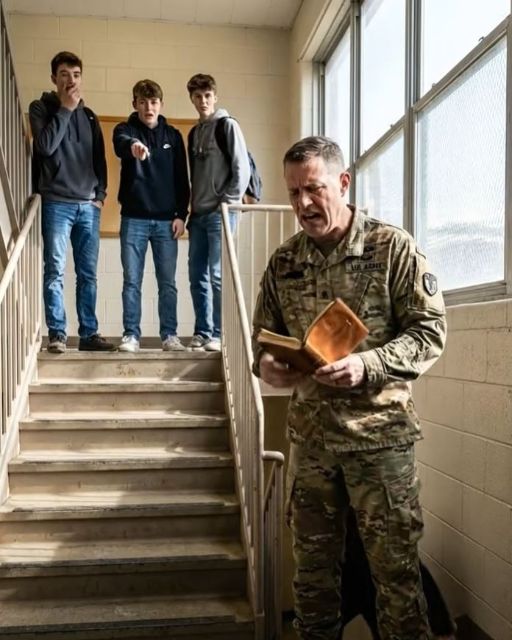
The notebook landed flat on the polished floor below. Right at the feet of a man in a crisp army uniform.
He had been standing there, unnoticed. A statue of stillness in the swirling chaos of the school.
The laughter upstairs sputtered out. One by one, they saw him.
The soldier didn’t look up. He simply bent at the waist, his movements precise, and picked up the book.
It had fallen open to a random page.
His eyes scanned the careful handwriting. The hallway was now utterly silent. You could hear the hum of the fluorescent lights.
He read for a moment, his expression unreadable. Then he slowly lifted his head, his gaze sweeping over the crowd of students until it landed on Mark Jennings.
The soldier’s voice wasn’t loud. But it carried to every corner of the vast space.
“This is his mother.”
He paused, letting the words hang in the dead air.
“And you just threw her down the stairs.”
The words didn’t make sense to Mark at first. He just stared, his smug grin frozen on his face.
The soldier took a single step forward, and the crowd of students instinctively parted for him.
He began to walk up the stairs. His footsteps were measured, each one landing with a quiet finality that echoed louder than any shout.
Jacob finally recognized him. “Uncle Thomas?”
The soldier, Sergeant Thomas Stone, gave his nephew a brief, reassuring glance before his eyes locked back onto Mark.
“You think this is a diary?” Thomas asked, his voice still quiet, but now laced with something cold and hard.
He held the book open. “Let me read you an entry. August 4th.”
His voice filled the silent hall. “‘She didn’t know it was her birthday. I brought her a cupcake with a single candle. She thanked me and asked my name. I told her it was Jacob. She smiled and said, ‘That’s a nice name.’ She used to call me her little Jaybird.’”
Thomas looked up from the page, his gaze piercing. “This isn’t a diary. It’s a memory book.”
He took another step up. Mark and his friends took a step back.
“His mother, my sister, was in a car accident a year ago,” Thomas continued, his voice unwavering. “She has a traumatic brain injury. She doesn’t remember her own name most days. She sure as hell doesn’t remember she has a son.”
A collective gasp rippled through the students. The cruelty of the moment suddenly had a name and a face.
“Every single thing Jacob can remember about his mom is in this book,” Thomas said, tapping the scuffed leather cover. “Every vacation. Every scraped knee she patched up. The way she smelled after she’d been gardening.”
He was standing right in front of Mark now. He wasn’t yelling. He didn’t have to. The truth was heavy enough to crush the air out of the room.
“He writes it all down, hoping that one day, he can read it to her and she’ll come back. That she’ll remember the boy she raised.”
Thomas held the book out to Mark. “You didn’t just throw a book down the stairs. You threw away his only hope.”
Mark stared at the notebook as if it were on fire. The laughter was a sour taste in his mouth. He felt sick.
The school principal, Mrs. Albright, finally pushed through the throng of students. “What is going on here? Sergeant?”
Thomas turned to her, his posture ramrod straight. “Ma’am. These boys were bullying my nephew and destroyed his personal property.”
Mrs. Albright looked from Mark’s pale face to Jacob’s, which was streaked with silent tears.
“My office,” she said, her voice sharp. “All of you. Now.”
The principal’s office was suffocatingly quiet. Jacob sat in one chair, his uncle beside him. Mark and his two friends sat opposite, looking at their shoes.
Mrs. Albright steepled her fingers on her desk. “Mark, I want an explanation.”
Mark mumbled something about it being a joke.
“A joke?” Thomas repeated, his voice dangerously low. “You think a son’s love for his mother is a joke?”
Jacob flinched. He just wanted to disappear. He reached out and touched the notebook, which sat on the corner of the desk. Its spine was bent, one corner crushed.
“Thomas,” Mrs. Albright said gently. “I am so sorry. For all of this.”
She turned her attention back to Mark. “This goes far beyond typical high school nonsense. This was malicious. Cruel.”
Mark finally looked up. “I didn’t know. I swear, I didn’t know.”
“That’s the point, son,” Thomas said, his voice softening just a fraction. “You didn’t bother to know. You just saw someone you thought was weaker than you, and you decided to tear him down to make yourself feel bigger.”
He leaned forward. “My sister, Sarah, is in the West Creek Care Facility. She’s being treated by one of the best neurologists in the state. A man who works day and night trying to piece people’s minds back together.”
A strange look crossed Mark’s face. West Creek. That was where his dad worked all those long hours.
“A man who sacrifices time with his own family to help strangers,” Thomas went on, unaware of the bomb he was about to drop. “Jacob and I are grateful to him every day. Dr. Jennings is a hero in our eyes.”
The name hit Mark like a physical blow. Dr. Jennings. His father.
His mind reeled. The late nights. The missed dinners. The constant exhaustion on his father’s face. All the resentment he’d felt toward the anonymous patients who stole his father’s attention… one of them was Jacob’s mom.
He had been tormenting the son of the woman his own father was trying to save.
“My dad…” Mark whispered, the words catching in his throat. “My dad is Dr. Jennings.”
The room went completely still. Thomas stared at him, his hard expression melting into disbelief. Jacob looked up, his eyes wide with shock.
Mrs. Albright slowly took off her glasses and rubbed her eyes, as if the weight of the irony was too much to bear.
Mark felt a wave of shame so profound it almost buckled him. All his anger, his casual cruelty, it all suddenly felt so small and so monstrously misplaced.
He had become the very thing his father fought against: a force of random, meaningless destruction.
The phone call to Dr. Jennings was the worst ten minutes of Mark’s life. He listened to Mrs. Albright explain the situation, hearing his own actions described in the cold, clear language of a school incident report.
He didn’t have to see his father’s face to know the depth of his disappointment.
An hour later, Dr. Jennings walked into the office. He looked tired, still in his light blue scrubs. He didn’t look at his son at first. His eyes went straight to Jacob.
“Jacob,” he said, his voice full of a gentle weariness. “I am so, so sorry. There are no words.”
He then looked at his own son, and Mark saw a pain in his father’s eyes he had never seen before. It wasn’t anger. It was a deep, soul-crushing sadness.
“We’ll go home and talk,” was all he said to Mark.
Thomas stood up and offered his hand to the doctor. “Sir. Your son made a terrible mistake. But he’s a kid. What you do for my sister… that’s what matters.”
Dr. Jennings shook his head. “How we raise our children to treat others is what matters, Sergeant. It seems I have failed on that front.”
That evening, the conversation between Mark and his father wasn’t a lecture. It was quieter, and somehow, much worse.
“I see so much pain every day, Mark,” his father said, sitting across from him at the kitchen table. “People’s lives change in an instant. One minute, they’re driving home from work. The next, they’re… gone. Or pieces of them are.”
He looked at his hands. “Sarah Stone… Jacob’s mother… she was a vibrant woman. A painter. She loved hiking. Her son was her entire world. Now, she looks at him and sees a stranger. Do you have any idea what that does to a boy?”
Mark could only shake his head, the shame a lead weight in his stomach.
“I work so hard to try and find a way back for them,” his father continued. “To reconnect those broken wires. And today, I found out that my own son was actively trying to break the spirit of someone already going through that hell.”
He finally looked Mark in the eye. “Why, Mark? Why would you do that?”
“I don’t know,” Mark choked out, and it was the honest truth. “I was stupid. I was trying to be funny. I… I was angry that you’re never here.”
The confession hung in the air. It was a selfish, childish reason, and he knew it. But it was the truth.
Dr. Jennings sighed. “I know I’m not here enough. And that’s on me. But the answer isn’t to inflict pain on others, Mark. The answer is to find a way to help heal it.”
The consequences at school were swift. Suspension. Mandatory counseling. But the real punishment was the one Mark had to create for himself.
The next Saturday, he asked his dad to take him to the West Creek Care Facility. He walked into the sterile-smelling building, his heart pounding.
He found Jacob sitting in a small, sunny garden with his uncle, reading from the battered notebook to a woman in a wheelchair who was staring blankly at a bird bath.
Mark walked over, his hands trembling.
Jacob looked up, his expression guarded.
“I…” Mark started, his voice barely a whisper. “I wanted to apologize. Again. What I did was… there’s no excuse. Your book… I get it now. It’s everything.”
He reached into his pocket and pulled out an envelope. “It’s not much. It’s all my savings. I was hoping it could help pay for a new one, or… something.”
Jacob looked at the envelope, then back at Mark. He didn’t take it.
“Keep it,” Jacob said quietly. “This one still works. The words are what matter.”
An idea, terrifying and necessary, formed in Mark’s mind. “Then… could I do something else? Could I… volunteer here? Do whatever. Clean floors. Anything.”
Thomas studied him for a long moment. Then he nodded slowly. “Talk to the volunteer coordinator. Tell them I sent you.”
So that’s what Mark did. Every Tuesday, Thursday, and Saturday, he went to West Creek. He started by mopping hallways and cleaning rooms. He learned the names of the residents. He listened to their stories, the ones they could remember.
He saw Jacob and his mother often. He never interrupted their time, but he would watch from a distance. He saw the boy’s relentless devotion, the endless patience as he read to a woman who gave nothing back.
He saw his own father on his rounds, saw the kindness and focus he gave to every single patient, and his resentment was replaced by a profound sense of awe.
Months passed. The seasons changed. Mark became a fixture at the facility. He wasn’t just cleaning anymore. He was helping residents with their meals, reading to a man named Arthur whose eyesight had failed, playing checkers with a woman who had lost a leg but not her competitive spirit.
He was healing something in himself, one small act of service at a time.
One crisp autumn afternoon, Mark was helping wheel Jacob’s mother back from the physical therapy room. Jacob was walking beside them, talking about a test he had aced in history class.
“…and Mr. Henderson said I really understood the causes of the conflict,” Jacob was saying.
Suddenly, Sarah Stone’s hand, which had been resting limply in her lap, twitched.
Her head turned slowly. She looked at her son.
For the first time in over a year, the polite, vacant look in her eyes was gone. It was replaced by a flicker of confusion, a glimmer of recognition.
Her brow furrowed. A word formed on her lips, quiet and raspy.
“Jaybird.”
Jacob stopped breathing. The world seemed to stop spinning. He stared at his mother, his heart hammering against his ribs.
“Mom?” he whispered, afraid to hope. “What did you say?”
She looked at him, really looked at him. A slow, fragile smile touched her lips. “My little Jaybird.”
Tears streamed down Jacob’s face. He fell to his knees and took her hand, pressing it to his cheek. It was real. A piece of her was back.
Mark stood frozen a few feet away, his own eyes burning with tears. He was witnessing a miracle, born from a boy’s unwavering love and a battered notebook he had once thrown away in a moment of thoughtless cruelty.
He quietly backed away, giving them their moment. He saw his father coming down the hall and waved him over, pointing toward the mother and son.
Dr. Jennings saw what was happening, and the tired lines on his face were erased by a look of pure, unadulterated joy. He put a hand on Mark’s shoulder, and in that simple gesture, a year of pain and disappointment was forgiven.
The road ahead for Sarah was long, and a full recovery was never guaranteed. But a light had been switched on in the darkness. Hope, which had been a one-sided conversation in a leather-bound book, was now a shared smile.
We all carry a book inside of us, filled with memories and stories that make us who we are. We never know when a careless word or a cruel act might tear out a page from someone else’s story. But compassion has the power to help write a new chapter, one of healing, forgiveness, and the quiet, stubborn miracle of hope.