She hadn’t walked in six months… then a stranger handed her one flower – and everything changed.
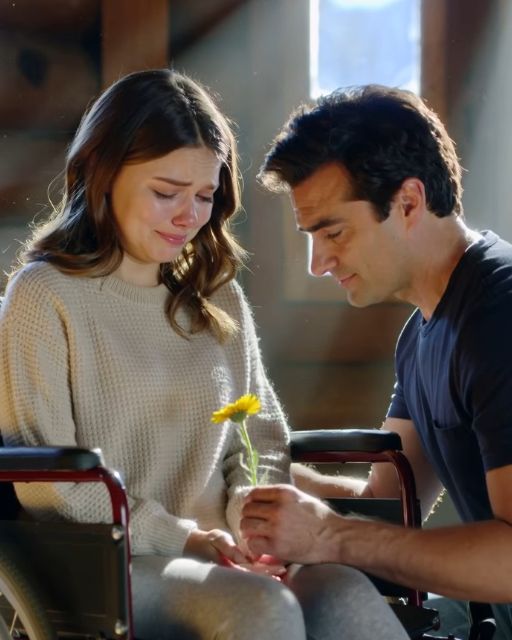
The man placed a single yellow wildflower in her lap.
Its color was a shock against the sterile blue of the blanket. Six months of blue blankets. Six months of wheels instead of feet.
His name was Leo.
He said, “Your body’s waiting on your heart.”
Then he added the part that broke everything open.
“And your heart is waiting for permission.”
Before the flower, there was the silence.
The silence of a hospital room where machines did all the talking. The silence of a sprawling mansion her father, Marcus Vance, had turned into a private rehab clinic.
He was a titan who built skylines. But he couldn’t rebuild a single damaged nerve.
He hired the best. Flew in specialists. Bought chrome-and-wire exoskeletons that promised miracles and delivered only noise.
Clara remained still.
A ballerina who had once commanded stages now couldn’t command her own legs to move. The accident had taken the light. The applause. The words.
Her father’s hope began to rust.
So he sent her away. To a mountain retreat that smelled of pine and last chances.
She hated it. The air was too clean. The quiet was too loud.
She parked her chair on the porch and watched the clouds, a fortress of one.
Then came the boy. Leo’s son. He pointed a grubby finger at her.
“My dad helps sad people,” he said, as if stating the time.
Leo didn’t try to fix her.
He just made space.
He left a tray of watercolors by her door. He tuned a small radio to a classical station, and she heard a piece she once danced to. He never mentioned it.
He just left the music in the air.
And one morning, he left the flower. That tiny, impossible piece of yellow.
That afternoon, he wheeled a mirror in front of her. Taped a straight line on the floor.
“Not therapy,” he said. “A memory.”
He helped her to a small barre he’d installed on the wall. Her hands, when they gripped the wood, felt like they belonged to someone else.
He turned on the music.
Her body remembered before her mind did.
A flicker. A deep, forgotten muscle in her calf trembled. Just once.
It was enough.
Days became a new kind of rhythm. Breathwork. Tiny shifts in weight. The boy clapping at the wrong moments until she started clapping with him.
Then came the morning.
Leo stood beside her, his hands hovering near her waist, a human safety net.
“Together,” he said. His voice was calm. The world was not.
She pressed down.
Pain shot up her legs, hot and electric. It was the sound of something waking up.
Her arms shook. Her jaw clenched.
And her legs held.
One second. Two. An entire lifetime passed in the space between heartbeats. Three.
Tears streamed down her face. Not for the pain. But for the proof.
Her father was standing in the doorway. The titan, undone. His voice was a crackle of static.
“I hired the world’s best,” he whispered. “How?”
Leo looked at Clara, not at the man who owned half the city.
“I don’t see what she lost,” he said. “I only see what’s left.”
Weeks later, she stood on the lawn by herself. The grass tickled her bare ankles.
She kept the flower, pressed between the pages of a book.
Not as a symbol of a miracle.
But a reminder.
Permission.
It was the only key that ever mattered.
But permission to walk wasn’t the same as permission to live.
The weeks that followed were a clumsy dance. One step forward, two steps of searing pain back.
Some mornings, the fear was a physical weight, pressing her back into the chair. The memory of falling was louder than the memory of flying.
Leo never pushed.
He’d just sit with her, sometimes bringing his son, Sam. They’d watch the birds, or Sam would show her a particularly interesting rock he’d found.
They talked about everything but her legs.
They talked about the shapes of clouds, the taste of wild strawberries, the way music could feel like a color.
Her world, once shrunk to the size of a wheelchair, began to expand again.
Her father, Marcus, grew impatient. He saw the standing, the single steps, as a problem solved.
“We need a schedule,” he declared one afternoon, marching in with a binder full of charts. “Physical therapy at nine, hydro-therapy at eleven. We’ll have you on a treadmill by Friday.”
Clara looked at the pages. They were filled with numbers and goals, but no room for fear. No space for a bad day.
Leo quietly took the binder from her hands.
“The treadmill can wait,” he said to Marcus. “Right now, Clara is learning to trust the ground again. That’s not on a schedule.”
Marcus’s jaw tightened. He saw a simple carpenter telling him how to manage the most important project of his life.
“And what do you know about it?” he demanded.
“I know you can’t build a person the way you build a skyscraper,” Leo replied, his voice even. “You have to listen to the materials.”
Marcus left that day, the binder still in Leo’s hand.
Clara felt a tremor of the old silence, the one her father’s presence always created. She had spent her life performing for him. On stage. In rehab.
She realized she had been trying to walk for him, too.
That night, she couldn’t sleep. The pain was a dull, constant ache. She made her way to the small kitchen, her hands tracing the walls for support.
She found Leo there, sketching in a notebook by the low light of the stove.
“Can’t sleep either?” she asked, her voice raspy.
He looked up and smiled, a gentle, tired smile. He didn’t ask about the pain.
“Sometimes the quiet is too loud,” he said, echoing her own thoughts from months ago.
She pulled up a chair. She watched his pencil move across the page, creating the intricate petals of a flower.
“Why do you do this?” she asked softly. “Help people. Help me.”
He stopped sketching. He looked at the drawing, but she knew he was seeing something else entirely.
“My wife, Isabella… she loved to dance.”
The words hung in the air. It was the first time he’d ever mentioned a wife.
“She was a lot like you,” he continued. “She found the music in everything. Even in silence.”
He finally met her eyes. There was a depth of sadness there that Clara hadn’t seen before.
“She was in an accident. A bad one.”
Clara’s breath caught in her throat.
“I did what your father is doing,” Leo said, his voice barely a whisper. “I hired the best. I pushed. I made schedules. I tried to fix her.”
He closed the notebook.
“I was so focused on making her walk again, I forgot to just be with her. I forgot to hold her hand. I forgot to listen.”
He took a slow, heavy breath.
“She never walked again. And I lost so much time trying to rebuild what was gone, I missed the beauty of what was still there.”
The kitchen was silent, save for the hum of the refrigerator. Clara understood.
He wasn’t fixing her. He was honoring Isabella. He was correcting his own past.
He was giving Clara the one thing he couldn’t give his wife: permission to heal at her own pace.
Their relationship shifted after that night. An unspoken understanding flowed between them.
He taught her how to feel the earth, not just stand on it. They took slow, measured walks into the woods, where she learned the names of trees.
Sam would run ahead, a flash of red jacket between the pines, and his laughter was better than any applause she’d ever heard.
Her father, however, saw this slowness as failure. As insubordination.
He couldn’t control Leo. He couldn’t buy him or intimidate him.
And for a man like Marcus Vance, that was unacceptable. So he decided to remove him.
He began to dig into Leo’s past, looking for a weakness. A forgotten debt. A past mistake. Something he could use as leverage to get rid of this gentle carpenter who had succeeded where his millions had failed.
He hired a private investigator. A man who specialized in finding cracks in people’s lives.
A week later, a thick manila envelope landed on Marcus’s mahogany desk back in the city.
He opened it, expecting to find proof of a checkered past.
Instead, he found a ghost.
There were old newspaper clippings. A formal accident report.
The headline was small, buried in the back of the business section from five years ago. “Scaffolding Collapse at Vance Tower Construction Site.”
He remembered it vaguely. A minor incident, his legal team had assured him. Handled quickly and quietly.
But as he read on, the words blurred. The report detailed the injuries of the single victim. A woman who had been walking on the sidewalk below.
Her name was Isabella Rossi.
A dancer.
The report listed her next of kin. Her husband. Leo Rossi.
The air left Marcus’s lungs. The silence in his penthouse office was suddenly deafening.
He stared at the photo of Leo and Isabella attached to the file. They were smiling, young, vibrant.
His project. His tower. His company’s negligence.
It had all led to this. The man who was healing his daughter was the man whose life he had destroyed.
Marcus flew back to the retreat the next morning. The manicured calm of the place felt like a mockery.
He found Leo by the small pond, skipping stones with Sam. Clara was sitting on a nearby bench, her face turned up to the sun, a genuine smile on her lips.
Marcus’s throat was dry. The titan felt like a child.
He waited until Sam ran off to chase a frog. He walked over to Leo, the manila envelope clutched in his hand like a verdict.
“I know,” Marcus said, his voice cracking. It was not the voice of a CEO.
Leo didn’t feign surprise. He just stopped, a flat, smooth stone in his palm. He looked at Marcus with a profound and weary sadness.
“You knew,” Marcus whispered, the accusation hollow. “All this time, you knew it was me. My company.”
Leo nodded slowly. “Yes.”
“Why?” Marcus choked out the word. “Was this revenge? To get close to my daughter… to hurt me?”
Clara had heard his voice and was now making her way over, her steps hesitant but steady. She saw the look on her father’s face and froze.
“Revenge?” Leo said, his voice soft but clear enough for Clara to hear. “I thought about it. For a year, it was all I thought about.”
He looked over at Clara, then back at the man who had built an empire.
“But anger is a cage. It locks you in the past. My wife wouldn’t have wanted that. She loved the world too much.”
He finally looked Marcus straight in the eye.
“I read about what happened to Clara. I saw you on the news, making promises, hiring armies of doctors. I saw myself. I saw the same mistakes I made.”
He paused, letting the weight of his words settle.
“I didn’t come here for you, Marcus. I came here for her. I came because I couldn’t help Isabella, but I thought… I thought maybe I could help someone else avoid the prison I built for her.”
He was offering forgiveness. Not absolution, but something far more powerful. A path forward.
Clara stood, rooted to the spot, tears streaming down her cheeks. The man who had given her back her legs had been carrying a weight far heavier than her own. Her father, the man who could move mountains, had caused the earthquake in this kind man’s life.
Everything clicked into place. The watercolors. The music. The flower. They weren’t just acts of kindness. They were echoes of a love that had been lost.
Marcus Vance finally broke.
The titan crumbled, sinking onto the bench. He covered his face with his hands, and for the first time in his daughter’s memory, he wept.
The healing that happened after that day was of a different kind. It wasn’t about nerves and muscles. It was about heart and soul.
Marcus didn’t try to fix things with money, not at first. He started by showing up. He learned to be quiet. He learned to listen.
He sold his plans for the new, state-of-the-art “Vance Recovery Center.”
Instead, he used the money to start a small, quiet foundation. He named it “The Isabella Project.”
It wasn’t a building. It was a network of people like Leo. Gardeners, musicians, artists. People who understood that healing wasn’t about conquering an ailment, but about making space for a new way of life.
Clara never returned to the grand stages of the ballet world. The desire was gone. The applause felt empty now.
She found a new stage.
She worked with Leo at the foundation. She started a small dance class for children with disabilities. She taught them not about perfect form, but about the joy of moving. The freedom of expression.
She taught them that their bodies weren’t broken, they just had a different story to tell.
One evening, as the sun set behind the mountains, painting the sky in shades of orange and pink, she was on the lawn. The same lawn where she had first stood on her own.
Leo and Sam were there, flying a kite.
She closed her eyes, feeling the cool grass beneath her bare feet. She lifted her arms, not in a practiced pose, but in a simple, grateful stretch toward the sky.
She began to move.
It wasn’t a performance. It was a prayer. A conversation between her body and the earth. It was clumsy and imperfect and more beautiful than any sold-out show she had ever danced.
Her father watched from the porch. He wasn’t a titan anymore. He was just a father, watching his daughter, truly happy for the first time.
Leo smiled, his hand resting on his son’s shoulder. He saw Clara, and in her, he saw the enduring echo of the love he had lost, transformed into a new and beautiful song.
The key was never about walking. It was never about a cure.
It was about realizing that the most broken parts of us are often where the most beautiful flowers grow. It was about giving your own heart permission, not just to heal, but to begin again.