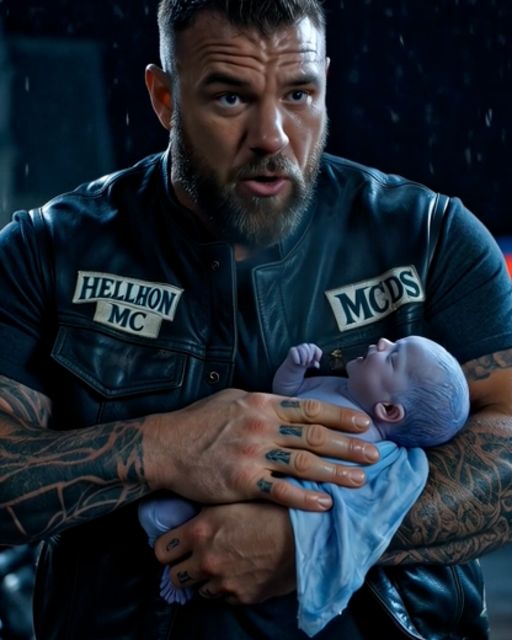
The abandoned baby was turning blue in the freezing church doorway when the biker found her at 3 AM.
I was working the late shift at the gas station across the street when I saw him pull up to St. Mary’s on his thundering Harley, probably just looking for shelter from the sleet.
He was massive – maybe 6’4″, covered in prison tattoos, wearing a Hellhounds MC vest that made my blood run cold.
Then I heard him scream.
Not an angry scream. A terrified one.
I ran across the street and found him on his knees in the doorway, cradling something tiny against his leather-clad chest, ripping off his vest to wrap around what I now saw was an infant.
“Call 911!” he roared at me, his voice cracking. “She’s not breathing right!”
The baby’s lips were purple. She couldn’t have been more than a few days old. Someone had left her in a cardboard box with nothing but a thin blanket.
I fumbled for my phone while this terrifying biker started doing something I never expected – infant CPR. Precise, gentle, clearly trained.
“Come on, little one,” he whispered between breaths. “Come on, baby girl. Stay with me.”
The baby gasped. Then cried. The most beautiful sound I’ve ever heard.
He clutched her to his chest, tears streaming down his scarred face, rocking her like she was his own.
“You’re okay,” he kept whispering. “You’re okay. I got you.”
When the paramedics arrived, they tried to take her. He wouldn’t let go.
“Sir, we need to – “
“I’m coming with her,” he said. It wasn’t a request.
At the hospital, I watched him pace the waiting room for six hours. His club brothers showed up, twenty deep, filling the ER lobby with leather and concern.
The doctor finally came out. “The baby’s stable. She’s lucky. Five more minutes in that cold…”
The biker collapsed into a chair, head in his hands.
“Sir,” the doctor continued, “social services wants to know… do you have any connection to this child?”
He looked up. And what he said next made the entire room go silent.
“Yeah,” he whispered, pulling out his wallet with shaking hands. “I do.”
He showed the doctor a photo – a woman holding a newborn, same blanket, same face.
“That’s my sister. She died three days ago. Overdose. I’ve been looking for her baby ever since.”
He looked at the doctor, then at the social worker who’d just walked in.
“That little girl in there? Her name is Willow.”
The social worker, a woman named Eleanor with tired eyes and a firm set to her jaw, stepped forward. “I’m sorry for your loss, Mr…?”
“Marcus,” he said, his voice raw. “Marcus Thorne. My sister’s name was Sarah.”
Eleanor took the photo, her expression unreadable. I stayed in the corner, unable to leave. This felt like the middle of something important, not the end.
“Mr. Thorne, you understand that even with this connection, there’s a process,” she said softly but professionally. “We’ll need to run a background check. Find a suitable placement while we sort this out.”
One of Marcus’s brothers, a man with a long gray beard, stepped forward. “He’s her uncle. That’s her placement.”
Eleanor didn’t flinch. “I appreciate your concern, but a Hellhounds Motorcycle Club is not a conventional home environment.”
Marcus stood up slowly. He seemed to tower over everyone in the room.
“My sister made mistakes,” he said, his voice quiet but carrying a weight that silenced everyone. “Big ones. But she loved that little girl more than anything. She told me if anything ever happened, I was to take care of her.”
“Did she have a will? Any legal documents?” Eleanor asked, holding her clipboard like a shield.
“No,” Marcus admitted. “She had nothing. Just me.”
I could see the wall going up in Eleanor’s eyes. I saw a man who looked like every warning your parents ever gave you, trying to claim a fragile infant. But I also saw what she didn’t. I saw him breathing life back into that baby.
The next few days were a blur of paperwork and hushed, tense conversations. I found myself drawn to the hospital, bringing coffee for Marcus and his crew, who kept a round-the-clock vigil outside Willow’s room in the NICU.
I learned that Marcus worked as a master mechanic at a custom bike shop. He had a small, clean apartment above the garage. I also learned he’d done time. Assault.
“I protected my sister,” he told me one night, staring at the linoleum floor. “Some guy got rough with her. I ended it. He lived. I went away for two years.”
That was the prison ink. Not a symbol of a hardened criminal, but a mark of fierce, misguided loyalty.
The system wasn’t kind. Marcus’s record, his association with the club, it was all working against him. They were talking about foster care, a closed adoption. They saw a liability, not a loving uncle.
His club brothers didn’t just sit there. They sprung into action. One guy, who went by “Preacher,” had a cousin who was a family lawyer. He offered his services pro bono.
Another, “Tiny,” who was anything but, started a collection. Within an hour, they had thousands of dollars for diapers, formula, a crib, anything Willow would ever need. They were a family, and that tiny baby was now part of it.
Eleanor, the social worker, remained the biggest hurdle. She visited Marcus’s apartment and I could tell she was unimpressed. It was sparse, masculine. A world of engine grease and leather, not lullabies and baby powder.
“Mr. Thorne, a child needs stability,” she said, her voice echoing in the small living room. “She needs… a different environment.”
“I can give her that,” Marcus insisted, his desperation palpable. “I’ll do anything. I’ll take parenting classes. I’ll quit the club if I have to.”
The thought of him quitting the only family he had left for a baby he’d just met was staggering. But I believed him. I saw it in his eyes every time he looked at Willow’s photo on his phone.
The day of the first custody hearing arrived. It was a sterile, cold courtroom. Marcus sat at a table with his lawyer, wearing a clean, pressed shirt that looked unnatural on his massive frame. His hands, usually so steady with a wrench, trembled slightly.
I was there. I’d given a statement about what I saw that night, how he’d saved her life without a second’s hesitation. I hoped it would be enough.
Eleanor presented her case. She spoke of Marcus’s record, his known associates, the “unsuitable” nature of his lifestyle. She recommended Willow be placed with a pre-approved foster family, a nice couple from the suburbs.
It felt like a death sentence.
The judge looked at Marcus. “Mr. Thorne, do you have anything to say?”
Marcus stood. He didn’t look at the judge. He looked at Eleanor.
“You see my tattoos,” he began, his voice raspy. “You see my vest. You see my record. You see a monster.”
He paused, swallowing hard. “But you didn’t see my sister, Sarah. You didn’t see her light go out a little more each year. You didn’t see her fight a battle she couldn’t win.”
“And you weren’t there in that doorway,” he continued, his voice cracking. “You didn’t feel that little girl’s heart stop. I did. I felt it. And I promised her, and I promised my sister, that I would never let her be alone or scared again.”
He finally looked at the judge. “I am not the perfect man. But I am all she has left. I’m her blood. And I will spend every day of my life making sure she knows how much she is loved. That’s a stability you can’t find in a file.”
The courtroom was silent. Even the judge seemed moved. But the law was the law.
“I’ll take this under advisement,” the judge said, his face grim. “A decision will be made in forty-eight hours.”
The mood was bleak. We all left the courthouse feeling like we’d lost. Marcus looked broken.
That evening, a call came. It was Father Michael from St. Mary’s. The church janitor had been doing a deep clean and found something tucked deep into the crevices of the stone doorway. A small, folded, and damp piece of paper.
It was a note.
Marcus, Preacher, and I met the priest at the church. He handed Marcus the fragile paper. With trembling fingers, Marcus unfolded it.
It was Sarah’s handwriting.
“My Dearest Marcus,” it read. “If you are reading this, it means I trusted you. I know you pass here on your way home. I knew you would find her. I’m so sorry. His name is David. He’s her father. He found me. He said he’d take her, that I wasn’t fit. He hurt me, Marcus. He’s dangerous. I can’t let him have her. Leaving her is the hardest thing I’ve ever done, but it’s the only way to keep her safe from him. Her name is Willow. Please, take her. Run. Love her for me. Always, Sarah.”
This changed everything. It wasn’t an abandonment. It was a desperate, heartbreaking act of protection. Sarah hadn’t just left her baby; she had placed her in the only safe hands she knew.
The overdose made a horrible, tragic new sense. She wasn’t just getting high. She was a terrified mother, heartbroken at giving up her child, trying to numb an unbearable pain. It was an accident born of grief.
The next morning, armed with the note, Marcus’s lawyer filed an emergency motion. We were back in court.
When the note was read aloud, Eleanor, the social worker, began to cry. The hard, professional mask fell away, and for the first time, she saw Marcus not as a file, but as a hero. A brother fulfilling his sister’s dying wish.
The police were notified. They found David, the ex-boyfriend, and it turned out he had a long and violent history. He was arrested on outstanding warrants and for the assault on Sarah. The threat was gone.
The judge looked at the note, then at Marcus. There was a long silence.
“Mr. Thorne,” he finally said, his voice thick with emotion. “It seems this court, and social services, have misjudged you.”
He cleared his throat. “Temporary custody of the infant Willow Thorne is granted to her maternal uncle, Marcus Thorne, effective immediately.”
The sound Marcus made was a strangled sob of pure relief. His entire club, filling the back benches of the courtroom, erupted not in cheers, but in a deep, rumbling sound of collective joy.
The rewarding conclusion wasn’t just the judge’s ruling. It was what happened after.
Eleanor personally oversaw the transition. She helped Marcus fill out paperwork for benefits, for parenting classes, for anything he needed. She became his fiercest advocate.
The Hellhounds transformed. Their clubhouse got a fresh coat of paint and a dedicated, baby-proofed nursery in the corner. These huge, tough men learned how to change diapers and warm bottles. They’d take turns rocking Willow to sleep on bike runs, her tiny carrier strapped safely to Marcus’s chest, the gentle rumble of the Harley her favorite lullaby.
Marcus thrived. Being a father softened his edges but strengthened his core. He was still a biker, covered in ink, but he was also the guy who could sing every word to “Twinkle, Twinkle, Little Star” and knew exactly how to get a stubborn burp out of a fussy baby.
Two years later, I stopped by the custom shop. The Hellhounds were having their annual charity drive. They had started a foundation in Sarah’s name, helping mothers struggling with addiction and domestic violence.
I saw Marcus across the lot. He was no longer just the massive, scary biker. He was on his knees, his back to me, holding out his arms.
A little girl with bright eyes and a cloud of dark hair toddled unsteadily toward him, squealing with laughter.
“Dada!” she yelled, collapsing into his embrace.
He scooped her up, burying his face in her hair, and I saw a smile on his face so full of love it could have lit up the whole city. He wasn’t just Willow’s uncle or her guardian. He was her dad.
I realized then that we spend so much time looking at the surface of people – the clothes, the tattoos, the reputation. We make up our minds based on the cover, never bothering to read the story inside.
That night in the freezing sleet, I thought I saw a monster. But I was wrong. I saw a guardian angel in a leather vest, on his way to save the one thing in the world that mattered. Family isn’t just about who you’re related to. It’s about the people who show up in the storm, the ones who pull you from the cold and hold you until you’re warm and safe. It’s about the love you fight for, and the life you build from the pieces of what was broken.