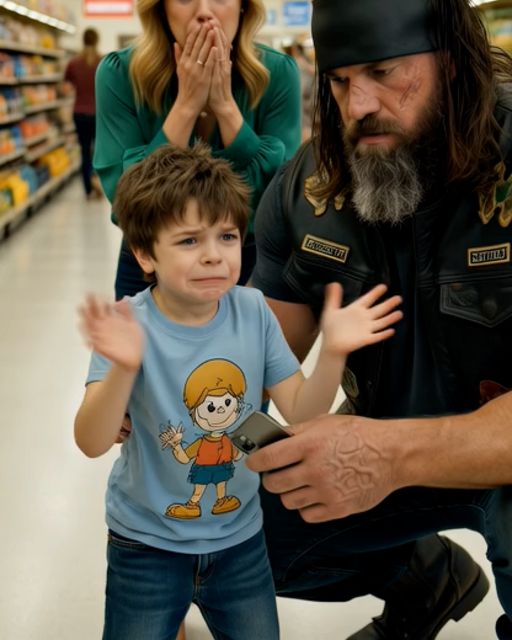
The autistic boy started screaming the second he saw the massive biker walk into the grocery store.
Not crying. Not whimpering. Full-blown, soul-shattering screams that made every shopper freeze and stare.
His mother tried everything – covering his ears, pulling him away, promising him candy – but he kept pointing at the biker and screaming louder, his whole body rigid with terror.
The biker was exactly what nightmares are made of: 6’7″, arms like tree trunks, a scarred face half-hidden by a gray beard, leather vest covered in patches that screamed “danger.”
Everyone pulled out their phones. The manager was already calling security.
But the biker didn’t leave. He didn’t even look annoyed.
He walked straight toward the screaming child.
The mother stepped between them, trembling. “Please, I’m so sorry, he has autism, he’s terrified of loud noises and your motorcycle outside – “
“Ma’am,” the biker interrupted gently. “Does he know sign language?”
She blinked. “What?”
“Sign language. Does. He. Know. It.”
“Y-yes, but why would – “
The biker knelt down, putting himself at eye level with the boy who was now hyperventilating. And then he did something that made the entire store go silent.
He started signing.
His massive, scarred hands moved with impossible precision and gentleness, forming words in ASL.
The boy stopped screaming mid-breath.
The biker kept signing. The boy’s eyes went wide. Then he signed back, his small hands flying frantically.
The mother’s face went white as paper.
“What… what is he saying?” someone whispered.
The biker stood up slowly, his expression darker than anyone had ever seen a human face go.
He looked at the mother. “Ma’am, your son just told me that the man in the blue car in the parking lot has been following you for three days.”
The mother gasped. “That’s… that’s my ex-husband. We have a restraining order, but how could he possibly – “
“Your son,” the biker said, his voice deadly calm, “learned to read lips to cope with overwhelming sound. He’s been watching that man mouth the same words for three days: ‘I’m gonna take you back.’”
He turned to face the store entrance.
Standing in the doorway, frozen in shock, was a man in a blue jacket who’d just realized his plan had been exposed by a child he thought couldn’t communicate.
The biker pulled out his phone, never breaking eye contact with the stalker.
“Yeah, it’s Priest,” he said into the phone. “I need the whole chapter at Miller’s Grocery. Now. We got a Code Purple.”
The stalker turned to run.
But the sound of motorcycles was already closing in from every direction.
The boy tugged on the biker’s vest. He signed something that made the giant man’s eyes go soft.
The mother, tears streaming down her face, whispered: “What did he say?”
The biker smiled for the first time, a gentle smile that transformed his terrifying face.
“He said his guardian angel finally showed up. He’s been praying every night for someone who speaks both his languages – sign and biker – because the angels told him that’s the only person who could help.”
The deep, guttural rumble of a dozen engines grew from a distant hum to an earth-shaking roar.
It wasn’t just noise; it was an announcement.
The man in the blue jacket, Mark, scrambled for the parking lot exit, his face a mask of pure panic.
He was too late.
Six motorcycles, chrome glinting under the fluorescent lights, formed a perfect, intimidating semi-circle, blocking the only way out.
The riders sat impassively, their engines idling in a low, threatening chorus.
Priest walked calmly toward the trapped man, his boots echoing in the now-silent store.
The boy, Caleb, held tight to his mother’s hand, his eyes fixed on Priest, no longer with fear, but with a kind of awe.
His mother, Sarah, was still trying to process everything. Her ex-husband was here. This terrifying biker was their savior. Her son, her silent, watchful son, had understood the danger all along.
Two police cruisers screeched into the lot, their sirens wailing. The officers who emerged looked young, overwhelmed by the sight of the biker chapter.
“What’s going on here?” one of them demanded, his hand hovering near his sidearm.
Mark saw his chance. “Officer, thank God! This man, this… this gang, they’re threatening me!”
Priest didn’t even turn around. He just pointed a thick finger back toward Sarah and Caleb.
“Ask her,” he rumbled. “Ask her about the restraining order this piece of work has been violating for the last three days.”
The police looked from the frantic, well-dressed Mark to the imposing biker and the trembling woman with her child.
They chose the path of least resistance. “Ma’am, is this true?”
Sarah found her voice, shaky but clear. “Yes. Mark isn’t supposed to be within 500 feet of us. He’s been following us.”
Mark scoffed. “It’s a public grocery store! I was just shopping. This is harassment.”
The younger officer seemed inclined to believe him. “Look, unless you have proof he was actively following you…”
That’s when Priest stepped in fully. He walked over to the officers, his sheer size making them take a step back.
“My proof is the boy,” Priest said, his voice low and steady. “He’s non-verbal, but he’s not blind. He saw everything.”
The officer looked at Caleb, who was hiding behind his mother’s legs. “The kid? What’s he going to do, write a statement?”
The casual dismissal hung in the air, sharp and ugly.
Priest’s eyes narrowed. “No. He’s going to tell me. And I’m going to tell you.”
He knelt again, right there on the grimy tile floor of the grocery store entrance. He faced Caleb.
He signed, his hands gentle and questioning. ‘Can you tell me what you saw? Take your time.’
Caleb peeked out from behind his mother. His small hands began to move, hesitantly at first, then with growing confidence.
He signed about a blue car parked at the end of their street, hidden behind a bush. He signed about seeing it near his school playground. He signed about seeing the man’s face in the rearview mirror at a stoplight yesterday.
Priest translated every word in a flat, emotionless tone that somehow made the story even more chilling.
The shoppers who had lingered to watch were completely silent, their phones now forgotten in their pockets. They were witnessing something profound.
The police officers exchanged an uneasy glance. This was not in their training manual.
“That’s… that’s just the kid’s word,” Mark stammered, sweat beading on his forehead. “He’s making it up!”
Priest stood up, his gaze locking onto Mark’s. “He also described the air freshener hanging from your rearview mirror. A little green pine tree.”
The senior officer glanced outside. He could just see the front of Mark’s blue sedan. A small, green tree was dangling from the mirror.
The game was over.
The police cuffed Mark, who was now spewing empty threats and denials. As they led him away, one of the bikers from the parking lot walked in and handed Priest a small memory card.
“Dash cam from Reaper’s bike,” the man said. “Got him pulling into the lot right behind her. And footage from yesterday near the school. We’ve been keeping an eye out.”
Priest nodded, then handed the card to the stunned police officer. “There’s your proof.”
The crisis was over, but the silence it left behind was heavy. Sarah sank to her knees and pulled Caleb into a hug so tight it seemed she was trying to fuse them together.
Tears streamed down her face. “You were so brave, baby. You were so, so brave.”
Caleb just kept his eyes on Priest.
Priest walked over, the other bikers slowly and quietly dispersing, their job done.
“Thank you,” Sarah whispered, looking up at him. “I don’t know how I can ever…”
Priest just shook his head. “No need. You’ve got a smart kid there.”
He looked at Caleb and signed, ‘You’re a warrior.’
Caleb beamed, a pure, unfiltered smile that lit up his entire face. He signed back, ‘You too.’
Over the next few days, the world shifted for Sarah and Caleb.
The bikers, the “Iron Guardians,” didn’t just disappear. One of them was always discreetly parked down the street from their small house.
Another would be sitting in a coffee shop across from Caleb’s school.
They weren’t threatening. They were just… there. A silent, leather-clad promise of safety.
Priest, whose real name they learned was Arthur, became a regular visitor.
He never came empty-handed. He’d bring motorcycle magazines for Caleb, who was fascinated by the shiny engines, or a coffee for Sarah.
He would sit on their living room floor with Caleb, not speaking a word, just signing.
They talked about everything. Dinosaurs. Stars. The different patches on Arthur’s vest.
Sarah watched them once, hidden in the doorway of the kitchen. Arthur’s massive, calloused hands, which looked like they could crush stone, were forming delicate signs, telling a story about a dragon.
Caleb was laughing, a silent, shoulder-shaking laugh that was the most beautiful sound Sarah had ever not heard.
One evening, after Caleb was asleep, Sarah finally asked the question that had been burning in her mind.
“Why?” she said, her voice soft. “Why do you know sign language so well? It’s not exactly common in… your world.”
Arthur was quiet for a long moment, staring at a framed picture of Caleb on the mantlepiece.
“I had a daughter,” he said, his voice thick with an old, deep sadness. “Her name was Lily.”
Sarah’s heart ached.
“She was born deaf,” he continued. “Brightest little girl you’d ever meet. She taught me how to listen with my eyes.”
He pulled out his wallet and carefully took out a faded photograph. It showed a younger, less scarred Arthur, holding a little girl with pigtails and a mischievous grin. She was signing ‘I love you.’
“She loved bikes. The vibration, she said, was like the world was singing to her.”
He swallowed hard. “We lost her in a car accident when she was seven. A drunk driver.”
The air in the room grew heavy with his grief.
“When I saw Caleb… when I saw the fear in his eyes, but not of me… it was like Lily was telling me to pay attention.”
He looked at Sarah, his own eyes glistening. “He couldn’t use his voice to ask for help. My little girl couldn’t either. I couldn’t fail another kid who was trying to be heard.”
Now Sarah understood. This wasn’t just a random act of kindness. It was a promise kept. It was a father’s love reaching across time to protect another child.
This was the first twist, the one that re-framed the entire event from a chance encounter to something that felt like fate.
But their peace was short-lived. Mark, out on bail, began a different kind of attack.
His lawyer filed a motion, claiming Sarah was endangering Caleb by associating with a known motorcycle gang. He painted a picture of her as an unfit mother, using the Iron Guardians’ protection against her.
It was a cruel, brilliant move.
Sarah was terrified. The very people who made her feel safe were now being used as a weapon to take her son away.
She called Arthur, her voice breaking. “I don’t know what to do. They want to put Caleb in foster care until the hearing.”
Arthur’s voice on the other end was dangerously calm. “Don’t you worry about a thing, Sarah. Let him play his games. We play, too.”
The day of the custody hearing arrived. The courtroom was cold and sterile.
Mark sat with his smug lawyer, looking like a concerned father. Sarah sat alone, feeling small and helpless.
Mark’s lawyer presented photos of the bikers outside her house, their leather vests and tattoos looking menacing under the courtroom lights.
“Your Honor, is this a safe environment for a special-needs child? A world of violence and intimidation?”
The judge, a stern-looking woman, seemed to be swayed. She looked at Sarah with disapproval.
Just when Sarah thought all hope was lost, the courtroom doors opened.
Arthur walked in. But he wasn’t wearing his leather vest.
He was wearing a perfectly tailored suit. His gray beard was neatly trimmed. His hair was combed back.
He looked less like a biker and more like a CEO.
Behind him walked ten other men. They were the Iron Guardians. All of them were in suits or respectable work clothes.
One was in a mailman’s uniform. Another in paramedic’s scrubs. One wore a tie and a name badge that said “High School Science Teacher.”
Mark’s jaw dropped.
Arthur approached the bench. “Your Honor, Arthur Collins. I’m a small business owner. I run a custom motorcycle shop.”
He gestured to the men behind him.
“This is Dave, he’s a mail carrier. That’s Miguel, a paramedic. Frank over there teaches chemistry at Northwood High. We’re not a gang. We’re a club. We’re a group of fathers, brothers, and sons who look out for our community.”
He then laid a thick folder on the judge’s bench.
“This is a file we compiled on Mr. Mark Jennings. It contains sworn affidavits from three of his former coworkers detailing his stalking and harassment of them. It has security footage from four different locations showing him following Sarah and Caleb, long before we ever got involved. And it contains a financial report showing he drained his joint savings account with Sarah a week before he started following her, in anticipation of a custody battle.”
Every word was a hammer blow to Mark’s case.
The judge looked at Mark, her expression now one of pure contempt.
But the final, most rewarding twist was yet to come. It came from the smallest person in the room.
Caleb, who had been sitting quietly, watching everything with his intelligent eyes, stood up.
He walked past his mother, past Arthur, and stood right in front of the judge’s bench, so she could see him clearly.
And then he began to sign.
Arthur stepped forward to translate, his voice filled with emotion.
“‘He told me mommy was bad,’” Arthur said, translating Caleb’s frantic signs. “‘He said he would take me away to a place with no loud noises. But his car is loud. And his voice is loud when he yells in the car.’”
Caleb paused, took a deep breath, and looked right at Mark.
For the first time in six years, since the trauma of his parents’ divorce had stolen his voice, Caleb spoke.
It wasn’t a scream. It wasn’t a cry. It was one, clear, powerful word that echoed through the silent courtroom.
“No.”
The entire room gasped. Sarah sobbed openly.
Caleb looked at Mark, his small body filled with a giant’s courage. “No. Go. Away.”
That was it. That was the end for Mark. He had built his entire case on Caleb being a broken, helpless victim.
But in that moment, Caleb was the strongest person in the room. He wasn’t a weakness to be exploited; he was his mother’s greatest and most powerful defender.
The judge threw out Mark’s case immediately and revoked his bail. He was led away, a truly defeated man, undone by the child he had so horribly underestimated.
Months later, life was different. It was calm.
The Iron Guardians were no longer sentinels; they were family. They came for barbecues, their deep laughter filling the backyard.
Arthur was a permanent fixture, a grandfather figure to Caleb. He was teaching him how to fix a bicycle, their hands, one large and scarred, one small and delicate, working together.
Caleb was still quiet, preferring to sign. But sometimes, when he and Arthur were working, a word would slip out. “Tool.” “Tight.” “Done.”
Each word was a small miracle.
One sunny afternoon, Sarah sat on the porch, watching them. Arthur looked up and caught her eye, a warm smile on his face.
She finally understood the lesson in all of this.
Sometimes, the things that seem most terrifying are the only things that can save you. A massive biker can have the gentlest heart. A silent boy can have the loudest voice.
And true strength isn’t about never being afraid. It’s about finding the courage to face your fears, even if all you can say is a single, perfect word.
The family you are born with isn’t always the one that saves you. Sometimes, your real family, your true guardians, find you in the most unexpected of places, like the middle of a grocery store aisle, guided by a silent scream.