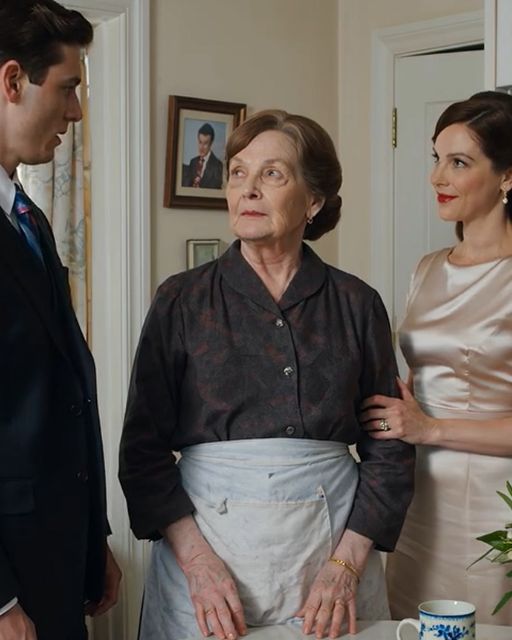
The flowers were a blast of color on my old kitchen table. Too bright for the room.
My son, Mark, looked at me with that gentle, distant way he has now.
“Mom, my wife still sends you five thousand dollars every month, right?”
He was just checking in. Making sure I was comfortable.
My blood went cold.
Five thousand dollars?
For the last eight months, my comfort came from food boxes dropped off by the local church. It came from neighbors slipping twenty-dollar bills into my hand, pretending they didn’t see me counting pennies for a carton of milk.
That question hung in the air between us.
It was a question from a different world. A world of glass offices and sleek, dark cars. His world.
Not my world, here in this small house where the same clock has ticked on the same wall for forty years.
He looked so sure. So at ease in my faded armchair, smelling of expensive cologne and a life I couldn’t imagine.
My fingers gripped the worn fabric of my apron.
“Five thousand,” I repeated, and my voice was a stranger’s. “Son… the church has been helping me with groceries.”
His smile vanished.
It was the look of a child finding out the magic trick isn’t real.
Before he could process it, she was there.
Chloe.
Her heels clicked on my worn floorboards like tiny, sharp hammers. A cloud of expensive perfume pushed out the familiar scent of my house, the smell of the apple pie I’d baked for them.
Her smile was an actress’s. Her eyes were not.
“Oh, Mother, you must have forgotten,” she said, her voice like honey. She slid next to him, a perfect picture. “I stop by every month to bring the money, remember?”
She was using my age against me.
A fragile old woman. A faulty memory. That’s what she wanted him to see.
But I was an accountant for thirty years. I remember every bill that crosses my table, every face that walks through my door.
And I knew.
I knew with a certainty that settled deep in my bones. No one had handed me forty thousand dollars.
“If you did bring it,” I said, my voice quiet but clear, “then it must have gotten lost somewhere.”
The room went dead silent.
Just the tick-tock of the old clock on the wall. The faint hum of a car passing outside. The frantic pounding of my own heart in my ears.
“Chloe,” Mark said, his brow furrowed with confusion. “You have been bringing the money, right? I transfer it to you.”
“Of course, darling,” she said, tilting her head. That smile never moved. “Maybe Mother just had a senior moment. You know how it is.”
She looked at me like I was a ghost. A problem to be managed.
They left soon after. Air kisses that never landed. Empty promises to visit more.
The front door clicked shut, and I was alone in the quiet.
Sunlight streamed onto the table, onto the flowers that seemed to mock me.
Five thousand a month. For eight months.
Forty thousand dollars.
Money for the leaking roof. For the refrigerator that hums on its last legs. Money for fresh fruit instead of canned peaches from the donation bin.
I sat there for a long time.
That night, I pulled out an old ledger.
I wrote two lines on a clean page.
Find the truth.
Don’t trust fake tears.
She thought she was stealing from a forgetful old woman in a dusty house.
She forgot I spent my life balancing books.
And every number tells a story.
The next morning, the sun felt different. It felt like a spotlight.
My first call wasn’t to Mark. Accusations without proof were just noise. They would make me look bitter and confused, playing right into Chloe’s hand.
My first call was to my old friend, Beatrice.
Beatrice had been the head teller at the downtown bank for as long as I’d been an accountant. We used to share lunch breaks and complain about our bosses.
She was retired now, too, but she still knew how things worked.
“Bea, it’s Eleanor,” I said into the phone.
“Eleanor! It’s been too long. How are you holding up?”
I kept my voice light. “Oh, you know me. Busy doing nothing.”
We chatted for a few minutes about our gardens and the rising price of everything.
Then I got to it.
“Bea, I have a strange question. It’s about my son, Mark.”
I explained the situation carefully, leaving out the accusations. I framed it as me being forgetful.
“Mark says his wife has been bringing me cash every month, but for the life of me, I can’t recall. My memory is like a sieve these days.”
Beatrice made a sympathetic noise.
“I was just wondering,” I continued, “if there’s any record of large cash withdrawals from my son’s account? Or his wife’s?”
There was a pause on the line.
“Eleanor, you know I can’t give you that information. Privacy laws.”
“I know, I know,” I said quickly. “I wouldn’t ask you to break the rules. I just thought… maybe you could tell me if it’s even possible. If the story makes sense.”
I could almost hear her thinking.
“Well,” she said slowly, “withdrawing five thousand in cash every month would raise a flag. The bank would have to file a report. It’s not illegal, but it’s unusual.”
She was giving me a clue.
“So it would be a very memorable transaction,” I said, letting her fill in the blanks.
“Very memorable,” she confirmed. “Not something a teller would forget.”
That was all I needed from her. No one at the bank would remember Chloe coming in month after month for a huge stack of cash.
Because it never happened.
My next step was sitting on my porch, watching the world go by.
I was waiting for Sarah, the young woman who lived next door. She was a student, always rushing around with a laptop bag slung over her shoulder.
She checked my mail for me when my arthritis was bad. She was kind.
When she came home that afternoon, I waved her over.
“Sarah, dear, could I bother you for a minute? I’m having some trouble with this newfangled internet.”
Her smile was genuine. “Of course, Eleanor. What’s up?”
I invited her in for a glass of iced tea and sat her down at my kitchen table.
“My daughter-in-law, Chloe, is involved with a lot of charities,” I began, choosing my words like I was choosing stones to cross a river. “I’m so proud of her, but I can’t keep them all straight.”
Sarah pulled out her phone, ready to help.
“She’s always posting about her charity work on that… what do you call it? The face-book?”
Sarah chuckled. “Facebook. Yeah, I can look her up. What’s her full name?”
I told her. A few taps later, Sarah’s expression changed.
“Hmm. Her profile is private, Eleanor. I can’t see anything unless I’m her friend.”
My heart sank a little. A dead end.
“But wait,” Sarah said, her fingers flying across the screen. “Sometimes people who are tagged in photos don’t have their profiles locked down.”
She was typing names of Chloe’s friends, people I’d heard mentioned at Christmas dinners.
And then, she found it.
A picture from a gala event two months ago. Chloe was in the center of the photo, wearing a shimmering dress that must have cost more than my monthly mortgage payment ever did.
She was holding a microphone, standing in front of a banner.
The banner read: “An Evening of Hope with The Gilded Foundation.”
“The Gilded Foundation,” I said aloud. “That’s one of them.”
Sarah’s brow furrowed. “That’s a new one on me. Let me Google it.”
She typed the name into the search bar. The results were sparse.
There was a slick, professional-looking website. It was full of beautiful photos of smiling children and heartfelt stories of families in need.
It talked about providing grants for education and emergency relief for single mothers. It was all very noble.
“It looks wonderful,” I said, trying to keep the tremor out of my voice.
“Yeah, it does,” Sarah agreed. “Let’s see who’s behind it.”
She clicked on the ‘About Us’ page. There was a Board of Directors listed.
And there, at the very top, was the founder and executive director.
Chloe Anderson. Mark’s wife. My daughter-in-law.
My blood ran cold for the second time in as many days.
“Well, isn’t that something,” I whispered.
“Wow, you weren’t kidding. She runs the whole thing,” Sarah said, impressed. “She must be a very generous person.”
Generous. The word hung in the air like a bad smell.
“Sarah,” I said, my voice low. “Can you look up one more thing for me? Can you see when this… Gilded Foundation was registered as a charity?”
Sarah navigated to a different website, one that looked much more official and governmental. She typed in the foundation’s name.
A record popped up.
The Gilded Foundation. Registered as a non-profit corporation.
Date of incorporation: Nine months ago.
One month before the money started to disappear.
I thanked Sarah, telling her she’d been a tremendous help. After she left, I went back to my ledger.
Underneath my first two lines, I wrote a third.
The Gilded Foundation.
The numbers weren’t just telling a story anymore. They were screaming it.
She wasn’t just stealing. She was building an empire on lies. She was using my struggle, my poverty, as the foundation for her own pedestal.
The anger I felt was cold and clean. It wasn’t the hot, messy anger of a shouting match. It was the precise, calculating anger of an accountant who has found a fatal error in the books.
And I knew exactly how I was going to conduct my audit.
A week later, Mark called. His voice was strained.
“Mom, Chloe is hosting a small fundraising dinner for her foundation this Saturday. She’d… we’d really love for you to be there.”
It was a test. An invitation to her world, on her terms. She wanted to parade me around, the sweet, doting mother-in-law, blissfully unaware.
“Oh, that sounds lovely, dear,” I said, my voice as sweet as her perfume. “I wouldn’t miss it for the world.”
On Saturday evening, I put on my best dress. It was twenty years old, a simple navy blue sheath, but it was elegant and it made me feel strong.
I didn’t look like a charity case. I looked like a woman who knew her own mind.
Mark picked me up. He was nervous, fussing with his tie in the rearview mirror.
“Mom, you look great,” he said, but his eyes were full of a plea. A plea for me to just play along, to not make things difficult.
He didn’t know I was bringing my own ledger.
The event wasn’t at their house. It was at a chic, minimalist art gallery downtown. Waiters in black uniforms floated through the crowd with trays of champagne and tiny, complicated-looking appetizers.
Chloe was a queen in her court.
She greeted me with a theatrical hug, her cheek cold against mine.
“Mother! I’m so glad you could make it. Isn’t this wonderful? All these generous people, coming together to make a difference.”
She gestured around the room at the well-dressed guests.
“It’s very impressive, Chloe,” I said. And it was. The lie was impressive in its scale and its audacity.
I spent the first hour observing. I listened to Chloe speak to donors, her voice filled with a passion that sounded almost real.
She told them about the single mothers they’d helped, the scholarships they’d provided. She was weaving a beautiful tapestry of deceit.
I accepted a glass of water from a passing waiter and found a quiet chair in the corner. I just watched.
Finally, the presentations began. Chloe took the stage to a round of warm applause.
She was radiant under the lights, a portrait of compassion and grace.
She spoke for fifteen minutes, her speech polished and moving. She was good. I had to admit that.
When she finished, she asked if there were any questions.
A few hands went up. Soft, easy questions about future plans and how to volunteer.
Then, after a pause, I raised my hand.
Chloe’s smile tightened for a fraction of a second. “Yes, Mother?”
I stood up slowly. I didn’t have a microphone, but my voice, though quiet, carried in the suddenly silent room.
“Chloe, dear,” I began. “It’s all so inspiring. I was just looking at your foundation’s public filings the other day. It’s a matter of public record, you know.”
A murmur went through the crowd. Mark, standing by the side of the stage, looked like he’d been turned to stone.
“I was an accountant for thirty years,” I continued, my voice steady and clear. “So I can’t help but notice the numbers. I saw that your foundation has received exactly forty thousand dollars in anonymous donations over the last eight months.”
I let that sink in.
“That’s a very specific number. Five thousand dollars a month.”
Chloe’s face was a mask of polite confusion, but her eyes were panicking.
“What an incredible coincidence,” I said, my voice dripping with false innocence. “Because that’s the exact amount my son has been sending for my care. The money you were supposed to be bringing to me.”
The silence in the room was absolute. You could have heard a pin drop on the polished concrete floor.
“But of course,” I went on, looking directly at her. “I must be confused. I’m just a forgetful old woman, after all. You told me so yourself.”
I looked over at my son. His face was pale, his eyes wide with a dawning, horrified understanding. He was connecting the dots. The strained finances he couldn’t understand. Chloe’s insistence on handling my money personally. My quiet admission that the church was feeding me.
It all clicked into place for him, right there, in front of everyone.
Chloe opened her mouth, but no sound came out. The beautiful, compassionate mask had shattered, and for the first time, everyone in that room saw the ugly truth underneath.
She tried to laugh it off, a brittle, high-pitched sound. “Oh, Mother, you’re getting things mixed up. Let’s talk about this later.”
But it was too late. The damage was done. The seed of doubt had been planted in the minds of every one of her “generous donors.”
I didn’t need to say another word. I had simply presented the facts, laid out the numbers on the ledger for all to see.
I sat back down in my chair, my work finished.
The rest of the evening was a blur of whispers and hasty exits. The party died an immediate and public death.
Mark drove me home in complete silence. The sleek, dark car felt like a funeral procession.
When we pulled up to my little house, he turned off the engine and just sat there, his hands gripping the steering wheel.
“Mom,” he finally choked out, his voice thick with shame. “I am so, so sorry.”
Tears were streaming down his face. Not fake tears, like his wife’s. Real, painful tears of regret.
“I didn’t see it. I didn’t want to see it,” he said. “I let you… I let you struggle while she was…”
He couldn’t finish the sentence.
I reached over and put my hand on his arm.
“It’s not about the money, Mark,” I said softly. “It never was. It was about the truth.”
He looked at me, his eyes searching mine.
“Let’s go inside,” I said. “I’ll make us some tea.”
The weeks that followed were quiet. Mark filed for divorce. The Gilded Foundation dissolved under a cloud of scandal and investigation.
Most of the money was gone, spent on dresses and parties and the illusion of a grand life. It didn’t matter.
Mark paid to have my roof fixed. He bought me a new refrigerator that hummed a quiet, happy tune.
He started visiting every Sunday. Not out of duty, but because he wanted to.
We would sit at my old kitchen table, the one that had seen forty years of my life, and we would just talk.
One afternoon, he brought me a small, simple bouquet of daisies from his own garden. They weren’t a blast of color. They didn’t feel out of place at all.
They looked like they belonged.
I took the first check Mark gave me for my living expenses and I walked it down to the church. I gave it to the same woman who had been dropping off my food boxes.
“This is an anonymous donation,” I told her. “From someone who knows what it’s like to need a little help.”
Watching her face light up was worth more than forty thousand dollars.
In the end, Chloe didn’t just steal money. She tried to steal my dignity, my mind, and my son. But she underestimated me.
She saw a frail old woman. She didn’t see the accountant who knew that every column must balance in the end.
Life has its own ledger. The debits and credits aren’t always in dollars and cents. They are measured in truth, in kindness, in the love you give and the respect you earn. And in the end, that account always, always balances.