Her lipstick was perfect. That’s what I remember.
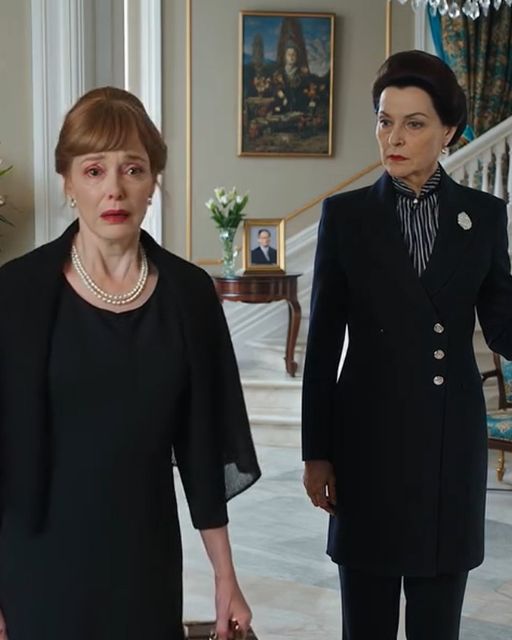
Three days after I buried my husband, his mother stood in the foyer of my home and told me to get out. The funeral lilies were still dropping petals on the marble floor.
Her voice was calm. Six words. “Pack your things and get out.”
I was 62 years old, still wearing my black funeral dress. My body started to shake.
She just smoothed the front of her tailored suit. “Robert is gone, Kate. You’re no longer under his protection.”
Fifteen years. I’d met him when he was visiting his father on the oncology floor where I worked as a nurse. He wasn’t my patient. He just kept showing up at my station with bad coffee and worse jokes.
He swept me out of my little apartment in the city and into this sprawling house with white columns. I spent the next decade and a half tending to him. Chemo. Remission. The relapse that finally won.
I emptied my savings for treatments the insurance wouldn’t touch. I learned the names of drugs I couldn’t pronounce. I retired early because his body was giving out and he needed me home.
We never lived like the money was real. We cooked in the kitchen. We drove upstate on weekends. I knew he was comfortable.
I had no idea about the thirty-three million.
Not until she said the number like it was a weapon. She pulled a folder from an antique desk. Papers fanned out across the dining room table where I’d fed him soup just a week ago.
“My home,” I whispered. It sounded pathetic.
She actually laughed. A short, sharp bark.
“Your home? My dear, you haven’t been paying attention.”
Her finger tapped a document. The house, the stocks, the business. All in his name. All under his family’s trust.
“Did you really think my son would leave his family’s fortune to a nobody nurse from the city?”
She called me a convenient caretaker.
She said my services were no longer required.
I had until Sunday. Monday, the locks would be changed.
By nightfall, my life fit into four suitcases and three cardboard boxes. I left the coffee maker he gave me for our fifth anniversary. I left the bed where I held his hand as he took his last breath.
I checked into a motel off the interstate. The kind of place that smells like bleach and desperation. The kind of place I used to send patients when they had nowhere else to go.
My phone buzzed. It was on the stiff motel bedspread next to me.
A text from Robert’s lawyer, David Chen.
Call me when you can. We need to discuss the estate.
My hands were numb. I figured he was calling to make it official. To tell me she was right. I was nothing.
I dialed his number at 6:30 the next morning.
“Kate,” he said. His voice was so kind it almost broke me. “Where are you?”
“A motel off the interstate,” I said. “Helen threw me out. She said Robert left me nothing.”
Silence on the other end.
Then, a new tone. Something hard. “She did what?”
“She said he left her everything. The house, the money. She said I was just… staff.”
“Kate.” He was speaking slowly now, carefully. “Do not go back there. Do not sign anything she gives you. Do not answer her calls.”
“David, just tell me the truth. I can take it.”
“That’s exactly what I’m doing,” he said. “Whatever Helen told you about Robert’s will… she’s either lying, or she’s seen the wrong documents. I’m coming to you. Right now.”
“Why?”
“Because Robert Vance did not spend fifteen years loving you just to leave you homeless in a motel,” he said. “You have no idea what your husband actually did to protect you from his mother.”
He hung up.
I sat there, in that cheap, cold room, listening to the rain against the glass.
For the first time since she spoke those six words, a new thought cut through the grief.
What if she was wrong?
And what if the man I just buried had been planning for this all along?
An hour later, a knock came at the door. It wasn’t the tentative rap of housekeeping. It was firm, certain.
I opened it to David Chen. He was holding two cups of coffee and a pastry bag. His suit was damp from the rain.
He wasn’t just Robert’s lawyer. He was his friend since college. He’d been at our small wedding.
“I figured this coffee is probably better than what they have here,” he said, stepping inside. The room suddenly felt smaller, but also safer.
I took the cup he offered. The warmth seeped into my cold hands.
He sat in the room’s only chair, placing a leather briefcase on the floor beside him. He looked at me, his expression a mixture of anger and deep sympathy.
“I am so sorry, Kate. I should have seen this coming. Robert always said she was predictable.”
“She had documents, David. It all looked so official.”
He nodded, taking a sip of his coffee. “Oh, it was official. It just wasn’t complete.”
He leaned down and opened his briefcase. He didn’t pull out a single folder. He pulled out a thick, bound document.
“Helen manages the Vance Family Trust. That’s what she showed you. It governs the ancestral properties, the core family business. It’s old money, tied up in knots.”
“The thirty-three million,” I said, the number tasting like ash.
“Give or take,” he confirmed. “And according to the rules of that trust, if Robert passed without a direct heir, his share reverts to the next of kin. His mother.”
My heart sank. So she was right.
David held up a hand, seeing the despair on my face. “But that was only one part of Robert’s financial world, Kate. The part he let his mother see.”
He slid the bound document across the stained motel table. The title on the cover was simple. The Katherine Vance Trust.
My name.
“Robert knew his mother,” David said softly. “He knew she saw you as an outsider. He knew she’d try to erase you the second he was gone.”
My fingers trembled as I touched the cover.
“So, about ten years ago, he started planning for this day. He started building you a fortress.”
“I don’t understand.”
“Every bonus he ever received, every stock option he exercised, every single dollar he earned that wasn’t automatically funneled into the family business… he moved it. Legally. Quietly. Into this.”
He tapped the document.
“This is a completely separate entity. A private trust in your name, with you as the sole beneficiary and me as the executor. Helen has no knowledge of it. She has no power over it. It was designed to be ironclad.”
I stared at him, unable to process the words. “He… did that?”
“He did more than that. He did it specifically to protect you from her. He structured it so it would only become fully active upon his death. He played the long game.”
My vision blurred with tears. Robert, my quiet, gentle Robert, with his bad jokes and his love for old movies. He had been a secret warrior for me all along.
David’s voice was gentle. “He loved you, Kate. He wasn’t going to let anyone hurt you.”
I finally opened the document. The first page was not legal jargon. It was a letter. In Robert’s familiar, slightly messy handwriting.
My Dearest Kate,
If you are reading this, then I am gone, and I am so sorry. I am sorry for every moment of pain you are feeling. I am even sorrier that my mother has likely added to it. Please forgive me for the secret I had to keep.
His words felt like he was in the room with me.
I never wanted our life to be about money. I never wanted it to be about fighting with my family. All I ever wanted was to sit on the porch with you, drive upstate in the fall, and watch you smile. That was my fortune.
But I knew my mother. Her love is a transaction, and she could never understand what we had. So I built this for you. Not as a prize, but as a shield. It’s a tool, nothing more. A tool to give you the peace you gave me every single day.
Live, my love. Don’t just survive. Live beautifully.
He had even included a list. ‘Kate’s Next Chapter,’ he called it.
The first item was a real estate listing for a small blue house in Cold Spring, the town we always talked about retiring to. He’d circled the address.
The second was the name of a small medical technology startup. ‘They’re working on something for at-home palliative care,’ he’d written. ‘It’s a beautiful idea. You’d understand it better than anyone.’
The last thing on the list was just three words. ‘Get a dog.’
I laughed through my tears. It was so perfectly him.
David let me have my moment. Then he cleared his throat. “There’s more, Kate. The numbers.”
I turned the page. My breath caught in my throat. It wasn’t thirty-three million. It was just over fifteen million. A sum so vast it felt like a misprint.
“This was his,” David explained. “His work, his investments, his life outside the family shadow. And now, it is all yours.”
For two days, I stayed in that motel. Not out of despair, but to absorb the truth. The shock of his loss was still there, a constant ache in my chest. But now it was wrapped in the incredible warmth of his love.
He hadn’t abandoned me. He had armed me.
On Friday, David called. “Helen’s legal team has requested a formal reading of the will at my office on Monday morning. She wants to finalize the transfer of the estate.”
“My estate?” I asked, the words feeling foreign.
“No,” David said, a hint of steel in his voice. “Her estate. She thinks she’s won. Robert and I prepared for this exact meeting. Will you be there?”
A week ago, I would have hidden. I would have let her walk all over me.
But I wasn’t the same woman she’d thrown out of her home. I was the woman Robert Vance had loved enough to build a fortress for.
“Yes,” I said. “I’ll be there.”
Monday morning, I walked into David Chen’s office. I wasn’t wearing my funeral black. I wore a simple cream-colored dress. I felt calm.
Helen was already there, sitting opposite a large mahogany desk. Her lipstick was, as always, perfect. She looked at me with pure disdain, as if I were a piece of trash that had blown in off the street.
She didn’t even say hello. She just looked at David and said, “Let’s get this over with. I assume she’s here to beg for scraps.”
David sat down behind his desk. He looked at Helen. He looked at me.
“Thank you both for coming,” he began formally. “We are here to execute the final will and testament of Robert Vance.”
He slid a document over to Helen. “Helen, as you know, you are the trustee of the Vance Family Trust. Robert’s shares in that trust now revert to you, as per the bylaws.”
She gave a smug, tight-lipped smile. “I am aware.”
“That trust,” David continued, “is currently valued at approximately thirty-three million dollars in assets, the primary one being the family home on Westland Drive.”
Helen nodded, impatient.
“Now,” David said, turning a page. “We must address the liabilities against the trust.”
Helen’s smile faltered. “Liabilities?”
“Yes. Ten years ago, Robert, as acting manager of the estate’s business interests, secured a twelve-million-dollar loan to fund a critical expansion. That loan was secured against the only asset large enough to cover it: the house.”
Helen went pale. The perfect red of her lips suddenly looked garish against her ashen skin.
“That loan is still outstanding,” David said calmly. “The trust is now responsible for it. Furthermore, Robert deferred several major repairs on the property. The roof needs replacing. There’s evidence of foundation damage. The estimates for these essential repairs total just over two million dollars.”
He let the numbers hang in the air.
“So, while you are inheriting an asset worth thirty-three million, you are also inheriting fourteen million dollars of immediate debt and necessary expenses.”
Helen stared at him, speechless.
“But that’s not why we’re here today,” David said, his voice softening as he turned to me. He slid the other, thicker document across the desk. My document.
“This is the final and primary testament of Robert Vance. It supersedes all previous versions. In it, he bequeaths his entire personal estate – all assets held outside of the Vance Family Trust – to his wife, Katherine Vance.”
He looked directly at Helen. Her face was a mask of disbelief.
“His personal estate,” David said, “comprised of his private investment portfolio, liquid savings, and stock holdings, is valued, as of this morning, at fifteen million, two hundred and forty-seven thousand dollars.”
Silence. The only sound in the room was the quiet ticking of a grandfather clock in the corner.
Helen finally found her voice. It was a strangled whisper. “He… what?”
“He left his personal fortune to his wife,” David said simply. “He left the family’s crumbling, debt-ridden house to his mother.”
Her perfect composure shattered. Her hands were shaking. She looked from David to me, her eyes filled with a rage that was terrifying to behold.
“He wouldn’t,” she hissed. “He wouldn’t do that to me. To his own mother.”
And for the first time, I spoke. My voice was quiet, but it didn’t tremble.
“Yes, he would,” I said. “He would do anything to protect the people he loved.”
She just stared at me, her mask of superiority gone, replaced by the raw, ugly face of defeat. Her lipstick was smudged at the corner of her mouth.
I stood up. I didn’t need to see any more.
I walked out of that office and didn’t look back.
The weeks that followed were a blur of paperwork and decisions, but for the first time in my life, they were my decisions. I bought the little blue house in Cold Spring. It had a garden out back and a porch with a swing.
I invested in the medical startup, just as Robert had suggested. I joined their board, my years as a nurse suddenly becoming my greatest asset. I found a new purpose in helping them develop tools that brought comfort to people in their final days.
And one sunny afternoon, I went to a local shelter. I came home with a scruffy, one-eared terrier mix who I named Robert. He was a terrible listener, but a world-class cuddler.
A year later, David called me. He told me Helen had been forced to sell the mansion. After paying off the loan and the realtors, she was left with a fraction of what she had imagined. She’d sold off the antique furniture to keep up appearances, but the word was out. She had lost her fortune and her standing. She was just another woman living in a condo, haunted by the ghost of a son who had outsmarted her.
I felt a brief, faint flicker of pity for her, but it passed.
That evening, I sat on my porch swing, watching the sunset paint the sky in shades of orange and pink. My dog, Robert, was asleep at my feet. I thought about the man who had given me all of this.
He had known that true wealth wasn’t about a mansion with white columns or a number in a bank account. It was about peace. It was about purpose. It was about knowing you were loved so completely that even death couldn’t take that protection away.
His greatest gift wasn’t the money. It was the quiet, unshakeable proof that he had seen me, truly seen me, all along. And in his final act, he made sure the rest of the world had to see me, too.