After I woke up from a coma, I stayed in the hospital for 2 more weeks. Every night at 11 p.m., a woman in scrubs sat with me for exactly 30 minutes. She never checked my vitals. She just talked.
She told me about her garden. About her daughter’s piano recital. About the recipe for her mother’s lemon cake. Normal things. Quiet things.
I looked forward to her visits more than anything. She made the beeping machines and sterile walls feel less suffocating.
On my last night, I asked her name. She just smiled and squeezed my hand. “You’ll be okay now, sweetheart.”
The next morning, I asked the head nurse to thank her.
She pulled up the shift logs. Checked twice. Then a third time.
“Sir, no one matching that description has worked the night shift this month.”
My stomach dropped. “That’s impossible. She was here every single night. Room 412. Eleven o’clock.”
The nurse looked like she had an idea. She excused herself.
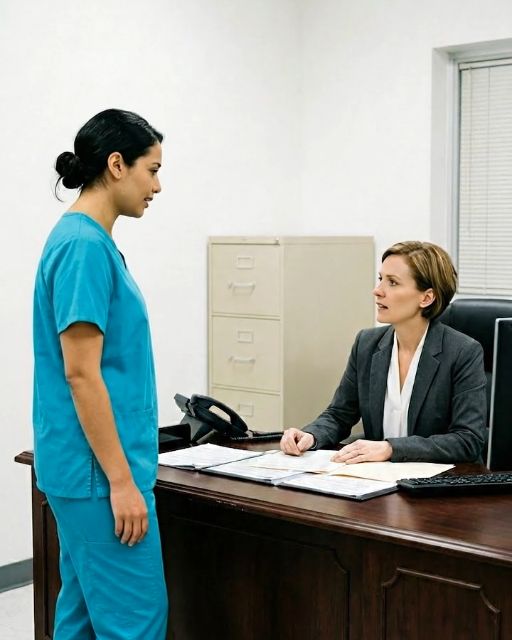
Twenty minutes later, she came back with the woman who sat with me, but this time, she was a patient.
“This is Beth. She likes to sneak out of her bed during the night. I have no idea how she got the uniform,’ she whispered.
I looked at her. ‘Why did you visit me?’
Beth stood there, clutching the loose fabric of her pale blue patient gown. Her face, which had looked so calm and knowing in the dim light of my room, now seemed fragile and full of shame.
She wouldn’t meet my eyes. Her gaze was fixed on the polished linoleum floor.
The head nurse, a woman named Miller, put a gentle hand on Beth’s arm. “It’s okay, Beth. Just tell him.”
Beth shook her head slowly, a single tear tracing a path down her cheek.
I felt a strange mix of confusion and compassion. This wasn’t a ghost or a figment of my imagination. This was a real, breathing, hurting person.
“It’s alright,” I said, my voice softer than I expected. “I’m not angry. I just… I want to understand.”
Nurse Miller gave me a sympathetic look. “I’ll give you two a few minutes. Don’t you go wandering off again, Beth.”
She gave Beth’s arm a final, reassuring squeeze before turning and walking quietly out of the room, leaving the door slightly ajar.
Silence hung between us, punctuated only by the distant, rhythmic beep of a machine down the hall.
Finally, Beth took a hesitant step forward. She sank into the visitor’s chair, the same one she’d occupied every night for two weeks.
“The uniform,” she began, her voice a near whisper. “It was my daughter’s.”
She looked up at me then, her eyes swimming with a sorrow so deep it felt like I could fall into it.
“Her name was Sarah. She was a nurse. Here, on this floor.”
My own breath caught in my chest. “Was?”
Beth nodded, swallowing hard. “She passed away. A little over a year ago.”
Suddenly, the whole situation shifted. This wasn’t a prank or a sign of delusion. This was grief.
“I’m so sorry,” I said, the words feeling small and useless.
“She loved her job,” Beth continued, a faint, sad smile touching her lips. “She loved taking care of people. She used to tell me stories about her patients, about the little things that made a difference.”
“A kind word. Holding a hand. Just being present.”
I thought of her hand squeezing mine. The simple, solid comfort of it.
“I keep her uniform in my bag. Sometimes… sometimes I just hold it. It still smells a little like her. Hospital soap and that floral perfume she always wore.”
She smoothed a non-existent wrinkle on her patient gown. “I’m here for some tests. My heart’s been acting up. The doctors say it’s stress.”
“But at night,” she said, her voice dropping again, “the quiet is too loud. The memories get overwhelming.”
“One night, I couldn’t sleep. I just… I put on her uniform. It felt like I was putting on her strength. Her purpose.”
She looked around my room, at the IV stand and the heart monitor. “And then I just started walking.”
“I don’t know why I picked your room. I heard the other nurses talking. They called you the miracle in 412. The man who shouldn’t have survived the crash.”
A chill went down my spine. The crash. The details were still a blur, a chaotic mess of shattered glass and screaming metal.
“I peeked in,” Beth said. “You looked so alone. Hooked up to all those machines. It reminded me of…”
She trailed off, dabbing at her eyes with the back of her hand.
“It reminded me of the end. With Sarah.”
We sat in that shared understanding of hospital rooms and the fragility of life.
“I just wanted to sit with you,” she confessed. “I thought, this is what Sarah would have done. She wouldn’t have let you be alone.”
“So I started talking. Telling you things. To fill the silence. To make it feel less like a hospital and more like a home.”
A thought occurred to me then, a piece of the puzzle clicking into place.
“The stories,” I said. “Your garden? Your daughter’s piano recital?”
Beth’s sad smile returned. “The garden was Sarah’s. She had a little patch behind her apartment. Grew the most beautiful tomatoes.”
“And the recital… that was my granddaughter, Lucy. Sarah’s little girl.”
My heart ached for her. For this woman who was keeping her daughter’s world alive by sharing it with a stranger.
“And the lemon cake?” I asked quietly.
“My mother’s recipe,” she confirmed. “I made it for Sarah every year on her birthday. It was her favorite.”
I realized then that she hadn’t just been talking to fill the silence. She was giving me pieces of her daughter. She was honoring her memory in the only way she knew how.
She was sharing a life that had been cut short, making sure it still echoed in the world.
I didn’t see her as a patient who’d broken the rules anymore. I saw her as a grieving mother who had found a unique way to channel her love.
“Thank you, Beth,” I said, and I meant it more than any words I had ever spoken. “You have no idea how much that meant to me.”
“You helped me. You made me feel… human again.”
She finally offered a genuine, watery smile. “I think,” she said softly, “I think maybe I needed it as much as you did.”
We talked for a little while longer, and she told me more about Sarah. About her bright laugh and her stubborn streak. About how she could comfort the most difficult patients with her gentle presence.
Before Nurse Miller returned, a memory surfaced in my mind, hazy and indistinct, from the accident.
It was a feeling more than a clear picture. A sense of pressure on my hand. A voice, soft and steady, cutting through the pain and confusion.
“Hold on. Just hold on. Help is coming.”
I always assumed it was a paramedic, one of the first responders.
I looked at Beth, a sudden, wild thought taking root in my mind.
“Beth,” I started, my voice trembling slightly. “My accident… it was at the intersection of Oak Street and the old highway.”
Her eyes widened in disbelief. She stared at me, her mouth slightly agape.
“How… how did you know that?” she whispered.
“It’s in my chart, I guess,” I lied, not wanting to explain the fragmented flashes that were starting to come back to me. “What were you doing there?”
The question hung in the air, heavy with unspoken possibilities.
Beth’s hand went to her mouth. The color drained from her face.
“I was driving home,” she said, her voice shaking. “From my grief support group meeting. It’s just a few blocks from there.”
My heart started to pound against my ribs, a frantic, unsteady rhythm.
“I saw the lights,” she continued, her gaze distant, as if she were seeing it all over again. “The twisted metal. I was the first one there.”
“I pulled over. I ran to your car. You were… you were in a bad way.”
Tears were streaming down her face now, unchecked.
“I didn’t know what to do. I’m not a nurse like Sarah was. But I knew I couldn’t leave you.”
“So I called 911. And I held your hand. And I just talked to you.”
The memory slammed into me with the force of a physical blow. The soft voice. The steadying presence.
“Hold on,” she whispered, repeating the words from my memory. “Just hold on. Help is coming.”
It was her.
It was Beth.
She wasn’t just some patient who had wandered into my room. She was the first person who saved me. The stranger on the side of the road who refused to let me go.
I stared at her, speechless. The universe suddenly felt both impossibly large and incredibly small.
Of all the hospitals in the city, we had ended up in the same one. Of all the rooms on the floor, she had been drawn to mine.
It wasn’t a coincidence. It felt like something more. Something like fate.
“You,” I finally managed to say, my voice thick with emotion. “It was you.”
She nodded, wiping her tears with the sleeve of her gown. “I never knew what happened to you. They took you away, and I just… I prayed.”
“Every night, I prayed for the man in the blue car.”
We were no longer just two patients in a hospital. We were a beginning and an end, a closed circle of trauma and healing. She was there at the worst moment of my life, and she was here again, guiding me through the aftermath.
When Nurse Miller came back, she found us both in tears, my hand holding Beth’s.
I was discharged two days later, but my recovery had only just begun. The first thing I did when I got my phone back was get Beth’s number from Nurse Miller, who seemed to understand that hospital rules were sometimes secondary to human connection.
I called Beth every day. I learned that she was going to be in the hospital for another week for observation.
I started visiting her. I was no longer the patient; I was the visitor.
I’d sit in the uncomfortable chair in her room, and we would just talk.
One day, I brought her a small potted tomato plant. “For your garden,” I told her.
Her eyes lit up in a way I hadn’t seen before.
Another day, I brought my laptop and played a recording of a beautiful piano concerto. “For the recital,” I said.
She closed her eyes and listened, a peaceful expression on her face.
I was helping her heal, just as she had helped me. I was bringing the pieces of her daughter’s life that she had shared with me into her hospital room, making them tangible, making them real.
I finally met Lucy, her granddaughter, during one of my visits. She was a bright, bubbly seven-year-old with Sarah’s smile.
She hugged me tightly. “Grandma Beth told me you were her hospital friend.”
“I am,” I said, my voice catching. “A very good one.”
The day Beth was discharged, I was there to pick her up. She was moving in with Lucy and her son-in-law, who welcomed me with a grateful handshake.
A few weeks after that, on a sunny Saturday afternoon, the three of us stood in Beth’s kitchen.
A worn, handwritten recipe card was propped up on the counter. Flour dusted our hands. The sweet, zesty smell of lemons filled the air.
We were baking her mother’s cake. Sarah’s cake.
As Lucy carefully stirred the batter, I watched Beth. The deep lines of sorrow on her face seemed to have softened. There was a light in her eyes that had been missing.
She was still grieving, I knew. That would never go away completely.
But she was also living. She was laughing as Lucy got a smudge of flour on her nose. She was sharing stories. She was making new memories.
As we sat at the table, eating warm slices of the most delicious lemon cake I had ever tasted, I looked at these two people who had become my family.
Our connection was born from the worst day of my life, from a tangle of metal and a mother’s profound loss. But from that tragedy, something beautiful and unexpected had grown.
We had found each other in the dark.
I realized that healing isn’t just about medicine and recovery. It’s about connection. It’s about finding the people who will sit with you through the night, even when they’re fighting their own battles.
Sometimes, the person who saves you on the side of the road is the same person you are meant to help find their way back home. Life has a strange, beautiful symmetry like that. Kindness is never a one-way street; it’s a circle that always, eventually, finds its way back to you. We had saved each other. And that was a miracle greater than just surviving a crash.