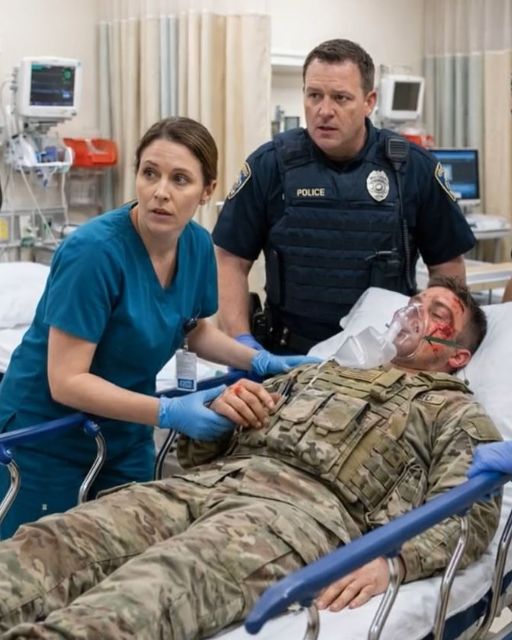
The man was dead. The surgeon called the time. But Lena, the new nurse, just pushed him aside. She didn’t reach for the paddles. She pulled a small glass vial from her own worn bag. “What the hell is that?” Dr. Mason shouted, grabbing her arm. “That’s not hospital issue.”
Lena didn’t look at him. She looked at the flat line on the screen. “He’s already dead,” she said, and slammed the needle into the man’s heart.
We all saw it. The line jumped. A steady beat.
The next morning, two men in stiff suits were at the nurses’ station. “We need to speak with Lena Carter,” the tall one said, not smiling.
Our head nurse, Sharon, crossed her arms. “She’s a hero. That man is alive because of her.”
The agent looked at Sharon, then at the other doctors gathered around. “We’re aware,” he said. “We also know that drug she used is a military prototype. And the only way she’d have it is if she was at the scene of the massacre in Kandahar.”
The name of the city hung in the air like smoke. Kandahar. We’d all seen the news reports years ago. A special forces unit, ambushed. No survivors.
Sharon’s face went pale. Dr. Mason, who had been loudly complaining about Lena’s rogue actions all morning, suddenly went quiet.
The agents, Miller and Davis, weren’t aggressive. They were just… heavy. Their presence felt like an anchor dropped in our busy hallway.
They asked Lena to come with them to a small, unused consultation room. She just nodded, her face calm, as if she had been expecting this visit her whole life.
I watched her walk away, her back straight, her worn nurse’s scrubs looking like a disguise.
Inside the sterile white room, Lena sat opposite them at a small table. Agent Miller placed a thin file in the center.
“Lena Carter,” he began, his voice low. “Or should we say, Sergeant Lena Carter, combat medic.”
Lena didn’t flinch. She just gave a slight, sad smile. “It’s just Lena now.”
“That vial you used,” Agent Davis chimed in, “was part of ‘Project Lazarus.’ An experimental regenerative compound. Only one batch was ever sent into the field.”
“I know,” Lena said softly. “I was there to administer it.”
Agent Miller leaned forward, his eyes intense. “According to the official report, the entire unit, including the research team, was wiped out in an ambush. The prototypes were all destroyed in the firefight.”
He paused, letting the words sink in. “All but one, it seems.”
Lena looked down at her hands, which were folded neatly in her lap. “I didn’t steal it, if that’s what you’re asking.”
“Then how did you get it?” Miller pressed.
She finally looked up, and for the first time, I could see the story she’d been holding back in her eyes. It was a story of fire and dust and loss.
“They were all gone,” she whispered, her voice cracking just a little. “Everyone. I was… I was checking for survivors. For a pulse. Anything.”
She took a deep breath. “My C.O., Captain Wallace… he was the last one I got to. He was gone. But his pack was open. The case with the vials was shattered, but one had rolled underneath him.”
“It was intact. I picked it up. It felt like… like the only thing that survived that day was this tiny piece of hope. So I kept it.”
Agent Davis scribbled in a notepad. “You kept a classified, multi-million dollar piece of government property as a souvenir?”
Lena’s gaze hardened. “I kept it as a reminder. A reminder of what we lost. And a promise that if I ever had the chance to use it, to save someone when I couldn’t save them… I would.”
There was a silence in the room. Even from the hallway where a few of us were pretending to be busy, you could feel it.
“The man you saved,” Miller said, changing tactics. “Mr. George Harrison. An accountant from out of town. Why him? Why use your one and only miracle on a complete stranger?”
This was the question we all had. Lena was a good nurse, quiet and efficient, but she was new. She had no connection to this patient.
Lena looked from one agent to the other. “He wasn’t a stranger.”
She leaned in, and her voice dropped so low it was almost a prayer. “When Dr. Mason tore open his shirt to use the paddles, I saw it. On his chest. A very specific shrapnel scar.”
Her eyes were distant, seeing something far away from that little room. “It was shaped like a crescent moon, just above his heart. I gave him that scar myself.”
“I was patching him up after a skirmish two weeks before the ambush. I remember it. I remember him.”
Agent Miller frowned. “Mr. Harrison’s file shows no military service. He’s sixty-two. He would have been too old for active duty in Kandahar.”
“His name isn’t George Harrison,” Lena said, her voice full of a certainty that sent a shiver down my spine.
“The man in that bed is Captain Marcus Wallace. My commanding officer. The man I thought I left for dead.”
The two agents stared at her. Then Miller stood up and walked out of the room without a word, Davis right behind him. They went straight to the ICU.
We all held our breath. This was impossible. Captain Wallace was a name on a memorial wall. He was a national hero, posthumously decorated.
Minutes later, Agent Miller came striding back, his face a mask of disbelief. He was holding a portable fingerprint scanner.
“His prints are a match,” he said to his partner, loud enough for us to hear. “The patient in ICU Bed 4 is Captain Marcus Wallace. He’s alive.”
The story exploded. It turned out Captain Wallace hadn’t died in the ambush. He’d been severely wounded, left for dead, and found by a local family who nursed him back to health.
He’d been living in obscurity, under an assumed name, suffering from severe PTSD and memory loss. The heart attack hadn’t been a random medical event. It was his body finally giving out from the strain of his old injuries.
He had come to our city for a specialist consultation, and his heart had failed in his hotel room.
Lena hadn’t just saved a patient. She had found a ghost. A hero the entire country had mourned.
The FBI investigation shifted immediately. Lena was no longer a suspect; she was a key witness. Dr. Mason, to his credit, was a changed man. He followed Lena around, his earlier arrogance replaced by a profound, humbling respect. He asked her questions, listened to her opinions. He saw her now not as a subordinate, but as a seasoned veteran who had seen and done things he could only imagine.
But the story wasn’t over. As Captain Wallace slowly recovered, fragments of his memory began to return. And they were dark.
He spoke to Lena and the FBI in hushed tones from his hospital bed. The ambush, he started to remember, wasn’t a random enemy attack.
It was too perfect. Too well-coordinated. The enemy knew exactly where they would be, and when. They knew about Project Lazarus.
It was a setup.
He remembered a conversation he’d overheard a week before the mission. A call between a high-ranking general and a man from a private defense contracting firm, a company called Sterling Dynamics.
Sterling Dynamics had been competing with the military’s own research division to develop a battlefield medical solution. Their product was cheaper, but vastly inferior. Project Lazarus would have ruined them.
If Wallace’s unit and the project were wiped out by the “enemy,” Sterling Dynamics could sweep in with their own solution and secure a trillion-dollar government contract.
The “massacre” wasn’t just a tragedy. It was corporate sabotage on a scale that was almost treasonous.
Suddenly, the hospital didn’t feel so safe anymore.
The CEO of Sterling Dynamics was a man named Alistair Finch. A powerful, ruthless man with connections everywhere. If he found out Wallace was alive, he wouldn’t send a lawyer. He would send someone to finish the job.
The FBI placed agents outside Wallace’s room. But we all knew how porous a hospital could be. There were a hundred ways in.
The next evening, things got strange. The power on our floor flickered and died for a few seconds. The backup generator kicked in, but the brief darkness was unsettling.
Then two new orderlies showed up, big men with hard eyes who said they were there to transfer Captain Wallace to a more secure federal facility. They had paperwork that looked official.
Agent Miller looked at the papers, then at the men. He was suspicious. “I wasn’t briefed on any transfer,” he said.
One of the “orderlies” smiled, but it didn’t reach his eyes. “It was a last-minute order. For his safety.”
Lena was standing in the doorway. She wasn’t looking at their faces; she was looking at their shoes. They were wearing expensive, polished leather shoes. Not the standard-issue sneakers a hospital orderly would wear.
She caught Agent Miller’s eye and gave a tiny, almost imperceptible shake of her head.
That was all he needed.
“We’ll just verify the order,” Agent Miller said calmly, reaching for his phone.
That’s when the first orderly pulled a weapon, a small pistol with a silencer. The second one moved toward Wallace’s bed.
But they underestimated a hospital.
Sharon, our head nurse, who had seen everything, didn’t scream. She slammed the big red code blue button on the wall. Immediately, the hallway was filled with the sound of alarms and running feet.
Dr. Mason, who was checking Wallace’s chart, didn’t hesitate. He swung a heavy metal oxygen tank and slammed it into the armed man’s wrist. The gun clattered to the floor.
Lena moved like lightning. She grabbed a crash cart, a two-hundred-pound behemoth of steel and medical supplies, and shoved it with all her might into the second man, pinning him against the wall.
The FBI agents took care of the rest. Within seconds, the two imposters were subdued and in cuffs. They weren’t soldiers or spies. They were private security, mercenaries hired by Finch.
The failed attempt on Wallace’s life was the final piece of the puzzle. It was the proof of a guilty conscience.
With Wallace’s testimony and the captured assassins, the case against Alistair Finch and Sterling Dynamics was airtight. The ensuing scandal was one of the biggest in military history. Finch and his co-conspirators were arrested, their contracts were voided, and the truth of what happened in Kandahar finally came to light.
A few weeks later, Captain Wallace was well enough to be discharged. He walked out of the hospital on his own two feet, into the arms of a family who thought they had lost him forever. Before he left, he stood in front of Lena.
Tears streamed down his face. “You never give up on your people, do you, Sergeant?”
Lena smiled, her own eyes misty. “Never, sir.”
The story could have ended there. But it didn’t.
One afternoon, a package arrived for Lena at the nurses’ station. It was from the Department of Defense. She wasn’t being disciplined. She was being honored.
Inside was a medal and a letter. The letter explained that Project Lazarus was being reinstated, with new funding and oversight. They were creating a new kind of unit, a team of elite medics who would not only treat but innovate on the front lines.
They wanted her to lead it.
Lena looked at the letter, at the offer to return to the world she had left behind. But this time, it would be different. She wouldn’t just be a medic following orders. She would be a leader, making sure what happened in Kandahar never happened again.
She accepted.
On her last day at the hospital, Dr. Mason found her by the nurses’ station, the same place where this whole crazy story began.
He looked humbled, a different man from the arrogant surgeon who had yelled at her.
“I was taught to follow the protocols, the established rules,” he said quietly. “If you don’t, people can die.”
He looked at her with genuine admiration. “But you taught me that sometimes, you have to break the rules. Sometimes, you have to write a new page in the book when you know the old one is wrong.”
Lena just nodded, a simple gesture of understanding between two very different people who had been through the fire together.
As she walked out of the hospital doors and into her new future, she thought about the vial she had carried for so long. The drug inside was a miracle of science, yes. But it wasn’t the real miracle.
The real miracle was the refusal to give up. It was the loyalty that saw a man, not just a flat line. It was the hope she had carried in her bag, a quiet promise to a ghost, that finally brought a hero home and healed not just a body, but a history of lies.
Sometimes, the most powerful medicine isn’t what’s in the needle. It’s the conviction in the hand that holds it.