I had to go on a work trip. Just one night. My sister was out of town, so my only choice was Dorothy, my husband’s mother. She never liked me. After Ryan died in the crash, she looked at me like I was a loose end. But she was family. I told myself it would be fine.
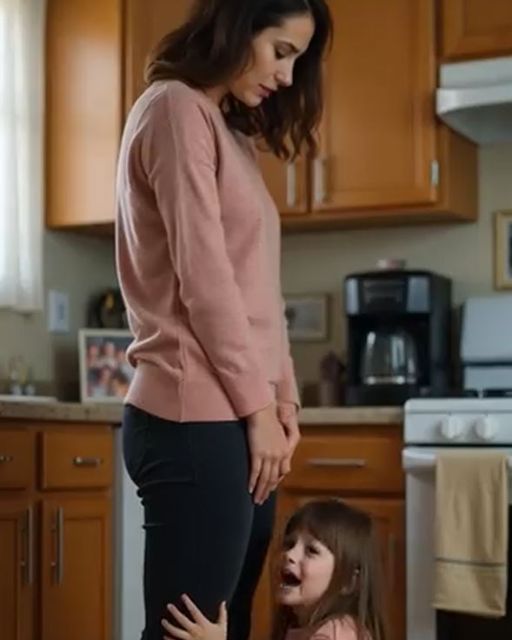
When I picked up my five-year-old, Ellie, the next morning, the house was dead quiet. Dorothy just handed me Ellie’s bag and shut the door. In the car, Ellie wouldn’t talk. She just stared out the window, hugging her little stuffed rabbit so hard its seams were straining.
Halfway home, she leaned forward from her car seat.
“Mommy,” she whispered. “Grandma said I can’t ever tell you about the girl.”
My blood went cold. I pulled the car over. I turned around and kept my voice soft. “What girl, sweetie?”
“The girl in the basement,” Ellie said, her eyes wide. “She was crying. Grandma brought her soup but she wouldn’t eat. Grandma told me she was just a bad dream and I had to forget her.”
I was already dialing 911 when Ellie spoke again.
“Mommy?” she said. “Why did the girl have a picture of Daddy? She kept kissing it and saying she wanted to come home. It was the picture from the beach, the one where he’s holding…”
My breath caught in my throat. I knew the picture.
“…holding the silver locket.”
The world tilted on its axis. The dispatcher’s voice on the phone was a distant buzz. I gave her the address, my voice a hollow echo of itself.
The silver locket. It was Ryan’s. He never took it off. It had been a gift from his father, he’d told me. It was lost in the crash, the paramedics said. They never found it.
I drove straight to the local police station, my knuckles white on the steering wheel. Ellie was quiet in the back seat, her small presence a heavy weight of responsibility. I couldn’t go back to Dorothy’s house alone. I couldn’t face what was in that basement without someone official by my side.
An officer, a kind-faced woman named Sergeant Miller, sat with me and Ellie in a small, quiet room. I told her everything, my words stumbling over each other. I recounted Ellie’s story about the girl, the soup, the crying.
And the picture. The locket.
Sergeant Miller’s expression was carefully neutral, but I saw a flicker of something in her eyes. It was the look of someone who had seen too much. She arranged for a child services advocate to sit with Ellie while two officers accompanied me back to Dorothy’s house.
The drive was the longest ten minutes of my life. My mind was a whirlwind of terrible possibilities. Was this a secret lover? A hidden child? Did Ryan have a whole other life I knew nothing about? The thought was a physical blow, stealing the air from my lungs.
We pulled up to the neat suburban house with its perfectly manicured lawn. It looked so normal. So peaceful.
Dorothy opened the door before we even knocked. Her face was a mask of fury.
“What is this?” she spat, her eyes locking on me with pure venom. “What have you done?”
Sergeant Miller stepped forward. “Ma’am, we’ve received a report that requires us to check the welfare of an individual who may be on your property.”
Dorothy laughed, a sharp, ugly sound. “There’s no one here but me. This is harassment. It’s her,” she said, pointing a trembling finger at me. “She’s always been trouble.”
The male officer with us, Officer Collins, was already moving past her, his voice calm but firm. “Ma’am, we have a warrant. We need to check the premises. Including the basement.”
Dorothy’s face crumpled. The fight went out of her in an instant, replaced by a deep, shuddering terror. She didn’t say another word. She just sank onto the floral armchair in her living room and stared blankly at the wall.
I followed the officers, my heart pounding against my ribs. The door to the basement was at the end of the hall. It was locked.
Officer Collins knocked. “Is anyone down there? This is the police.”
Only silence answered.
He broke the lock with a single, sharp kick. The sound echoed through the silent house. He flicked a switch, and a weak, yellow light illuminated a set of steep wooden stairs.
The air that wafted up smelled of dust and damp concrete. And something else. Something like old sadness.
I stayed at the top of the stairs, my hand over my mouth, as the two officers descended. I could hear their murmurs, their footsteps on the concrete floor.
Then, Sergeant Miller’s voice, impossibly gentle. “It’s okay. We’re not going to hurt you.”
A few moments later, she came back up the stairs. Her face was pale.
“I think you should see this,” she said softly.
My legs felt like lead, but I forced them to move. I went down the stairs, one by one, each step a lifetime.
The basement was surprisingly clean, but sparse. There was a cot in the corner with a thin blanket. A small table held a bowl of cold soup and a glass of water.
And on the cot, huddled into a ball, was a young woman.
She looked to be in her early twenties, with lank, dark hair that was unmistakably Ryan’s. Her face was thin and pale, her eyes wide with a fear that seemed ancient. She clutched something to her chest, a small, framed photograph.
It was the picture from the beach. Ryan, smiling at the camera, tan and happy. In the picture, he was holding up the silver locket, letting it catch the sun.
The woman on the cot looked up at me. Her eyes, the same deep brown as my husband’s, were filled with a wild, pleading confusion. She wasn’t a lover. She wasn’t a stranger.
She was Ryan. In female form.
“Who is she?” I whispered, the words catching in my throat.
“Her name is Clara,” Sergeant Miller said, her voice low. “Dorothy’s daughter. Ryan’s twin sister.”
The world stopped. Ryan never had a sister. He was an only child. He’d told me so a hundred times. We’d laughed about it, about how he was spoiled rotten.
Clara was taken to the hospital. Dorothy was taken to the station. I was left in the wreckage of a life I no longer recognized.
At the station, under the flat, fluorescent lights, the whole story came out. Dorothy, stripped of her anger, was just a tired, broken old woman.
Clara and Ryan were twins. Clara was born with severe developmental and psychological issues. When they were children, she was prone to violent outbursts and self-harm. The doctors said she needed professional, full-time care.
Dorothy’s husband, a proud and image-obsessed man, couldn’t handle the “shame” of it. They made a decision. A terrible, life-altering decision.
They sent Clara to a private residential facility upstate. They erased her. They told everyone she had passed away from a childhood illness. They told Ryan his twin had died. He was only six. He grew up believing he was an only child.
Dorothy’s husband died a few years later, and she was left to carry the secret alone. She visited Clara, paid the bills, and lived a double life. Her love for her daughter was a fierce, possessive thing, twisted by shame and secrecy.
Then, two months ago, everything changed. The facility had a funding cut. They were moving residents to a state-run institution that Dorothy considered a nightmare. In a panic, she did the only thing her terrified mind could think of.
She pulled Clara out. She brought her home.
She locked her in the basement, convinced she could care for her, convinced she could keep her a secret from the world. From me.
“Ryan found out,” Dorothy said, her voice barely a whisper. She wouldn’t look at me. She just stared at her hands, folded in her lap. “He was going through old boxes in the attic, looking for a photo album. He found her birth certificate. He found letters from the facility.”
My heart ached for my husband. The betrayal he must have felt. The shock.
“He confronted me,” Dorothy continued. “He was so angry. Not at me for hiding her, but angry that his sister had been alone all these years. He wanted to bring her home. He wanted her to meet you. To meet Ellie.”
She finally looked at me, her eyes swimming with unshed tears. “He said he was going to tell you everything. That we were going to be a real family. All of us.”
The day of the crash. I remembered it so clearly. He’d called me from the car. He said he had something amazing to tell me, that our lives were about to change. He sounded so happy, so excited.
“He was driving up to the facility to see her for the first time as an adult,” Dorothy choked out. “He was going to bring her back. We argued on the phone. I told him he was making a mistake, that he didn’t understand. I was screaming at him.”
There was a long silence.
“The police report said he was on his phone when he lost control of the car.”
A single tear traced a path through the wrinkles on her cheek. The weight of her guilt was a palpable thing in the small room. She hadn’t just lost a son. She had, in her own mind, caused his death. Her secret had finally consumed him.
And her resentment of me suddenly made a terrible kind of sense. In her twisted grief, she blamed me. If Ryan hadn’t built this new life with me, he never would have been digging in the attic. He never would have found the secret. He would still be alive. And her world, however broken, would still be intact.
The weeks that followed were a blur. Clara was moved to a wonderful new facility, one with gardens and art therapy and doctors who spoke to her with kindness. Dorothy was charged with unlawful imprisonment and neglect. Given her age and the circumstances, she was sentenced to probation and mandatory grief and family counseling.
I was numb. I felt like a stranger in my own life. The man I had loved and married had a whole universe inside him I’d never known. A lost sister. A family secret that had ultimately cost him his life.
The first time I went to visit Clara, I almost turned back. What could I possibly say to her? But then I thought of Ryan, of the excitement in his voice on that last phone call.
I found her sitting in a sunny courtyard, sketching in a notepad. She looked healthier. Her hair was clean and cut neatly, and there was a hint of color in her cheeks.
I sat down on the bench next to her. For a long time, we didn’t speak.
Then, I pulled something out of my purse. The photo from the beach. The police had given it to me from Dorothy’s house. I placed it on the bench between us.
Clara looked at it. A small, sad smile touched her lips. She pointed a delicate finger at the locket in the picture.
“He promised,” she said, her voice soft and unused. It was the first time I had ever heard her speak a full sentence.
“Promised what?” I asked gently.
“He promised he would come back. And we would go to the beach. He said he would give me the locket. So I’d always have him with me.”
My eyes filled with tears. He had found her. He had remembered her, somewhere deep in his six-year-old heart. And he had tried to make it right.
In that moment, my grief for Ryan shifted. It was no longer just about my loss, but about his. The years he’d lost with his sister. The joy that had been stolen from him.
From that day on, Ellie and I visited Clara every week. At first, it was quiet. But slowly, she began to open up. She told me about Ryan’s brief visits when they were children, secret meetings Dorothy arranged, where he would bring her comic books and tell her stories about the outside world.
She was not a stranger. She was the missing piece of my husband’s heart.
One afternoon, months later, I was cleaning out the last of Ryan’s things from our closet. Tucked away in the back of his sock drawer, I found a small, velvet box.
Inside was the silver locket.
It wasn’t lost in the crash. He had it with him, but it must have been in his pocket. It had been returned to me with his personal effects and I’d put it away, unable to look at it.
He had bought a new chain for it. He must have been taking it to her that day.
The next time I saw Clara, I handed her the box. Her hands trembled as she opened it. She lifted the locket, its silver surface gleaming in the sunlight. She clicked it open.
On one side was a tiny photo of Ryan as a boy. On the other, a matching photo of a little girl with his same dark eyes.
Clara looked up at me, her face luminous with a joy that transcended all the years of silence and pain. She closed the locket around her neck.
She was finally home.
Secrets are like poison. They don’t just harm the person they are kept from; they corrupt the person who keeps them, twisting love into fear and protection into a prison. My husband tried to be the antidote. He tried to let the light in. His death was a tragedy, but his intention was one of love.
By finding Clara, by bringing her into my life and Ellie’s life, I was not just uncovering a secret. I was finishing his story. We are a strange, broken, and beautiful family, formed from the ashes of a terrible lie. And in a way, we are more whole than we ever were before.