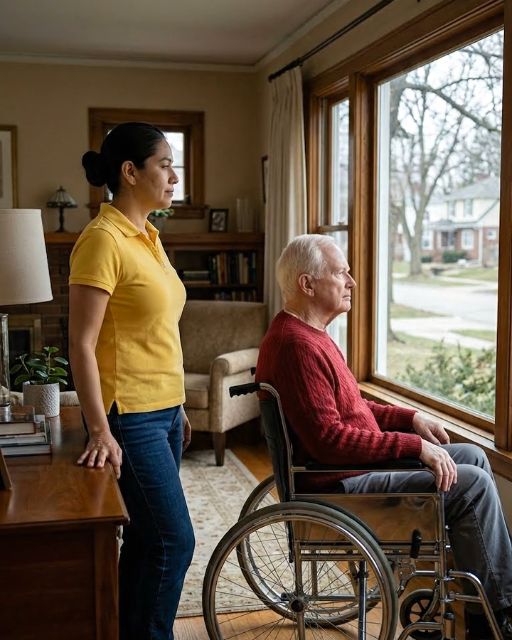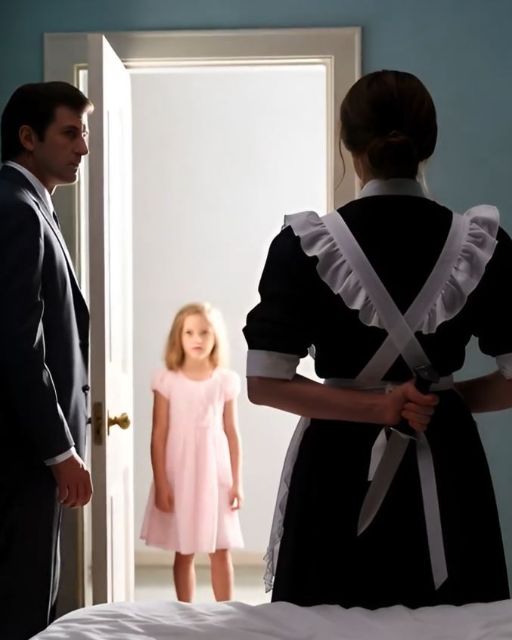
The security feed froze on my screen. Tuesday, 2:47 PM. Mary – or whoever she was – standing in front of the old bookshelf, her sleeve rolled up. That mark on her wrist. That crescent mark.
I hadn’t seen it in thirty years. Not since the day my sister vanished.
Her name was Rosa. She was sixteen. She left to meet a boy at the train station and never came back. My parents died not knowing what happened. I became rich trying to forget.
But I couldn’t forget that birthmark. I used to touch it when we were kids. She’d laugh and swat my hand away.
I watched the tape again. Mary pulled down the leather journal—the one I kept my old photos in. Her hands were shaking. She slipped something inside. A photograph. Then she looked directly at the camera. Not like she’d spotted it. Like she knew it was there.
Her eyes. Christ. Her eyes were Rosa’s eyes.
I stood up from my desk. My legs felt hollow. I walked to the library. The book was exactly where she’d left it. I opened it with both hands, afraid the pages would shatter.
Inside: a photo of a baby girl, newborn, wrapped in a white blanket. On the back, in faded pen: “Rosa, 1995. I’m sorry I couldn’t keep her.”
My sister had a child. A daughter.
And Mary—my maid—was wearing my dead sister’s face.
I heard the front door slam. I ran to the window. Mary was getting into an old sedan, a man in the driver’s seat. He had his hand on her shoulder. She was crying.
I grabbed my phone to call her back, but my thumb stopped. Because I saw something else in the photograph. On the back of the baby photo, underneath the date, was a name written in different handwriting—scratched in hard, like with a nail:
“If you’re reading this, don’t let him find us. He’s still—”
The pen mark ended mid-word.
My hands started to shake. Because the handwriting was mine. From a note I’d written to Rosa the day before she disappeared. A note I’d never sent.
I looked back at the window. The sedan was gone.
My phone buzzed. A text from an unknown number:
“You weren’t supposed to see that. But now you know. Mom never left you. Dad never—”
I clicked on the contact details. The phone number was registered to a name that made the air leave my lungs in a single, painful rush.
Marcus Vance.
Vance. The boy at the train station. The boy Rosa was going to meet.
I’d always thought of him as some insignificant high school crush. A footnote in a tragedy. Now his name was a ghost screaming in my silent, empty house.
My mind raced back thirty years. I remembered him now. A little older than us, a slick sort of charm that always felt wrong to me. He’d lean against his car, all confidence, and Rosa would melt.
I’d warned her. We had a stupid, brother-sister fight about him the night before she left. “He looks at you like you’re a possession,” I’d told her. She called me jealous and stormed off to her room.
That was the last real conversation we ever had.
The note I never sent was an apology for that fight. It was me, a clumsy seventeen-year-old, trying to say I was sorry and that I just wanted her to be safe. “Don’t let him find us,” was a silly inside joke we had, something we’d say when we were hiding from our parents after breaking a rule. He’d taken our joke and turned it into a threat.
I sank into my chair, the phone heavy in my hand. He was still with her. With Mary. That was him in the car. The cryptic text must have been from Mary, cut short by him. “Dad never—” was what she was trying to type. Marcus was her father.
My grief, thirty years old and buried under a mountain of money and success, was suddenly raw again. But this time, it wasn’t just grief. It was rage. A cold, clear rage that sharpened my thoughts.
I didn’t call the police. What would I say? That my maid, who just quit, looks like my sister who has been missing for three decades? They’d think I was crazy.
Instead, I called a man named Peterson. He was a private investigator, a former detective with tired eyes and a reputation for finding people who didn’t want to be found. I’d used him once before for a corporate matter.
He was at my house within the hour.
I didn’t tell him everything. I couldn’t. It sounded insane. I just told him a young woman who worked for me had left abruptly in a concerning situation. I gave him the name Mary, the license plate of the sedan I’d frantically memorized, and the name Marcus Vance.
“Find them,” I said, my voice flat. “I don’t care what it costs.”
Peterson just nodded, his expression unreadable.
The next forty-eight hours were the longest of my life. I paced the halls of my cavernous house, the silence pressing in on me. Every room felt haunted. I saw Rosa’s ghost everywhere—laughing in the kitchen, reading in the library, her crescent birthmark visible as she turned a page.
I had built this empire to insulate myself from that pain. Now, the walls I had built were a prison. I had everything and nothing.
Peterson called on the third day. “Got ’em,” he said, his voice gravelly. “Old sedan was easy. Registered to Marcus Vance. They’re in a rundown apartment building over in the industrial district. Place is a real dump.”
My heart hammered against my ribs. “Are they okay?”
“The girl, Mary, looks okay. Scared, maybe. Vance has a sheet. Nothing major. A few charges for disorderly conduct, intimidation. Looks like he pushes people around for a living.” Peterson paused. “You want me to approach?”
“No,” I said instantly. “Just watch them. I need to know what I’m walking into.”
I needed a plan. I couldn’t just storm in there. Marcus had controlled my sister’s life, and now he was controlling her daughter’s. A direct confrontation could put Mary in more danger.
That evening, I did something I hadn’t done in years. I went up to the attic. I pulled out a dusty box labeled “Rosa.” Inside were her yearbooks, her terrible poetry, a dried corsage from a school dance. And her diary.
I’d never read it. It felt too private, too final. But now, I opened it, the scent of old paper and cheap perfume filling the air. Her teenage scrawl filled the pages, talking about school, friends, and him.
Marcus.
At first, the entries were giddy. He was exciting, different. But then the tone shifted. “Marcus got mad when I talked to Stephen in chemistry,” she wrote. “He said I belong to him.” A few pages later: “He took my house keys and made a copy. He said it was so he could always protect me.”
It was a textbook of control, of isolation, and I had been too young and too stupid to see it. The last entry was dated the day before she disappeared.
“Fighting with David was awful. He doesn’t get it. Marcus is taking me away tomorrow. A new start. He says we’ll go somewhere beautiful and I won’t have to worry about anything ever again. I’m scared. But I’m more scared of staying.”
She wasn’t running to him. She was running from something else, and he had presented himself as the only escape.
The next morning, I drove to the industrial district. The apartment building was even worse than Peterson had described. It sagged, paint peeling, windows grimed over. I parked down the street, my expensive car looking alien in the landscape of rust and decay.
I just sat there, watching. For hours.
Finally, I saw her. Mary came out, carrying a small bag of trash. She looked over her shoulder, her movements furtive and quick. Her face was pale, her shoulders hunched. She was a prisoner.
This was Rosa’s daughter. My niece.
On impulse, I got out of the car. I started walking towards her, keeping my distance. Her eyes widened when she saw me. It wasn’t recognition of me as her employer. It was something deeper. She knew exactly who I was.
An angry shout came from a second-floor window. “Mary! Get back in here!”
It was Marcus.
Mary flinched, a full-body tremor of fear. She looked at me, her eyes pleading. Then, in a swift, almost unnoticeable motion, she dropped something small and metallic next to the overflowing dumpster. She gave me one last look before scurrying back inside.
My heart was pounding. I waited until the door slammed shut, then walked casually over to the dumpster. Lying in the dirt was a key. A small, simple key for a padlock, attached to a tag with a number on it: 34B.
Scribbled on the other side of the tag was the name of a storage facility a few miles away.
This was it. This was the message she was trying to send.
I found the storage facility easily. It was a sprawling place of identical, roll-up metal doors. I found unit 34B and the key slid into the lock with a satisfying click. I pulled up the heavy door, revealing a small, dark space that smelled of dust and time.
It was a shrine. A time capsule of a life lived in the shadows.
There were a few boxes of clothes, all worn and faded. A small collection of children’s books. A stuffed bear with one button eye. And a large, sealed plastic tote.
I opened it. Inside were journals. Dozens of them.
They were Rosa’s.
I sat on the cold concrete floor of that storage unit and I began to read. My sister’s life unfolded before me, page by painful page.
Marcus had taken her, just as he’d promised. But it wasn’t a rescue. It was a kidnapping. He’d kept her moving from town to town, working odd jobs, never letting her contact anyone. He told her I hated her, that our parents had disowned her. He twisted her world until he was the only thing in it.
Then Mary was born. Rosa wrote about her with a desperate, fierce love. Mary became her reason to live, but also the bars of her cage. Marcus used the child to control her completely.
Then I found the entry about the photograph.
“I found a place that does one-hour photos,” she wrote. “I told Marcus I needed medicine for the baby. I only had twenty minutes. I got her picture taken. It’s the only proof she exists. The only proof that I do.”
And then, the part that made my blood run cold.
“I still have David’s note. The one I took from his desk before I left. I wanted a piece of him with me. I wrote on the back of it, a plea, a prayer that he might find us. But Marcus found it. He laughed. He tore up my note. Then he took the photo of Mary. He found the line from David’s note, ‘don’t let him find us.’ He carved it into the back of the photo with a penknife. He said, ‘If he ever finds this, he’ll be reading his own failure.’ He gave it back to me. A reminder that I can never escape.”
It wasn’t my handwriting. It was his. A cruel, twisted imitation.
The journals continued. Rosa discovered she had the same genetic heart condition our mother had. She knew she was running out of time. Her focus shifted from escaping herself to ensuring Mary could escape.
She filled Mary’s head with stories of me, of our family. She showed her pictures. She taught her the crescent birthmark was a link to a life she deserved. She saved every penny she could, planning.
The last entry was from five years ago.
“Mary is old enough now. She understands. I’ve told her how to find David. It’s a crazy plan, to get a job in his house, but it’s the only way. I don’t think I’ll be here to see it. But my daughter will be free. That’s all that matters. My beautiful, brave girl.”
My sister was gone. She had died, alone, still a prisoner. But not before she had planted the seed of her daughter’s freedom.
I closed the final journal, tears streaming down my face. I cried for the sister I’d lost, for the niece I’d never known, and for the thirty years that had been stolen from all of us.
When the tears stopped, all that was left was a quiet, unshakeable resolve.
I called Peterson. “I’m going in,” I said. “Call the police. Tell them to wait for your signal. I don’t want them busting in unless they have to. This has to end on my terms.”
I drove back to the apartment. This time, I didn’t park down the street. I parked right out front. I walked up the rickety stairs to the second floor and knocked on their door.
Marcus Vance opened it. He was older, his face puffy, but the same arrogant smirk was there. His eyes narrowed when he saw me. “What do you want?”
“I’m here for my niece,” I said, my voice calm.
He laughed, a short, ugly sound. “You’ve got the wrong place, pal.”
“Mary,” I called out, looking past him. “It’s your Uncle David. Your mom sent me.”
I saw her then, standing in the shadows of the dim living room. Her face was a mask of terror and hope.
Marcus tried to slam the door, but I was ready. I wedged my foot in the frame. “It’s over, Marcus. I know everything. I read the journals.”
His smirk vanished. For the first time, I saw a flicker of panic in his eyes.
“She kept everything,” I continued, pushing the door open gently. I stepped inside. The apartment was small and smelled of stale cigarettes. “Every letter, every photo. Every moment of the life you stole from her.”
“She’s a liar,” he spat.
“My sister is dead,” I said, the words like stones in my mouth. “But she was smarter than you. She was stronger than you. And she won.”
I looked at Mary, who was now staring at Marcus, her fear slowly being replaced by a dawning strength.
“He told me she ran away,” Mary whispered, her voice trembling. “He said she left us.”
“She would never have left you,” I said softly. “She spent her whole life making sure you’d get away from him.”
That’s when Marcus lunged at me. He was clumsy with rage. I was ready. I sidestepped him easily. He stumbled, catching himself on the wall. At that moment, Mary did the bravest thing I have ever seen.
She stepped between us.
“No more,” she said, her voice clear and strong. She looked directly at the man who had been her father and her jailer. “It’s over.”
Marcus looked at her, truly seeing her for the first time not as a possession, but as a person defying him. His face contorted with fury. He raised a hand.
That’s when Peterson’s signal must have gone out. The door burst open and two uniformed officers stepped in.
It ended quickly after that. Marcus didn’t fight. The arrogance had crumbled away, leaving behind the small, pathetic man he’d always been.
As they led him away in handcuffs, Mary ran to me. She wrapped her arms around my waist and sobbed, thirty years of inherited pain finally pouring out. I held her tight, my family, returned to me at last.
We buried Rosa’s ashes a week later, not in some forgotten plot, but next to our parents. Mary and I stood there, hand in hand. We had a proper headstone carved, with her name and a single, perfect inscription: “Finally Home.”
My big, empty house is no longer quiet. It’s filled with Mary’s laughter, the smell of her cooking, the sound of music from her room. We spend hours in the library, going through the old photo album. She tells me stories her mother told her, and I tell her stories about the sister I knew.
I spent half my life building a fortune to forget my past. I thought wealth was a shield. But I was wrong. The past isn’t something you can outrun or wall off. It’s a part of you. My sister taught me that love is the only thing that truly endures, a thread that can’t be broken by time or distance or even death. It was a lesson written in a journal, delivered by a daughter, and it finally brought me home.