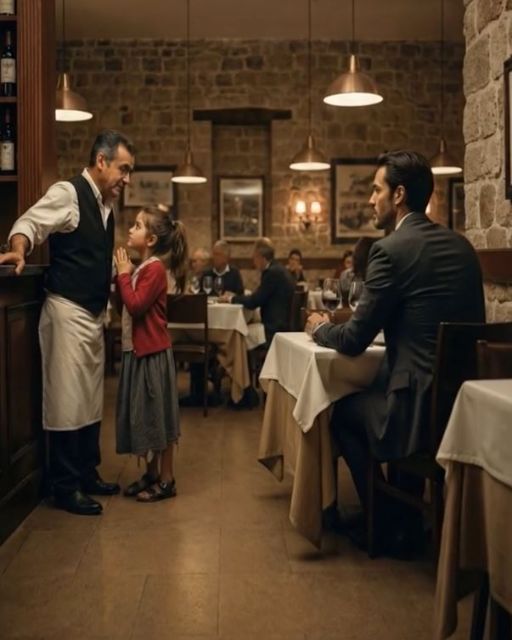
I was eating alone at Miller’s Steakhouse when the yelling started. The owner was shoving a man and a little girl toward the door. The guy looked rough – greasy hair, a coat three sizes too big, dirt under his nails. The girl looked worse. She was skinny, pale, clutching a pink plastic purse like it was a life raft.
“Please,” the man begged, his voice cracking. “It’s her birthday. She just wants to blow out a candle. We have five dollars.”
“Get out,” the owner spat. “You’re scaring the customers.”
I couldn’t watch it. I waved the manager over. “Put them on my tab,” I said. “Give them the corner booth and the ribeye. And get the kid a cake.”
The manager froze, then nodded. Money talks. The man looked at me with watery eyes. “God bless you, sir. You don’t know what this means.”
They sat. I watched them from my table. The man ate like a wolf, tearing into the bread. The girl didn’t touch her food. She just stared at the table, gripping that purse. She looked terrified. I figured it was just the shame of poverty. I was wrong.
When the cake came out, I walked over. I wanted to see her smile.
“Happy birthday, sweetheart,” I said.
The man wiped his mouth. “Say thank you to the nice man, Sarah.”
She didn’t speak. She just opened that little pink purse. She pulled out a crumpled five-dollar note. Her hands were shaking so hard the table rattled. She held the money out to me.
“She wants you to have it,” the man said, his voice dropping an octave. His grip tightened on her shoulder. “She’s very grateful.”
I took the bill to be polite. I was about to hand it back, to tell her to buy a toy. Then I looked down at the paper in my hand. It wasn’t just a bank note. Written across the watermark in thick, red crayon were three words that made my blood freeze. The man saw me read it. He stopped chewing. He reached for his steak knife. The note said:
HELP ME. PLEASE.
My heart didn’t just freeze; it stopped cold. Every instinct in my body screamed to yell, to call for help, to point at the knife now half-hidden under the man’s napkin.
But I looked at the little girl. Her eyes, wide and pleading, were locked on mine. They weren’t the eyes of a child ashamed of being poor. They were the eyes of a prisoner.
I forced a smile, a brittle, cracking thing that felt like glass on my face.
“Well now,” I said, my voice sounding impossibly calm. “It says ‘THANK YOU.’ That’s very polite of you, Sarah.”
The man, whose name I didn’t know, relaxed his grip on the steak knife. Just a fraction. But I saw it. His eyes were like chips of ice, calculating.
“She’s a good girl,” he grunted, resuming his attack on the steak.
I folded the five-dollar bill carefully, my own hands shaking now. I tucked it into my shirt pocket, right over my heart.
“You know,” I said, pulling up a chair uninvited. “I own a few businesses around town. I’m always looking for hard workers.”
The man looked up, chewing slowly. A flicker of greed crossed his face, warring with his suspicion. “Is that so?”
“It is,” I continued, leaning forward. “A man trying to provide for his daughter on her birthday… that’s admirable. It shows character.”
Every word was a lie, a carefully constructed bridge over a chasm of terror. The little girl, Sarah, hadn’t moved. She was a statue carved from fear.
“What kind of work?” he asked, his voice still low and gravelly.
Under the table, out of his line of sight, I pulled out my phone. My driver, Robert, was waiting in the car just outside. He was former special forces, a man who could read a situation faster than most people could read a book.
I opened my texts. I typed a single word. One word I had never had to use before.
Trouble.
I hit send.
“Construction,” I lied smoothly, meeting the man’s gaze. “Good, honest work. Pays well. Cash, if that’s what you need.”
That got his full attention. The knife was forgotten. “Cash is good,” he said, nodding. “We’ve been… moving around a lot. Hard to keep a bank account straight.”
“I understand completely,” I said. “Life can be tough.”
My phone buzzed silently in my hand. A reply from Robert.
Understood. Police en route. 2 mins.
Two minutes. It felt like a lifetime. I had to keep him talking. I had to keep him calm.
“So, Sarah,” I said, turning to the little girl with my fake, warm smile. “How old are you today?”
She flinched when I said her name. The man’s hand rested on her shoulder again, a casual gesture that was anything but.
“She’s seven,” he answered for her. “A bit shy, this one.”
I watched her, really watched her. The dress she wore was frayed. There was a small, faded bruise on her cheekbone, almost hidden by her pale skin. The pink purse was scuffed and dirty, but she held it like it contained the crown jewels.
My mind raced. The purse. The money. The crayon. She must have written that message in secret, waiting for a moment, any moment, to pass it to someone. It was the bravest thing I had ever seen.
“Seven is a big year,” I said, my heart aching for her. “You get to be a big girl. Do you like cake?”
She gave a tiny, almost imperceptible nod. Her eyes darted from me to the man and back again.
“Of course she does,” the man boomed, a false cheerfulness in his voice. “Loves chocolate cake.”
The cake on the table was vanilla with strawberry frosting. A small detail, but it was another crack in his story. He didn’t know her at all.
Through the large window of the steakhouse, I saw it. A plain sedan pulled into the parking lot, parking two spaces away from my own car. It didn’t look like a police car, but I knew. Robert was thorough.
Then, two men in regular jackets got out and walked toward the restaurant entrance. They looked like any other customers coming for a late dinner.
“You know what,” I said, standing up suddenly. “I think this calls for a real celebration.” I gestured to the waiter. “Another round of sodas for my new friends here.”
The man, Frank, as I’d later learn his name was, looked startled by my sudden movement. His eyes darted to the door as the two men walked in. He saw them scan the room. He saw their eyes land on our table.
And he knew.
The mask of the desperate father dissolved. His face contorted into a mask of pure, cornered rage.
“You,” he snarled at me.
In one swift motion, he grabbed Sarah, yanking her from the booth. He pulled the steak knife from the napkin and held its dull edge against her throat.
The girl didn’t even cry out. She just let out a small, terrified gasp.
The restaurant erupted in screams. Diners scrambled from their tables, overturning chairs. The two plainclothes officers drew their weapons, their voices calm but commanding.
“Let the girl go, Frank,” one of them said.
So they knew his name. This wasn’t random.
“Stay back!” Frank screamed, his voice raw with panic. He started dragging Sarah toward the kitchen. “I’ll do it! I swear I will!”
I didn’t think. I just acted. I grabbed the heavy, wooden chair I had been sitting on and hurled it with all my might at a stack of wine glasses behind the bar.
The crash was deafening. It was the sound of a thousand shattering crystals.
For a single, vital second, Frank’s head snapped toward the sound. It was the only distraction they needed.
One officer lunged, tackling Frank at the knees. The other swooped in, grabbing the hand that held the knife and twisting it until he cried out and the weapon clattered to the floor.
A third man, who I now recognized as Robert, my driver, was suddenly there, pulling the little girl away from the chaos. He wrapped her in his own coat, murmuring soft, reassuring words as he carried her away from the scene.
It was over in less than ten seconds.
Frank was on the floor, handcuffed and spitting curses at me, at the police, at the world. The manager and staff were pale with shock. The other patrons were huddled in the corners, staring.
I just stood there, my legs feeling like jelly, my hand on my chest, feeling the crinkle of the five-dollar bill in my pocket.
The hours that followed were a blur of police statements and flashing lights. I learned the truth in the quiet, sterile environment of the police station.
The little girl’s name wasn’t Sarah. It was Lily.
And she wasn’t Frank’s daughter. He was a low-level criminal who had kidnapped her from a park a week ago, hoping for a ransom from her wealthy parents. He had been moving from town to town, living on scraps, getting more desperate by the day.
Lily had been missing for six days. Her parents, the Hamiltons, had been on every news channel, pleading for her return. I’d seen the story myself but had barely registered it, another tragedy in a world full of them.
The pink purse was her own. The five-dollar bill was lunch money her mother had given her that fateful day. And the red crayon was her desperate, brilliant idea. She had been waiting for a chance, for one person to look, really look, and see her.
I was that person.
A few hours later, a detective led me to a small waiting room. “The Hamiltons are here,” he said quietly. “They want to thank you.”
A man and a woman rushed toward me. Their faces were tear-streaked but radiant with relief. They weren’t just wealthy; they were a family made whole again.
“I’m Arthur,” I said, shaking Mr. Hamilton’s hand.
“We know who you are,” Mrs. Hamilton said, her voice choked with emotion. “And we don’t know how we can ever repay you. You saved our little girl.”
I just shook my head. “She saved herself. She’s the brave one.”
They brought Lily in then. She was clean, wearing a new set of clothes, but she still clutched that same pink plastic purse. She looked at me, and for the first time, she smiled. A real, genuine smile.
She walked right up to me and held out her hand. In it was another crumpled five-dollar bill.
I looked at her parents, confused.
“She insisted,” her father said, his voice thick. “She said you were owed a thank you.”
I knelt down to her level. “You can keep this one,” I said softly. “But I am going to keep the first one you gave me. For the rest of my life.”
I left the station that night feeling like a different man. My life of solitary dinners at fancy steakhouses, of board meetings and stock prices, suddenly felt hollow. Empty.
The Hamiltons insisted on staying in touch. At first, it was just polite calls. Then, an invitation to dinner. I went, expecting a formal, awkward affair.
Instead, I found a home filled with chaos and laughter. Lily showed me her room, her toys, her drawings. She had drawn a picture of me, a stick figure with a huge smile, holding hands with a stick figure of her.
That dinner turned into another, and then a weekend barbecue. I found myself at her school play, at her eighth birthday party – this time with a huge chocolate cake and dozens of friends.
I became Uncle Arthur.
I, the man who had everything, had realized I had nothing. I had a portfolio, not a family. I had employees, not friends. My kindness in the restaurant that night wasn’t entirely selfless; it was the act of a bored, lonely man trying to feel something.
But that one small act, that single tab I picked up, cascaded into something I could never have bought. It brought me a connection. It brought me love.
One evening, I was sitting with Mr. Hamilton on his porch, watching Lily play in the yard.
“You know, Arthur,” he said, “we tried to find a way to reward you. A check, a donation to a charity in your name… nothing seemed right.”
I smiled, watching Lily chase a butterfly. “You already have.”
He looked at me, and he understood.
The real twist wasn’t the kidnapping. The real twist was that on that night, Frank wasn’t the only one who was desperate, and Lily wasn’t the only one who was saved.
I still have that five-dollar bill. It’s framed and sits on my desk, the red crayon message a little faded now. It’s a reminder. It’s a reminder that sometimes the smallest gesture of compassion can change a life. You just never know if the life it changes most will be your own.
True wealth isn’t measured by the money you accumulate, but by the lives you touch. It’s not about what you can buy, but about what you can give. A meal, a moment of your time, a helping hand – these are the currencies that truly matter. They are investments that pay dividends in joy, connection, and a purpose that no amount of money can ever purchase.