Sergeant Miller was five minutes from ending his shift when the glass doors slid open. A young couple, dressed in expensive suburban casual, walked in dragging a hysterical toddler between them. The father, a man named Gary, looked exhausted. The mother, Linda, looked embarrassed.
“Can you help us?” Gary asked, leaning over the high desk. “This is ridiculous, but our daughter, Sarah, hasn’t stopped crying for six hours. She thinks she’s a criminal.”
Miller sighed and put down his coffee. “A criminal?”
“She says she stole ‘buried treasure’ from the backyard,” Linda explained, rolling her eyes. “We told her it’s just rocks, but she’s terrified the police are coming for her. Can you just… pretend to pardon her? Or tell her jail is full?”
Miller looked at the girl. She was about three years old, face red from screaming, clutching her coat pocket so hard her knuckles were white.
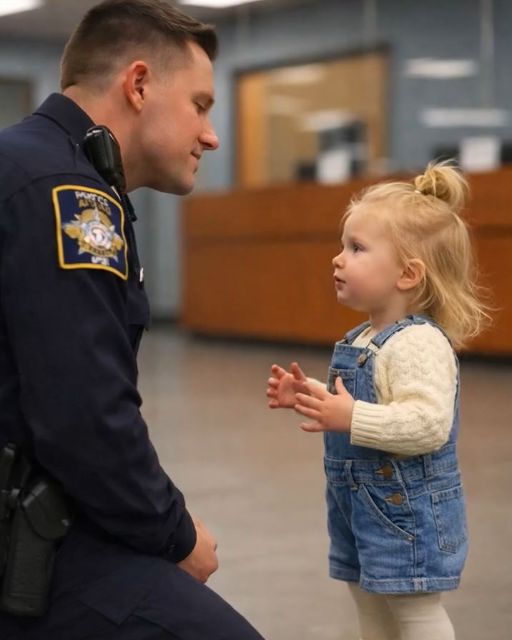
Miller walked around the desk and knelt down. He softened his voice. “Hey there, Sarah. I’m Officer Miller. I hear you have something you shouldn’t.”
The girl nodded, tears spilling onto her shirt. “I was bad,” she whispered. “I dug in the soft dirt. Daddy said never dig in the soft dirt.”
Gary chuckled nervously behind her. “She ruins her clothes, officer. You know how it is.”
“I see,” Miller said, ignoring the father. “And what did you find in the dirt, Sarah?”
“The lady’s necklace,” Sarah sobbed. “I stole it from the sleeping lady.”
“It’s just an old chain, officer,” Gary said, his voice suddenly sharp. “Come on, Sarah, give it to the man so we can go.”
Sarah reached into her pocket. She didn’t pull out a rusty chain. She pulled out a pristine, platinum locket encrusted with diamonds.
Miller felt the blood drain from his face. He recognized the jewelry immediately. It was the exact piece described in the missing person’s briefing regarding Gary’s ex-wife, Eleanor, who had “moved to Europe” two days ago according to him. Her frantic parents had reported her missing yesterday.
Miller took the locket. He didn’t look at Sarah. He looked at Gary, whose smile had just vanished. Miller’s hand drifted to his holster as he whispered, “Sarah, did the sleeping lady…”
“Talk to you?” he finished, his voice a low, steady rumble that didn’t betray the alarm bells screaming in his head.
Sarah shook her head, her tiny body trembling. “She was very, very sleepy. Like a doll.”
Gary took a half-step forward, his hand outstretched. “Okay, that’s enough. We’ve wasted enough of the officer’s time. Sarah, let’s go.”
Miller stood up slowly, creating a barrier between the child and her father. He held up a hand. “Just one more minute.”
He walked back to the main entrance, his movements calm and deliberate. With a soft click, he engaged the magnetic lock on the station doors. The sound was quiet, but in the tense silence, it echoed like a gunshot.
Linda’s eyes widened. “Officer? What are you doing?”
“Just a precaution,” Miller said, his gaze fixed on Gary. “The doors lock automatically after hours. My shift just ended.” It was a lie, but a necessary one.
He turned to the dispatch window behind his desk, where a young officer named Peterson was watching, wide-eyed. Miller made a subtle hand gesture, one they practiced for situations just like this. It meant, ‘silent alarm, domestic situation, potential homicide.’
Peterson’s face paled, but he nodded once and turned back to his console. Within seconds, every officer in a five-mile radius would be converging on their location. Now, he just had to keep them here.
“So, Gary,” Miller began, his tone conversational as he leaned against the desk, the locket now tucked safely in his own pocket. “You said your ex-wife went to Europe?”
Gary’s Adam’s apple bobbed. “Yes. She, uh, she needed a break. Found a new job in Paris.”
“Paris,” Miller repeated. “That’s nice. Did she leave a forwarding address? Her parents have been trying to reach her. They seem to think she wouldn’t leave without Sarah.”
Linda spoke up, her voice high and strained. “Eleanor was always flighty. She could never handle responsibility. That’s why Gary got full custody.”
Miller looked at Sarah, who was now hiding behind his leg, peering out at her parents as if they were strangers.
He knelt down again. “Sarah, honey, I need you to be a very brave girl for me. Can you do that?”
She nodded timidly.
“When you found the necklace,” he said softly, “was the sleeping lady wearing it?”
“No,” Sarah whispered. “It was in her hand. Her hand was cold.”
A cold dread washed over Miller. He pictured the scene a three-year-old was describing. The soft dirt. A sleeping lady. A cold hand.
Gary’s composure finally shattered. “She’s a child! She has an overactive imagination! She watches cartoons! You can’t listen to this.”
Just then, a female officer, Corporal Dunn, came through the back hallway. She’d gotten Peterson’s silent message. Her expression was calm, but her eyes were sharp and focused.
“Sergeant, is there a problem?” she asked, her gaze taking in the scene.
“Corporal Dunn, perfect timing,” Miller said, standing. “Could you take Sarah here back to the break room? I think there are some cookies and maybe some cartoons on the little TV in there.”
Dunn gave a warm smile that didn’t quite reach her alert eyes. “Of course. Come on, sweetie. Let’s go find some chocolate chip cookies.”
Linda reached for her daughter. “No, she stays with us!”
Dunn stepped smoothly between them. “It’s alright, ma’am. We just need to ask you and your husband a few questions. She’ll be perfectly safe.”
Sarah looked up at Miller, her tear-filled eyes asking a question. He gave her a reassuring nod. “Go with Officer Dunn. She’s my friend. She’s one of the good guys.”
As Dunn led the little girl away, the atmosphere in the lobby dropped ten degrees. The facade of the worried suburban parents had crumbled, leaving two cornered, frightened people in its place.
“Sit down,” Miller commanded, his voice now stripped of all gentleness. “Both of you.”
They sat in the hard plastic chairs opposite his desk. The distant wail of sirens began to grow, a sound that Gary and Linda seemed to notice at the same time. Panic flickered across Gary’s face.
“I want a lawyer,” he blurted out.
“You’re not under arrest,” Miller said calmly. “You’re just helping me clear up a misunderstanding. Your daughter found a very expensive piece of jewelry. I just want to know how it ended up in your backyard.”
Linda began to weep, not the hysterical sobs of her daughter, but quiet, terrified tears. “Gary, tell him. Tell him what happened.”
Gary shot her a venomous look. “Be quiet, Linda.”
The station doors opened to admit two uniformed officers, their hands resting on their sidearms. Miller nodded at them, and they took up positions by the door. The trap was set.
Miller pulled up two separate files on his computer. One was the missing person report for Eleanor Vance. The other was an internal memo about a string of recent burglaries in their affluent neighborhood. He was just looking for leverage, for any small crack he could exploit.
“Let’s talk about the soft dirt, Gary,” Miller said. “Your daughter mentioned you told her not to dig there. Why is that? New sod? Sprinkler system?”
“I was putting in a flower bed for my wife,” Gary said through gritted teeth. “For Linda.”
“A flower bed,” Miller mused. “That’s thoughtful. What kind of flowers?”
“I don’t know! Roses, whatever! What does it matter?”
It mattered a great deal. Miller brought up a satellite image of the property from the county database, updated just a week prior. He turned the monitor so they could see it. In the backyard, near a large oak tree, was a pristine, undisturbed lawn. There was no patch of soft, freshly turned earth.
“This image is from last Tuesday,” Miller said quietly. “Where’s the flower bed, Gary?”
Linda let out a choked sob. “He did it. It was him.”
Gary lunged from his chair towards her, his face a mask of rage. “You shut your mouth!”
The two officers at the door moved instantly, pinning Gary against the desk before he could take two steps.
“That’s enough,” Miller said, his voice like ice. “You’re both going to separate rooms. And you’re both going to tell me what happened to Eleanor Vance.”
Miller had Linda taken to a small interview room, while he and another detective took Gary to a separate one. The stories they told were initially the same. Eleanor had been unstable. She’d shown up at the house unannounced, screaming, trying to take Sarah. There was a struggle. She fell. It was an accident.
Gary claimed he panicked. He buried her in the backyard, intending to move her later. He told Linda that Eleanor had just run off after the argument.
But Linda’s story started to show cracks. She was too calm, her answers too rehearsed. She painted Gary as a monster, a man with a violent temper who she was terrified of. But her timeline was off. She claimed she was at the grocery store during the “accident,” but store receipts and security footage Miller’s team quickly pulled showed she was there two hours earlier.
Meanwhile, Corporal Dunn was getting the real story from the only honest person involved. In the quiet of the break room, surrounded by coloring books, Sarah told Dunn about the “big loud talk” between her daddy and “Mommy El.” She said her other mommy, Linda, was there too.
“Mommy Linda was crying,” Sarah said, scribbling with a purple crayon. “But her face was smiling.”
That one sentence sent a chill down Dunn’s spine. She relayed it to Miller immediately. A crying woman with a smiling face. It was the kind of strange, contradictory detail that a child would notice but an adult would never invent.
Miller went back into the interview room with Linda. He placed a photo of Eleanor on the table. She was smiling, holding a much younger Sarah in her arms.
“A child’s memory is a funny thing,” Miller said, sitting down opposite her. “They remember feelings. They remember strange details. Like a smile on a crying face.”
Linda’s composure finally broke. Her carefully constructed victim narrative fell apart, revealing something far more sinister underneath.
The twist wasn’t that Gary had killed his ex-wife. It was that Linda had orchestrated the entire thing. She was consumed by a venomous jealousy of Eleanor, the woman who had given Gary his daughter, the woman who would always be a part of their life.
She had lured Eleanor to the house under the pretense of letting her see Sarah. She had started the argument, pushing and provoking until Gary, a weak-willed and easily manipulated man, had shoved his ex-wife. Eleanor had stumbled, hit her head on the stone fireplace, and fallen unconscious.
It might have ended there. But it was Linda who saw the opportunity. While Gary was in a panic, she was the one who retrieved a heavy statue from the mantle. She was the one who made sure Eleanor never woke up.
She convinced Gary that no one would believe it was an accident. She helped him dig the shallow grave in the dead of night. She came up with the “moved to Europe” story. She thought she had planned the perfect crime.
Her only mistake was the locket. In the struggle, it had come off. After they buried Eleanor, Linda realized it was missing. She and Gary searched frantically but couldn’t find it in the dark. They hoped it was buried with her.
But it wasn’t. It was lying in the grass, just waiting for a curious little girl to discover it.
When Sarah found it and started her six-hour crying jag, Linda saw not a disaster, but a twisted opportunity. She convinced Gary that the best way to handle it was to go to the police themselves. It was an act of supreme arrogance. She believed they could control the narrative, portray themselves as concerned parents with a fibbing child, and have the police dismiss the locket as a piece of junk. It would be their final alibi, a story of them “trying” to turn in the “trinket” their daughter found.
Confronted with Sarah’s description of her smiling-while-crying face, Linda confessed everything. Her confession was cold, chilling, and utterly without remorse. Gary, in the other room, had already broken down, his story a pathetic attempt to minimize his own role in a crime he was too weak to prevent and too cowardly to report.
A search warrant was executed. Under a newly planted rose bush by a large oak tree, investigators found Eleanor Vance.
Sarah was placed in the care of Child Protective Services, who immediately contacted Eleanor’s parents. The elderly couple drove through the night, their faces etched with grief, but their eyes filled with a desperate love for the granddaughter they thought they might have lost forever.
Miller was there when they arrived. He watched as Sarah ran into her grandmother’s arms, a moment of pure light in a world of profound darkness. Before they left, he knelt down and handed Sarah a small, plush teddy bear wearing a tiny police uniform.
“This is Officer Ted,” he said softly. “He’s very brave, just like you. He’ll keep you safe.”
Sarah hugged the bear tightly. “Thank you for finding Mommy El’s necklace.”
“You found it, Sarah,” Miller replied, his voice thick with emotion. “You’re the hero.”
Years passed. Captain Miller often stood before new classes of police recruits, the story of Sarah Vance his most important lesson. He told them about the power of listening, about how the most earth-shattering truths are often spoken in the quietest whispers. He told them to never, ever dismiss what a child says, because their world is one of simple, unvarnished honesty.
Somewhere across the country, a teenage girl named Sarah excelled in her art class. She lived in a house filled with laughter, warmth, and the unconditional love of her grandparents. Her memories of that terrible time were fuzzy, like a half-forgotten dream, overshadowed by a lifetime of healing and happiness. She was known for her kindness, her quiet strength, and her uncanny ability to find things others had lost.
The truth, no matter how deep you bury it, has a way of finding its way to the surface. Sometimes, it just needs a small hand to help it dig, to bring a dark and terrible secret into the light, proving that the most innocent heart can possess the most profound courage.