My colleague sent me a friend request. I declined, saying I keep work separate. It wasn’t meant to be an insult or a declaration of war. I just like having a space where I can post pictures of my messy garden or my cat without worrying about how it looks to the people I sit next to for forty hours a week. I’ve always believed that boundaries are what keep a professional environment healthy and productive.
She said, “Wow! Seriously?” Her name was Monica, and she was one of those people who treated the office like a high school common room. She was always at the center of the gossip, organizing the drinks, and knowing exactly who was dating whom. When I gave her my polite, standard explanation about privacy, she looked at me like I’d just told her I hated Christmas. She didn’t say anything else, but the air in the breakroom felt like it dropped twenty degrees in a matter of seconds.
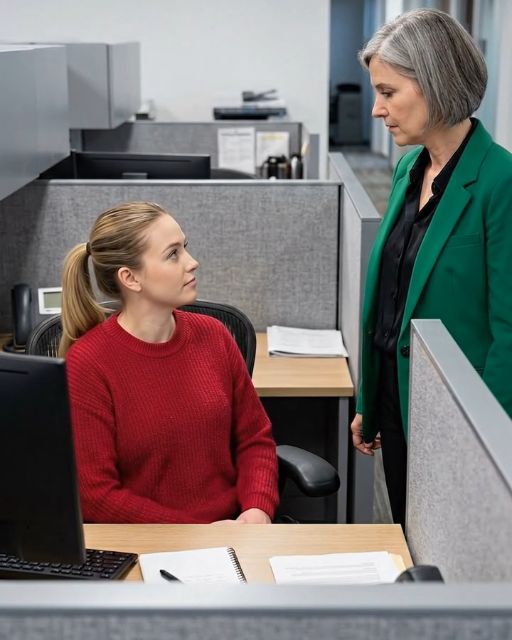
Within days, I was frozen out: no lunch invites, no replies in group chats. It was subtle at first, the kind of things you think you might be imagining. I’d walk into the kitchen, and the conversation would die a sudden, awkward death. I’d ask a question in the project Slack channel about a deadline, and it would sit there with “seen by everyone” but zero responses. It was incredibly isolating, and I started to dread the commute into our central London office every single morning.
I tried to keep my head down and focus on my data reports, telling myself that I wasn’t there to make best friends anyway. But the silence was heavy, and it started to affect my work because I was being left out of crucial project updates. I felt like a ghost haunting my own cubicle, watching everyone else laugh and plan their weekend trips while I was treated like a traitor. Monica was always at the heart of it, her laughter just a little too loud whenever I was within earshot.
But the real shock came when my manager, a stern man named Harrison, pulled me aside and led me into his private office. My heart was pounding against my ribs because I knew something was wrong, but I assumed he was going to talk about my recent drop in productivity. I sat down in the leather chair, bracing myself for a lecture about “team spirit” or “collational harmony.” Instead, he closed the door and sat behind his desk with an expression that looked more like concern than anger.
“Arthur, I’ve had several reports about your behavior on social media,” Harrison said, leaning forward and folding his hands. I felt my jaw drop, my mind racing through every boring thing I’d ever posted online. I told him that was impossible because my accounts were private and I didn’t have any coworkers on my list. He sighed and pulled his laptop around, showing me a series of screenshots that made the blood drain from my face.
There was an account that looked exactly like mine—same name, same profile picture of my golden retriever, and even a similar bio. But the posts were horrific. This “Arthur” was posting nasty comments about our clients, making fun of our company’s mission statement, and even sharing “confidential” looking documents that were actually clever fakes. I stared at the screen, my ears ringing, realizing that someone had gone through a lot of trouble to frame me for professional misconduct.
“I didn’t post these, Harrison,” I whispered, my voice shaking with a mix of fear and fury. I explained the whole situation with Monica’s friend request and the subsequent cold shoulder I’d been receiving. Harrison looked at the screenshots and then back at me, his eyes narrowing as he thought it through. He told me he wanted to believe me, but the “leaked” documents were a serious matter that HR would have to investigate. He told me to go home for the day while they looked into the digital trail of the account.
I walked out of the building feeling like my entire career was crumbling because of a single clicked button. I spent the evening at home, scouring the fake profile and noticing things I hadn’t seen in the office. The “leaked” documents had some very specific typos—the kind of mistakes I knew Monica made in her weekly reports. I realized she hadn’t just been offended by my rejection; she had been trying to get me fired to “protect” herself from something.
I didn’t wait for HR to call me; I did some digging of my own into the timestamps of the posts. I noticed that several of the most damaging “leaks” were posted during times when I was actually in meetings with Harrison. I gathered my evidence, including my own phone’s screen-time logs, and went back to the office the next morning. I didn’t go to my desk; I went straight to Harrison’s office and laid it all out on his desk like a hand of winning cards.
“Look at the timing,” I said, pointing to the logs. “I was sitting three feet away from you when this ‘Arthur’ was supposedly posting trade secrets.” Harrison looked at the data, his professional mask finally cracking into a look of genuine anger. He called Monica into the room, and the look on her face when she saw me sitting there was worth more than any bonus I’d ever received. She tried to play it off as a joke, then as a mistake, and finally, she just stopped talking altogether.
ThMonica wasn’t just being petty because I wouldn’t be her digital friend. It turned out she had been using the fake account to leak actual company secrets while making it look like it was coming from me. She had been selling lead lists to our biggest competitor for months, and she needed a fall guy in case the IT department ever caught on. My refusal to add her on social media made me the perfect target because she could claim she “saw” my posts, and I was hiding them from everyone else.
A week later, after Monica had been fired and escorted from the building, Harrison called me back into his office, but this time, he had a bottle of expensive sparkling water and two glasses. He told me that the investigation into Monica’s “leaks” had uncovered a massive flaw in our company’s data security protocols. Because I had been the one to fight back and prove the fraud, the board wanted to move me into a new role.
I was promoted to the Head of Internal Security and Data Privacy, a position that came with a significant raise and my own office. I went from being the “loner” who was frozen out of lunch to the person responsible for making sure no one ever had their identity weaponized again. The team that had ignored me for weeks suddenly started hovering around my door, trying to apologize and get back in my good graces. I was polite, but I didn’t change my policy—I still didn’t add any of them on Facebook.
The rewarding conclusion wasn’t just the new title or the extra money, though they certainly helped with the stress. It was the fact that I had stood my ground and been proven right about the importance of professional boundaries. I realized that my coworkers didn’t need to be my “friends” to be my teammates, and the ones who pushed the hardest for access were often the ones with the most to hide. My privacy hadn’t just protected my cat photos; it had saved my entire reputation from a predator.
I learned that your “no” is a powerful tool, even when it makes you unpopular in the short term. We often feel pressured to be “open” and “accessible” in a world that wants to monitor every second of our lives, but there is dignity in having a private world. You don’t owe anyone a window into your personal life just because you share an office or a project. True character shows up in the work you do, not in the “likes” you accumulate on a screen.
Never be afraid of the silence that comes when you set a boundary. People who respect you will understand it, and people who don’t will eventually reveal why they wanted to cross it in the first place. I’m proud of that “declined” request now because it was the moment I chose myself over the crowd. And in the end, the crowd had to learn to respect the man behind the desk, even if they never got to see his garden.
If this story reminded you that it’s okay to keep your work life and your personal life separate, please share and like this post. We all deserve a space where we can just be ourselves without the “office” watching. Would you like me to help you draft a polite but firm response for the next time someone tries to cross a boundary you aren’t ready to open?