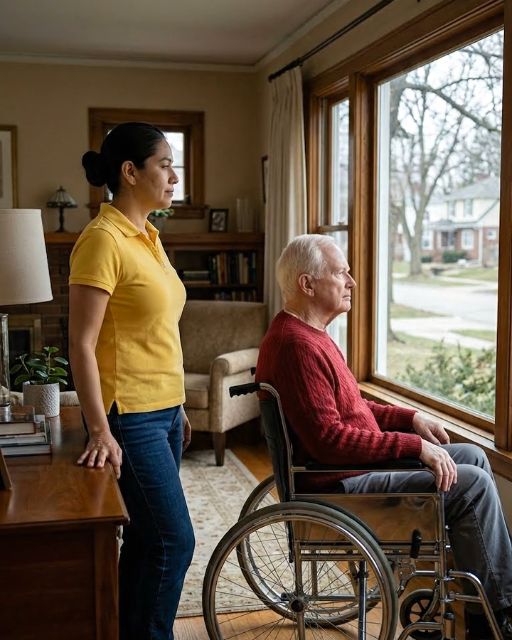
Every week, I visited Ruth, 84, who had dementia. She’d grab my hand and call me ‘Claire,’ telling me stories about a childhood that wasn’t mine. The nursing home staff just said, “Go with it. It makes her happy.” So for six months, I was Claire.
When she passed, I went to the funeral to say goodbye. Her son, Todd, pulled me aside. With tears in his eyes, he thanked me for being there for his mom. “She wanted you to have this,” he said, handing me a small, folded piece of paper from her wallet.
I thought it would be a note. It wasn’t. It was a faded photograph of two young women laughing on a porch swing.
One was a young Ruth.
The other one… my blood ran cold. It was my mother.
Todd looked at my face, his own growing pale with confusion. “My mom always called you Claire. But that’s my aunt’s name in this photo. And that’s impossible, because my mother was the one who testified that she saw her…”
He trailed off, the words hanging in the somber air of the reception hall.
“…saw her walk into the lake,” he finally whispered, his voice cracking.
My mind was a whirlwind. My mother, Helen, had died when I was very young. I only knew her through a handful of photographs and my father’s quiet, sad stories. He never mentioned an aunt named Claire. He never mentioned a friend named Ruth.
“I don’t understand,” I managed to say, my own voice a stranger to my ears. My gaze was fixed on the photograph. On my mother’s beaming face, so full of life. And the woman next to her, Claire. They looked so much alike they could have been twins. They were sisters.
“My Aunt Claire was my mother’s best friend,” Todd explained, his eyes darting between me and the photo. “They were inseparable. Her sister… your mother, I guess… was right there with them.”
He looked utterly lost.
“The official story is that Claire drowned. It was a tragic accident during a summer storm at our old family cabin.”
My legs felt weak. I found a nearby chair and sank into it.
“My mom was the only witness,” Todd continued, sitting opposite me. “She told the police she saw Claire go for a swim, that she warned her not to, but Claire was always headstrong.”
He shook his head, running a hand through his hair. “It haunted her. All her life, it haunted her. She never went back to that cabin.”
For six months, Ruth had been telling me stories. Stories about skipping stones, about sneaking out to a dance, about sharing secrets on a porch swing just like the one in the picture. I had assumed they were her memories, scrambled by the disease. Now I realized she hadn’t been reliving her own childhood. She had been reliving my mother’s.
And she was talking to my aunt.
“Can we talk?” I asked Todd, my voice barely audible. “Not here. Somewhere else.”
He nodded, his eyes filled with a shared, sudden dread. We agreed to meet for coffee the next day. I went home in a daze, the faded photograph clutched in my hand.
That night, I didn’t sleep. I tore through the old storage chest in the attic, the one my dad had labeled ‘Helen’s Things.’ Inside were yearbooks, a pressed corsage, and a small wooden box tied with a ribbon. I had never opened it before. My dad said it was too painful.
Inside were bundles of letters, held together by aging rubber bands. The handwriting was a graceful, looping cursive. The signature on the first one I opened made my heart stop. ‘Love, Ruth.’
I sat on the dusty floor and read for hours. The early letters were bright and full of youthful gossip. They painted a picture of three young women – Ruth, Helen, and Claire – on the cusp of their lives. They were full of dreams and inside jokes.
But then the tone shifted. The letters written after that fateful summer were different. They were heavy, strained. Full of apologies that made no sense.
“I hope you can forgive me, Helen,” one read. “I did what I had to do. For my family. For Todd.”
Another said, “He knows what I did. He holds it over me every day. I see her face in my dreams.”
My father had always said my mother died of a broken heart. He said she faded away a few years after I was born, lost in a grief he could never fully understand. He thought it was because she missed her sister so terribly.
Now, I wondered if it was something far heavier.
The next day, I met Todd at a quiet café. I brought the box of letters. His face was etched with sleeplessness, just like mine.
“I think your mother was lying,” I said, my voice flat. I pushed the letters across the table.
He read them, his expression hardening with each page. He saw the same coded guilt, the same suffocating fear that I had.
“My father…” Todd began, then paused. “My father was not a good man. He had a temper. Especially when he drank.”
He looked up at me, a dark understanding dawning in his eyes. “My mom was always so… timid around him. So careful.”
We sat in silence, the unspoken truth filling the space between us. Ruth hadn’t been testifying against her friend. She had been covering for her husband.
“The lake house,” I said suddenly. “You said your family still owns it?”
“Yeah,” he replied. “It’s been boarded up for decades. After that summer, no one ever went back.”
“We need to go,” I said. It wasn’t a question.
The drive was two hours long, winding through country roads until we reached a gravel path nearly swallowed by nature. The cabin was small and dilapidated, its paint peeling like sunburnt skin. The air was thick with the smell of pine and damp earth.
The front porch creaked under our weight. It was the same porch from the photograph. The swing was gone, but the hooks it once hung from were still screwed into the ceiling beams, rusted and lonely.
Inside, the cabin was a time capsule. Dust motes danced in the slivers of light piercing the boarded-up windows. Furniture was draped in white sheets, like ghosts waiting for a party that would never come.
We didn’t know what we were looking for. A clue. A confession. Anything.
Todd moved toward the old stone fireplace. I stayed on the porch, my hand tracing the space where the swing used to be. My foot snagged on a loose floorboard.
Curiosity piqued, I knelt down. The board lifted easily. Beneath it was a small, hollowed-out space. And inside that space was a small, tarnished silver locket.
“Todd,” I called out, my voice trembling.
He rushed over. I held the locket in my palm. It was heart-shaped, with the initial ‘C’ engraved on the front. Claire’s.
I fumbled with the clasp. It snapped open. I expected to see a tiny photograph inside, maybe of my mother, or even of Ruth.
But it was empty. Except for a minuscule, tightly folded piece of paper, yellowed with age. With trembling fingers, I unfolded it.
It wasn’t a note. It was a bus ticket.
A one-way ticket to a small town in Oregon, dated for the day after Claire had supposedly drowned.
She wasn’t going for a swim. She was running away.
“Why?” Todd whispered, staring at the ticket. “Why would she leave?”
And then, the fragmented memories from my visits with Ruth began to click into place. The things she’d said to me, thinking I was Claire.
“We have to be quiet, Claire. He’ll hear us.”
“Don’t tell Helen. It will only worry her. We can handle this ourselves.”
“The money is hidden. Enough for a fresh start.”
“He saw the bruises. He knows. We have to go. Tonight.”
Ruth hadn’t been talking about her own childhood. She had been replaying the last day of Claire’s life. Claire wasn’t just running away. She was helping Ruth and a very young Todd escape.
Escape from Todd’s father.
The pieces slammed together with brutal force. Claire had discovered that Ruth’s husband, Frank, was abusing her. She had scraped together money and arranged for them to disappear. The bus ticket wasn’t for her alone. It was for them.
Frank must have found out.
He must have followed them to the cabin that night.
“My God,” Todd breathed, sinking onto the dusty floor. “That night… there was a storm. My dad came home late, soaked to the bone. He was furious. He told my mom to pack me a bag, that we were leaving immediately.”
He looked at me, his face a mask of horror. “He said Claire had an accident. That she had been reckless. He made my mother tell the police what she saw.”
But what she saw wasn’t Claire taking a reckless swim. She saw her best friend, her sister-in-law, trying to save her. She saw her husband, in a drunken rage, confronting them on the dock. There must have been a struggle. A push. A fall.
Frank hadn’t just let Claire drown. He had caused it. And then he threatened the only witness into silence.
Ruth’s entire life had been a prison. Held captive not only by an abusive husband but by a terrible, suffocating secret. Her testimony wasn’t a betrayal. It was a desperate, terrified act to protect her only child.
The guilt hadn’t been about what she did. It had been about what she couldn’t do. She couldn’t save Claire. She couldn’t tell the truth.
In her final months, as her mind unraveled, the truth finally began to spill out. Her dementia wasn’t erasing her past; it was trying to correct it. She saw me, a young woman who looked so much like her long-lost friend and her sister, and her broken mind tried to bridge the chasm of fifty years.
She wasn’t calling me the wrong name. She was finally talking to the person she needed to talk to all along. She was apologizing to Claire. She was trying to explain.
Tears streamed down Todd’s face. “All these years,” he choked out. “I thought she was just… fragile. I never understood the depth of her sadness.” He now saw his mother not as a weak woman, but as a survivor who had endured an impossible choice.
A heavy peace settled over the dusty cabin. The ghosts of the past didn’t feel angry anymore. They felt understood.
As we were about to leave, Todd paused at the doorway. “You know,” he said quietly, “my father died a few years after that summer.”
I waited.
“He was out on the lake, on his boat. A sudden storm kicked up, just like that night. The boat capsized. They found it days later. It was ruled an accident.”
He looked out at the dark, still water. “I guess the lake keeps its secrets.”
We left the cabin and its painful history behind. The locket and the bus ticket felt sacred in my hands. They were the final words in a story that had been silenced for decades.
Ruth’s final gift to me wasn’t just a photograph. It was the truth. It was the key that unlocked my own family’s silent sorrow, explaining the grief that had shadowed my mother’s life and, in turn, my own.
The world is not a simple place of good people and bad people. It is a messy, complicated tapestry of impossible choices, of love that endures even through unimaginable pain, and of guilt that can echo through generations. Ruth wasn’t a villain in this story. She was a victim who did the only thing she could to protect her son.
In the end, she found a way to unburden her soul, even if it was through the fog of a failing mind. She gave Todd a new understanding of his mother’s strength, and she gave me back the family I never knew I had lost. And in a quiet, forgotten corner of a nursing home, a profound act of love and confession finally brought peace to three women whose lives were irrevocably bound by a dark secret on a stormy night.