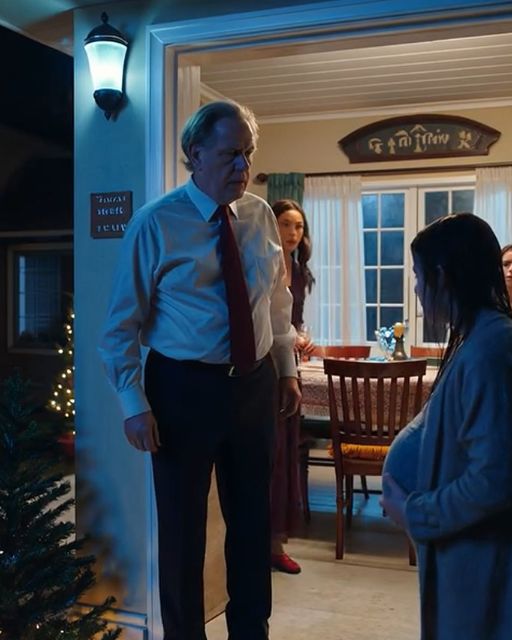
My husband yelled from the dining room, “We’re not a shelter – get lost!”
My daughter-in-law sneered, “She’ll contaminate the food.”
I looked through the open door at the girl on our porch. At her thin coat and the impossible curve of her pregnant belly against the cold night.
My hand slammed down on the entry table. The keys in the little ceramic bowl rattled.
“Set another place,” I said. “She’s eating with us.”
The silence that followed was thick enough to choke on.
Just moments before, our dining room was a picture. Burgundy napkins I’d ironed myself. My mother’s china, gleaming under the chandelier. The whole house smelled of rosemary and wealth.
My husband, Mark, sat at the head of the table, pretending to be busy on his phone. Our son, Alex, was talking about investments. His wife, Chloe, checked her reflection in a spoon.
Perfect. A perfect American Christmas.
Then the doorbell rang.
The girl on the porch looked maybe twenty. Hair damp from the cold winter drizzle, one hand on the railing to keep her balance.
Her voice was soft when she asked. “I’m sorry. Do you have any water?”
That’s when Mark’s voice boomed from the other room. That’s when Chloe appeared with her wineglass and her disgust.
They looked at her like she was trash blown in from the street.
Maybe it was the memory of all the sermons about charity, the ones Mark always complained about in the car on the way home. Maybe it was the quiet pride in the girl’s eyes.
But something in me just broke.
Mark’s chair scraped the hardwood as he stormed into the hall, his face already flushed. “Have you lost your mind? Inviting some vagrant to our family dinner?”
“Her name,” I said, turning back to the girl, “is what?”
“Leah,” she said.
So I brought Leah to our perfect table. I watched my family wrap themselves in a cold, brittle politeness.
Chloe slammed down a spare plate. Alex suddenly became fascinated by the label on his beer. Mark stared at our guest like she was holding a grenade.
And Leah, shivering and exhausted, thanked me for a glass of water like I had handed her the world.
She said she grew up on the east side, near the old park. Said her mother died a few months ago. Said she was figuring things out.
Chloe kept dropping little bombs. “Where’s the father?” she’d ask. “Friends must get tired of supporting people.”
Leah answered every question with a grace that shamed us all.
All the while, I saw Mark watching her. Not with anger anymore. With something else. A weird, focused attention, like he was trying to solve a puzzle he didn’t want the answer to.
My own dinner tasted like dust.
Then it happened.
Leah reached for her water glass, and the cuff of her worn sweater rode up her arm.
Just an inch of pale skin.
But it was enough.
There, on her wrist, was a dark crescent moon. A birthmark, clear as day under the warm dining room lights.
My fork stopped.
Mark’s knife clattered against his plate. The sound was a gunshot in the silent room.
He stared at that mark.
I watched the blood drain from his face, leaving it the color of old paper. I saw his perfect Christmas composure crumble into ash.
Because I knew that mark.
I had traced its identical shape on my husband’s shoulder a thousand nights in a row.
The girl I invited in from the cold wasn’t a stranger.
And in that moment, with the tree glowing in the corner and my family frozen around the table, I realized the man I had been married to for thirty years was a complete and utter stranger to me.
Chloe was the first to speak, her voice sharp and ugly. “What is wrong with everyone?”
She looked from my face to Mark’s, then followed his gaze to Leah’s arm.
Leah, sensing the shift, slowly pulled her sleeve back down. She looked small and confused.
“I… I’m sorry,” she whispered, though she had no idea what for.
Alex finally looked up from his beer, his brow furrowed. “Dad? What’s going on?”
Mark didn’t answer. He couldn’t.
He just kept staring at Leah, his mouth slightly ajar, as if he’d seen a ghost from a past he’d worked his entire life to bury.
I stood up. My own legs felt unsteady.
“Chloe, Alex,” I said, my voice surprisingly firm. “I think you should both go home now.”
Chloe scoffed, a little bubble of outrage. “Go home? In the middle of Christmas dinner? Mother, have you gone mad?”
“Yes,” I said, meeting her cold stare. “Go home.”
Alex looked at his father, then at me. He saw something in my eyes that made him stand.
He grabbed Chloe’s arm. “Come on. We’re leaving.”
She pulled away, indignant. “We are not! I want to know what this is all about.”
That’s when I looked at my son, the boy I had raised, and saw the same selfish curiosity I now saw in his father.
“It is about a family matter,” I said, the words tasting like acid. “One that doesn’t concern you right now.”
They left in a flurry of slammed doors and angry whispers that echoed in the hall.
Now it was just the three of us in the vast, silent dining room.
Me. My husband. And his daughter.
Leah was looking down at her plate, her hands clasped tightly in her lap. She was trying to disappear.
I walked over and put a hand on her shoulder. She flinched.
“It’s okay, Leah,” I said gently. “You’ve done nothing wrong.”
I turned to Mark. He finally tore his eyes away from Leah and looked at me.
In his eyes, I saw it all. Guilt. Fear. And a pathetic plea for me to fix this, to make it all go away like I’d fixed everything else for thirty years.
“The guest room is made up,” I told him, my voice devoid of any warmth. “You can take her things up. Make sure she has towels.”
It wasn’t a request.
He nodded numbly, like a man in a trance.
I helped Leah to her feet. She was trembling.
“You can rest here tonight,” I said. “We’ll sort everything out in the morning.”
She looked at me, her eyes full of questions she was too scared to ask. She just nodded and let me lead her from the room.
I didn’t watch Mark follow us with her worn-out backpack. I couldn’t bear to look at him.
After I settled Leah in the guest room, I closed the door softly behind me.
I found Mark standing in the middle of the living room, surrounded by the ghosts of our perfect Christmas. The half-eaten dinner, the expensive gifts under the tree.
It all looked like a cheap movie set.
“When?” I asked. It was the only word I could manage.
He sank into an armchair, covering his face with his hands. His voice was muffled.
“Twenty years ago. Maybe twenty-one.”
Twenty-one years ago. Alex would have been a boy. We would have been saving for this house.
We would have been happy, or so I thought.
“A business trip,” he mumbled. “To the coast. I was young, I was stupid.”
He said her name was Susan. She was a waitress at a diner he’d stopped at.
He said it was just one night. A mistake.
“I never heard from her again,” he insisted, finally looking up at me, his eyes pleading. “I swear. I never knew. I never knew she was pregnant.”
I just stared at him. I tried to feel something. Anger, betrayal, sorrow.
But all I felt was a profound, chilling emptiness.
The man I loved, the life I had built, was a lie. It was a beautiful house with rotten foundations.
“Her mother died a few months ago,” I said flatly. “That’s what she told us at dinner.”
The color drained from his face again. He hadn’t connected the dots.
He had been so horrified by the arrival of a poor girl that he hadn’t even truly listened to her words.
“What was her last name?” I pressed.
He shook his head, looking lost. “I don’t remember. Smith, or Jones. Something common. It was so long ago.”
Cowardice. It radiated from him.
He hadn’t wanted to know. He had wrapped himself in his success and his perfect family and had deliberately forgotten.
“She has your eyes,” I said quietly. “And your birthmark.”
A tear finally rolled down his cheek. It wasn’t a tear of remorse for his betrayal of me.
It was a tear of self-pity. He was crying for himself, because his perfect world was collapsing.
“What are we going to do?” he whispered.
I looked at him, at this man I’d shared a bed with for three decades.
The “we” in his question felt like a punch. There was no “we” anymore.
“I don’t know what you are going to do, Mark,” I said. “But I know what I am going to do.”
“I am going to make a pot of tea. And in the morning, I am going to help that girl. Your daughter.”
I left him there, weeping in his expensive chair.
The next morning, the house was still and cold.
I found Mark asleep on the sofa, a bottle of scotch on the floor beside him. I walked right past him.
I knocked softly on the guest room door.
Leah opened it, already dressed in the same worn clothes. She looked like she hadn’t slept at all.
“I should go,” she said immediately. “Thank you for the room.”
“You’re not going anywhere,” I told her. “Come and have some breakfast.”
She hesitated, then followed me to the kitchen. I made toast and eggs, the simple domestic act a strange comfort in the chaos.
We ate in silence for a few minutes.
Finally, she spoke. “That man… your husband,” she started, her voice barely a whisper.
“He has a birthmark, doesn’t he?”
I just nodded.
A single tear traced a path down her cheek. “My mom told me about him once. She said he was a good man who made a mistake.”
She looked at me, her gaze full of a pain that was far older than she was.
“She said he had a family. That he was happy. She never wanted to ruin that for him.”
So her mother knew. And she had protected Mark’s perfect life, even at the cost of her own.
She had raised her daughter alone, with grace and love, while Mark built his empire on a foundation of lies.
That’s when a new feeling finally broke through my numbness.
It was a hot, righteous anger. An anger for Leah, for her mother, and for the fool I had been.
Just then, Mark shuffled into the kitchen, his face puffy and gray.
He looked at Leah, and for the first time, he seemed to truly see her not as a problem, but as a person. His daughter.
“Leah,” he started, his voice thick with shame. “I… I am so sorry.”
Leah didn’t say a word. She just looked down at her hands. She owed him nothing.
Not forgiveness. Not acknowledgement. Nothing.
I stood up and faced my husband.
“I want you to pack a bag,” I said, my voice calm and clear. “I want you to go to a hotel. I’ll call you when I’m ready to talk.”
He opened his mouth to protest, to argue, to beg.
But he saw the look in my eyes and knew it was useless.
He simply turned and walked away.
The next few weeks were a blur.
Alex and Chloe called, of course. Chloe was furious, demanding to know why I had “thrown Dad out for some street girl.”
Alex was more measured, talking about the family’s reputation, the company.
He didn’t ask how I was. He didn’t ask about Leah.
I realized with a sickening lurch that I had raised a son who was a carbon copy of his father. All surface, no substance.
I told them I needed space and hung up the phone.
My life became about Leah.
I took her to doctor’s appointments. I bought her maternity clothes and a proper winter coat.
We talked. For hours.
She told me about her mother, a woman of quiet strength who worked two jobs and always made sure Leah felt loved. She told me about her dreams of being a graphic designer.
She never once asked for a thing.
One day, we were cleaning out the nursery I had set up in what used to be Alex’s room.
“Why are you doing this?” she asked softly, folding a tiny blanket. “For me.”
I looked at her, at the gentle slope of her belly, at the strength in her tired eyes.
“Because for thirty years,” I said, “I lived in a beautiful, empty house. It was full of expensive things, but it was hollow.”
“You walked through that door, and for the first time in a long time, this place felt like a home.”
It was the truth.
The quiet compassion of this girl had shown me everything that was missing from my own life.
Mark called every day. At first, I didn’t answer.
Then, I started picking up. I didn’t let him apologize or make excuses.
I just listened. I let him sit in the uncomfortable silence of his own making.
Slowly, something in his voice began to change. The self-pity was replaced by a quiet shame. The shame was replaced by something that sounded a little like true remorse.
He started asking about Leah. Not what she wanted, but how she was feeling.
He asked about the baby.
A month after that disastrous Christmas, Leah went into labor.
I was the one who held her hand. I was the one who told her she could do it.
She gave birth to a beautiful, healthy baby boy.
As I stood there, looking at this tiny, perfect new life, my phone buzzed. It was Mark.
I answered it.
“She had the baby,” I said. “A boy.”
There was a long pause on the other end of the line. I heard him take a shaky breath.
“Can I… can I see him?” he asked. His voice was small.
I looked at Leah, who was gazing at her son with a look of pure, unadulterated love.
I whispered his question to her.
She looked up at me, then towards the door. She thought for a long moment.
Then she gave a small, tired nod.
Mark arrived twenty minutes later. He wasn’t the man who had stormed into the hall on Christmas night.
He was humbled. He was broken. He was just a man, full of regret, standing at the door.
He didn’t come in with a checkbook or a lawyer. He came in with a single, small teddy bear.
He walked over to the bed and looked down at his grandson.
Tears streamed down his face, silent and real this time.
“He’s beautiful,” he choked out.
He looked at Leah. “You are so much like your mother,” he said. “She was strong. And kind.”
It was the first time he had truly honored her memory.
That was the beginning.
It wasn’t a fairy tale. Our family didn’t magically glue itself back together.
Alex and Chloe kept their distance, unable to look past the money and the scandal. Their perfect world had been tarnished, and they couldn’t forgive us for it.
Mark and I didn’t get back together, not right away. We started over. We started with coffee and honest conversations.
He had a daughter to get to know, and a lifetime of amends to make.
But my home was no longer hollow.
It was filled with the sound of a baby’s laughter. It was filled with Leah’s quiet creativity as she started taking online design courses.
It was filled with a new kind of love. A love that wasn’t built on appearances or expectations, but on truth, forgiveness, and second chances.
That Christmas, I thought my life was ending. I thought the perfect picture had been shattered beyond repair.
But I learned that sometimes, things need to be broken.
Sometimes, you have to shatter the facade to find the truth underneath. The life I have now isn’t perfect. It’s messy, and complicated, and real.
And I wouldn’t trade it for all the gleaming china in the world.
Because on a cold winter night, I opened my door to a stranger, and in doing so, I finally let myself in.