I walked the two miles from the bus station. I expected balloons. I expected a hot meal. Instead, I found a silent house. My wife, Rebecca, stood on the back porch. She didn’t run to me. She didn’t smile. She had a purple bruise blooming on her cheekbone and her hands were shaking.
“Where is Lena?” I asked.
Rebecca didn’t speak. She just pointed toward the abandoned hog pen at the edge of the woods. Then she stepped back inside the house and I heard the deadbolt slide shut.
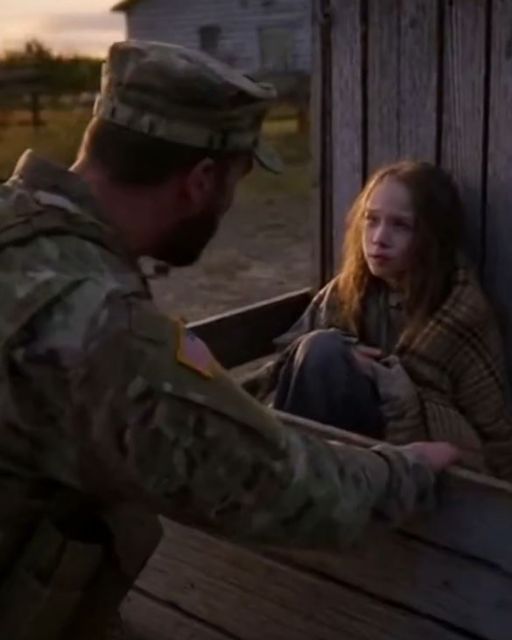
I ran. I found my twelve-year-old daughter curled up in the muck, wrapped in a thin, filthy sheet. She was shivering. When she saw me, she let out a wail that broke my heart.
“Daddy!” she screamed. “Mommy threw me out! She said I didn’t deserve a bed! She said I was a monster!”
My blood turned to lava. I scooped her up. She felt frail. Cold. I held her tight against my chest, marching toward the back door. I was going to kick it down. I was going to call the police. I was going to take my girl and leave this house forever.
“I’ve got you, baby,” I said. “We’re going inside.”
Lena stopped crying instantly. Her body went rigid in my arms.
“Good,” she whispered.
That’s when the smell hit me. It wasn’t just mud and rot. It was sharp. Chemical.
My daughter smelled like lighter fluid.
I froze on the bottom step. I looked up at the kitchen window. Rebecca was standing there. She wasn’t glaring. She was pressing a fire extinguisher against her chest, sobbing in terror.
I looked down at Lena. Her eyes were dry. She wasn’t looking at me; she was staring at the wooden siding of the house with a hunger that made my stomach turn. I felt a hard, rectangular metal object in the pocket of her pajamas.
“Lena,” I asked, my voice trembling. “What is in your pocket?”
She looked up at me and grinned.
“Mommy locked the matches away,” she said, pulling out my silver Zippo. “But she forgot to check the garage.”
My entire world tilted on its axis. The rage I felt for Rebecca vanished, replaced by a cold, slithering dread. The scene replayed in my head, but with terrifying new clarity.
Rebecca wasn’t a monster. She was a gatekeeper.
The deadbolt wasn’t to keep me out. It was to keep Lena out.
I gently set my daughter down on the steps. Her smile faltered, replaced by confusion.
“Give me the lighter, Lena,” I said, my voice low and steady, a tone I hadn’t used since my days in the service.
She clutched it to her chest. “No! It’s mine. You gave it to me.”
“I told you not to touch it,” I corrected her gently, though my heart was hammering against my ribs. “I told you it was for emergencies.”
“This is an emergency,” she hissed, her eyes darting back to the house. “Mommy needs to learn a lesson.”
I knelt down, so we were eye to eye. The smell of gasoline was stronger now, mixed with the damp earth and the stink of the hog pen.
“What lesson, honey?”
“She thinks she can lock me out. She thinks she can hide things. I’ll show her. I’ll make it all bright and warm.”
The words chilled me to the bone. I looked past her, at the dark, wet stains on the back of her pajamas. She hadn’t just gotten gasoline on her hands. She had doused herself.
My daughter was a walking fuse.
Slowly, carefully, I reached out and took her small hand. I uncurled her fingers, one by one, and took the Zippo from her grasp. Her hand was ice-cold.
“Let’s go inside,” I said, my voice barely a whisper. “But we’re going to do it my way.”
I walked to the door and knocked softly. After a long moment, the deadbolt slid back. Rebecca opened the door a crack, her eyes wide with fear, fixed on Lena.
“It’s okay,” I said. “I have it.”
She sagged with relief, opening the door wider. I guided Lena inside. The house smelled of stale coffee and fear.
I led Lena straight to the bathroom. I turned on the shower, stripped off her reeking pajamas with trembling hands, and washed her from head to toe with cold water. She didn’t protest. She just stood there, limp as a doll, her eyes vacant.
I wrapped her in the thickest towel I could find and sat her on the living room couch. Rebecca and I stood on opposite sides of the room, two silent sentinels guarding a bomb.
The silence stretched on, thick and suffocating. Finally, Rebecca spoke.
“It started small,” she said, her voice raw. “A few months after you left for that long-haul contract.”
I sat down in the armchair, my body feeling heavy as lead.
“Started what?”
“The fires,” she whispered. “First, it was just Barbie dolls in the fireplace. I thought it was a weird phase.”
She wrung her hands, her gaze never leaving Lena, who was staring at the blank television screen.
“Then I found a patch of burned grass behind the shed. Then the neighbor’s cat went missing. We found it… we found it in the woods.”
My stomach churned. I couldn’t speak.
“I confronted her,” Rebecca continued, tears streaming down her face, tracing paths through the dust on her cheeks. “She denied everything. She got so good at lying, Mark. So good.”
“The bruise,” I finally managed to say. “Did she…”
Rebecca nodded, touching her cheek tenderly. “I found her in the garage this afternoon. With the gas can. I tried to take it from her, and she shoved me. I hit the tool rack.”
She took a shuddering breath. “She said she was going to wait for you. She said you would understand. That you’d help her ‘cleanse’ the house.”
The word hung in the air. Cleanse.
I looked at my daughter, this twelve-year-old stranger sitting on my couch. The little girl who loved catching fireflies and reading fantasy novels was gone. In her place was someone I didn’t recognize.
That night was the longest of my life. I sat in that armchair all night, watching her sleep. Every twitch, every sigh sent a jolt of adrenaline through me. Rebecca had locked herself in our bedroom. I couldn’t blame her.
The next morning, I called a man whose number I hoped I’d never need again. Dr. Aris Thorne. He was a child psychologist my old unit commander had recommended years ago for a soldier’s troubled son.
His voice was calm and measured over the phone as I explained the situation in clipped, broken sentences. He didn’t sound shocked. He just sounded… ready.
He agreed to see us that afternoon. The drive was silent. Lena stared out the window. Rebecca stared at her hands in her lap. I just stared at the road, my knuckles white on the steering wheel.
Dr. Thorne’s office was the opposite of our home. It was clean, quiet, and filled with soft, calming colors. He was a kind-looking man with graying temples and eyes that seemed to see right through you.
He spoke to Rebecca and me first. We told him everything. The timeline, the escalation, the lies. Rebecca finally broke down, confessing her guilt.
“I should have told you,” she sobbed into my shoulder. “I was just so scared. I thought I could handle it. I thought if I just loved her enough, it would stop.”
I held her, the wall between us finally crumbling. I had been gone. I had left her to face this nightmare alone. My guilt was a physical weight.
Then, he spoke to Lena alone for almost an hour. When she came out, her expression was unreadable.
“Lena is a very intelligent girl,” Dr. Thorne said to us, after she’d been settled in the waiting room with a book. “She is also carrying a profound amount of anger and a dangerous fixation.”
He explained it was a form of pyromania, but rooted in something deeper. A need for control. A way to feel powerful when she felt abandoned and unheard. My long absences on the road had created a void, and this terrible thing had filled it.
The next few months were a blur of therapy sessions, both for Lena and for us as a family. We learned to communicate in ways we never had before. We learned to talk about the ugly, scary things instead of hiding from them.
We childproofed our own home. Lighters, matches, chemicals, all locked away. We installed new smoke detectors. Our house became a safe zone, but it felt like a prison.
Lena was a model patient on the surface. She said all the right things to Dr. Thorne. She apologized to her mother. But sometimes, I’d catch a look in her eye. A flicker of that old, hungry coldness. It terrified me.
The progress was slow, agonizingly so. There were good weeks, where she’d seem like her old self, laughing at my dumb jokes or helping Rebecca in the garden. Then there were bad weeks, where she would be sullen and withdrawn, and the air in the house would grow thick with unspoken tension.
The breaking point, the real one, came on a rainy Tuesday in October. Rebecca’s sister, Carol, was visiting. We were trying to have a normal family dinner. Carol was talking about her new boyfriend, and Lena was unusually quiet.
Later that evening, after Carol had left, I went to check on Lena. Her room was empty. Her window was open.
Panic seized me. I yelled for Rebecca, and we both ran outside into the downpour, screaming her name. We searched the house, the yard, the edge of the woods. Nothing.
Then, I saw it. A faint, flickering light coming from the old, dilapidated barn at the far end of our property. The barn where my grandfather had taught me how to work with wood, the barn that held a lifetime of memories.
I ran faster than I’ve ever run in my life, Rebecca right behind me.
We burst through the rotting wooden doors. There was Lena, standing in the center of the hay-strewn floor. She had a small pile of dry kindling in front of her and was striking two rocks together, trying to create a spark. A small, stolen can of kerosene sat beside her.
“Lena, no!” I screamed.
She looked up, and for the first time, I saw not malice, but pure, bottomless despair in her eyes. “I can’t stop it,” she cried, tears mixing with the rain on her face. “The thoughts won’t go away! They tell me to burn it all! They tell me I’m bad!”
I started toward her, but Rebecca put a hand on my chest, stopping me. She walked forward slowly, her own face a mask of anguish. She knelt in the damp hay in front of our daughter.
“They used to call me a monster, too,” Rebecca said, her voice shaking but clear.
I stopped breathing. Lena stared at her mother, her hands frozen in mid-air.
“When I was a little girl,” Rebecca said, her eyes locked on Lena’s, “a little younger than you are now. I was fascinated by fire. I didn’t know why. It was just so… beautiful. So powerful.”
She took a deep, shuddering breath. “One day, I was playing with my father’s lighter in my bedroom. I just wanted to see the flame. But my sleeve caught fire. I panicked. I threw my shirt, and it landed on the curtains.”
Tears were streaming down her face now. “My little brother, your Uncle Stephen, was napping in his crib in the same room. The fire… it moved so fast. He got burned. Not badly, but enough.”
She closed her eyes, the memory obviously excruciating. “My parents never forgave me. They never got me help. They just told me I was wicked. They told me I had a darkness inside me. They locked things away and watched me every second. They made me feel like a monster, so I buried it. I buried it so deep I almost forgot.”
She opened her eyes and looked right at Lena. “When I saw that same look in your eyes, that same fascination… I didn’t see my daughter. I saw the monster they told me I was. I was so terrified of you becoming me, I ended up treating you exactly the way they treated me.”
She reached out and pulled Lena into her arms, holding her tight. “You are not a monster, Lena. You are my daughter, and you are hurting. And I am so, so sorry I didn’t see that.”
Lena just collapsed against her mother, and a sound came out of her that wasn’t a wail or a scream, but a deep, guttural sob of pure, unadulterated pain. A pain that had been trapped inside her for years. I walked over and wrapped my arms around both of them, my own tears falling freely into the hay.
We stood there for a long time, the three of us, a broken family clinging to each other in a crumbling barn as the rain washed the world clean around us.
That night was the real beginning of our healing. It wasn’t a magic fix. The therapy continued. But something fundamental had shifted. The secrets were gone.
Rebecca had to confront her own childhood trauma, and in doing so, she was able to truly see Lena’s pain, not just her behavior. Lena, knowing she wasn’t alone in her struggle, that her own mother understood the ‘darkness,’ finally let down her walls. She started talking, really talking, about the thoughts and the urges.
We learned that Lena’s brilliant, obsessive mind needed an outlet. Dr. Thorne suggested something intricate and constructive. We got her a complex kit for building model engines. She took to it with a ferocity that was breathtaking. She spent hours in the garage with me, channeling all that intense focus into creating something beautiful and functional, instead of destroying it.
It’s been two years now. Our house is no longer a prison. It’s a home again. Lena is fourteen. She’s still quiet and intense, but her eyes are clear. She’s at the top of her science class and wants to be an engineer.
Sometimes I’ll find Rebecca and Lena sitting on the back porch, just talking. There’s an understanding between them now, a bond forged in fire and rebuilt with honesty.
The old hog pen is gone. Last spring, the three of us tore it down, board by board. In its place, Rebecca planted a garden filled with wildflowers. It’s a riot of color and life.
I know the scars are still there, for all of us. But they are not the ugly, festering wounds they once were. They are reminders of a battle we fought, and a battle we won. They are a testament to the fact that the most monstrous things are not the darkness we find in others, but the secrets we keep from the ones we love. Love isn’t about never having to face the fire; it’s about being willing to walk through it together, and having the courage to rebuild from the ashes.