The squeeze in his chest felt like a fist.
General Arthur Vance told himself it was nothing. Too much salt. He pushed the cart into the cereal aisle.
Then the world tilted sideways.
The bright colors of the boxes smeared into a single streak. The air felt thin, stolen. He reached for a shelf to steady himself.
His hand never made it.
His knees buckled first. The cart shot away from him, scattering a few items across the floor.
A man who survived firefights was suddenly falling in a quiet American store.
The tile was cold against his cheek.
Lights buzzed overhead. Voices swirled at the edge of his hearing, distant and distorted.
People stared. They held their phones. They formed a circle.
But no one came closer.
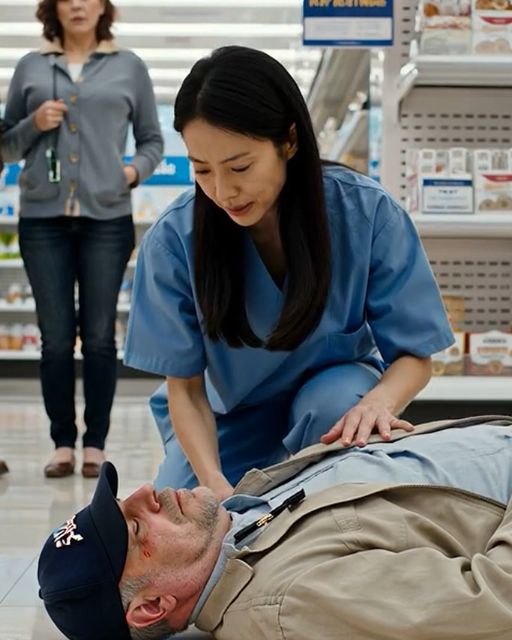
Until a blur of blue scrubs cut through the crowd.
She left her own cart in the middle of the frozen food aisle and ran. No hesitation. She just saw a man down and moved.
She slid to her knees beside him.
Two fingers pressed against his neck.
Nothing.
She tilted his head back, planted the heel of her hand on his sternum, and started pushing.
Hard. Fast. A relentless rhythm.
Everything else vanished. The store music, the whispers, the panic. There was only the blunt force of her hands driving life back into his chest.
Thirty compressions. Two breaths. Again.
Her shoulders trembled with the effort. She didn’t stop.
She saw the color draining from his face, a creeping gray.
“Come on,” she breathed, the words a raw whisper. “Stay with me.”
Then she leaned in closer, and her voice dropped even lower.
“Stay with me, Marine.”
Minutes felt like an hour before the paramedics arrived. She kept counting, kept pushing, only stopping to give a report between compressions.
“Male, seventies. Sudden collapse. No pulse. CPR ongoing.”
“Clear,” one of them ordered.
She pulled her hands away.
A machine whined. His body jolted on the tile.
For a single, silent beat, the whole aisle held its breath.
Then a jagged line on a small screen began to dance.
They loaded him onto a stretcher and were gone. The woman in scrubs sat back on her heels, sweat on her brow, her chest heaving.
Someone asked for her name.
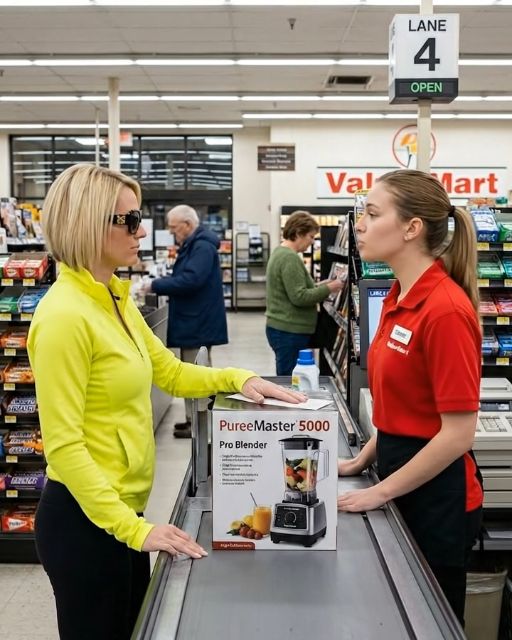
She just shook her head, got up, and walked toward the restrooms. A few minutes later, she was just another shopper at the checkout, pushing a basket toward the exit.
Three days later, Arthur Vance opened his eyes to the soft beeps of a hospital room.
The doctor was blunt.
“Whoever started CPR, they saved you. One minute later, and we wouldn’t be having this conversation.”
Arthur stared at the ceiling. One minute. One stranger. Two hands.
“Who was she?” he asked, his voice a rasp.
“We don’t know,” the doctor said. “She was gone before anyone got her name.”
The question haunted him for days. A man who commanded divisions couldn’t identify the one person who mattered most.
Then the hospital called.
A shopper who had been there finally reached out. She couldn’t stop thinking about something she’d heard.
Arthur felt his own heart kick in his chest.
“What did she say?”
There was a pause on the line.
“She said, ‘Stay with me, Marine.’”
The quiet in the room was absolute.
She wasn’t just a bystander.
She was one of his own.
The weight of those three words settled on him heavier than any medal. Marine.
It wasn’t a guess. It was a statement of fact.
How could she have known? He wasn’t wearing anything to suggest it. Just a polo shirt and slacks.
He had the bearing, yes. The haircut, maybe. But that was a long shot.
This wasn’t a guess. This was recognition.
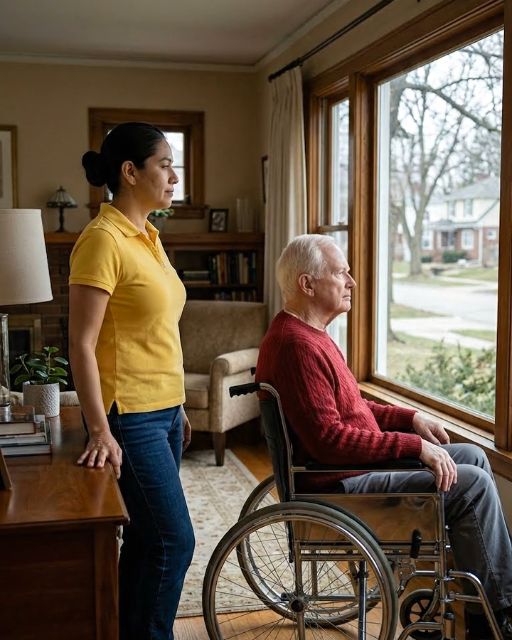
When he was discharged a week later, his daughter, Eleanor, fussed over him. She fluffed his pillows and made him broth.
He appreciated it, but his mind was elsewhere. It was in a supermarket aisle, with a woman in blue scrubs.
“Dad, you need to rest,” Eleanor said, her brow furrowed with worry.
“I need to find her,” Arthur replied, his voice firm despite its weakness.
He started with the logical first step for a general. He deployed his resources.
His first call was to a former aide, a sharp man named Peterson who now ran a private security firm.
“I need you to find someone, Pete.”
He explained the situation. The supermarket. The woman. The single, defining clue.
“General, that’s not much to go on.”
“It’s all I have,” Arthur said. “She knew I was a Marine. That’s our starting point.”
Peterson agreed to try. He got the security footage from the store.
The video was grainy. A wide shot of the aisle.
You could see the commotion. You could see the blue blur moving with purpose.
But when she was on her knees, working on him, her back was to the camera. When she stood up, her head was down.
A dead end.
Next, Arthur tried a public appeal. He was a private man, but this was different. This was a debt that had to be repaid.
A local news station ran the story. “Four-Star General’s Life Saved by Mystery ‘Angel’ in Supermarket.”
The piece was tasteful. It showed a photo of Arthur in his dress uniform, then cut to an interview with him in his study.
“I don’t know who she is,” he said to the camera, his voice filled with a quiet urgency. “But she knew who I was. She called me a Marine. And she gave me my life back. I just want to say thank you.”
The story aired on the six o’clock news.
Across town, a woman named Sarah Jenkins was making dinner for her son. The television was on in the background, just for noise.
She was chopping vegetables when she heard the news anchor mention the supermarket.
She paused, knife in hand.
Then his face filled the screen. General Arthur Vance.
Her heart hammered against her ribs.
Her eight-year-old son, Ben, looked up from his homework. “Mom? Are you okay?”
She couldn’t answer. She just stared at the screen.
Then she heard his voice, and the words he spoke. “She called me a Marine.”
Sarah sank into a kitchen chair, the knife clattering onto the cutting board.
It was him.
She hadn’t been sure at the time. It had been decades since she’d seen that face in a photograph on her husband’s desk.
But now, there was no doubt.
“Mom?” Ben asked again, coming to her side.
“I’m fine, sweetie,” she managed to say, forcing a smile. “Just tired.”
She didn’t want this. She didn’t want the attention, the thanks, the memories.
She had acted on instinct. A human being was dying. A Marine was dying. That was all that mattered.
The past was supposed to stay in the past.
The next day, her friend Maria called. Maria was a military spouse, too. She knew Sarah’s story.
“Turn on your computer,” Maria said, her voice tight with excitement. “Look at the news.”
“I saw it last night,” Sarah said quietly.
There was a long silence on the other end of the line.
“Sarah,” Maria said softly. “That was you, wasn’t it?”
Sarah closed her eyes. She couldn’t lie to Maria.
“Yes.”
“You have to call him. He’s looking for you!”
“I can’t, Maria. You know why.”
“That’s exactly why you should,” Maria insisted. “Maybe this is… I don’t know. A chance. For something.”
Sarah didn’t know what that something could be. Closure? Justice? It all felt too late.
But the thought wouldn’t leave her alone.
Meanwhile, Arthur’s search was hitting wall after wall. The news story generated a few false leads, people seeking attention.
He was growing frustrated, a feeling he wasn’t accustomed to. He was used to orders being followed, to objectives being met.
This felt different. This felt like searching for a ghost.
One afternoon, Peterson called him.
“General, we might have something. A long shot.”
“What is it?” Arthur leaned forward in his chair.
“We cross-referenced lists of registered nurses and paramedics in the area with public records of military families. Specifically, Marine families.”
It was a staggering amount of data.
“We found a woman named Sarah Jenkins. A widow. Her late husband was Corporal David Jenkins.”
The name hit Arthur like a physical blow.
David Jenkins.
He remembered the name. He remembered the file that crossed his desk ten years ago.
A training accident. A vehicle rollover. Tragic, but straightforward.
He had signed the condolence letter himself. He signed hundreds of them.
“Where does she live?” Arthur asked, his voice low.
Peterson gave him the address.
Arthur knew he couldn’t just show up. He couldn’t send an aide. This was something he had to do himself.
He wrote a letter. His hand, usually so steady, shook slightly.
He kept it simple. He thanked her for what she did. He asked if he could meet her, to thank her in person.
He sent it by courier.
Two days later, his phone rang. It was an unknown number.
“Hello?”
“General Vance?” a quiet voice asked. “This is Sarah Jenkins.”
The silence stretched between them.
“Mrs. Jenkins,” Arthur said finally. “Thank you for calling. And thank you for… everything.”
“You’re welcome,” she said. Her voice was steady, but he could hear the tension beneath it.
“I hope my letter wasn’t an intrusion.”
“No. It wasn’t.”
He took a breath. “I would very much like to meet you.”
She hesitated. “I don’t think that’s a good idea.”
“Please,” Arthur said, the word coming out with more humility than he thought he possessed. “I need to understand. You knew who I was.”
Another pause.
“Yes,” she said. “I did.”
She agreed to meet him at a small, quiet coffee shop halfway between their homes.
Arthur arrived early. He sat at a small table in the corner, his back to the wall. Old habits.
She walked in right on time. She wasn’t wearing scrubs, just a simple sweater and jeans.
She was younger than he expected. Lines of grief and resilience were etched around her eyes.
She sat down opposite him.
“Thank you for coming,” he began.
She just nodded, her hands wrapped around her purse.
“I owe you my life. There are no words to properly express my gratitude.”
“I did what anyone would have done,” she said, though they both knew that wasn’t true.
He looked at her, really looked at her. “You called me a Marine. But it was more than that. Your voice… it was personal.”
She met his gaze, and for the first time, he saw a flicker of the fire that must have driven her that day.
“My husband was Corporal David Jenkins,” she said, her voice clear and level. “He served under your command in the 3rd Battalion.”
Arthur nodded slowly. “I remember his file. A terrible accident. I was so sorry.”
Sarah’s expression didn’t change, but something in her eyes hardened.
“It wasn’t an accident, General.”
The air in the coffee shop seemed to grow still.
“What do you mean?” he asked.
“David told me for weeks that the transport vehicle was faulty. He said the steering was shot. He filed three separate maintenance reports. They were all ignored.”
She took a shaky breath, but her voice remained strong.
“He told his sergeant. He told his lieutenant. They told him to stop making waves. Two days later, the steering failed on a training route. The vehicle went into a ravine.”
Arthur felt the blood drain from his face. He remembered the report he signed. Mechanical failure was mentioned, but it was framed as an unforeseeable, tragic event. Not negligence.
Not a cover-up.
“The report I read…” he started.
“The report you read was designed to protect a few careers,” she cut in, her voice sharp with a decade of pain. “It was easier to call it an accident than to admit that a Marine died because of a faulty truck and lazy paperwork.”
He stared at her, the pieces clicking into place. The sanitized report. The condolence letter. The life that was erased to avoid an inconvenient truth.
And this woman, the widow of the man he had failed, had knelt on a cold floor and refused to let him die.
The fist was back in his chest. It was shame.
“Why?” he whispered, the question hanging between them. “Why did you save me?”
Her eyes welled with tears, but she didn’t let them fall.
“Because when I saw you on that floor, I didn’t see the general who signed a piece of paper. I didn’t see the man at the top of a chain of command that failed my husband.”
She leaned forward slightly.
“I saw a Marine. And we don’t leave our own behind.”
The simple, profound truth of her words broke something open inside him. All the years of command, of pride, of duty, crumbled away, leaving only the raw, aching reality of his failure.
He had left one of his own behind. He had just never known it until now.
He went home that day a different man. The heart attack hadn’t changed him. Sarah Jenkins had.
He spent the next two weeks on the phone. Calling in favors he hadn’t used in years. Pulling on threads he didn’t know existed.
He tracked down the men who had served with David Jenkins. He found the lieutenant, now a major. He found the sergeant, now retired.
He flew across the country to meet them in person.
Their stories, told with reluctance at first, then with a flood of guilt, confirmed everything Sarah had said. The faulty truck. The ignored reports. The pressure from above to close the case quickly.
He discovered the maintenance contract had been given to a company with friends in high places. An investigation would have been embarrassing.
So a hero’s death was reduced to a statistic.
Arthur felt a cold fury he hadn’t experienced since his days as a young officer in the field. This wasn’t an enemy on the battlefield. This was a rot from within.
He compiled everything. Every testimony, every piece of evidence. He put his own name and reputation on the line.
He submitted a formal request to the Commandant of the Marine Corps to have Corporal David Jenkins’ case reopened.
It caused an earthquake. A retired four-star general doesn’t make that kind of request lightly.
The investigation was swift and brutal. Careers were ended. The truth, ten years late, finally came to light.
Corporal David Jenkins’ death was officially reclassified. Not a training accident. It was ruled a death in the line of duty, caused by gross negligence.
His name was cleared. His honor was restored.
A small ceremony was held at the base. Arthur stood in the back, in a simple suit. He watched as a new headstone was placed for David, one that reflected his true sacrifice.
Sarah was there with her son, Ben.
She was presented with the flag, folded crisply into a triangle. She was given the benefits and the honors that she and her son had been denied for a decade.
After the ceremony, she found Arthur standing by his car.
“I don’t know what to say,” she said, her voice thick with emotion.
“You don’t have to say anything,” he replied. “I was just doing my duty. Ten years too late.”
He looked at Ben, who was clutching his mother’s hand.
“Your father was a good Marine, son. He did the right thing. Never forget that.”
Ben looked up at the old general, his eyes wide. He nodded.
From that day on, Arthur’s life had a new mission. He started a foundation, a small one at first, dedicated to helping military families navigate the bureaucracy, to fight for those who had been overlooked or wronged.
He didn’t command divisions anymore. He commanded a small office with two paralegals and a deep sense of purpose.
He and Sarah became unlikely friends. He would visit for coffee, and Ben would show him his model airplanes.
He was no longer just the general. He was Arthur. A man who had been given a second chance at life, and a final chance at honor.
One afternoon, sitting on Sarah’s porch, he watched Ben play in the yard.
“It’s a strange thing,” he said quietly. “My life had to nearly end for me to truly understand what it means to live it.”
Sarah smiled, a genuine, peaceful smile.
“Sometimes,” she said, “the heart has to be broken before it can be healed.”
He knew she wasn’t just talking about his. She was talking about hers, too.
In the end, it wasn’t about the battles won or the medals earned. It was about the quiet moments of grace. It was about a woman who saw a brother in need and refused to let him go, and a man who learned that the greatest act of a leader is not to give orders, but to serve those you have sworn to protect, long after the uniform comes off.