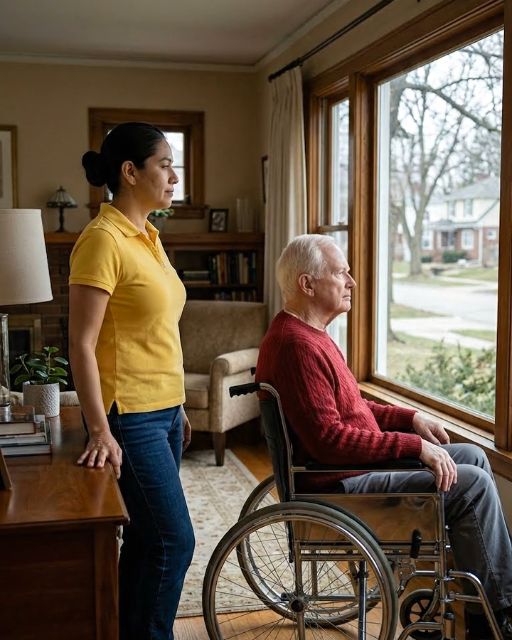

The boss, Mr. Hale, had one rule I never understood. “The boys do not go near the pool. Ever.” He said it the day he hired me, his face like stone. The house was like a museum, cold and quiet. And his twin sons, Ethan and Leo, were like little statues in it. Four years old and they never made a sound. Not a laugh, not a cry. The doctors said they were fine. Just… quiet.
I thought Mr. Hale was just a cold man, obsessed with control. I’d see the boys press their faces against the big glass doors, just staring at the blue water outside. They wanted to be out there. I knew it. A little sun wouldn’t hurt them.
So today, I did it. I unlocked their special chairs and rolled them out onto the warm patio stones. I put the brakes on right at the edge of the pool. The water rippled in the light. I knelt between them. “See, boys?” I whispered. “It’s pretty, isn’t it?”
They just stared. Blank faces, as always. For a full five minutes, nothing. My heart sank. I thought, “I was wrong.” I was about to wheel them back inside.
Then Ethan, the smaller one, slowly lifted his hand. He pointed a tiny finger at the deep end. His mouth opened. But it wasn’t a word that came out. It was a noise. A soft, wet, gurgling sound.
Leo turned his head to watch him. Then he copied it perfectly. The same awful choking sound. They looked at each other, then back at the water. And I realized they weren’t staring at the sunlight on the surface. They were re-enacting the sounds they heard when they watched their mother… drown.
My blood turned to ice in my veins. I couldn’t breathe. The pretty blue water suddenly looked like a monster. It was a grave.
I yanked the brakes off their chairs so fast one of them squealed. I practically ran, pushing them back towards the house. The glass doors slid shut behind us, but it didn’t feel safe. The entire house felt different. It was no longer a museum. It was a crime scene.
I got them into the playroom and locked the door. My hands were shaking so hard I could barely turn the key. I sank to the floor, my back against the wood. Ethan and Leo were still in their chairs, watching me with those wide, silent eyes. They weren’t just quiet. They were keepers of a terrible secret.
Mr. Hale’s words echoed in my head. “The boys do not go near the pool. Ever.” It wasn’t about control. It was about fear. He was afraid they would remember. He was afraid they would show someone what they knew.
My mind raced back through all the little details of my job here. The way Mr. Hale never mentioned his wife. The way all her pictures were gone from the walls. The official story was that she had a weak heart and had passed away in her sleep one night. A tragic, peaceful end.
But that gurgling sound was not peaceful. That was the sound of a fight. The sound of life leaving a body that didn’t want it to go.
The boys just sat there. They were looking at me, really looking at me, for the first time. It was as if a door had been unlocked inside them. They knew that I now knew. We shared the secret now.
I spent the rest of the afternoon in a daze. I went through the motions of their feeding and therapy exercises. But every time I looked at them, I saw what they saw. I heard what they heard.
That evening, when Mr. Hale came home, I almost threw up. He walked in, tall and imposing in his dark suit. He gave me a curt nod, the same as always. “Everything all right today, Sarah?” he asked. His voice was smooth, even.
“Yes, Mr. Hale,” I managed to say. My own voice sounded thin and weak. “The boys were… quiet.”
He glanced into the playroom, where Ethan and Leo were sitting on the floor with their blocks. He didn’t see what I saw. He didn’t see the memory flickering behind their eyes. He just saw two silent, broken children. And maybe that’s all he wanted to see.
That night, I couldn’t sleep. I lay in my small room in the staff wing, listening to the hum of the house. I had to do something. I couldn’t just leave. I couldn’t leave those boys with him. But what could I do? I had no proof. Just a sound made by two traumatized children. No one would believe me.
The next morning, I started looking. I had to be careful. Mr. Hale was a man of routine, but he was sharp. He would notice if things were out of place. I started in the one place that felt forbidden. His wife’s old room. He kept it locked.
I told him I needed to get some old linens from the closet inside. He hesitated for a moment, his eyes narrowing. Then he handed me the key. “Be quick,” he said.
The room was just as people said. It was untouched. A layer of dust covered everything. Her clothes were still in the closet, her perfume bottles on the dresser. It was like a shrine. But it felt cold, unloved. It felt like a part of a story he needed to preserve for appearances.
I pretended to sort through blankets. My eyes darted around the room, looking for anything. A diary. A letter. A clue. Underneath a stack of sweaters in a drawer, my fingers brushed against something hard and small. It was a locket.
My heart pounded. I slipped it into my pocket and left the room, locking it behind me. Back in my own room, I fumbled with the clasp. It snapped open. I expected a picture of Mr. Hale, or maybe the boys.
But it wasn’t. It was a tiny, folded piece of paper. With shaking hands, I unfolded it. It was a note, written in a delicate, looping script. “He knows. Clara told him everything. He said he would ruin me. I have to get the boys out. The old oak tree. 10 p.m.”
Clara. That was Mr. Hale’s sister. She came by once a month, always doting on the boys, bringing them expensive toys they never played with. She always seemed so kind, so concerned. She and Mr. Hale’s wife, Eleanor, were supposed to have been the best of friends.
He knows. Ruin me. Get the boys out. This wasn’t the note of a woman with a weak heart. This was the note of a woman who was terrified. A woman who was planning to run.
The next few weeks were torture. I acted normal. I smiled at Mr. Hale. I played with the boys. But inside, I felt like a spy in enemy territory. I watched him. I watched the way he flinched whenever a car drove by too fast. I watched the way his eyes would sometimes drift to the pool, a flicker of something dark and ugly in their depths.
Clara came to visit. I watched her, too. She hugged the boys, her smile bright and perfect. “Oh, my poor, sweet nephews,” she cooed. “Aunty Clara loves you so much.”
Leo, who was usually so still, flinched away from her touch. It was a tiny movement, but I saw it. He pressed himself back into his chair, his eyes fixed on the floor. It was the first time I had ever seen one of them react to a person. And it was a reaction of fear.
I knew I needed more. The note was something, but it wasn’t enough. I started thinking about the note. The old oak tree. There was a huge, ancient oak at the far end of the property, near the back fence. It was a place no one ever went.
One afternoon, when Mr. Hale was at a long meeting, I took the boys for a “walk” in their chairs. I pushed them across the vast lawn, my heart hammering with every step. I felt exposed, like a hundred hidden cameras were watching me.
We reached the old oak tree. Its branches were thick and gnarled, like old arms. There was a hollow in the trunk, near the base. It was dark inside. I reached my hand in, my skin crawling at the thought of spiders. My fingers closed around a plastic bag.
Inside the bag was a small, digital camera. My breath caught in my throat. This was it. This had to be it. Eleanor must have hidden it here, planning to retrieve it after she escaped.
Getting it back to the house was the most nerve-wracking walk of my life. I hid the camera in my room and waited. I had to wait until he was asleep. The hours ticked by like years. Finally, around 2 a.m., when the house was completely silent, I took out my laptop and plugged the camera in.
There were only a few video files. My hands trembled as I clicked on the last one. The date was from almost a year ago. The day Eleanor died.
The video flickered to life. It was shaky, clearly filmed by someone hiding. It was pointed at the pool patio. The angle was from the upstairs balcony. Eleanor had set it up herself.
I saw her come out of the house. She was talking on her phone, pacing back and forth. She looked scared. Then Mr. Hale came out. They started arguing. His voice was low and menacing, but I could hear the words. “You are not taking my sons.”
“They are my sons, too!” she cried. “I won’t let you and your sick sister poison them!”
Then the camera shook. Someone else had come onto the patio. It was Clara. “You have no idea what you’re talking about, Eleanor,” Clara said, her voice dripping with venom. “You were never good enough for him. You were never good enough for this family.”
What happened next made me gasp. Clara lunged at Eleanor. They struggled. Mr. Hale just stood there, watching, his face a mask of cold fury. Clara gave a final, vicious shove. Eleanor stumbled backward. Her head hit the stone edge of the pool with a sickening crack. She fell into the water and didn’t come back up.
The gurgling started. It was the sound of her drowning. It went on for what felt like an eternity.
Mr. Hale didn’t jump in to save her. He didn’t call for help. He just stood there. After a moment, he turned to his sister. “Go inside,” he said, his voice flat. “Clean yourself up. No one saw. I’ll handle this.”
The video ended. I felt sick to my stomach. It wasn’t just him. It was Clara. And he didn’t try to save his own wife. He just watched her die to protect his sister and his perfect, cold life. And the boys… where were the boys? They must have been watching from the window. They saw it all.
I copied the file onto a small USB drive. I knew what I had to do. I couldn’t just call the police. These were powerful people. They could make a video like this disappear. They could make me disappear.
I had to get the boys out. First.
The next day, I packed. I put a few of my things in a backpack, along with the boys’ favorite soft blankets and a few snacks. I tucked the USB drive into my pocket. My plan was simple. I would wait until Mr. Hale left for work. Then I would take the boys and walk out the front door. I would call a taxi and go straight to the police station in the next town over.
But things never go according to plan.
As I was putting the boys in their chairs, ready to leave, I heard a car in the driveway. It was too early for Mr. Hale to be leaving. My blood ran cold. It was Clara. She walked in without knocking, a bright, false smile on her face.
“Sarah! I was just in the neighborhood, thought I’d pop in and see my boys!” she chirped. Her eyes flicked from me to the backpack on my shoulder. Her smile tightened. “Going somewhere?”
“Just… for a walk,” I stammered.
“With a backpack? On a Tuesday morning?” She took a step closer. Her eyes were like chips of ice. “What have you been up to, Sarah?”
Before I could answer, the front door opened again. It was Mr. Hale. He must have seen her car. He took in the scene in an instant. Me, the boys in their chairs by the door, his sister standing there like a predator. His face went pale.
“What is going on?” he demanded.
Clara laughed, a short, ugly sound. “I think our little nanny has found something she shouldn’t have.”
They both looked at me. The room felt like it was shrinking. There was nowhere to run. Mr. Hale walked over and locked the front door. The click of the bolt sounded like a gunshot.
“Give it to me, Sarah,” he said, his voice dangerously calm. “Whatever you think you have. Give it to me, and you can walk out of here. We’ll even give you a generous severance.”
I clutched the USB in my pocket. I looked at Ethan and Leo. They were watching the scene, their small faces completely blank. But their hands were gripping the arms of their chairs so tightly their knuckles were white.
“I can’t do that,” I said, my voice shaking. “You know what you did. Both of you. They saw you.” I nodded toward the boys.
Clara sneered. “They can’t talk. They can’t do anything. They’re just empty little shells.”
At that moment, something incredible happened. Ethan, the smaller twin, the one who had made the sound by the pool, slowly lifted his arm. He didn’t point at the door. He didn’t point at Mr. Hale. He pointed a small, steady finger directly at Clara.
His mouth opened. He struggled for a second. His face scrunched up with effort. And then a word came out. It was raspy from disuse, but it was clear as a bell.
“Bad,” he said.
The world stopped. Mr. Hale stared at his son, his mouth agape. Clara looked like she’d been struck by lightning.
Then Leo, who always copied his brother, also lifted his hand. He pointed at his father. And he said his own first word.
“Water,” he whispered.
It was all they needed. Two words. Bad. Water. It was a complete sentence. A complete accusation.
The spell was broken. Mr. Hale lunged for me. But in that split second of shock, I had already moved. I grabbed the chairs and shoved them with all my might towards the glass patio doors. I didn’t have the key, but I didn’t need it.
I grabbed a heavy lamp from a side table and hurled it at the glass. It shattered with a deafening crash. Cold air rushed in. I scrambled through the broken glass, pulling the boys’ chairs after me. I didn’t look back. I just ran. Across the lawn. Towards the front gate. Towards freedom.
The police were already there. In my terror, I had forgotten the one smart thing I’d done. When I saw Clara’s car pull up, my hand had instinctively found my phone. I had dialed 911 and just left the line open in my pocket. They had heard everything. The threats. The confession in their panicked words. The shattering glass.
The aftermath was a blur of flashing lights and gentle-voiced officers. The USB drive was handed over. Mr. Hale and Clara were led away in handcuffs, their faces twisted in disbelief and rage.
The boys were taken to a children’s hospital for evaluation. I stayed with them. In the quiet, sterile room, they held my hands. They didn’t say any more words that night. But they didn’t have to. The silence was finally broken.
A few days later, Eleanor’s parents arrived. They were kind, elderly people who had been told their daughter died of natural causes and that their grandsons were unresponsive due to the shock. They had been kept away by Mr. Hale. When they saw the boys, they wept.
I stayed on for a few weeks, helping the boys transition to their new life with their grandparents. The words started to come more frequently. Simple things at first. “Toy.” “Juice.” “Sun.” And then one day, Leo looked at me, a real smile on his face, and said, “Sarah.”
My last day there was the hardest. I knelt down between them. They were out of their chairs now, standing on their own two feet. “I have to go now,” I said, my voice thick with emotion.
Ethan reached out and touched my cheek. “Good,” he said. He meant me.
I watched them playing in their grandparents’ sunny, happy yard, a place with no dark secrets, no cold pools. They were laughing. A real, beautiful, childish laugh. It was the most wonderful sound I had ever heard.
The world sees silence and often assumes it means emptiness. But that’s not true. Silence can be a container, holding things too terrible to be spoken. It can be a shield, protecting a truth that is waiting for the right person to listen. Those boys taught me that you don’t always need a loud voice to speak the truth. Sometimes, all you need is the courage to make a single sound, to point a single finger, and to trust that love will be there to hear you.