I worked three jobs. I ate stale bread. I took out $200,000 in loans.
While I was pulling double shifts at the warehouse to pay for med school, my dad, Gary, bought a new boat. My mom, Linda, went to “Cabo” every winter.
They sent me postcards while I was scrubbing toilets.
Today, I finally got my MD. They showed up to the ceremony smiling, holding a bouquet of cheap daisies. I snapped.
The years of resentment boiled over in the parking lot.
“Get out,” I spat at them. “You didn’t pay a dime. You spent it all on yourselves. Go back to Cabo.”
Gary looked at his shoes. Linda didn’t cry.
She just opened her purse. She pulled out a thick, stained ledger and shoved it into my chest.
“We didn’t go to Cabo, Mike,” she whispered. “We went to the hearings.”
I laughed, thinking it was a joke. Then I opened the book.
It wasn’t a savings account. It was a log of monthly restitution payments.
$3,000 a month for ten years.
I flipped to the first page. There was a police report from the night of my 16th birthday.
The night I came home drunk and told them I hit a deer. The report didn’t say “deer.”
It said “pedestrian.” And the signature at the bottom of the confession wasn’t mine—it was my father’s.
The cheap paper of the report felt heavy as a tombstone in my hands. The world tilted.
The joyful shouts of my graduating classmates faded into a dull hum.
My father’s signature. Gary Miller. Scrawled in a shaky hand I didn’t recognize.
My own memory of that night was a blur of shadows and shame. Flashing lights in my rearview mirror. The sickening thud against the fender.
I had stumbled into the house, reeking of cheap beer, my mind a fog of panic.
“It was a deer,” I’d slurred to them, over and over, trying to convince myself as much as them. “Just a deer.”
Now, standing in that parking lot, I looked at them. Really looked at them for the first time in years.
They weren’t tanned and rested from years of Mexican vacations. They were pale. Exhausted.
The lines around my mother’s eyes weren’t laugh lines; they were trenches dug by worry. My father’s shoulders, which I always remembered as broad and strong, were slumped in permanent defeat.
The new boat, the winter trips… it was all a lie. A carefully constructed wall to hide a devastating truth.
“Why?” I choked out, the single word scraping my throat raw.
My dad finally lifted his head. His eyes were bloodshot.
“You were sixteen, Mike,” he said, his voice raspy. “You had your whole life… medical school… you talked about it since you were a little boy.”
“We found you on the side of the road,” my mom added, her voice trembling but firm. “You were just a kid. You were terrified.”
They had made a choice in that moment. A choice to shield me, to take the blast so I could walk away unscathed.
They took my crime and wore it like their own skin.
The drive back to their house was silent. It was the same small, tidy house I had grown up in, the one I had resented for its modesty.
Now I saw it for what it was: a home stripped bare to pay a debt that wasn’t theirs.
Linda made tea, her hands shaking slightly as she set the mugs on the worn kitchen table. The ledger sat between us like an unexploded bomb.
They told me everything.
The man I hit was named Arthur Bell. He didn’t die, but his life was shattered.
He was a carpenter. A husband. A father.
The “Cabo trips” were monthly drives to a courthouse three counties over. They had to face the judge, the lawyers, and the quiet, accusing eyes of Arthur Bell’s wife.
They did it alone so my name would never appear on a single document.
The “new boat” was a fiction to explain why their life savings vanished overnight. They had sold their actual boat, a small fishing vessel my dad had cherished, to cover the initial legal fees and settlement.
The postcards? Sent by Linda’s sister from her own vacation, addressed in a different handwriting, all to keep the illusion alive.
They did it so I could study. So I could focus. So I could become a doctor without the stain of a felony conviction.
They weren’t living it up. They were drowning. And they did it silently, so I wouldn’t hear them gasp for air.
Gary had started working nights at a steel mill on top of his day job. Linda, a retired teacher, had started cleaning office buildings after dark.
The stale bread I ate out of necessity, they ate out of love. The loans I took out felt like a mountain, but the debt they carried was a whole different universe of heavy.
A wave of nausea and shame so profound washed over me that I had to grip the table to keep from falling.
My anger, my years of bitter resentment, felt like the cruelest kind of joke. I had been yelling at two people who were serving a prison sentence for me.
“I need to see him,” I said, my voice barely a whisper. “Arthur Bell. I need to apologize.”
My parents exchanged a worried glance.
“Mike, part of the settlement was a no-contact order,” my dad said gently. “His wife, Sarah, she requested it. She didn’t want to see the person who did it. She only wanted to see the payments.”
But I couldn’t accept that. I was a doctor now. I took an oath to do no harm, and the first significant act of my adult life had been to cause the most profound harm imaginable.
I needed to make it right.
It wasn’t hard to find him. My new hospital credentials gave me access to databases I’d never had before.
Arthur Bell was a resident at the Northwood Long-Term Care facility. The list of his injuries was long and clinical. Traumatic brain injury. Partial paralysis.
He had been there for ten years.
I drove there the next day, my freshly-pressed doctor’s coat feeling like a costume. I told the front desk I was a new physician consulting on a few cases.
I found his room at the end of a quiet, sterile hallway. The door was slightly ajar.
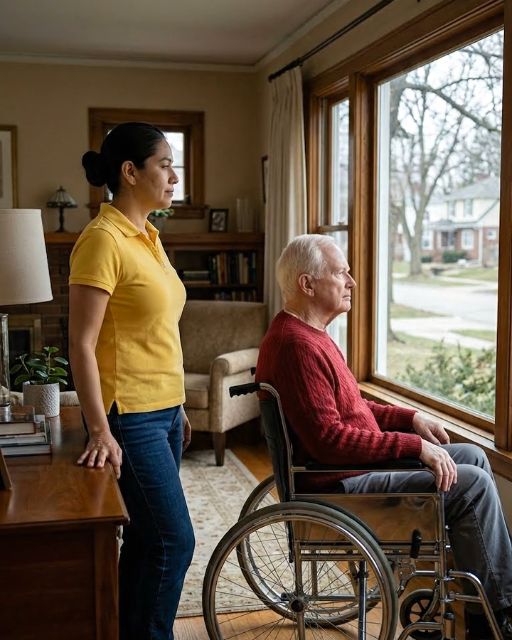
I saw him. He was in a wheelchair, staring out the window. His body was frail, but his eyes, reflected in the glass, were sharp.
A woman sat beside him, holding his hand, reading from a book. She had the same tired resilience in her face that I now recognized in my own mother.
This was Sarah Bell.
I took a deep breath and knocked softly. “Excuse me,” I said, my voice sounding foreign and shaky. “I’m Dr. Miller. Just checking in.”
Sarah looked up. She offered a small, weary smile. “Hello, Doctor. It’s a quiet day.”
I walked in, my heart hammering against my ribs. I did a routine check, my hands trembling as I took his pulse. He didn’t speak. He couldn’t. But his eyes followed my every move.
I asked Sarah how he was doing, how she was doing. We made small talk. She spoke of their daughter, Eleanor.
“She’s just finishing nursing school,” Sarah said with a flicker of pride. “She was inspired… by all of this. She wanted to help people like her dad.”
My stomach twisted.
Then I saw it. On the small bedside table, there was a framed photograph. It was of Arthur, Sarah, and a teenage girl with bright, smiling eyes.
The girl was wearing a bracelet. A crudely woven thing made of blue and green embroidery floss.
My breath caught in my chest. I knew that bracelet.
I had made it. At a summer camp when I was fifteen.
I gave it to a girl in my history class. A quiet, smart girl I had a hopeless crush on.
Her name was Eleanor Bell.
The world collapsed for a second time. This wasn’t a random tragedy. This wasn’t a stranger.
I hadn’t just hit a pedestrian. I had hit the father of a girl I knew. A girl I had tried to impress, a girl whose smile I had tried to earn with a stupid, handmade bracelet.
The randomness was gone, replaced by a horrifying, cosmic cruelty.
I stumbled back, my professional demeanor crumbling. “I… I have to…”
Sarah’s brow furrowed with concern. “Doctor? Are you alright?”
The truth came spilling out of me in a torrent of guilt and confession. “My name isn’t just Miller,” I stammered. “It’s Mike Miller. Gary Miller is my father.”
I watched her face as the pieces clicked into place. The weariness in her eyes hardened into something else. Not the explosive anger I had braced for, but a cold, deep, ancient pain.
She stood up slowly. “You,” she said, her voice flat. “It was you.”
“Yes,” I whispered, tears blurring my vision. “I’m so sorry. I was a stupid, drunk kid.”
She was silent for a long moment, just looking from me to her husband in the wheelchair.
“We knew your father took the blame,” she said finally, her voice low and controlled. “The lawyers told us. They said he was protecting his son. I hated that son. I hated him for a decade.”
She pointed a trembling finger at Arthur. “He was on his way home from Eleanor’s band concert. He had stopped to help someone with a flat tire on the shoulder of the road. He was a good man, Dr. Miller. He was the best man.”
I couldn’t speak. I could only stand there and absorb the full weight of the life I had broken.
“But the money,” she continued, her voice cracking. “Those payments. Every month, for ten years. It was the only reason Eleanor got to go to college. The only reason I didn’t lose this house. I chose to focus on the check with your father’s name on it, and not the ghost of the boy he was protecting.”
She told me Eleanor never knew my name. Sarah had protected her daughter from the burden of that knowledge, just as my parents had protected me.
All this time, I thought I was the only one being shielded. But love and sacrifice were happening in another family, too, born from the same dark moment.
From that day on, my life found a new purpose. My career was no longer about my own ambition.
It was about atonement.
I went to my parents and I hugged them. I wept for the years I had wasted in resentment, for the burden they had carried in silence. Our healing began not with words, but with a shared understanding of that quiet, immense sacrifice.
I took over the restitution payments, increasing them significantly. But it was more than money now.
I used my knowledge as a doctor. I brought in specialists to review Arthur’s case. We found new physical therapies, new ways to manage his pain, small ways to improve his quality of life.
I didn’t try to reconnect with Eleanor as the boy she once knew. That boy was gone.
Instead, I met her as a colleague. A fellow caregiver dedicated to her father.
One afternoon, we were in Arthur’s room, adjusting his pillows. She was a natural, her movements full of a gentle competence that I admired.
“Thank you,” she said suddenly, looking at me. “For everything you’re doing. The new doctors, the attention… it’s made a difference.”
“He deserves the best care,” I said, my voice thick.
“My mom told me who you are,” she said softly, not looking at me. “She told me everything.”
I waited for the accusation, the hatred. It never came.
“All those years,” she said, “I hated a nameless, faceless monster. But you’re not a monster. You’re just… a man trying to fix something that can’t ever be truly fixed.”
She was right. I could never go back and undo that night. I could never give Arthur back his mobility, or give Sarah back her husband, or give Eleanor back the father she had before the accident.
But I could spend the rest of my life honoring the man he was.
The conclusion to my story isn’t a celebration in a parking lot. It’s the quiet hum of a hospital room.
It’s my father, Gary, now retired, sitting with Arthur, talking to him about fishing. It’s my mother, Linda, bringing Sarah a cup of tea, the two of them sharing a silent understanding that transcends forgiveness.
It’s Eleanor and me, working together, a nurse and a doctor, our lives forever linked by a tragedy that, in a strange and painful way, taught us both how to care.
My parents didn’t pay for my tuition with money. They paid for it with their lives, their peace, their honor. They gave me a future by sacrificing their present.
The greatest debts we owe are never financial. They are the debts of love and sacrifice. And paying them back is not a transaction, but a lifelong commitment to being a better person than you were yesterday. It is the quiet, daily work of making amends, not with grand gestures, but with steadfast care and a humble heart.