For twelve days, Lily Harper stood. She stood during circle time, her small hands clutching the back of her chair. She stood while eating her snack, shifting her weight from one tiny foot to the other. The other kids in my first-grade class thought it was a game. I thought it was a quirk. I was so wrong.
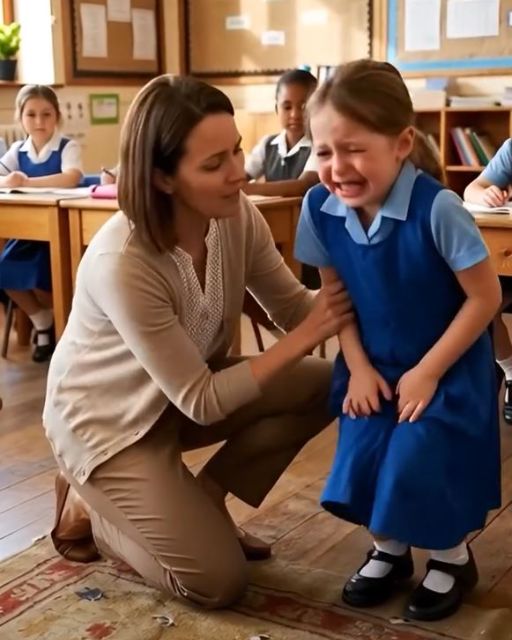
The wall she had built around herself crumbled in the gymnasium. The squeak of sneakers on the polished floor, the happy shouts of a game of tag—it was all normal until Lily tripped. She didn’t cry from the scrape on her knee. She cried from pure terror.
“Please, don’t tell!” she sobbed, grabbing my arm, her whole body shaking. The other children stopped their game, staring. “Please, Mrs. Davis, I’m okay!”
I led her to the quiet of the nurse’s office. “It’s alright, sweetie. Let me just look at your back, make sure you didn’t hit it.”
I gently lifted the hem of her small t-shirt. My breath caught in my throat. My blood ran cold. It wasn’t a bruise from the fall. It was a pattern of small, cruel marks, laid out with chilling precision across her fragile skin.
“Lily,” I whispered, my voice trembling. “What is this?”
Her eyes filled with tears as she looked at the floor. “The chair,” she mumbled. “The special chair.”
“What special chair, honey?”
“Uncle Greg’s chair. When I’m bad, I have to sit in it. He said it has nails to help me remember how to be good.” Her voice was barely audible. “He told me if I ever told anyone, no one would believe me. He said… he said all the judges are his friends.”
My hands were shaking, but my mind was clear. I tucked her shirt back in and hugged her tightly. “He is not going to hurt you again,” I promised.
I left her with the nurse and walked into the hallway, my heart pounding against my ribs. I pulled out my phone and dialed the number for Child Protective Services. I gave them the address, the name, every horrifying detail Lily had whispered. The woman on the phone assured me they would act immediately. For the first time all day, I felt a wave of relief wash over me. I had saved her.
I hung up and turned to go back to Lily.
Standing in the hallway, blocking my path, was her Uncle Greg. He wasn’t angry. He wasn’t yelling. He just smiled, a cold, empty smile that didn’t reach his eyes.
He held up his own phone, and the screen was lit up. It was a picture of him and the chief of police, laughing on a golf course, their arms slung around each other’s shoulders. Then his phone began to ring, and he showed me the screen. The call was from a number I recognized. It was the same one I had just dialed.
My blood turned to ice in my veins. The world seemed to tilt on its axis.
He answered the call, his gaze never leaving mine. “Greg Harper speaking,” he said, his voice smooth as silk. “Yes? A report about my niece?”
He listened for a moment, his smile widening slightly. “Oh, a misunderstanding, I’m sure. Her teacher, Mrs. Davis, can be a bit… overly imaginative. Lily just had a little tumble in the gym. Kids, you know.”
He winked at me. It was a slow, deliberate gesture of pure dominance.
“Of course. I’ll be right there to pick her up. Thank you for your diligence.” He ended the call and slipped the phone back into his pocket.
“You see, Mrs. Davis,” he said, taking a step closer. His voice was low, confidential. “This is a small town. People look out for each other. Friends help friends.”
I couldn’t find my voice. I was frozen, trapped in a nightmare.
“Lily is my family. I know what’s best for her,” he continued. “And what’s best for you is to stick to teaching ABCs and forget all about this. It would be a shame for a dedicated teacher like you to suddenly find her contract not renewed.”
He brushed past me as if I were nothing more than a piece of furniture and walked toward the nurse’s office. I heard him greet the nurse with a practiced charm, his voice dripping with false concern.
A moment later, he emerged with Lily. She wouldn’t look at me. Her small face was pale, her eyes fixed on the floor. She held his hand like he was her savior, not her tormentor. That was the most heartbreaking part.
I watched them walk away, down the long, empty school corridor, until they disappeared out the front doors.
The promise I had made to her echoed in my head. “He is not going to hurt you again.” The words were a bitter ash in my mouth. I hadn’t saved her. I had just made everything so much worse.
I went straight to my principal, Mr. Henderson. He was a good man, nearing retirement, a man who believed in rules and procedures.
He listened patiently as I recounted the entire story, my voice breaking. I told him about the marks, the chair, the phone call.
When I finished, he sighed, a deep, weary sound. He steepled his fingers and looked at me over the top of his glasses.
“Carol, Greg Harper is a pillar of this community,” he said softly. “His family practically built this town. He sits on the school board. He funds the police athletic league.”
“He’s hurting a child,” I insisted, my frustration boiling over.
“I believe you,” he said, holding up a hand. “But believing you and being able to do something are two different things. His roots in this town are deep. Deeper than you can imagine.”
He warned me to be careful. He told me to let it go. It was advice born of fear, not malice. He was trying to protect me.
But how could I let it go? Every time I closed my eyes, I saw those cruel marks on Lily’s back.
The next few days were a special kind of hell. Lily was back in class, but she was a ghost. She wouldn’t make eye contact with me. She stood silently at the back of the room, a tiny, solitary statue. The other kids stopped trying to include her. A wall of fear had been built around her, and her uncle was the architect.
I tried calling CPS again, from a different phone. I used a fake name. The response was the same. A polite, dismissive tone. A promise to “look into it” that I knew was empty. The system was compromised. Greg Harper owned it.
I felt so utterly alone. It felt like I was screaming into a void.
One night, I couldn’t sleep. I was sitting at my kitchen table at 2 a.m., staring at a cold cup of tea, when a memory surfaced. It was from a few years back, a parent-teacher conference.
Sarah Jenkins. Her son had been in my class. She was a journalist, a sharp, inquisitive woman who had moved away to take a job at a big city newspaper. We’d exchanged Christmas cards a few times.
My heart started to beat faster. She wasn’t part of this town. She wasn’t under Greg Harper’s thumb.
It took me an hour of frantic searching through old address books, but I finally found her number. My hands were trembling as I dialed.
“Hello?” Her voice was sleepy, confused.
“Sarah? It’s Carol Davis. From Northwood Elementary? I’m so sorry to call so late.”
I poured out the whole story, the words tumbling over each other in my haste. I expected her to be skeptical, to think I was some hysterical small-town teacher.
But she just listened. When I was done, there was a long silence on the other end of the line.
“Carol,” she finally said, her voice now wide awake and sharp. “Tell me everything again. Slowly. Don’t leave out a single detail.”
For the first time in days, a tiny spark of hope ignited within me.
Sarah began to dig. She was careful, discreet. She told me to document everything. Every strange car that parked on my street for too long. Every phone call that was just dead air. I started a journal, filling it with meticulous notes.
The intimidation started subtly. A single nail left in the center of my car’s driver-side tire, causing a slow leak. A perfectly placed dead crow on my welcome mat one morning. Nothing I could prove, but I knew who it was from. It was Greg’s way of telling me he was watching.
Sarah’s investigation confirmed what Mr. Henderson had said. The Harper family wasn’t just influential; they were the town’s shadow government. But she also found cracks in the facade. Greg had a reputation for being ruthless in business, not just strict. There were whispers of deals that had gone sour, of partners who had been mysteriously ruined.
“He’s not just a bully, Carol,” Sarah told me over the phone one evening. “He’s a predator in every sense of the word. The abuse is about power. And people who crave power like that are usually hiding something bigger.”
She was right. The first real twist came a week later. Sarah discovered that Greg’s “successful” construction business was a house of cards. He was involved in a massive fraud scheme, using substandard materials on a city-funded project and billing for top-grade ones, pocketing the difference.
The chief of police wasn’t just a golf buddy; he was a silent partner, receiving kickbacks to ensure no pesky inspectors ever got too close. This was it. This was something bigger than our small town. It reached into the city, into federal jurisdiction.
Then, Lily disappeared from school.
She was marked absent on a Tuesday. Then Wednesday. Then Thursday. My calls to the house went straight to an answering machine with Greg’s smooth, confident voice.
Panic, cold and sharp, seized me. I drove by the house after school. The curtains were drawn. It looked quiet, lifeless. My imagination ran wild with horrifying possibilities.
I called Sarah, my voice a frantic whisper. “She’s gone, Sarah. He’s taken her somewhere.”
“Stay calm, Carol. Do not go near that house again,” she ordered. Her voice was firm, pulling me back from the edge. “This is good. It’s a mistake on his part. It shows erratic behavior. I have a contact now. Someone in the FBI’s white-collar crime division. They’ve been sniffing around Greg’s business partners for months. Your story… it gives them a whole new reason to accelerate things.”
That’s when Sarah revealed the second, more personal twist. She had been searching for any other family members. She found a sister. Greg’s older sister, Margaret, who had left town decades ago and never looked back.
Sarah had tracked her down in Oregon. At first, Margaret was defensive, protective of the family name. But as Sarah gently laid out the facts—the school, the marks, the chair—Margaret’s defenses crumbled.
She began to weep. She told Sarah that Greg had always had a cruel streak, even as a boy. She recalled him trapping small animals, his cold fascination with their fear. The family had always dismissed it, calling him “intense” and “a leader.” They had protected him, enabled him.
Margaret confessed she had worried for Lily, who had been left in Greg’s care after her parents, Margaret’s brother and his wife, had passed away in a car accident two years prior. She had tried to get custody, but Greg, with his money and local lawyers, had painted her as an unstable, estranged relative. He had won easily.
Margaret was filled with a terrible guilt, but also a fierce, protective anger. She booked the first flight she could get. She was coming.
The pieces were finally falling into place. It wasn’t just my word against his anymore. It was me, a city journalist, a federal agency, and a family member who could testify to his character. The web of power he had woven around himself was about to be torn apart.
The plan came together quickly and quietly. The local authorities were kept completely out of the loop.
On a gray Friday morning, two black cars with government plates rolled silently into our town. They didn’t stop at the local police station. They went straight to the Harper house on the hill.
I wasn’t there, but Sarah’s FBI contact told her everything later.
Federal agents and a state-level CPS team from the capital city swarmed the property. Greg Harper was caught completely by surprise. His arrogant smirk faltered for the first time when he saw the search warrant was signed by a federal judge. His power ended at the county line.
They found Lily locked in her room. She was scared, but physically unharmed. She had been kept home from school so no one could see the new bruises blooming on her arms.
And in the basement, behind a locked door, they found the chair.
It was just as Lily had described it. A small, dark wooden chair, almost like a child’s antique. But the seat was a nightmare. Dozens of small, sharpened nail points protruded just enough to cause excruciating pain, to dig into the flesh of a small child forced to sit on it. It was a custom-made instrument of torture.
Greg Harper was arrested on the spot. As they led him out in handcuffs, his face was a mask of disbelief. All his life, he had been untouchable. He couldn’t comprehend that his reign was over. The chief of police was arrested at his desk an hour later. The whole corrupt system came crashing down.
Margaret was waiting at the state CPS office when they brought Lily in. I was there, too.
The moment Lily saw her aunt, a woman she barely remembered, something shifted in her eyes. Margaret knelt and opened her arms, her face wet with tears. Lily hesitated for only a second before running into her embrace, burying her face in her shoulder and sobbing, releasing all the pain and fear she had held inside for so long.
Lily went to live with Margaret in Oregon. The road to healing would be long, but she was finally in a safe, loving home.
A few months later, I flew out to visit them. Margaret’s house was bright and filled with sunlight. Lily’s drawings were taped to the refrigerator.
She was still quiet, but the fear in her eyes was gone. It had been replaced by a tentative curiosity. She showed me her new room, her new toys, a picture she had drawn of a big, green dragon.
Later, she sat down at a small table in the living room to color. She just sat. She wiggled in her seat, adjusted her position, and leaned over her paper, completely absorbed in her task.
Watching her sit, so carefree and normal, was the most profoundly beautiful and rewarding sight I had ever witnessed. It was a simple act, an act most of us take for granted, but for her, it was a victory. It was freedom.
That experience changed me. I realized that systems, even those designed to protect us, can be broken or corrupted. But the will of a single person, the courage to make a phone call, to push back against the darkness, can be enough to let the light in.
Sometimes, doing the right thing feels like you’re standing all alone against a hurricane. You feel small, and the forces against you seem immense and insurmountable. But you can’t give up. You have to hold your ground, because you might be the only hope that a child like Lily has. One person’s voice, refusing to be silenced, can be powerful enough to save a life and bring a monster out of the shadows.