Caleb had been locked up for a little more than a year. He never denied what he did.
He owned it. But owning it didn’t make the weight of missing his daughter any lighter.
When he went in, Lila was barely forming sentences. Now, at two and a half, she was a chatterbox.
His wife, Emery, brought her every single visiting day, through the long hallway that always smelled like bleach.
The officer nodded. Caleb stepped forward.
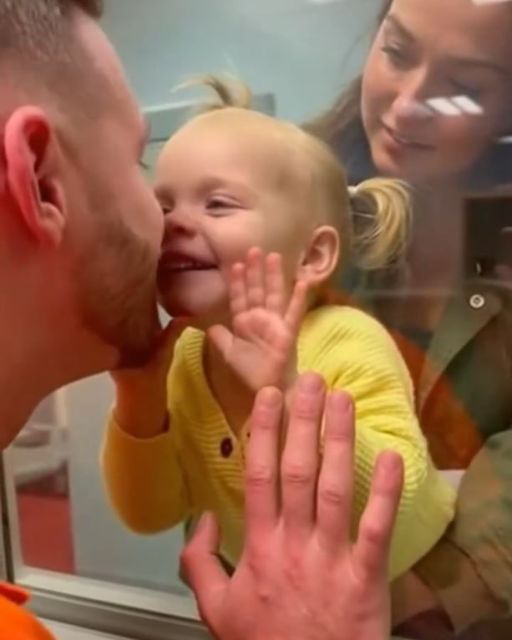
The glass was clean enough to see every detail of his daughter’s smile.
“Hey, my little princess. Daddy’s right here.”
Lila pressed her small palm against the partition. Caleb matched it.
Their hands lined up perfectly through the cold barrier, but the feeling was warm enough to break him. He swallowed hard, fighting the sting in his eyes.
This was the only thing that felt real anymore.
In the booth next to them, an older woman named Margaret watched them. She came every week to see her own son.
She had seen this young family’s painful ritual play out many times, a silent witness to their grief.
Lila pulled her hand back and pointed, her tiny finger jabbing at the glass. “Daddy, your flower.”
Caleb frowned, confused. “What flower, baby?”
He looked down at his orange jumpsuit. There was nothing there.
“On your arm,” Lila said, insistent. “The flower.”
He pulled up his sleeve slightly. There was a faint, star-shaped scar on his forearm, pale against his skin.
An old burn from years ago. He’d almost forgotten it was there.
“That’s just an old ouchie, sweetheart. It’s not a flower.”
“The flower from the loud bang,” Lila repeated, her voice clear. She traced a star shape on the glass with her finger.
“Boom!”
The room was filled with low murmurs, but Lila’s little voice seemed to cut through it. Whispers rippled through the other visitors.
Caleb felt his cheeks heat up, trying to quiet her down.
But Margaret, in the next booth, had frozen. Her blood ran cold.
She wasn’t looking at her son anymore. Her eyes were locked on Caleb’s arm.
Her hands started to shake as she remembered a small, dismissed detail from the news report about the crime a year ago. A witness miles away from the scene had reported illegal fireworks—a specific kind known for leaving a distinct star-shaped burn.
Margaret stood up so fast her chair scraped loudly against the floor. A guard turned, his face stern.
“Ma’am, sit down.”
She ignored him, her voice trembling but loud enough for everyone to hear as she pointed at Caleb. “That mark on his arm. Ask him where he was on the Fourth of July.”
The visiting room fell into a stunned silence. Emery’s face went pale, her hand hovering protectively over Lila’s shoulder.
Caleb just stared, his mind a blank canvas of confusion. Fourth of July?
Two guards moved towards their booth immediately. One spoke into his radio, his voice a low, urgent hum.
“Visit’s over,” the other guard said, his tone leaving no room for argument.
Caleb pressed his hand back against the glass, his eyes pleading with Emery. “I don’t know what she’s talking about.”
Emery nodded, her own eyes welling with tears as she scooped a crying Lila into her arms. She trusted him, but fear was a cold knot in her stomach.
They led Caleb away, out of the visiting room and down a corridor he’d never seen before. Margaret was also escorted out, her son David looking on with a mixture of shock and concern.
The warden’s office was small and smelled of stale coffee. Margaret sat across from the imposing desk, her hands clasped tightly in her lap.
“Ma’am, you caused quite a disturbance,” Warden Thompson said, his voice calm but firm.
“My husband,” Margaret began, her voice cracking. “He was killed in a hit-and-run last year. On the Fourth of July.”
She explained the story, the details she had memorized like a prayer. The police had no leads, no real witnesses to the actual event.
All they had was a noise complaint from a few blocks away about illegal fireworks just minutes before the accident. A witness had mentioned seeing a man with a “star-burst” burn on his arm.
The police had dismissed it. It was tenuous, a flimsy connection at best.
But for a grieving widow, it was everything. “That little girl said, ‘the flower from the loud bang.’ That’s what it was.”
Warden Thompson listened patiently, his expression unreadable. He had seen a lot in his years, but this was new.
Meanwhile, Caleb sat in a sterile interrogation room. He knew why he was in prison.
He had robbed a convenience store with a toy gun. It was a stupid, desperate act.
Lila had been sick, a rare respiratory condition that required a specialist, and the bills were piling up like mountains. He had caved under the pressure, made the worst mistake of his life, and confessed the moment the police arrived.
He was a thief. But he wasn’t a killer.
“Where were you on the evening of July Fourth last year, Caleb?” a detective asked, sliding a folder onto the metal table.
“I was working,” Caleb said immediately. “I was a line cook at The Corner Bistro. I worked a double shift that day to make extra money for the holiday.”
The detective scribbled in a notepad. “Can anyone verify that?”
Caleb’s heart sank. “The place closed down about eight months ago. The owner, Mr. Henderson, he retired and moved to Florida, I think.”
It sounded like a convenient excuse. Even he could hear how weak it sounded.
He explained the scar on his arm. A stupid accident when he was sixteen, playing with fireworks with his friends in a backyard.
It was just a pale mark on his skin, a ghost of a teenage mistake. He never imagined it could be twisted into something so monstrous.
For weeks, a shadow hung over their lives. Emery was only allowed short, tense phone calls.
Caleb’s case was being reviewed. The local news had picked up the story, a sensational headline about a toddler’s clue from behind bars.
Emery felt the stares in the grocery store, heard the whispers from other parents at the park. Her belief in Caleb was a shield, but it was getting heavier every day.
Margaret, however, was not celebrating a potential break in her husband’s case. She was consumed by a different feeling: doubt.
She had seen the look on Caleb’s face. It wasn’t the look of a killer caught in a lie.
It was the look of a terrified father. A man who had already lost so much and was about to lose everything else.
Had she done the right thing? Or had she just destroyed another family based on the ramblings of a two-year-old?
The thought kept her up at night. She decided she couldn’t just wait for the police.
She owed it to that young family, and to the memory of her husband, to be absolutely sure. She started with what she knew.
The police report. She read it over and over, until the words blurred.
Then she saw it, a detail she’d skimmed past a hundred times. The witness who reported the fireworks hadn’t just mentioned the man with the burn.
They had also mentioned a vehicle. A white work van, maybe for a plumber or an electrician, speeding away from the area just after the “loud bang.”
It was another small thing, another detail lost in the noise of the investigation. But now, it felt important.
During her next visit with her son, David, she told him about the van. David was in for a short sentence on a non-violent offense, trying to get his life back on track.
He listened quietly, his brow furrowed in concentration. “A white plumber’s van?” he asked slowly.
“Yes,” Margaret said. “Does that mean anything to you?”
David went quiet. His face lost its color.
He had shared a cell for a few weeks with a guy named Marcus when he first arrived. Marcus was loud, arrogant, and loved to brag.
He was a plumber by trade. He also had a very distinct tattoo on his forearm.
It was a crudely drawn, five-pointed star. He called it his “lucky star.”
David had never thought much of it. But now, a conversation from months ago came flooding back.
Marcus had been bragging about a “crazy” Fourth of July. He and his buddies had been setting off professional-grade fireworks in a residential area.
He said he “tapped” something with his van while peeling out of the neighborhood to avoid the cops. He laughed it off, saying he was sure it was just a mailbox or a garbage can.
He never even slowed down to check.
David’s heart hammered in his chest. A tattoo, not a scar.
A child wouldn’t know the difference. Lila would have just seen the shape.
The “flower.”
He knew he had to speak up. It was the right thing to do, but it was also terrifying.
He was an inmate. Snitching was a dangerous game.
But then he thought of that little girl, Lila. He thought of Caleb, a man who might be innocent, facing a life sentence.
He thought of his own mother’s unending grief.
He told Margaret everything. The next day, Margaret and David were sitting in the warden’s office, recounting the story to the same detectives who had questioned Caleb.
This time, they listened with a new intensity. They had a name: Marcus.
It didn’t take long for them to find him. He was a plumber, just as David said.
He owned a white work van. A forensic team found faint, almost invisible traces of paint on the front bumper that matched the paint from Margaret’s husband’s car.
Confronted with the evidence and David’s testimony, Marcus crumbled. He confessed to the whole thing.
He was a man who had lived in careless denial, never once considering the devastating consequences of his actions that night. He truly believed he had just hit a garbage can.
The news of Caleb’s exoneration in the hit-and-run case was a quiet affair, not nearly as loud as the accusation had been.
Margaret requested to see Caleb and Emery. They met not in the visiting room, but in a small, private office.
There was no glass between them this time.
“I am so sorry,” Margaret said, her eyes filled with tears. “I can’t imagine the pain I’ve caused you.”
Emery took her hand. “You were just trying to find answers for your husband. We understand.”
Caleb nodded, his own heart heavy with a strange mix of relief and sorrow for this woman. “You helped find the man who did it. You gave your husband justice.”
But Margaret wasn’t finished. “That’s not enough,” she insisted.
She had received a significant life insurance settlement after her husband’s death. She used a portion of it to hire the best appeals attorney in the state for Caleb.
The attorney built a case not just around Caleb’s good behavior, but around the circumstances that led to his crime. He presented the mountain of medical bills for Lila’s condition.
He argued that Caleb was not a hardened criminal, but a desperate father failed by a system that offered little support. He had made a terrible choice, but it was a choice born of love and fear.
The judge listened. The story of the mistaken identity, of Margaret’s quest for truth, and of David’s courage had softened public opinion.
Caleb’s sentence was reviewed. In light of the extraordinary circumstances and his non-violent offense, he was granted immediate parole.
The day he walked out of the prison gates, Emery and Lila were there waiting. He dropped to his knees and pulled them into an embrace, the first real hug he’d had in over two years.
He was finally free.
A few weeks later, they met Margaret and David, who had also been released early for his cooperation, at a local park.
Lila ran through the grass, her laughter echoing in the afternoon sun.
Caleb sat on a bench next to Margaret. “I don’t know how to thank you,” he said quietly.
“By being a good father to that little girl,” Margaret replied, a gentle smile on her face. “You both gave me my peace back. My husband can finally rest.”
Lila ran up to Caleb and pointed at a man walking by with a sleeve of tattoos. “Look, Daddy! More flowers!”
Caleb smiled and pulled her onto his lap. He gently touched the old, faded scar on his own arm.
“This is an ouchie, remember? From a long time ago.” Then he pointed to the man. “Those are pictures. They’re very different.”
“Different,” Lila repeated, seeming to understand.
He held his daughter close, breathing in the scent of her hair. He had made a terrible mistake, and he had paid for it.
But life, in its strange and winding way, had offered him a second chance. It had come from the most unexpected place—from the innocent words of a child and the determined heart of a grieving stranger.
The truth doesn’t always travel in a straight line. Sometimes, it takes wrong turns and confused observations to finally find its way into the light.
And sometimes, doing the right thing, even when it’s hard, doesn’t just bring justice. It brings healing, forgiveness, and the chance to start again.