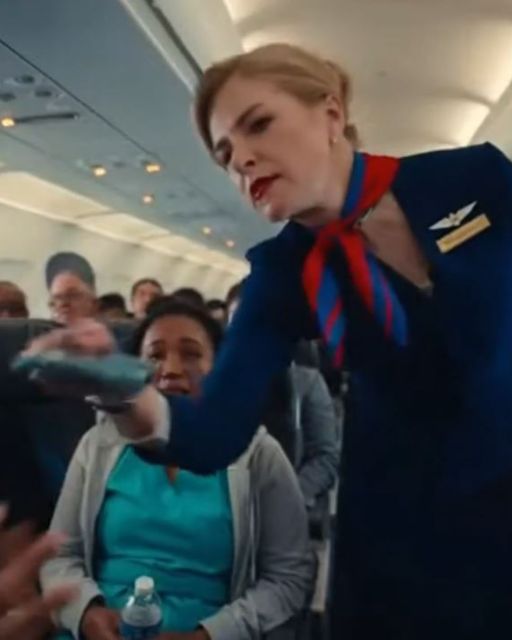
The flight attendant’s hand shot out like a viper.
She didn’t ask. She didn’t warn me. She just snatched the phone right out of my fingers.
“I said give it to me,” she hissed.
Her name tag read Sandra, but her eyes read something else entirely. They held a look I had seen too many times in my life. A look that said you don’t belong here.
“You people never listen,” Sandra said, her lip curling with undisguised disgust. “Maybe this will teach you to follow rules like everyone else.”
My mouth fell open.
My hands hung empty in the air where my device—my lifeline to the hospital—had been just a second ago.
“Did she really just say that?” a woman in row two whispered.
“What the hell?” a man behind me muttered.
But Sandra was already walking away, clutching my phone against her chest like a trophy, a satisfied smirk plastering her face as she disappeared into the galley.
I sat there, frozen.
I wanted to scream. I wanted to stand up and demand respect. I wanted to tell her who I was.
But I couldn’t.
I was paralyzed by a cocktail of exhaustion, shock, and that heavy, suffocating feeling of being small.
My daughter, Maya, watched from the window seat.
She is only eight years old. She was wearing her favorite purple dress and her hair was in braids with beads that usually clicked when she laughed.
She wasn’t laughing now.
Her small hands were gripping the armrest so hard her knuckles had turned the color of ash. She was looking at the empty space where the flight attendant had stood, and her eyes…
Her eyes looked ancient.
To understand why I didn’t fight back immediately, you have to understand where I had been four hours before this nightmare began.
My phone had buzzed at 3:47 A.M.
“Dr. Carter, we need you. He’s crashing.”
I was out of bed before the nurse finished the sentence.
I drove to Emory Children’s Hospital with my heart hammering against my ribs. A ruptured appendix in a six-year-old. Sepsis. Failing vitals.
When I ran into the hallway, the boy’s mother grabbed my arm. She was shaking so hard she could barely stand.
“Please,” she sobbed. “He’s all I have. Save my baby.”
I looked that terrified mother in the eye and I promised her.
“I will not let him go.”
For four hours, I fought death in that operating room.
I fought complications. I fought a dropping blood pressure. I fought the reaper himself for the soul of a little boy who loved soccer.
And I won.
When I walked out, stripping off my bloody gloves, I told that mother her son was going to live. The way she collapsed into my arms—that weight, that relief—it’s why I became a surgeon.
But I didn’t have time to recover.
I had twenty minutes to shower, grab Maya, and get to the airport. My husband, Marcus, was waiting for us in Seattle.
I hadn’t slept in 26 hours.
My body felt like it was filled with lead. My eyes felt like they were packed with sand.
“Mommy, you’re walking crooked,” Maya had said as we navigated the terminal.
“I’m just tired, baby.”
“You look like a zombie. A pretty zombie, though.”
I laughed. It was the last time I would laugh for a long time.
We boarded the plane. Business class.
I had worked hard for these seats. I had worked hard for this life.
We sat in 4A and 4B.
I settled in, closed my eyes, and prayed for sleep. Just a few hours. Just enough to function when we landed.
“Excuse me.”
The voice was like ice water.
My eyes snapped open.
Sandra was standing there. Blonde hair pulled back so tight it looked painful. Thin lips. Cold, dead eyes.
“I need to verify your tickets,” she said.
“We showed them at the gate,” I whispered, my voice raspy.
“I need to verify them again.”
I knew this dance. I pulled out my phone. She scanned it, not looking at the screen, but looking at me. Examining my clothes. My hair. My daughter.
She handed it back with two fingers, as if touching me would contaminate her.
“Try to sleep, Mommy,” Maya whispered after she left. “I’ll keep watch.”
“Keep watch for what?”
“I don’t know yet. But I’ll know when I see it.”
The plane took off. I drifted.
“Ma’am!”
I jerked awake.
“Your tray table needs to be up.”
I looked down. It was down maybe half an inch. I fixed it. “Sorry.”
Ten minutes later.
“Ma’am! Your seat needs to be fully upright.”
I looked around. The white man across the aisle was practically lying flat, snoring loudly. The woman two rows up had her feet on the bulkhead.
“I’ll adjust it,” I said, gritting my teeth.
“We take safety seriously,” Sandra said, hovering. “Even if you don’t.”
Maya’s hands curled into fists.
“Mommy,” she whispered. “Why is she only talking to you?”
“Shh, baby.”
“It’s not fair. Is it because we’re Black?”
The question hit me harder than the exhaustion.
“I don’t know, baby. Maybe.”
“Daddy wouldn’t like this.”
“Daddy isn’t here. I just need to get us to Seattle. Please, Maya. Just let it go.”
She went back to her book, but she wasn’t reading. She was watching. Calculating.
An hour passed.
My phone buzzed. It was a text from the hospital. The little boy I had operated on—his fever was spiking.
Panic surged through me. I needed to give instructions on the antibiotic dosage immediately. A post-op infection could kill him.
I started typing, my thumbs flying across the screen.
Monitor incision site. Increase dosage to—
A shadow fell over me.
“Ma’am, electronic devices must be in airplane mode.”
“It is,” I said, not looking up. “I’m using the Wi-Fi. I have a patient who needs—”
“I need to verify that.”
“I am a doctor,” I said, my voice rising for the first time. “A child’s life is at stake. Please, just let me send this message.”
“I don’t care if you’re the Queen of England,” Sandra snapped. “Hand it over. Now. Or I will have the police waiting at the gate.”
I looked at Maya. She looked terrified.
I thought about the headlines. Black Woman Arrested on Flight. Doctor Dragged Off Plane.
I couldn’t do that to my daughter.
Defeated, I held out the phone.
That was when she snatched it. That was when she said it.
“You people never listen.”
She walked away, taking my communication, my dignity, and my patient’s safety with her.
I broke.
The tears came hot and fast. I buried my face in my hands, sobbing quietly into my palms. 27 hours awake. A life saved. And now this.
“That woman is a monster,” the elderly lady across the aisle whispered.
“I’m recording everything,” a man behind me said. “Don’t worry, I have it all.”
But it didn’t stop the tears. I felt small. I felt helpless.
Then, I heard a click.
The sound of a seatbelt unbuckling.
I looked up, wiping my eyes.
Maya was standing up.
“Maya, sit down,” I choked out.
“No.”
Her voice wasn’t a child’s voice anymore. It was calm. Final.
“Maya, please. Don’t make this worse.”
She looked at me, her brown eyes blazing with a fierce intelligence that reminded me so much of her father.
“You always tell me to be kind, Mommy. But you also tell me to stand up for what’s right.”
“Baby, please—”
“She made you cry,” Maya said. “Nobody makes my Mommy cry.”
She stepped into the aisle.
The entire business class cabin went silent. Every eye turned to this little girl in a purple dress.
She smoothed her skirt. She lifted her chin.
And then, she started walking toward the galley.
Her little sneakers were silent on the carpeted floor.
Each step was deliberate, measured. She looked like a tiny soldier marching toward a battle she had no business fighting.
My heart was a hummingbird trapped in my chest.
I wanted to run after her, to scoop her up and shield her from the ugliness of the world.
But something held me in my seat.
Maybe it was the stunned silence of the other passengers. Maybe it was the look of resolve on my daughter’s face.
Or maybe it was a flicker of hope that her innocence could cut through where my exhaustion and anger could not.
She disappeared behind the curtain.
I could hear muffled voices. A sharp, irritated tone that had to be Sandra’s.
Then, a softer male voice I hadn’t heard before.
The seconds stretched into an eternity.
I held my breath. The man behind me was still filming, his phone held steady.
Then Maya’s small voice, clear and unwavering, drifted out from the galley.
I couldn’t make out the words at first.
I saw a flash of movement.
The other flight attendant, a young man with kind eyes who had helped us with our bags, poked his head out of the curtain. He looked pale.
He made eye contact with me, his expression a mixture of shock and something else I couldn’t quite read.
Then the purser, an older woman with a calm, authoritative air, briskly walked past my seat and into the galley.
More murmuring.
A moment later, the purser emerged, holding my phone.
She knelt beside my seat.
“Dr. Carter?” she asked, her voice gentle. “Is this yours?”
I nodded, unable to speak.
“I am so, so sorry,” she said, placing it in my hand. “Please. Finish what you need to do.”
My fingers trembled as I unlocked the screen.
The half-written message was still there. I quickly typed the correct dosage and the name of the antibiotic. I hit send.
A tiny “Delivered” receipt appeared under the message.
The air rushed out of my lungs in a great, shuddering gasp. I felt light-headed with relief. The little boy in Atlanta had a fighting chance.
Only then did I look up.
Maya was standing right behind the purser. She took her small hand and placed it on my shoulder.
“It’s okay now, Mommy,” she whispered.
Behind her, Sandra was being escorted out of the galley.
She wasn’t smirking anymore. Her face was a mask of disbelief and fury.
Her eyes locked onto mine, and the venom in them was terrifying. She looked at Maya with a hatred that chilled me to my core.
The purser guided Sandra to an empty seat at the very back of the plane, a place reserved for crew, and spoke to her in a low, firm voice.
Sandra did not return to her duties for the rest of the flight.
The young male flight attendant, whose name tag read Kevin, brought Maya a cup of juice and me a bottle of water.
“I’m so sorry,” he said, his voice barely a whisper. “I should have said something sooner. What your daughter did… she’s very brave.”
“What did she do?” I finally asked, my voice hoarse. “What did she say?”
He glanced nervously toward the back of the plane.
“She just told the truth,” he said.
The rest of the flight passed in a blur of surreal calm.
The purser, whose name was Susan, personally served us. Passengers smiled at us with sympathy and admiration.
The man with the video gave me a thumb drive. “For whatever you need it for,” he said.
When we landed in Seattle, Marcus was waiting at the gate, his face creased with worry.
“I got a strange text from the airline,” he said, hugging me tight. “They said there was an incident but you were okay. What happened?”
I looked down at Maya, who was already wrapped in her father’s arms.
“Your daughter,” I said, a watery smile touching my lips, “is a superhero.”
That night, in the hotel, after Maya was fast asleep, I finally asked her what she had said.
She had been quiet about it, as if it were a secret she was holding.
I sat on the edge of her bed, stroking her hair.
“Maya, honey. Can you tell me what you said to Sandra in the galley?”
She rolled over, her eyes blinking in the dim light from the hallway.
“I walked in,” she said, her voice sleepy. “And she was looking at your phone. She was mad.”
“What did you say to her?”
“I asked for the phone back. I said you were a doctor.”
“And what did she say?”
“She told me to go away. She said grown-ups were talking.”
My heart ached.
“Then what, baby?”
“I remembered what I saw when we were getting on the plane. When she thought no one was looking.”
I leaned in closer.
“She had one of those little bottles. The silver ones Daddy has sometimes. She drank it really fast and put it in her purse.”
My blood ran cold.
“And then I got closer to her in the galley,” Maya continued, her voice getting softer. “And she smelled funny.”
“Funny how?”
“She smelled like the sleepy medicine the doctor gave Grandma before she went to heaven.”
One sentence.
My eight-year-old daughter, in her simple, honest way, had put the pieces together.
She didn’t say “alcohol.” She didn’t say “drunk.”
She used a child’s memory, a heartbreakingly pure and honest comparison, to describe a smell she couldn’t possibly understand but knew was wrong.
That single sentence, spoken with the unshakeable conviction of a child, had been enough to make Kevin, the other flight attendant, snap to attention. It was enough to make the purser take it seriously.
It was enough to end a career.
The next morning, I got a call from the hospital.
“He’s turned a corner, Dr. Carter,” the resident on the line said. “Fever broke about an hour after we administered the new dosage. Vitals are strong. He’s going to be fine.”
I cried again, but this time, they were tears of pure, unadulterated joy.
The universe had protected that little boy.
Later that day, an email landed in my inbox.
It was from the airline’s head office. The subject line was “Formal Apology Regarding Flight 412.”
The email detailed the immediate termination of Sandra’s employment, pending an investigation by the FAA. It offered us flight vouchers, a refund, and a personal apology from the CEO.
But it was the name at the bottom of the email that made me stop breathing.
Vice President of Operations, Katherine Miller.
Miller. The name was so common, but something tugged at my memory.
I pulled up the hospital’s patient records on my secure app.
I searched for the six-year-old boy I had operated on.
His name was Leo Miller.
His mother’s name was Katherine.
My head spun. I felt a strange sense of vertigo, as if the world had just tilted on its axis.
The woman whose son I had saved, the terrified mother who had collapsed in my arms, was the Vice President of the very airline on which I had been humiliated.
An hour later, my phone rang. It was an unfamiliar number.
“Dr. Carter? This is Katherine Miller. I hope I’m not disturbing you.”
Her voice was different now. Not shaky and terrified, but strong, professional, and filled with a profound sense of gratitude.
“I don’t even know where to begin,” she said. “First, thank you. From the bottom of my soul, thank you for saving my son. The doctors here said your quick thinking on that infection saved his life.”
“It’s my job,” I said softly. “I’m just so glad he’s okay.”
“And then,” she continued, her voice cracking with emotion, “I get the incident report from the flight this morning. I read the name. I read what happened. And I… I was horrified.”
“It was an unfortunate situation,” I said, not wanting to burden her.
“No,” she said firmly. “It was unacceptable. It was racist. It was dangerous. What that woman did put my son’s life at risk a second time in less than 24 hours. The fact that she did it to the very person who saved him… the irony is just… cosmic.”
We talked for a long time.
She told me the man’s video and statements from a dozen other passengers had corroborated everything. Sandra had failed a breathalyzer test administered by authorities upon landing.
“She will never work in this industry again,” Katherine promised. “And we are using this, Dr. Carter. We are overhauling our implicit bias training from the top down. What happened to you will be a catalyst for real change.”
She paused.
“Your daughter,” she said, her voice filled with awe. “The purser’s report said your little girl was the one who… who spoke up.”
“She was,” I said, looking over at Maya, who was now drawing a picture of our family on the beach.
“She’s a hero. Just like her mother.”
We finished our vacation. We walked on the beach, we built sandcastles, we ate ice cream.
But something had shifted.
I watched Maya with new eyes. I saw the quiet strength, the fierce sense of justice that lived inside her small frame.
One evening, as we watched the sunset paint the sky in shades of orange and purple, she turned to me.
“Mommy,” she asked. “Are there a lot of bad people like Sandra?”
I took a deep breath, choosing my words carefully.
“There are some people in the world who let bitterness and anger make their hearts small,” I told her. “They try to make others feel as small as they do.”
“But they didn’t win,” she said, not as a question, but as a statement.
“No, baby,” I said, pulling her into a hug. “They didn’t win.”
I realized then that the most important lesson from this whole ordeal wasn’t about the victory or the justice.
It was about the source of the courage that won the day.
It wasn’t my title as a doctor, or the support of the other passengers, or even the karmic intervention of a grateful VP.
It was the clear, simple truth spoken by a child who knew the difference between right and wrong.
Courage, I learned, isn’t always a roar. Sometimes, it’s a quiet voice that speaks up in a silent room, armed with nothing more than the truth.
And a voice like that can be more powerful than any injustice in the world.