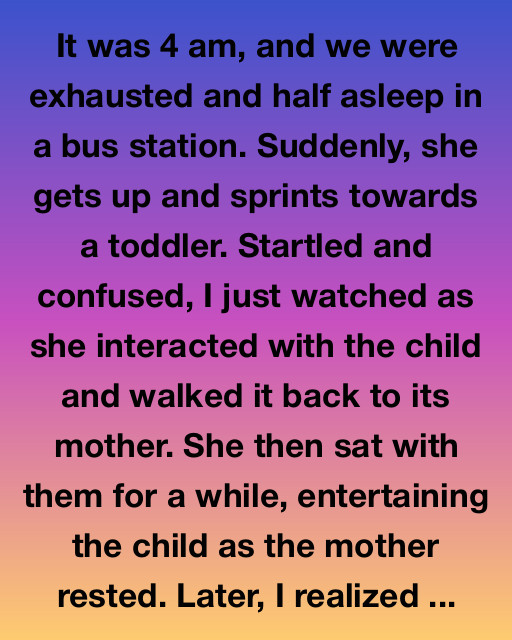
It was 4 am, and we were exhausted and half asleep in a bus station. Suddenly, she gets up and sprints towards a toddler. Startled and confused, I just watched as she interacted with the child and walked it back to its mother. She then sat with them for a while, entertaining the child as the mother rested. Later, I realized that moment summed her up better than anything I could have ever said.
Her name was Tessa. We had only been traveling together for three days, but in that short time, I had already seen glimpses of the quiet kindness she carried with her like a secret superpower.
We were both backpackers making our way across the country on a shoestring budget, bound by shared goals and convenience more than deep friendship. Yet, the more time I spent with her, the more I started noticing how she paid attention to things most people ignored.
The toddler that night had wandered several feet from his sleeping mother, heading toward the busy sidewalk just outside the station. Tessa had noticed instantly, while I—too tired and too focused on my aching back—had missed it completely.
She never made a big deal out of what she did. After getting the kid back to safety and making the young mother laugh with some silly peek-a-boo gestures, she just returned to our bench and pulled her hoodie over her eyes like nothing had happened.
I remember whispering, “How’d you even notice?”
She smiled under her hood. “You just keep your heart open. It tells you where to look.”
At the time, I thought it was something she’d read on a fortune cookie or maybe one of those travel quotes people post online. But as our journey continued, I kept seeing her live by that. She shared her food without being asked, helped an old woman carry bags up the station stairs, and gave her spare sweater to a shivering teenager at a bus stop in the mountains. Always small things. Always quietly done.
We were both headed to Portland, but decided to make some stops along the way. Spokane was the next on the map. It was in that city that things shifted. We arrived around noon, dusty and sore, after a seven-hour bus ride through winding roads.
I suggested we check into a hostel and rest. Tessa, though, had heard about a community kitchen that let volunteers earn a meal. She convinced me to go with her, saying, “Might be nice to give before we take, y’know?”
The kitchen was a warm, bustling place filled with laughter and chatter, despite the obvious signs of poverty in the people who came through the door. We spent the afternoon peeling potatoes, wiping tables, and handing out trays.
By the end of it, my feet were throbbing. But then I saw Tessa sitting with a teenage boy who had been eating alone. She had slid her tray across from him and just started talking. No judgment. No pity. Just genuine curiosity.
Later, I asked her about it.
“He reminded me of my brother,” she said simply. “When he was using.”
That was the first personal thing she’d ever shared. Until then, all I knew was that she was from somewhere in Ohio and had left home a year ago. She never talked much about herself. But that moment cracked something open. Slowly, over the next few days, she shared more.
Her brother, Marcus, had been her best friend growing up. Funny, restless, full of bad ideas and worse plans. He started using painkillers after a car accident and spiraled fast. Her parents were overwhelmed and scared. When he left home, no one heard from him for over a year.
One day, Tessa got a call from a woman in San Francisco who’d found his ID in a backpack left in a shelter. That was the last clue anyone had.
She had spent six months looking for him, couch-surfing, volunteering, asking around. No trace. Then she gave up looking directly, but not entirely. “Maybe,” she said one night, “if I help someone else’s brother or sister… it balances out somehow.”
I didn’t know what to say to that.
Portland came, and with it, a new chapter. Tessa found a flyer in a bookstore for a local program that helped homeless youth get their GEDs. They needed tutors. She signed up without hesitation. I took a short-term gig at a shipping warehouse to save up for my next leg to California.
We started seeing less of each other, but every few days we’d meet at a park bench with two coffees and update each other. She would talk about the kids she worked with—how one of them wrote poetry that made her cry, how another skipped three sessions but showed up on a rainy day just to sit in silence and read.
One evening, she showed up late, soaked from the drizzle, hair sticking to her face, but with a grin I hadn’t seen before.
“I found him,” she said, breathless. “I think I found Marcus.”
I froze. “Where?”
“A kid came into the GED class asking for help. Said he heard about the program from a guy he met at a shelter. Gave me a name—Marcus Langdon. Said he sometimes crashed at this church a few blocks down.”
My heart was pounding. She looked shaken, but hopeful. “I’m going tomorrow morning.”
That night I barely slept, even though it wasn’t my brother. Something about the idea of full-circle moments, of things finally clicking into place, stirred something deep.
She went alone. I waited by my phone all morning. When she called, her voice was different. Soft. Fragile.
“It wasn’t him,” she said.
I wanted to say something comforting, but she beat me to it. “But it could have been. And I think that’s enough for now.”
She kept volunteering. More than before, actually. And something shifted in me too. I stopped thinking about my travel plans and started thinking about purpose. Not in the grand, preachy way. But in the “what am I even doing with my time?” way.
Two weeks later, we were at a park festival. There were food trucks, music, and kids running barefoot across the grass. Tessa was volunteering at a booth collecting clothes for a local shelter. I had come by to drop off some old shirts and keep her company.
A man approached the booth—tall, thin, wearing a beat-up cap. Tessa froze. I looked at her and followed her gaze.
“Marcus?” she whispered.
He looked up slowly. His eyes widened.
It was him.
There was no cinematic reunion. No dramatic hug. Just silence. Then he whispered, “Tess…”
They talked for over an hour on a park bench. I kept my distance. Later, she told me the barebones: he’d been in and out of shelters, tried rehab twice, was now six months clean and living in a halfway house nearby. He’d stopped trying to reach out because he didn’t think anyone cared anymore.
“He thought we forgot him,” she said, eyes brimming.
They spent the next week rebuilding. She brought him snacks, walked with him to meetings, listened. No judgments. No pushing. Just presence.
But here’s where the twist came in. One day, he didn’t show up to their planned meeting.
Tessa panicked. She called every shelter, every number he’d given her. Nothing. Finally, she went to the halfway house.
He’d checked out. Left without a word.
I found her sitting alone on our park bench that evening, staring into the distance. I thought she’d be devastated. And she was. But not broken.
“People leave,” she said softly. “Sometimes they come back. Sometimes they don’t. But you can’t close your heart because of it.”
Weeks passed. She stayed in Portland. I did too. We both got steadier jobs—me at a bookstore, her at a youth center. One day, she came in holding a letter.
It was from Marcus.
No return address, but the note was clear. He had relapsed, but was checking himself into a new program out of state. He’d kept the bracelet she gave him. He ended the letter with, “You made me believe I wasn’t trash. That’s why I’m trying again.”
She folded the letter and smiled.
That night, I wrote my family for the first time in months. Told them I missed them. That I was okay. That I was finally doing something that felt like living.
Tessa’s kindness didn’t fix everything. But it mattered. Not just to Marcus. To me. To dozens of people who probably never knew her name but remembered her smile.
And maybe that’s the lesson in all of this.
We think impact has to be loud. Huge. Viral.
But sometimes, it’s a quiet woman in a bus station at 4 am, walking a toddler back to their mother. It’s someone peeling potatoes for strangers. Someone listening without rushing to fix.
It’s the choice, over and over, to keep your heart open—even when it hurts.
So if you’re reading this, and you’re tired or unsure or just wondering if what you’re doing even matters—trust me. It does.
Be like Tessa.
And if this story touched you in any way, share it. Maybe someone else needs to hear it too. Like. Comment. Pass it on. We need more hearts like hers in this world.