“Leo, you’re not my son.”
The words hit me before the smell of motor oil had even left my clothes. I was eighteen. It was my birthday.
I stood in the doorway of our tiny apartment, holding a paper box with a single slice of cake inside.
My suitcase was already packed and waiting by the wall. My father’s arms were crossed. My mother was staring at a spot on the floor so hard I thought she might burn a hole through it.
We raised you. We did our duty. You’re on your own now.
I laughed. A dry, tight sound in my throat. I was waiting for the punchline. For someone to jump out and yell surprise.
No one did.
I begged. I asked them what I did wrong. I called her “Mom” until my voice cracked and disappeared.
She just pulled her hand away from mine.
“You have to fend for yourself,” she whispered, not looking at me.
Then they closed the door. The sound of the lock clicking into place was the loudest thing I had ever heard.
My life as an adult started on that sidewalk, with a slice of cake slowly melting in a box.
I learned to survive. Cheap rooms. Double shifts at the garage. The taste of instant noodles for three days straight.
My world was small and smelled like grease. It was just me and the ache in my back.
Then Sarah walked in.
Her old car had a squeal in the brakes and she had ink on her fingers. A schoolteacher. She told me stories about her students while I wrestled with a rusted bolt under her hood.
One cup of burnt coffee from the garage machine became two.
Two became a first date.
Three years later, we were married. A thrift-store suit, a borrowed dress, and music playing from a friend’s phone. We didn’t have anything, but we had a room we called ours.
We saved every penny in a glass jar. Pictured a little house with a yard.
Four walls. A door with a lock. A place no one could ever throw me out of again.
That dream is what put us in the bank.
Sarah sat across from me, her best dress on, our whole future tucked into a paper folder on her lap. We had done everything right. We had worked for this.
The loan officer was all smiles. He typed our names into his computer, making small talk about the American dream.
Then his fingers stopped.
His smile disappeared. He stared at the screen, his brow furrowed. He typed again.
“There’s a problem here,” he said, not looking at us. “This Social Security number… the system says it’s not valid.”
My number. The nine digits I’d used for everything. My job. My taxes. My entire life.
I felt the blood drain from my face. A mistake, I told him. It has to be a mistake.
The loan was frozen. We had to go to the Social Security office.
The air in the government building was stale. We waited for an hour. A clerk with tired eyes called my name.
He typed my number into his computer.
His face changed. The same way the banker’s had.
“Sir, could you please come with me?”
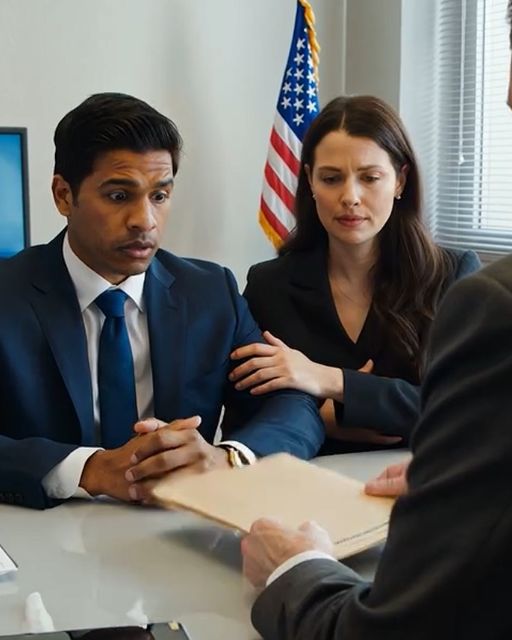
He led us to a small, windowless office and closed the door. He folded his hands on the desk between us.
“The number you have been using,” he started, his voice low, “belongs to a child who was reported deceased over thirty years ago.”
The words didn’t make sense. It was like he was speaking a different language.
Deceased? I’m right here. I’m breathing.
He made a phone call.
Soon, two men in dark suits were in the room. They didn’t smile. They asked me to come with them. To verify my identity.
They took my fingerprints at the federal building. They ran my name through a dozen databases. The clock on the wall ticked for hours.
Finally, an agent slid a file across the table. He looked me dead in the eye.
“Leo… according to our records, you don’t officially exist.”
And that was before he pushed the old photo across the table.
A missing child from a neighboring state. A baby with a last name I had never heard before.
The photo was grainy, a faded black-and-white copy of a copy. It showed a baby wrapped in a hospital blanket.
He had my eyes.
The name on the file underneath the picture read: Daniel Peterson.
“That’s not me,” I said. The words came out weak, a stranger’s voice.
Sarah reached across the table and took my hand. Her grip was the only thing keeping me from floating away.
The agent, a man named Harris, sighed softly. He had a kind face, which almost made it worse.
“Leo,” he said, using my name gently. “The child who was issued that Social Security number, the real one, died two days after he was born. Thirty-three years ago.”
He paused, letting the information sink in. “Somehow, that number was assigned to you. The people who raised you… what were their names?”
“Mark and Susan Miller,” I stammered.
Agent Harris typed the names into his laptop. He and his partner exchanged a look. There were no records of a couple with those names having a child.
“The baby in this photo, Daniel Peterson, went missing from a hospital in Northwood, two towns over from where you grew up,” he continued. “He was never found. His parents have never stopped looking.”
My head was spinning. A life. A whole other life. Parents who were looking for me.
It felt like a story someone was telling about a character in a book, not about me, Leo the mechanic.
“So… what does this mean?” Sarah asked, her voice steady even though I could feel her hand trembling.
“It means we need to find Mark and Susan Miller,” Harris said. “And it means, Leo, that we need a DNA test. To confirm if you are Daniel Peterson.”
The world I knew had tilted on its axis. The tiny apartment, the closed door, the loneliness — it all suddenly had a new, sinister context. They hadn’t just abandoned me. They had lied to me about everything.
The DNA test was just a swab on the inside of my cheek. It felt too simple for something that could rewrite my entire existence.
We went home to our small apartment, the one we were so desperate to leave. The dream of a house seemed trivial now.
Who was I if I wasn’t Leo Miller?
For two days, we just existed. I couldn’t work. I couldn’t eat. I just stared at the ceiling while Sarah held my hand, talking about anything and everything to keep the silence from swallowing me whole.
Then the phone rang. It was Agent Harris.
“It’s a match,” he said. No fanfare. Just a fact that split my life in two. “You are Daniel Peterson.”
I was the baby in the picture. I was someone’s missing son.
The next step was finding Mark and Susan. I gave the agents every detail I could remember. The name of the town we lived in. The factories where Mark worked. The way Susan always paid for everything in cash.
They were ghosts. They had moved the day I turned eighteen, leaving no trace. It was as if they had planned their exit for years.
Then I remembered something. A postcard Susan kept in a shoebox. A picture of a lighthouse on the Oregon coast. She used to stare at it sometimes, a sad, faraway look in her eyes.
I told Agent Harris. It was a long shot, a flimsy memory, but it was all I had.
A week later, they found them.
They were living in a small coastal town, just like the postcard. Mark was working as a handyman. Susan was a cashier at a local grocery store.
Agent Harris asked if I wanted to be there when they questioned them. A part of me screamed no. I wanted to forget they ever existed.
But another part, a deeper part, needed to know why.
I went. Sarah came with me, a silent pillar of strength by my side.
We sat in an observation room behind a one-way mirror. I watched as Mark and Susan were led into the sterile interrogation room.
They looked older. Smaller. The anger I expected to feel was replaced by a hollow ache.
Susan saw the file on the table with the baby picture on it. Her face crumpled. She started to weep before anyone even spoke a word.
Mark just sat there, his hands folded, his face a mask of weary resignation.
He was the one who spoke first. His voice was gravelly, tired.
“We never hurt him,” he said. “We loved him.”
Then, piece by piece, the story came out. It wasn’t what I thought. It wasn’t a kidnapping for ransom. It was something far more twisted and heartbreaking.
Susan had been a nurse. A neonatal nurse at Northwood General, the very hospital where I was born.
Just a week before I was born, her own baby boy had died. A sudden, unexplained illness. He had lived for only three days.
She was shattered. Drowning in a grief so profound she couldn’t see straight. The hospital had given her compassionate leave, but she came back to work too soon, hoping the routine would be a distraction.
That’s when she saw my birth parents. The Petersons.
They were fighting. Not just a disagreement, but a vicious, loud argument in the hospital hallway. The man, my biological father, was yelling. My biological mother was crying, pleading with him.
Susan said she heard him say he never wanted a child. That I was a mistake that would ruin his life.
In her broken, grief-stricken mind, something snapped. She saw me, a healthy baby, and she saw a man who didn’t want me. She thought of her own empty arms, her own silent nursery.
She didn’t see it as a crime. In her mind, she was saving me.
She knew the system. She knew how to cover her tracks. She swapped my wristband with her deceased son’s. She falsified the records.
Daniel Peterson was officially recorded as deceased. And she and Mark, with a new baby they named Leo, vanished. The Social Security number was her dead son’s. A ghost’s number for a ghost child.
I watched her tell the story through the glass, her body shaking with sobs. Mark just stared at the table, his hand protectively on her shoulder. He had gone along with it, lost in his own grief and desperate to ease his wife’s pain.
They weren’t monsters. They were just broken people who had done a monstrous thing.
They kicked me out when I was eighteen because they were terrified. They knew that once I started applying for credit, for official documents, the false identity would unravel. They thought sending me away would protect me, and them.
It was their final, misguided act of what they thought was love.
My anger evaporated, leaving only a profound, bottomless sadness. My whole life had been a lie, born from a moment of unbearable sorrow.
The next day, I was asked if I wanted to meet my family. The Petersons.
My real mother, Eleanor, and my real father, Richard.
I said yes. I had to.
We met at a neutral location, a quiet room at the federal building. Sarah was with me. I couldn’t have done it without her.
The door opened and they walked in. They looked like they had stepped out of a magazine. Richard was tall, imposing, in a suit that probably cost more than my car.
Eleanor was elegant and fragile. When she saw me, her hand flew to her mouth. A choked sob escaped her lips.
Her eyes were my eyes.
She rushed forward and hugged me. It was awkward. The hug of a stranger who was supposed to be the most familiar person in the world. I could feel her trembling.
“Daniel,” she whispered. “My boy. I knew you were alive. I always knew.”
Richard stood back, his expression unreadable. He just nodded at me. “It’s good to have you back.”
They told me about their life. They were wealthy. Very wealthy. Richard owned a massive construction empire. They lived in a sprawling estate.
They told me I had a sister, Olivia, who was born five years after I was taken.
It was all too much. The poverty I had known, the smell of grease, the constant struggle — it all felt like a different life, a story about someone else.
Over the next few weeks, they tried to bring me into their world. They wanted me to change my name back to Daniel. They offered me a job at the company, a house in their neighborhood, a trust fund.
It felt like they were trying to erase Leo.
Eleanor was kind, always trying to connect, showing me baby pictures and telling me stories. But Richard… he was different. He was controlling. He criticized my job, the way I dressed, the woman I had married.
He told Sarah she wasn’t “of our world.”
One evening, at a tense family dinner, he made a comment about how I should be grateful. How they were giving me the life I was supposed to have.
Something inside me, the part that was still Leo, the boy who survived on his own, finally spoke up.
“The life I was supposed to have?” I said, my voice quiet but firm. “The life I have, I built. I earned it. I wasn’t handed anything.”
The look he gave me was cold. It was a look of disapproval, of disappointment. And in that moment, I saw a flash of the man Susan had described from the hospital hallway. The angry, dismissive man.
Later that night, my sister Olivia called me.
“Don’t let him get to you,” she said. “He’s always been like that. Mom told me they were having a hard time when you were born. He was under a lot of pressure with the business. He said some things he didn’t mean.”
She paused. “But you know… Mom never gave up. Every year on your birthday, she’d release a balloon. For thirty-three years. She’s the one who kept the search going, even when Dad wanted to move on.”
That’s when it clicked. The final piece. Susan wasn’t just a grieving mother. She might have actually seen something real. A man who, in a moment of stress, resented the birth of his own son.
My father hadn’t wanted to “move on” from his son’s disappearance. He wanted to move on from a mistake he made. Maybe the guilt of what he said that day was too much to bear.
The truth wasn’t simple. It never is.
I went to see my mother, Eleanor, alone. We sat in her garden, a place of peace in the middle of their giant, cold house.
I told her about my life. About the garage, about meeting Sarah, about the glass jar we used to save for a home.
I told her, “My name is Leo. That’s who I am. Daniel is a part of me, the part that belongs to you. But Leo is the man who survived. He’s the man Sarah married.”
Tears streamed down her face, but this time, she was smiling. “I don’t care what your name is,” she said, her voice thick with emotion. “I just care that you’re here.”
As for Mark and Susan, they faced the consequences. Their crime was real. But at the hearing, I spoke.
I told the judge the whole story. The grief. The desperation. The misguided love. I didn’t ask for them to be set free, but I asked for understanding. I couldn’t forgive them for the lies, but I couldn’t hate them either. They were given a reduced sentence.
A few months later, Sarah and I finally bought our house. Not with a gift from Richard, but with a loan from a trust Eleanor set up in my name, a gift from a mother to her son. A real loan, with paperwork and a mortgage we would pay.
It was a small house with a little yard, just like we always dreamed.
The day we moved in, I placed the old glass jar on the mantelpiece. It was empty now, but it felt fuller than it ever had.
My life isn’t one story, but two. There’s Daniel Peterson, the boy who was lost, and Leo Miller, the man who was found. I am both.
I learned that family isn’t just about the blood in your veins. It’s about the hands that hold you when you’re falling. It’s about the love you choose, and the love that chooses you back, even when everything is broken.
My identity isn’t a name on a birth certificate. It’s in the calluses on my hands, in the love I share with my wife, and in the quiet strength I found on a lonely sidewalk all those years ago. You are not defined by where you began, but by the person you build yourself to be.