
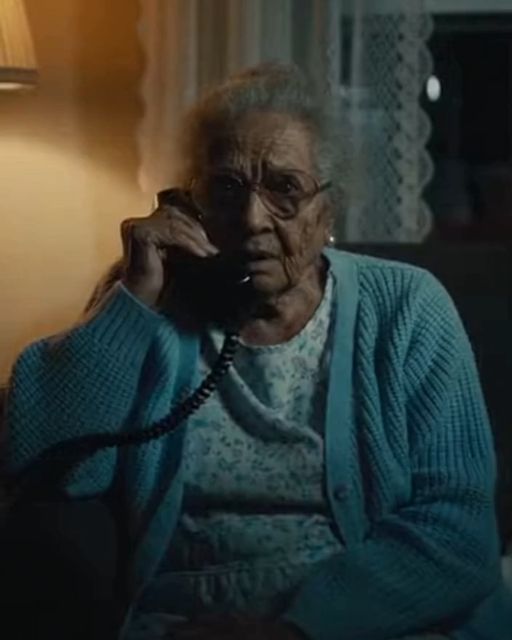
Ethel Thompson, 79 and widowed, dialed 911 shaking with fear. “I hear shouting next door. Guns? I’m scared,” she pleaded. But the operator dismissed her with, “It’s a noisy neighborhood, ma’am. Probably the TV.” Ethel hung up, heart pounding, feeling helpless.
Next morning, she confided in Tim, the young guy from down the street. Tim, a freelance journalist, always had his bodycam rolling. He decided to head up to Ethel’s third-floor window, capturing clear arguments, indistinct but troubling. He didn’t think much of it until he replayed the footage at home that night. He froze. His lens had caught something—a shadow, a clink of metal, fleeting but unmistakable. He uploaded it to his channel for his 50 followers.
Hours later, it went viral. Viewers noted timestamps, enhancing sound clips. Then came the flood of comments urging Tim to call the cops. He scrolled, hands sweating, as one comment leapt out. “That’s not a TV. That’s 100% the sound of a silencer being screwed onto a barrel.”
Tim’s blood ran cold. He read the comment again, then a dozen more like it from people claiming to be ex-military or gun enthusiasts. They were all certain. That quiet, metallic scrape wasn’t just a random noise. It was specific. It was purposeful.
He felt a wave of nausea. He hadn’t just recorded a noisy neighbor. He might have recorded the prelude to a murder. His 50 followers were now 50,000 and climbing. The video had a life of its own. He was no longer in control.
With trembling fingers, he dialed 911 himself, referencing the video link that was now being spammed in the comments section. This time, they couldn’t ignore it. The sheer volume of public outcry forced their hand.
Within the hour, two police cruisers pulled up to the apartment building. Ethel watched from behind her curtains, her hand pressed to her mouth. Tim met them downstairs, his bodycam still rolling out of habit.
The officers, a man and a woman who looked tired and unimpressed, listened to his story. They watched a few seconds of the video on his phone, their expressions unchanging. They clearly thought he was some kid chasing internet fame.
They went up to the apartment next to Ethel’s, number 3B. They knocked firmly. After a moment, the door opened. A man stood there, tall and impeccably dressed, with a disarmingly warm smile. He looked to be in his late forties.
“Can I help you, officers?” he asked, his voice calm and cultured.
The officers explained they were responding to a noise complaint, a serious one. The man, who introduced himself as Vincent Harrison, feigned a look of apologetic surprise.
“Oh, goodness,” he said, chuckling. “That would be my new home theater system. I was watching an old spy film. The sound is just so realistic, I guess it got away from me. I am so sorry if I disturbed anyone.”
He was smooth. He was believable. He invited the officers in. From the hallway, Tim could see a pristine, modern apartment. A large television was mounted on the wall. There was no sign of a struggle, no hint of violence.
The officers did a cursory look around and seemed satisfied. They came back out, handing Vincent a warning. Vincent nodded graciously, even thanking them for their diligence. He glanced at Tim and then at Ethel’s slightly ajar door, and his smile widened just a fraction. It was a smile that didn’t reach his eyes.
Downstairs, the officers gave Tim a stern lecture about wasting police time and the dangers of online hysteria. He tried to argue, to show them the comments, but they waved him off. The case was closed.
Ethel called him later that day, her voice a frail whisper. “I feel so foolish, Tim. I’ve caused all this trouble for nothing.”
“No, Ethel,” Tim said, his own voice tight with frustration. “You’re not foolish. I believe you. Something isn’t right about that man.”
The feeling ate at him for days. His video’s view count hit the millions. He was a viral sensation, but he felt like a fraud. Half the internet hailed him as a hero who exposed police inaction; the other half labeled him a fear-mongering crank.
He couldn’t let it go. He started digging into Vincent Harrison. On the surface, the man was a ghost. He had a sparse professional profile as an “independent arts and antiquities consultant.” He had no social media, no family photos, nothing that seemed personal. It was a curated, sterile online presence that felt more like a cover than a life.
Meanwhile, at the precinct, a veteran detective named Miles reviewed the incident report. It was flagged due to the high volume of public engagement. Detective Miles was old school. He hated trial by internet and believed in concrete evidence, not grainy videos and anonymous comments.
Still, something bothered him. The initial 911 call from the old woman. Her fear had sounded genuine. Dismissing the elderly was a common and often tragic mistake. On a hunch, he ran the address for 3B again, this time looking for financials and co-habitants.
A second name was on the lease. Marcus Thorne.
Miles did a soft check on Thorne. His credit card hadn’t been used in three days. His phone went straight to voicemail. His boss at a downtown courier service said Marcus had called in sick. It was all explainable, but the coincidences were starting to pile up.
Tim, driven by a gnawing sense of responsibility, kept watching his own footage. He watched it on his laptop, on his phone, on his big-screen monitor. He listened with headphones, trying to isolate every sound. The shouting was too muffled to make out words. The metallic clink was there, just as the commenters had said. But it wasn’t enough.
Then, he saw Vincent in the building’s lobby. Vincent was carrying out a large, rolled-up rug. He smiled pleasantly at Tim and said, “Spring cleaning. Getting rid of some old things.” Tim’s stomach twisted into a knot. It was a classic cliché, but seeing it in person was chilling.
He relayed this to Ethel over the phone. Her fear was palpable. “He knows, Tim,” she whispered. “He knows we were the ones who called. He looks at my door when he passes.”
That was it for Tim. This wasn’t about views anymore. It was about protecting this kind, elderly woman who had trusted him. He had to find something concrete.
He went back to the video, but this time, he ignored the sound. He focused only on the visual. He zoomed in on the window of 3B, pixel by agonizing pixel. It was mostly just a reflection of the building opposite.
But for a split second, as the angle of his camera shifted, the light caught something inside the room. It wasn’t the main window he was looking at, but a reflection in a smaller, glass-fronted cabinet against the far wall of Vincent’s apartment.
His heart stopped.
It was a distorted, warped image, but it was there. He could see Vincent’s silhouette. And next to him, another, shorter man. The man’s hands were raised, as if in pleading. Between them on a table was a dark object. He couldn’t make it out.
Tim took a dozen screenshots, layering them, increasing the contrast, running them through every enhancement software he could find for free online. The image became slightly clearer. The second man had a look of pure terror on his face. And the object on the table was a small, ornate wooden box.
He knew this was it. This was the proof. It wasn’t just a voice. It was a person. A person who was now missing.
He raced to the precinct and demanded to see Detective Miles. He laid the enhanced screenshots on the desk. Miles looked at them, then at Tim. The detective’s skepticism finally melted away, replaced by a focused intensity.
“This,” Miles said quietly, “changes everything.”
The screenshots were enough to argue for a warrant. That evening, a tactical team assembled quietly in the stairwell of the building. Tim and Ethel watched from her apartment, the door chained, their hearts pounding in unison.
They heard the sharp, authoritative knock. “Police! Open up!”
When they breached the door, Vincent was in his living room, calmly reading a book. He showed no surprise, only a weary resignation. He stood up and placed his hands behind his back before they even asked.
The apartment was immaculate. It smelled faintly of bleach. The officers searched for hours, finding nothing. No signs of a struggle. No blood. No weapon. The large rug Tim had seen was gone. Frustration began to set in.
Then, a young officer, tapping along the baseboards, noticed one section that sounded different. It was hollow. He pried it open with a crowbar. Inside the wall was a small, hidden safe.
They opened it. Inside were two things. A handgun, fitted with a freshly cleaned silencer. And the small, ornate wooden box from Tim’s screenshot.
Under the bright lights of an interrogation room, Vincent’s composure finally cracked. His story tumbled out. Marcus Thorne had been his business partner. They dealt in stolen art and antiquities. The wooden box was their latest acquisition, a rare 19th-century piece.
Marcus had gotten greedy. He wanted to cut Vincent out and threatened to expose their entire operation. The argument Ethel heard was their last. Vincent had ended it, coldly and efficiently. He admitted to disposing of the body in a remote, wooded area hours from the city.
The case was a slam dunk. The media exploded. Tim’s bodycam footage was now evidence in a homicide investigation. He was lauded as a hero. But for Tim, the victory felt hollow. A man was dead. A kind old woman had been terrified.
A few days later, Detective Miles came to see Ethel. Tim was with her, helping her with her groceries. The detective wasn’t there on official business. He carried a small, evidence-bagged object in his hand. It was the wooden box.
“Mrs. Thompson,” he began gently. “I have a strange question. Your late husband… what was his name?”
“Arthur,” Ethel said, her eyes clouding with memory. “His name was Arthur.”
“Was he by any chance a craftsman? A woodworker?”
Ethel’s breath hitched. “He was. The most gifted man I ever knew. He could make anything from a block of wood.”
Detective Miles carefully removed the box from the bag and placed it on her small coffee table. “We found an inscription on the inside of the lid. We thought it was a maker’s mark.”
With trembling hands, Ethel reached for the box. She fumbled with the tiny latch and lifted the lid. A soft, tinkling melody, a tune she hadn’t heard in over a decade, filled the small apartment.
Tears streamed down her wrinkled cheeks. She traced the carvings on the side, her fingers recognizing every curve. She looked inside at the faded, looping script engraved on the velvet lining.
“To my dearest Eleanor, on our wedding day. Arthur Thompson. 1965.”
It was her music box. The one Arthur had spent a year carving for their wedding. It had been in a storage unit with other treasured belongings. The unit was broken into years ago, and she had mourned the loss of this box more than anything else. It was a piece of her husband she thought was gone forever.
The story clicked into place. Marcus Thorne, in his early days, had been a petty thief. He had robbed Ethel’s storage unit, holding onto the box for years, sensing it was special but not knowing its true value. He had finally brought it to Vincent, the expert, to be sold.
It was this piece of her past, this vessel of her husband’s love, that had been the catalyst for the entire tragedy next door.
Ethel closed her eyes, listening to the music, one hand on the box, the other on Tim’s arm. Her panicked 911 call hadn’t just been a random report of a crime. It felt like an echo through time, a pull from her own heart, unknowingly calling out to a lost piece of her life, just one thin wall away.
Tim looked at Ethel, her face a mixture of sorrow and profound joy, and he finally understood. He had started this journey seeking a story, a viral moment, a way to make a name for himself. But he had found something so much more important.
He found that the biggest stories aren’t always the loudest ones. Sometimes, they are quiet whispers of fear from a neighbor, a forgotten melody in a wooden box, or the silent, steady courage to believe someone when no one else will. True justice isn’t about clicks or headlines; it’s about restoring a small piece of harmony to a world that has lost its tune. And sometimes, the most valuable things aren’t famous works of art, but the simple things we thought we had lost forever, miraculously finding their way home.