Mr. Davies had no idea the woman quietly sipping water at table seven was Eleanor Vance, the most feared food critic in the city. He was too busy making an example out of his best chef.
“That is theft, Leo,” Davies hissed, pointing a trembling finger at an empty plate.
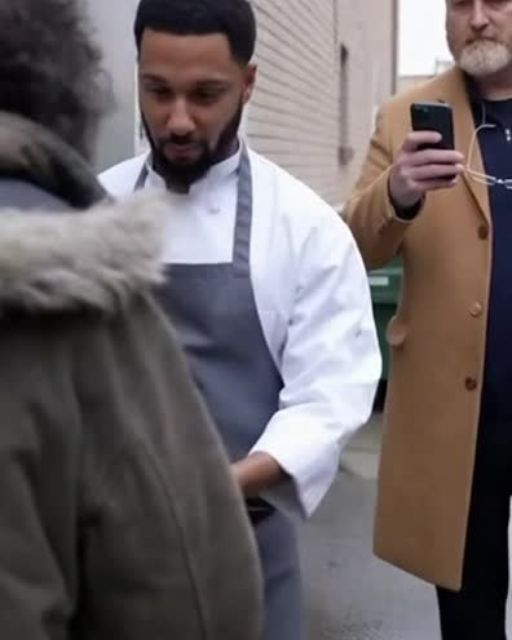
Leo, a man who’d worked 70-hour weeks for him, just looked at the old homeless man huddled by the back door, then back at his boss. “It was a returned order, sir. The risotto was going in the bin.”
“Company policy is company policy,” Davies snapped, his voice loud enough for the kitchen staff to freeze. “You’re fired. Clean out your locker.”
At table seven, Eleanor Vance discreetly pressed ‘record’ on her phone, which was propped up against the sugar caddy. She’d been about to write a glowing review. Now, she was documenting a crucifixion.
Leo didn’t argue. He just untied his apron, a gift from his daughter, and laid it gently on the steel counter. He walked out without looking back.
Davies watched him go, a smug little smile on his face. He thought he’d asserted his authority. He thought the matter was closed.
Eleanor stopped recording. She took one last sip of water, paid her bill in cash, and walked out into the cool night air. As she stood on the sidewalk, she uploaded the three-minute video.
She added a simple caption: “At the Michelin-contender ‘Aperture,’ I learned that unsold food belongs in the trash. Human decency, however, gets you fired.”
Then she tagged the restaurant, its parent company, and every major news outlet in the city before hitting ‘post.’
The post went live at 9:14 PM. By 9:30 PM, it had a thousand shares.
By 10:00 PM, the restaurant’s phone began to ring incessantly, not with reservation requests, but with angry callers. The online review sites were a wildfire of one-star ratings.
Davies, counting the night’s receipts in his office, was oblivious. He felt a sense of satisfaction, of order restored.
It was Maria, the young hostess, who finally knocked on his door, her face pale. “Sir, you need to see this.”
She showed him the video on her phone. He watched his own sneering face, his voice tinny and cruel, firing a man for feeding someone hungry. He saw the caption. He saw the name: Eleanor Vance.
A cold dread, heavy and suffocating, settled in his stomach. He had not just fired a chef. He had set fire to his own career.
Meanwhile, Leo was on the bus home, the city lights blurring past the window. He wasn’t angry, just tired.
He worried about telling his ten-year-old daughter, Maya. He worried about the rent.
When he got home, Maya was waiting up for him, a drawing of a superhero chef clutched in her hand. “How was work, Daddy?”
He forced a smile and hugged her tight, the smell of crayons and childhood innocence filling his senses. “It was an interesting night, sweetie.”
He didn’t know how to tell her that her superhero had just been defeated.
The next morning, the internet had passed its verdict. The video was national news.
#Aperturegate was trending. Major food bloggers were writing scathing opinion pieces. The parent company, a massive hospitality group called Sterling Holdings, issued a terse statement promising a “full investigation.”
Davies arrived at Aperture to find a news van parked outside. He tried to sneak in the back but was met by his entire kitchen staff. They were standing in the alley, their aprons folded neatly over their arms.
His sous-chef, a stoic woman named Clara, spoke for them all. “We quit, Mr. Davies. We work for a chef, not a bean counter.”
Davies stared at their unified, defiant faces. The empire he thought he ruled had crumbled overnight.
Leo, meanwhile, was making pancakes for Maya, his phone buzzing nonstop on the counter. He ignored it, focusing on getting the perfect golden-brown color.
Friends and former colleagues were calling, offering support, expressing their outrage. It was nice, but it didn’t pay the bills.
He finally answered a call from a number he didn’t recognize. “Hello?”
“Is this Leo?” a calm, professional voice asked. “My name is Eleanor Vance.”
Leo nearly dropped the phone. He had heard her name whispered in the kitchen with a mixture of terror and reverence.
“I saw what happened last night,” she continued, her tone softening. “I’m the one who posted the video. I’m so sorry for the chaos it’s caused you.”
Leo sank into a kitchen chair. “It wasn’t your fault. He was who he was.”
“Integrity like yours is rare, Leo,” Eleanor said. “Skill is common. Heart isn’t. I was wondering if we could meet. I have a proposition for you.”
They met at a small, quiet coffee shop downtown. Eleanor was unassuming in person, with sharp, intelligent eyes that seemed to see right through you.
“Sterling Holdings will offer you your job back,” she told him over a cup of black coffee. “They’ll fire Davies and make a big show of it. It’s a PR move.”
Leo nodded slowly. “I can’t go back there.”
“I know,” Eleanor said with a slight smile. “That’s why I’m here. I don’t just write about restaurants, Leo. For the past year, I’ve been looking for a partner.”
She explained that she had acquired a small property in a cozy, up-and-coming neighborhood. It was a former bakery, with good bones and a lot of charm.
“I’ve been looking for a chef to build a restaurant around,” she said, leaning forward. “Not a place that chases stars and accolades, but a place with soul. A place that’s part of the community.”
Leo was stunned into silence. He was a line cook, a head chef, not a business owner. The idea was terrifying.
“I don’t have any money,” he said, the words tasting like ash. “I have about two months’ rent saved, and that’s it.”
“I have the money,” Eleanor stated simply. “I have the capital. What I don’t have is your talent. I don’t have your heart. I’m not offering you a job, Leo. I’m offering you a partnership. You’ll have complete creative control. You’ll be the face and the soul of the restaurant.”
He thought about Maya. He thought about the endless 70-hour weeks, the missed school plays, the crushing pressure to please a man like Davies.
He looked at Eleanor, a woman who had the power to destroy a restaurant with a single post, and who was now choosing to build one.
“Why me?” he asked, his voice barely a whisper.
“Because,” she said, her gaze unwavering, “you fed a hungry man when you thought no one was watching. That’s the kind of character I’m willing to bet everything on.”
That afternoon, Sterling Holdings did exactly what Eleanor predicted. Their CEO released a public apology. Mr. Davies was “no longer with the company,” and they extended a formal offer to Leo to return as Executive Chef, with a significant raise.
Leo politely declined.
The news of his refusal, and the rumored partnership with Eleanor Vance, became the second chapter of the story everyone was following. People were rooting for him. A crowdfunding page, started by an anonymous well-wisher, raised over ten thousand dollars in two days to help him “get back on his feet.”
Leo, overwhelmed, pledged to use the money to set up a meal program at the new restaurant.
The next few months were a blur of construction dust, menu planning, and hopeful exhaustion. Eleanor was a force of nature, handling the business side with a quiet efficiency that was breathtaking.
Leo, for the first time in years, felt a spark of pure, unadulterated joy in his work. He wasn’t just cooking; he was creating.
He found most of his old kitchen crew, including Clara, and hired them on the spot. They were a family, and they were building their new home together.
He named the restaurant “Hearth.” It was simple, warm, and spoke of community and nourishment.
One afternoon, as they were testing a new bread recipe, a familiar, shuffling figure appeared at the back door. It was the old homeless man from that fateful night at Aperture.
He looked scared, as if expecting to be shooed away. Leo smiled and walked over.
“Hello again,” Leo said gently. “My name is Leo. What’s yours?”
“Arthur,” the man mumbled, not meeting his eyes.
“Arthur,” Leo said, holding out a piece of warm, crusty bread. “Would you like a job? We need someone to help with the washing up. We pay a fair wage.”
Tears welled in Arthur’s eyes as he took the bread. He just nodded, unable to speak.
This was the first twist nobody saw coming. The act of kindness wasn’t a one-time event; it was a philosophy. It was the foundation of everything Hearth was to be.
The grand opening of Hearth was a quiet affair. There was no big press event, just an open door and a sign that said, “Welcome.”
The place was packed from the moment they opened. Locals, foodies, and people who had simply followed the story online came to show their support.
The food was magnificent. It wasn’t fussy or pretentious. It was honest, delicious food made with skill and an abundance of care. It was Leo on a plate.
Maya was there, sitting at a small table near the kitchen, drawing in her sketchbook. She was drawing a new picture: her dad, in a bright, clean kitchen, smiling.
Late in the evening, a sleek black car pulled up outside. A well-dressed, older man stepped out and walked in. The room quieted slightly as people recognized him from the news. It was Mr. Sterling, the CEO of the parent company that had owned Aperture.
He walked straight to Leo, who was standing near the pass.
“Chef,” Mr. Sterling said, his voice surprisingly gentle. “I am not here to ask for anything. I’m here to apologize in person. What my manager did was a disgrace to our company, and to our industry.”
Leo simply nodded, accepting the apology.
Then came the second, more profound twist.
“I started as a dishwasher when I was sixteen,” Mr. Sterling continued, his voice low. “My family had nothing. There was a chef, an old German man, who would let me take home the leftovers every night so my little sister could eat. Without that kindness… I wouldn’t be here.”
He paused, looking around the warm, bustling room. “What you did reminded me of why I got into this business in the first place. It’s not about profit margins. It’s about feeding people. Body and soul.”
He reached into his jacket and pulled out an envelope. “This is from my personal account. It’s a grant for your meal program. No strings attached. Do with it what you do best.”
He placed the envelope on the counter, shook Leo’s hand, and walked out before Leo could even respond.
Eleanor, who had been watching from a corner table, came over and picked up the envelope. She and Leo looked at each other, a shared understanding passing between them.
The world wasn’t always just. But sometimes, a single act of decency could ripple outwards, reawakening the decency in others. It could remind a powerful CEO of the boy he used to be.
A few weeks later, Eleanor Vance published her review of Hearth. It was the most personal piece she had ever written.
She didn’t write about the food’s technical execution or the ambiance. She wrote about the feeling of the place. She wrote about Clara’s focused intensity in the kitchen, about Maya’s proud smile, about Arthur carefully polishing glasses behind the bar, his dignity restored.
She wrote about Leo, a chef who had been fired for an act of kindness and had responded by building a temple to it.
The final line of her review was simple: “You don’t go to Hearth for a Michelin star. You go to remember that a meal can be more than just food; it can be a lesson in what it means to be human.”
Hearth never needed a Michelin star. It became a city institution, loved for its warmth and its spirit. Leo never worked another 70-hour week. He was home for dinner with Maya every night. He had created not just a successful restaurant, but a successful life.
The story serves as a powerful reminder that our true character is revealed not in the grand gestures we perform in the spotlight, but in the small, compassionate choices we make when we believe no one is watching. It is in those quiet moments of integrity that we find our greatest strength and, sometimes, our most unexpected and rewarding destiny.