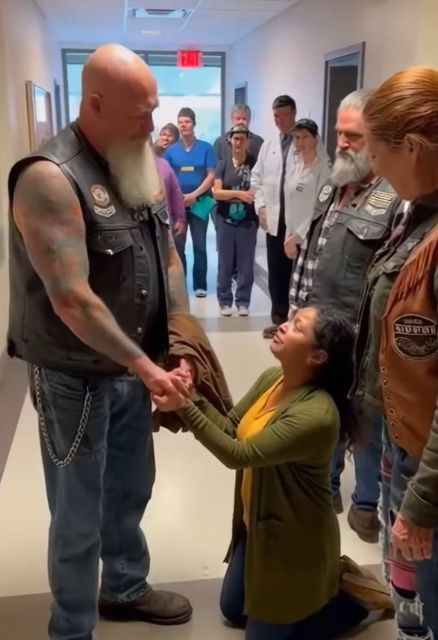
The scream wasn’t loud. It was the way her head fell back in that woman’s arms while cars knifed past that slammed my brakes.
Back tire skated. Bars shook. Exhaust from a passing van burned my face.
And there she was—this tiny kid, lips gray, sweat shining on her temple. The woman clutched her like a life jacket and still sank.
“Nobody’s stopping,” she rasped. Her voice shredded my chest.
I killed the engine and the silence hit like a bell.
Then heat. The kind you feel before you touch. The kind that crawls into your bones.
“Name?” I asked, even though I couldn’t feel my tongue. She said Mara. The girl was Nia. My gloves stuck to my palms.
I slid my arms under Nia. She weighed nothing and somehow everything. Her head rolled and I felt her breath flutter my wrist.
Traffic kept blowing by. Horns. Angry faces. Windows up.
So I did the only thing that made sense. I put her against my jacket, zipped her up like she was mine, and ran.
Leather soaked through. My boots hit gravel. Knees went soft. I did not care.
“Hospital?” Mara’s voice wobbled. Eyes wild, searching, begging.
“The county ER,” I said. “Now.” My mouth knew before my brain did.
We dove onto the bike. Mara pressed her body against my back, one hand over her child, both their breaths pounding through my spine.
And then the road opened like it remembered what mattered.
Red lights blurred. Wind tore the tears off my face. Every mile was a steal.
Nia’s heat lasted. I kept checking her cheek with two fingers, then the rise of her chest, then my speed, then her cheek again. A drumbeat.
Almost there.
Except not fast enough.
We slid into the ambulance bay crooked. I had the kickstand down before the bike stopped moving.
Doors. White lights. That smell of bleach and old fear.
“Fever. Lethargic. Not responding.” My voice came out like gravel. Words I thought I’d never say again.
A nurse took her. Mara’s hands floated empty in the air. It made my stomach fall.
And then the hallway swallowed us.
It was too bright and too cold and somehow still felt like a furnace. My hands couldn’t stop shaking. I could hear a monitor beeping in a room we couldn’t see.
Mara looked up at me. “Why did you stop?” The question landed like a brick.
I stared at the floor tiles, then at the door where they took Nia, then at my boots, still flecked with road dust, still wet with her sweat.
Because here’s the part I didn’t plan to say.
I know this heat.
I know this weight.
I know the shape a body makes when it’s trying to leave.
Twelve years ago, different hallway. Different fluorescent hum. Different small hand letting go.
So I leaned close, so she could hear me over everything, and I told her what nobody told me back then: that you don’t breathe for yourself right now, you borrow someone else’s breath until yours remembers.
Her fingers dug into my jacket like claws. She nodded and didn’t.
We stood there, stealing minutes while a door stayed shut.
And that’s the whole reason I couldn’t ride past.
Some roads let you keep going. Some roads stop you, turn you around, and make you hold on until the light changes.
The silence after I spoke was thick. It was made of a hundred unasked questions and one shared, unbearable fear.
We just stood there. Two strangers tied together by a thread of panic.
My leather jacket felt heavy. Nia’s warmth was gone, replaced by the hospital’s sterile chill.
Mara’s knuckles were white where she gripped her own arms. She was trying to hold herself together.
“I should call her dad,” she whispered, her voice a ghost. “He’s… he’s in Chicago. A conference.”
She pulled out her phone, but her hands shook too much to dial. Her thumb kept missing the numbers.
I reached out slowly. “Here.”
She handed me the phone without looking. I found ‘Robert’ in her contacts and pressed the call button.
I passed it back to her and turned away, giving her a sliver of privacy in a place that had none.
Her voice cracked on the first word. Then it became a flood of broken sentences. “It happened so fast… On the road… I don’t know.”
I walked to the vending machine down the hall. Not because I wanted anything, but because the sound of her falling apart was a sound I knew too well.
It was the sound of a world tilting off its axis.
The machine hummed. Its fluorescent light was sickly green. I stared at the rows of chips and candy bars, but I didn’t see them.
I saw a small Lego spaceship. Half-finished on a hospital tray. Daniel’s last project.
He’d wanted to be an astronaut. He had glow-in-the-dark stars all over his ceiling.
I bought a bottle of water I didn’t want and walked back.
Mara was off the phone. She looked smaller, hollowed out.
“He’s getting the first flight he can,” she said to the floor.
I twisted the cap off the water and held it out. “Drink.”
She took it. Her eyes met mine for a second. “Thank you. For… all of it. Your name is…?”
“Alex,” I said. The name felt strange in my mouth. I hadn’t had to introduce myself in a long time.
“Alex,” she repeated, like she was committing it to memory. “I’m Mara.”
We sat in the hard plastic chairs. The clock on the wall didn’t seem to move. Every tick was an accusation.
A doctor finally came through the double doors. He looked tired. Too young.
“Mrs. Collins?” he asked. Mara shot to her feet.
“It’s not just a febrile seizure,” he started, and the floor dropped out from under us. “Her temperature is dangerously high, but her respiratory system is also compromised. We’re seeing signs of a significant allergic reaction. Anaphylaxis.”
Mara swayed. I put a hand on her arm to steady her.
“Allergic? To what? She has no allergies,” Mara insisted, her voice rising. “None.”
“Sometimes they can develop suddenly,” the doctor said gently. “Did she eat anything new today? Was she stung by anything?”
Mara’s mind raced backward. I could see her retracing every step of their day.
“No. Nothing. We went to the park. The new one by the library. She played on the swings. She was picking flowers from some bushes.” Her face crumpled. “That’s it. That’s all we did.”
The doctor made a note. “We’ve given her epinephrine. We’re trying to stabilize her breathing. We’re moving her to the pediatric ICU. You can see her once she’s settled.”
He walked away, leaving a vacuum in his place.
Pediatric ICU. The words were a gut punch. I knew that floor. I knew the quiet nurses and the relentless, soft beeping of machines that were trying to argue with fate.
Mara started to tremble again. “This doesn’t make sense.”
I didn’t know what to say. So I just stood there, a useless anchor in her storm.
We took the elevator up to the third floor. The doors opened to a different kind of silence. Heavier. More fragile.
A nurse led us to a room at the end of the hall. Through the glass, we could see Nia.
She was so small in that big bed. Wires snaked from her arms. A clear mask was over her face.
Mara pressed her hand to the glass. A tear slid down her cheek and hit the linoleum.
I felt a ghost of a touch on my own hand. The memory of Daniel’s fingers, impossibly small, losing their grip.
I had to get out of there. I couldn’t breathe.
“I should go,” I said, my voice rough. “You’re not alone now. Your husband is on his way.”
Mara turned from the window. Her eyes were full of a terrifying gratitude.
“Don’t,” she said, just a whisper. “Please. Just… for a little while longer.”
And I couldn’t say no. Because I knew that loneliness. The kind that’s so big it has its own gravity.
So I stayed. We sat in another waiting room, this one with cartoon animals painted on the walls. The cheerfulness was brutal.
An hour passed. Then another. Robert, her husband, called. His flight was delayed.
Then a new doctor appeared. She was older, with sharp eyes that missed nothing. She carried an air of authority that the first doctor lacked.
“I’m Dr. Vance,” she said, her gaze sweeping over Mara, then landing on me. There was a brief, almost imperceptible pause. A flicker of something I couldn’t read.
“We’ve managed to get her breathing under control for now,” she said, her tone all business. “But we’re fighting to keep it that way. This is a severe, systemic reaction. The allergen is aggressive. Knowing what caused it would increase her chances significantly.”
She looked at Mara. “The park. The bushes. Can you describe them?”
Mara tried. “They were… green. With little white flowers. They smelled sweet. The city just planted them last week.”
My stomach went cold. I felt the blood drain from my face.
The park by the library. New plantings. Little white flowers.
I knew those bushes.
My company planted them.
The world went quiet. The humming of the lights, the distant beeps, everything faded.
I pulled out my phone, my fingers feeling like clumsy sausages. I opened my work app, went to recent jobs.
There it was. “Oak Street Park Beautification Project.”
I clicked on the material invoice. And I saw the name of the plant. Oleander. Beautiful. Common in warmer climates.
And poisonous.
We knew it. My foreman argued with me about it. We usually used safer, native species. But the client had been specific. He’d seen them in a magazine and insisted. He’d signed a waiver.
The client. City Councilman Harrison.
My breath hitched. The heat I felt on the road, Nia’s heat, it was nothing compared to the fire of shame that was now burning me from the inside out.
I was part of this. My hands did this.
I looked up from my phone. Dr. Vance and Mara were both staring at me.
“What is it?” Mara asked, sensing the shift.
My throat was tight. The words were stones.
“I know the plant,” I said, my voice a croak. “My landscaping company… we planted them. On Tuesday.”
The silence that followed was absolute. It was the loudest thing I had ever heard.
Mara’s face was a mask of disbelief, confusion, and then a flash of raw anger that was so justified it felt like a physical blow.
“You?” she breathed.
Dr. Vance’s sharp eyes narrowed on me. She didn’t look angry. She looked… focused. Like I was a puzzle piece she had just found.
“What is it called?” she demanded. “The exact species.”
“Nerium oleander,” I said, the name tasting like ash. “The client insisted. We advised against it. It’s toxic if ingested, but… some people can have a severe contact reaction. Especially children.”
I couldn’t look at Mara. I stared at Dr. Vance, bracing for the condemnation.
But it didn’t come. Instead, she turned to a nearby nurse. “Get me the toxicology brief for oleandrin poisoning. And get a specialist from the botanical gardens on the line. Now.”
She turned back to me. “Your mistake might have just saved her life, Mr…?”
“Alex,” I mumbled. “Alex Cole.”
Recognition dawned in her eyes. It was unmistakable now. My blood ran even colder, which I didn’t think was possible.
“I was Dr. Eleanor Roberts back then,” she said quietly, for my ears only. “I was Daniel’s attending physician.”
The world fractured.
Twelve years dissolved. This wasn’t just any hospital. It was the same one. And this wasn’t just any doctor. She was the one who had stood in a room that smelled like bleach and told me my son was gone.
I stumbled back against the wall. The cartoon giraffe behind me seemed to mock my agony.
Mara was oblivious to the bomb that had just gone off inside my head. She was still reeling from my confession.
“So you… you’re the reason she’s in here?” she asked, her voice trembling with a storm of emotions.
Before I could answer, before I could try to form an apology that was big enough for the hole I’d helped dig in her world, a man in a tailored suit hurried down the hall.
He was flustered, his face pale with worry. He skidded to a halt in front of us.
“I’m looking for my grandson,” he said, his voice strained. “Thomas Harrison. He collapsed at the playground.”
He was Councilman Harrison. The client.
Dr. Vance looked at him, then at me, then back at him. The pieces were clicking into place with horrifying speed.
“Your grandson is in the next room,” she said, her voice tight. “He’s having a severe allergic reaction. To the oleander bushes you had planted at the park.”
Harrison’s face went slack. The arrogance I remembered from our meetings was gone, replaced by pure, unadulterated fear. He looked from me to Mara, his eyes wide with dawning horror.
He saw Mara’s tear-streaked face. He saw the PICU sign. He understood.
His choice, his vanity project, had brought this down on his own family. And on hers.
“Oh, God,” he whispered, leaning against the wall for support. “I didn’t know.”
The doctors now knew exactly what they were fighting. With the specific toxin identified, they could formulate a precise treatment. They worked with a speed and purpose that was breathtaking.
Hours bled into one another.
Councilman Harrison sat across from me, a broken man. He tried to apologize to Mara, but the words caught in his throat.
I couldn’t find any anger for him. All I felt was a hollow echo of his own guilt.
Dr. Vance—Dr. Roberts—found me by the coffee machine. It was three in the morning.
“Daniel’s was different,” she said, her voice softer than I’d ever heard it. “It was a congenital heart defect. There was nothing anyone could have done. I hope you know that.”
I just nodded, unable to speak. I had spent twelve years believing that if I had been faster, if I had noticed sooner, the outcome would have changed.
“You stopped today, Alex,” she said. “You didn’t just stop. You ran toward the fire. And you held the key.”
She put a hand on my shoulder. “Go home. Get some rest. They’re both going to be okay.”
Nia and Thomas were moved out of the ICU by the next afternoon. The color was back in Nia’s cheeks.
Mara’s husband, Robert, had arrived. He shook my hand, his eyes filled with a gratitude so immense it was humbling.
Mara came over to me as I was getting ready to leave. The anger was gone from her face.
“The doctor said if you hadn’t known what that plant was… if you hadn’t told them… they would have lost precious time,” she said. “They might have lost her.”
She looked at me, really looked at me, and I felt like she could see all the broken parts inside.
“What you did on the road… that was everything,” she said. “But what you did in here… that was the miracle.”
She hugged me. A fierce, desperate hug. And in her arms, I felt a twelve-year-old knot in my soul begin to loosen.
I didn’t go home. I went to the small, quiet chapel on the first floor.
I sat in a wooden pew and for the first time in over a decade, I spoke to my son.
I told him about Nia. I told him about the heat of her skin, and the weight of her in my arms.
I told him I was sorry I had spent so long running from his memory, when I should have been carrying it.
I told him I finally understood. The pain of losing him wasn’t a punishment. It was a lesson. It had carved out a space in me, and today, that empty space was what allowed me to have enough room to hold someone else’s fear.
A week later, a thick envelope arrived at my office.
Inside was a child’s drawing. It was a stick figure of a man on a wobbly motorcycle. A little girl was zipped into his jacket. Above them, a giant, smiling sun filled the page.
Tucked behind it was a note from Mara.
It said, “Alex, you told me to borrow someone else’s breath. But you did more than that. You gave us ours back.”
I put the drawing up on the wall, right above my desk.
Today, I got on my bike. The engine turned over with a familiar rumble.
But I didn’t ride for the open highway. I didn’t ride to feel the wind scream past and drown out the ghosts.
I rode to the park by the library.
My crew was already there, digging up every last one of the oleander bushes. Councilman Harrison was there, too, his sleeves rolled up, dirt on his hands, working alongside them.
I parked the bike and just watched for a while. I watched a group of kids on the swings, their laughter lifting into the air.
The road doesn’t always lead you away from things. Sometimes, if you’re lucky, it stops you dead in your tracks and shows you the one thing you were meant to find.
The scars we carry aren’t just reminders of where we’ve been hurt. They are the maps that show us how to find our way back. Not to what we lost, but to who we are meant to become.