Judge Orders Disabled Veteran to Stand During Sentencing, Next Moment Leaves the Court in Tears. 😱 😱
Courtroom 7 looked tired of being a courtroom. Fluorescents hummed; the oak panels had lost their shine; the American flag beside the bench hung heavy, its fringe catching the stale air.
A bailiff called for order, and the gavel cracked like a starter’s pistol. In the defense chair sat Sergeant David Keane, U.S. Army (ret.), the kind of man you’d expect to see teaching physics or coaching wrestling, not gripping the arms of a wheelchair with knuckles pale against steel.
His prosthetic hid under pressed khaki like a secret everyone already knew; the tremor in his left hand did not. “Case 23–CR–7842,” the clerk read. “Contempt of court.”
The kind that accrues when buses move stops eight blocks and courthouses forget ramps and a veteran’s request for a video appearance dies somewhere in a stack of “not our policy.” The judge—black robe, flint eyes—peered over her glasses. “Mr. Keane, this court requires you to stand to receive your sentence.”
A cough from the gallery. A Korean War cap dipped. Someone whispered “ADA.” The public defender rose: “Your Honor, my client—” A palm cut the air.
“The law applies equally,” the judge said, because that line sounds right even when it lands wrong. David’s jaw worked once. “If I could, I would. Today isn’t a good day.” “This court,” the judge answered, “will not be manipulated.”
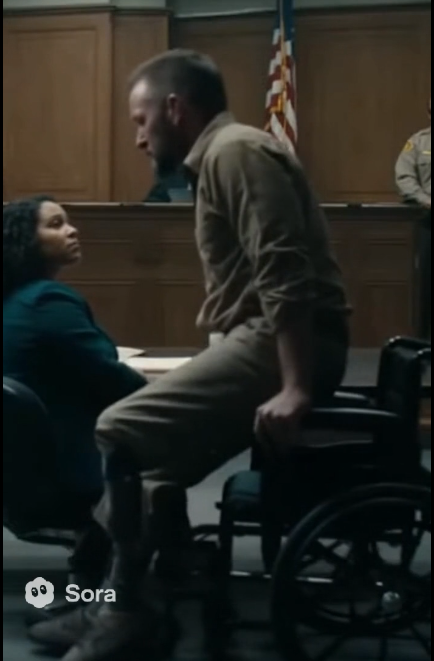
The room shrank to the distance between a wheelchair and a wooden table. David set his jaw. Shifted weight. Braced. The good leg trembled; the prosthetic fought physics and pain; sweat beaded under courtroom winter.
For half a second he was upright—swaying, yes, but there—eyes level with the bench, dignity doing what metal and nerve could not. Then a flicker ran up the bad side like a fuse.
The table edge bit his palm. Somewhere, a reporter forgot to type. The flag stirred as if remembering what it meant. Behind David, a mother in a postal uniform pushed up from her seat; a young reporter stood without knowing why; a bailiff’s hand hovered between rule and mercy.
“Your Honor—” the public defender started. David’s balance broke.
The gallery drew breath together—and David collapsed back into his chair with a sound that was part defeat, part survival. His knuckles throbbed from the impact against the wood. His breath came ragged, but his eyes didn’t waver. He locked them on the judge’s, not pleading, not begging—just burning with a quiet rage that spoke of deserts crossed, comrades lost, and promises broken long before this courtroom spectacle.
Silence stretched, taut as wire. The clerk shifted papers, unsure whether to speak or stay invisible. Then came the sound: not a gavel, not a command, but something human—a sob, sharp and small. It came from the gallery, from the postal-uniformed mother who had risen, her hand now over her mouth. And like dry tinder catching, others followed. A cough choked into a cry, a whisper into a tremble. Reporters glanced at one another, pens useless in the face of what no words could frame.
David’s public defender moved closer. “Your Honor, this man bled for this country. He carried brothers through fire, through smoke. To make him crawl through dignity for the sake of form is not justice. It’s cruelty dressed in robes.”
The judge’s mouth compressed into a line. For a moment she seemed carved from the same oak as the panels behind her. But her eyes—those eyes betrayed a crack, the faintest shimmer of glass under pressure.
David spoke then, his voice low but carrying, because silence had given him a stage he never wanted. “Your Honor, I didn’t come here to make a scene. I came because I was told I had no choice.
You wanted me to stand? I did. For a moment, I stood. But I’ve stood in worse places. In sandstorms where I couldn’t see the man ten feet beside me. In hospitals where doctors told me I wouldn’t walk again.
In living rooms where my daughter asked why I scream at night. So if this court thinks standing proves respect, then hear me: I have already stood for everything that mattered.”
The words hit the air heavy, unshakable. The bailiff, a broad man with the stoic training of decades, blinked faster than protocol allowed. The gallery stirred as if every person inside had been called to account, as if the very flag that hung limp behind the bench demanded they remember what it stood for.
The judge opened her mouth, closed it again. Her gavel hand trembled slightly before resting on the block. “This court,” she said finally, but softer now, almost unsure, “finds Mr. Keane guilty of contempt—” She stopped, the words brittle in her throat. Then, in a voice that shifted from steel to something almost human, she continued, “But sentences him to time served. This case is dismissed.”
It should have ended there. But David, still bracing in his chair, exhaled long and slow. His hand shook as he reached for the armrest. And then the unexpected happened.
The Korean War veteran in the gallery, his cap tilted low, rose to his feet. He stood steady, shoulders back, eyes sharp. One by one, others followed—an honor guard of strangers. The mother in the postal uniform. The young reporter. Even the bailiff, breaking every code of neutrality, straightened tall beside the man he was supposed to restrain.
The room became a forest of standing figures. For David, it was not pity—they weren’t standing because he couldn’t. They were standing because he already had, in ways most never would.
The judge sat frozen. For once, her authority meant nothing in the tide of humanity rising before her. She looked at David, at the crowd, and her gavel fell—not in command this time, but in surrender. “Court adjourned.”
David closed his eyes. The tremor in his hand worsened, but he let it rest openly on the table, unashamed. He had been stripped of much in life, but not of the truth that burned in that moment: dignity is not measured in posture, but in sacrifice.
As the room emptied, a reporter finally remembered to write. The story would run the next morning, not about a case number or contempt of court, but about a veteran who had shown what standing truly meant. And somewhere in the ink and headlines, America would be reminded—justice was never about legs under weight. It was about hearts carrying burdens together.
Outside, the autumn sun had broken through clouds. David wheeled himself into the light. People approached him—some with handshakes, some with quiet words, some just with eyes that said they’d never forget. He nodded, humbled but unbent.
Later that night, at home, his daughter climbed into his lap. She was nine, with hair the color of chestnuts and a stubborn streak he recognized as his own. “Daddy,” she asked softly, “did you stand today?”
David swallowed hard, pulling her close. “I did,” he whispered. “In every way that counts.”
And though his body ached, though his muscles still trembled, he smiled—for in that moment, he knew the truth: the world could break his bones, test his limits, strip him bare before strangers. But no one—not a judge, not a courtroom, not even fate—could ever make him sit in spirit.
And that was the day justice learned to stand.